 Add to Chrome
 Add to Firefox
 Add to Edge
Wan: Open and Advanced Large-Scale Video Generative Models
Mar 26, 2025
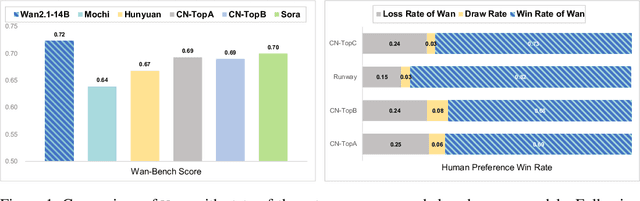
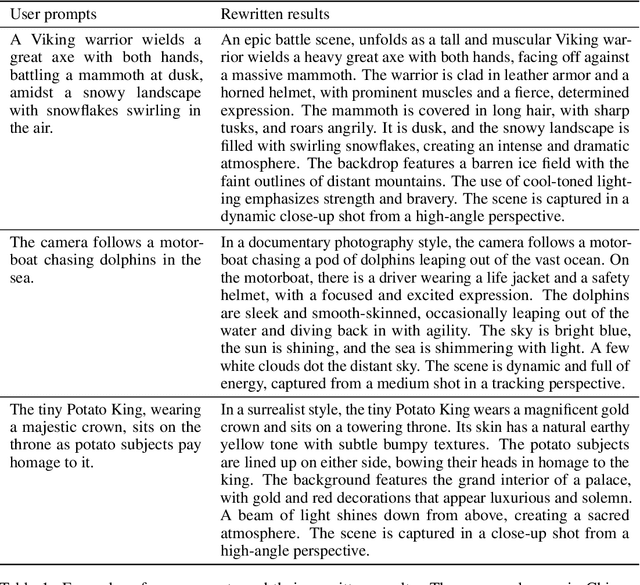
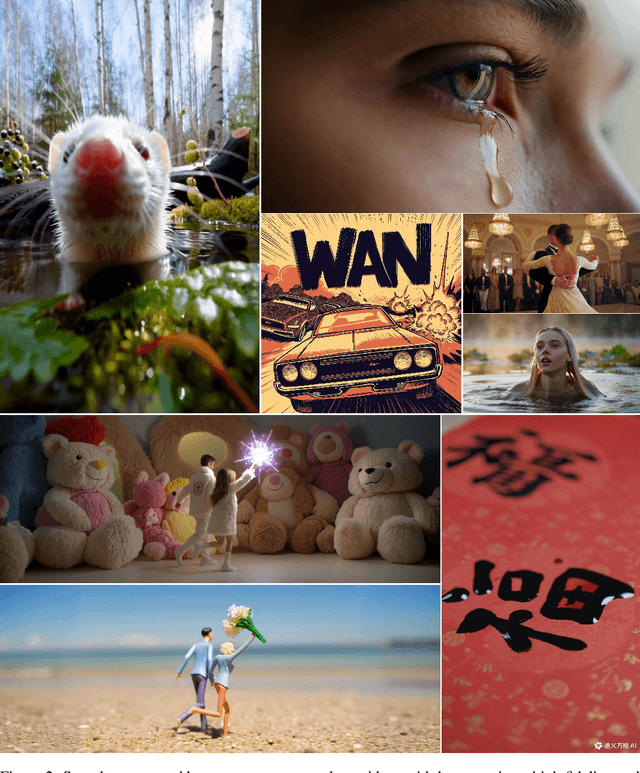
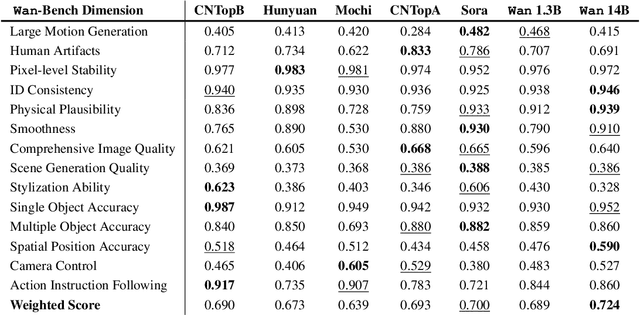
This report presents Wan, a comprehensive and open suite of video foundation models designed to push the boundaries of video generation. Built upon the mainstream diffusion transformer paradigm, Wan achieves significant advancements in generative capabilities through a series of innovations, including our novel VAE, scalable pre-training strategies, large-scale data curation, and automated evaluation metrics. These contributions collectively enhance the model's performance and versatility. Specifically, Wan is characterized by four key features: Leading Performance: The 14B model of Wan, trained on a vast dataset comprising billions of images and videos, demonstrates the scaling laws of video generation with respect to both data and model size. It consistently outperforms the existing open-source models as well as state-of-the-art commercial solutions across multiple internal and external benchmarks, demonstrating a clear and significant performance superiority. Comprehensiveness: Wan offers two capable models, i.e., 1.3B and 14B parameters, for efficiency and effectiveness respectively. It also covers multiple downstream applications, including image-to-video, instruction-guided video editing, and personal video generation, encompassing up to eight tasks. Consumer-Grade Efficiency: The 1.3B model demonstrates exceptional resource efficiency, requiring only 8.19 GB VRAM, making it compatible with a wide range of consumer-grade GPUs. Openness: We open-source the entire series of Wan, including source code and all models, with the goal of fostering the growth of the video generation community. This openness seeks to significantly expand the creative possibilities of video production in the industry and provide academia with high-quality video foundation models. All the code and models are available at https://github.com/Wan-Video/Wan2.1.

Decompositional Neural Scene Reconstruction with Generative Diffusion Prior
Mar 19, 2025Decompositional reconstruction of 3D scenes, with complete shapes and detailed texture of all objects within, is intriguing for downstream applications but remains challenging, particularly with sparse views as input. Recent approaches incorporate semantic or geometric regularization to address this issue, but they suffer significant degradation in underconstrained areas and fail to recover occluded regions. We argue that the key to solving this problem lies in supplementing missing information for these areas. To this end, we propose DP-Recon, which employs diffusion priors in the form of Score Distillation Sampling (SDS) to optimize the neural representation of each individual object under novel views. This provides additional information for the underconstrained areas, but directly incorporating diffusion prior raises potential conflicts between the reconstruction and generative guidance. Therefore, we further introduce a visibility-guided approach to dynamically adjust the per-pixel SDS loss weights. Together these components enhance both geometry and appearance recovery while remaining faithful to input images. Extensive experiments across Replica and ScanNet++ demonstrate that our method significantly outperforms SOTA methods. Notably, it achieves better object reconstruction under 10 views than the baselines under 100 views. Our method enables seamless text-based editing for geometry and appearance through SDS optimization and produces decomposed object meshes with detailed UV maps that support photorealistic Visual effects (VFX) editing. The project page is available at https://dp-recon.github.io/.
ICE-Bench: A Unified and Comprehensive Benchmark for Image Creating and Editing
Mar 18, 2025Image generation has witnessed significant advancements in the past few years. However, evaluating the performance of image generation models remains a formidable challenge. In this paper, we propose ICE-Bench, a unified and comprehensive benchmark designed to rigorously assess image generation models. Its comprehensiveness could be summarized in the following key features: (1) Coarse-to-Fine Tasks: We systematically deconstruct image generation into four task categories: No-ref/Ref Image Creating/Editing, based on the presence or absence of source images and reference images. And further decompose them into 31 fine-grained tasks covering a broad spectrum of image generation requirements, culminating in a comprehensive benchmark. (2) Multi-dimensional Metrics: The evaluation framework assesses image generation capabilities across 6 dimensions: aesthetic quality, imaging quality, prompt following, source consistency, reference consistency, and controllability. 11 metrics are introduced to support the multi-dimensional evaluation. Notably, we introduce VLLM-QA, an innovative metric designed to assess the success of image editing by leveraging large models. (3) Hybrid Data: The data comes from real scenes and virtual generation, which effectively improves data diversity and alleviates the bias problem in model evaluation. Through ICE-Bench, we conduct a thorough analysis of existing generation models, revealing both the challenging nature of our benchmark and the gap between current model capabilities and real-world generation requirements. To foster further advancements in the field, we will open-source ICE-Bench, including its dataset, evaluation code, and models, thereby providing a valuable resource for the research community.
Federated Mixture-of-Expert for Non-Overlapped Cross-Domain Sequential Recommendation
Mar 17, 2025In the real world, users always have multiple interests while surfing different services to enrich their daily lives, e.g., watching hot short videos/live streamings. To describe user interests precisely for a better user experience, the recent literature proposes cross-domain techniques by transferring the other related services (a.k.a. domain) knowledge to enhance the accuracy of target service prediction. In practice, naive cross-domain techniques typically require there exist some overlapped users, and sharing overall information across domains, including user historical logs, user/item embeddings, and model parameter checkpoints. Nevertheless, other domain's user-side historical logs and embeddings are not always available in real-world RecSys designing, since users may be totally non-overlapped across domains, or the privacy-preserving policy limits the personalized information sharing across domains. Thereby, a challenging but valuable problem is raised: How to empower target domain prediction accuracy by utilizing the other domain model parameters checkpoints only? To answer the question, we propose the FMoE-CDSR, which explores the non-overlapped cross-domain sequential recommendation scenario from the federated learning perspective.
TACO: Taming Diffusion for in-the-wild Video Amodal Completion
Mar 15, 2025Humans can infer complete shapes and appearances of objects from limited visual cues, relying on extensive prior knowledge of the physical world. However, completing partially observable objects while ensuring consistency across video frames remains challenging for existing models, especially for unstructured, in-the-wild videos. This paper tackles the task of Video Amodal Completion (VAC), which aims to generate the complete object consistently throughout the video given a visual prompt specifying the object of interest. Leveraging the rich, consistent manifolds learned by pre-trained video diffusion models, we propose a conditional diffusion model, TACO, that repurposes these manifolds for VAC. To enable its effective and robust generalization to challenging in-the-wild scenarios, we curate a large-scale synthetic dataset with multiple difficulty levels by systematically imposing occlusions onto un-occluded videos. Building on this, we devise a progressive fine-tuning paradigm that starts with simpler recovery tasks and gradually advances to more complex ones. We demonstrate TACO's versatility on a wide range of in-the-wild videos from Internet, as well as on diverse, unseen datasets commonly used in autonomous driving, robotic manipulation, and scene understanding. Moreover, we show that TACO can be effectively applied to various downstream tasks like object reconstruction and pose estimation, highlighting its potential to facilitate physical world understanding and reasoning. Our project page is available at https://jason-aplp.github.io/TACO.
VACE: All-in-One Video Creation and Editing
Mar 11, 2025Diffusion Transformer has demonstrated powerful capability and scalability in generating high-quality images and videos. Further pursuing the unification of generation and editing tasks has yielded significant progress in the domain of image content creation. However, due to the intrinsic demands for consistency across both temporal and spatial dynamics, achieving a unified approach for video synthesis remains challenging. We introduce VACE, which enables users to perform Video tasks within an All-in-one framework for Creation and Editing. These tasks include reference-to-video generation, video-to-video editing, and masked video-to-video editing. Specifically, we effectively integrate the requirements of various tasks by organizing video task inputs, such as editing, reference, and masking, into a unified interface referred to as the Video Condition Unit (VCU). Furthermore, by utilizing a Context Adapter structure, we inject different task concepts into the model using formalized representations of temporal and spatial dimensions, allowing it to handle arbitrary video synthesis tasks flexibly. Extensive experiments demonstrate that the unified model of VACE achieves performance on par with task-specific models across various subtasks. Simultaneously, it enables diverse applications through versatile task combinations. Project page: https://ali-vilab.github.io/VACE-Page/.
OT-DETECTOR: Delving into Optimal Transport for Zero-shot Out-of-Distribution Detection
Mar 09, 2025Out-of-distribution (OOD) detection is crucial for ensuring the reliability and safety of machine learning models in real-world applications. While zero-shot OOD detection, which requires no training on in-distribution (ID) data, has become feasible with the emergence of vision-language models like CLIP, existing methods primarily focus on semantic matching and fail to fully capture distributional discrepancies. To address these limitations, we propose OT-DETECTOR, a novel framework that employs Optimal Transport (OT) to quantify both semantic and distributional discrepancies between test samples and ID labels. Specifically, we introduce cross-modal transport mass and transport cost as semantic-wise and distribution-wise OOD scores, respectively, enabling more robust detection of OOD samples. Additionally, we present a semantic-aware content refinement (SaCR) module, which utilizes semantic cues from ID labels to amplify the distributional discrepancy between ID and hard OOD samples. Extensive experiments on several benchmarks demonstrate that OT-DETECTOR achieves state-of-the-art performance across various OOD detection tasks, particularly in challenging hard-OOD scenarios.
Rethinking Video Tokenization: A Conditioned Diffusion-based Approach
Mar 05, 2025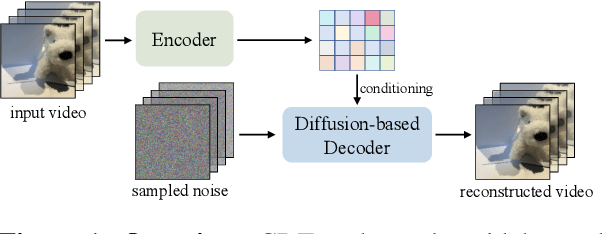
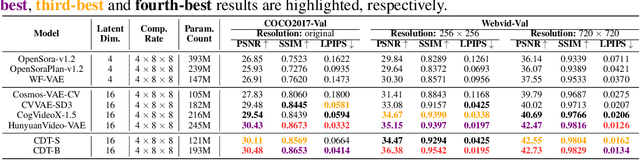
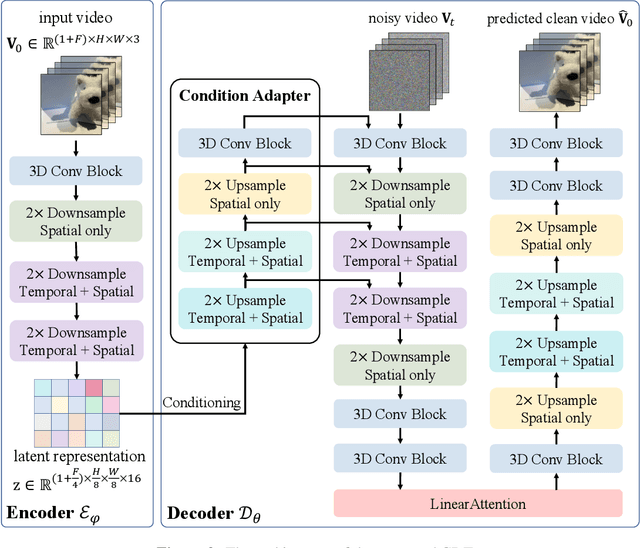
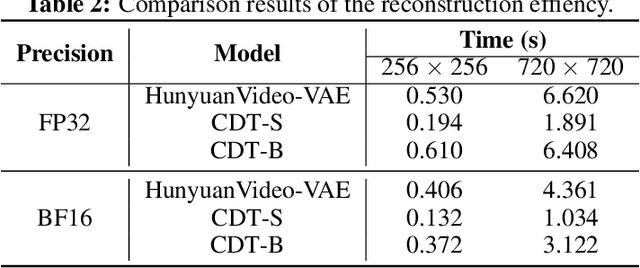
Video tokenizers, which transform videos into compact latent representations, are key to video generation. Existing video tokenizers are based on the VAE architecture and follow a paradigm where an encoder compresses videos into compact latents, and a deterministic decoder reconstructs the original videos from these latents. In this paper, we propose a novel \underline{\textbf{C}}onditioned \underline{\textbf{D}}iffusion-based video \underline{\textbf{T}}okenizer entitled \textbf{\ourmethod}, which departs from previous methods by replacing the deterministic decoder with a 3D causal diffusion model. The reverse diffusion generative process of the decoder is conditioned on the latent representations derived via the encoder. With a feature caching and sampling acceleration, the framework efficiently reconstructs high-fidelity videos of arbitrary lengths. Results show that {\ourmethod} achieves state-of-the-art performance in video reconstruction tasks using just a single-step sampling. Even a smaller version of {\ourmethod} still achieves reconstruction results on par with the top two baselines. Furthermore, the latent video generation model trained using {\ourmethod} also shows superior performance.
NTR-Gaussian: Nighttime Dynamic Thermal Reconstruction with 4D Gaussian Splatting Based on Thermodynamics
Mar 05, 2025Thermal infrared imaging offers the advantage of all-weather capability, enabling non-intrusive measurement of an object's surface temperature. Consequently, thermal infrared images are employed to reconstruct 3D models that accurately reflect the temperature distribution of a scene, aiding in applications such as building monitoring and energy management. However, existing approaches predominantly focus on static 3D reconstruction for a single time period, overlooking the impact of environmental factors on thermal radiation and failing to predict or analyze temperature variations over time. To address these challenges, we propose the NTR-Gaussian method, which treats temperature as a form of thermal radiation, incorporating elements like convective heat transfer and radiative heat dissipation. Our approach utilizes neural networks to predict thermodynamic parameters such as emissivity, convective heat transfer coefficient, and heat capacity. By integrating these predictions, we can accurately forecast thermal temperatures at various times throughout a nighttime scene. Furthermore, we introduce a dynamic dataset specifically for nighttime thermal imagery. Extensive experiments and evaluations demonstrate that NTR-Gaussian significantly outperforms comparison methods in thermal reconstruction, achieving a predicted temperature error within 1 degree Celsius.
Molecule Generation for Target Protein Binding with Hierarchical Consistency Diffusion Model
Mar 02, 2025Effective generation of molecular structures, or new chemical entities, that bind to target proteins is crucial for lead identification and optimization in drug discovery. Despite advancements in atom- and motif-wise deep learning models for 3D molecular generation, current methods often struggle with validity and reliability. To address these issues, we develop the Atom-Motif Consistency Diffusion Model (AMDiff), utilizing a joint-training paradigm for multi-view learning. This model features a hierarchical diffusion architecture that integrates both atom- and motif-level views of molecules, allowing for comprehensive exploration of complementary information. By leveraging classifier-free guidance and incorporating binding site features as conditional inputs, AMDiff ensures robust molecule generation across diverse targets. Compared to existing approaches, AMDiff exhibits superior validity and novelty in generating molecules tailored to fit various protein pockets. Case studies targeting protein kinases, including Anaplastic Lymphoma Kinase (ALK) and Cyclin-dependent kinase 4 (CDK4), demonstrate the model's capability in structure-based de novo drug design. Overall, AMDiff bridges the gap between atom-view and motif-view drug discovery and speeds up the process of target-aware molecular generation.