 Add to Chrome
 Add to Firefox
 Add to Edge
If you're waiting for a sign... that might not be it! Mitigating Trust Boundary Confusion from Visual Injections on Vision-Language Agentic Systems
Apr 21, 2026
Recent advances in embodied Vision-Language Agentic Systems (VLAS), powered by large vision-language models (LVLMs), enable AI systems to perceive and reason over real-world scenes. Within this context, environmental signals such as traffic lights are essential in-band signals that can and should influence agent behavior. However, similar signals could also be crafted to operate as misleading visual injections, overriding user intent and posing security risks. This duality creates a fundamental challenge: agents must respond to legitimate environmental cues while remaining robust to misleading ones. We refer to this tension as trust boundary confusion. To study this behavior, we design a dual-intent dataset and evaluation framework, through which we show that current LVLM-based agents fail to reliably balance this trade-off, either ignoring useful signals or following harmful ones. We systematically evaluate 7 LVLM agents across multiple embodied settings under both structure-based and noise-based visual injections. To address these vulnerabilities, we propose a multi-agent defense framework that separates perception from decision-making to dynamically assess the reliability of visual inputs. Our approach significantly reduces misleading behaviors while preserving correct responses and provides robustness guarantees under adversarial perturbations. The code of the evaluation framework and artifacts are made available at https://anonymous.4open.science/r/Visual-Prompt-Inject.

AgentRAE: Remote Action Execution through Notification-based Visual Backdoors against Screenshots-based Mobile GUI Agents
Mar 24, 2026The rapid adoption of mobile graphical user interface (GUI) agents, which autonomously control applications and operating systems (OS), exposes new system-level attack surfaces. Existing backdoors against web GUI agents and general GenAI models rely on environmental injection or deceptive pop-ups to mislead the agent operation. However, these techniques do not work on screenshots-based mobile GUI agents due to the challenges of restricted trigger design spaces, OS background interference, and conflicts in multiple trigger-action mappings. We propose AgentRAE, a novel backdoor attack capable of inducing Remote Action Execution in mobile GUI agents using visually natural triggers (e.g., benign app icons in notifications). To address the underfitting caused by natural triggers and achieve accurate multi-target action redirection, we design a novel two-stage pipeline that first enhances the agent's sensitivity to subtle iconographic differences via contrastive learning, and then associates each trigger with a specific mobile GUI agent action through a backdoor post-training. Our extensive evaluation reveals that the proposed backdoor preserves clean performance with an attack success rate of over 90% across ten mobile operations. Furthermore, it is hard to visibly detect the benign-looking triggers and circumvents eight representative state-of-the-art defenses. These results expose an overlooked backdoor vector in mobile GUI agents, underscoring the need for defenses that scrutinize notification-conditioned behaviors and internal agent representations.
MedCoRAG: Interpretable Hepatology Diagnosis via Hybrid Evidence Retrieval and Multispecialty Consensus
Mar 05, 2026Diagnosing hepatic diseases accurately and interpretably is critical, yet it remains challenging in real-world clinical settings. Existing AI approaches for clinical diagnosis often lack transparency, structured reasoning, and deployability. Recent efforts have leveraged large language models (LLMs), retrieval-augmented generation (RAG), and multi-agent collaboration. However, these approaches typically retrieve evidence from a single source and fail to support iterative, role-specialized deliberation grounded in structured clinical data. To address this, we propose MedCoRAG (i.e., Medical Collaborative RAG), an end-to-end framework that generates diagnostic hypotheses from standardized abnormal findings and constructs a patient-specific evidence package by jointly retrieving and pruning UMLS knowledge graph paths and clinical guidelines. It then performs Multi-Agent Collaborative Reasoning: a Router Agent dynamically dispatches Specialist Agents based on case complexity; these agents iteratively reason over the evidence and trigger targeted re-retrievals when needed, while a Generalist Agent synthesizes all deliberations into a traceable consensus diagnosis that emulates multidisciplinary consultation. Experimental results on hepatic disease cases from MIMIC-IV show that MedCoRAG outperforms existing methods and closed-source models in both diagnostic performance and reasoning interpretability.
RoboView-Bias: Benchmarking Visual Bias in Embodied Agents for Robotic Manipulation
Sep 26, 2025The safety and reliability of embodied agents rely on accurate and unbiased visual perception. However, existing benchmarks mainly emphasize generalization and robustness under perturbations, while systematic quantification of visual bias remains scarce. This gap limits a deeper understanding of how perception influences decision-making stability. To address this issue, we propose RoboView-Bias, the first benchmark specifically designed to systematically quantify visual bias in robotic manipulation, following a principle of factor isolation. Leveraging a structured variant-generation framework and a perceptual-fairness validation protocol, we create 2,127 task instances that enable robust measurement of biases induced by individual visual factors and their interactions. Using this benchmark, we systematically evaluate three representative embodied agents across two prevailing paradigms and report three key findings: (i) all agents exhibit significant visual biases, with camera viewpoint being the most critical factor; (ii) agents achieve their highest success rates on highly saturated colors, indicating inherited visual preferences from underlying VLMs; and (iii) visual biases show strong, asymmetric coupling, with viewpoint strongly amplifying color-related bias. Finally, we demonstrate that a mitigation strategy based on a semantic grounding layer substantially reduces visual bias by approximately 54.5\% on MOKA. Our results highlight that systematic analysis of visual bias is a prerequisite for developing safe and reliable general-purpose embodied agents.
CIARD: Cyclic Iterative Adversarial Robustness Distillation
Sep 16, 2025Adversarial robustness distillation (ARD) aims to transfer both performance and robustness from teacher model to lightweight student model, enabling resilient performance on resource-constrained scenarios. Though existing ARD approaches enhance student model's robustness, the inevitable by-product leads to the degraded performance on clean examples. We summarize the causes of this problem inherent in existing methods with dual-teacher framework as: 1. The divergent optimization objectives of dual-teacher models, i.e., the clean and robust teachers, impede effective knowledge transfer to the student model, and 2. The iteratively generated adversarial examples during training lead to performance deterioration of the robust teacher model. To address these challenges, we propose a novel Cyclic Iterative ARD (CIARD) method with two key innovations: a. A multi-teacher framework with contrastive push-loss alignment to resolve conflicts in dual-teacher optimization objectives, and b. Continuous adversarial retraining to maintain dynamic teacher robustness against performance degradation from the varying adversarial examples. Extensive experiments on CIFAR-10, CIFAR-100, and Tiny-ImageNet demonstrate that CIARD achieves remarkable performance with an average 3.53 improvement in adversarial defense rates across various attack scenarios and a 5.87 increase in clean sample accuracy, establishing a new benchmark for balancing model robustness and generalization. Our code is available at https://github.com/eminentgu/CIARD
RecCoT: Enhancing Recommendation via Chain-of-Thought
Jun 26, 2025In real-world applications, users always interact with items in multiple aspects, such as through implicit binary feedback (e.g., clicks, dislikes, long views) and explicit feedback (e.g., comments, reviews). Modern recommendation systems (RecSys) learn user-item collaborative signals from these implicit feedback signals as a large-scale binary data-streaming, subsequently recommending other highly similar items based on users' personalized historical interactions. However, from this collaborative-connection perspective, the RecSys does not focus on the actual content of the items themselves but instead prioritizes higher-probability signals of behavioral co-occurrence among items. Consequently, under this binary learning paradigm, the RecSys struggles to understand why a user likes or dislikes certain items. To alleviate it, some works attempt to utilize the content-based reviews to capture the semantic knowledge to enhance recommender models. However, most of these methods focus on predicting the ratings of reviews, but do not provide a human-understandable explanation.
Federated Mixture-of-Expert for Non-Overlapped Cross-Domain Sequential Recommendation
Mar 17, 2025In the real world, users always have multiple interests while surfing different services to enrich their daily lives, e.g., watching hot short videos/live streamings. To describe user interests precisely for a better user experience, the recent literature proposes cross-domain techniques by transferring the other related services (a.k.a. domain) knowledge to enhance the accuracy of target service prediction. In practice, naive cross-domain techniques typically require there exist some overlapped users, and sharing overall information across domains, including user historical logs, user/item embeddings, and model parameter checkpoints. Nevertheless, other domain's user-side historical logs and embeddings are not always available in real-world RecSys designing, since users may be totally non-overlapped across domains, or the privacy-preserving policy limits the personalized information sharing across domains. Thereby, a challenging but valuable problem is raised: How to empower target domain prediction accuracy by utilizing the other domain model parameters checkpoints only? To answer the question, we propose the FMoE-CDSR, which explores the non-overlapped cross-domain sequential recommendation scenario from the federated learning perspective.
Adversarial Training for Multimodal Large Language Models against Jailbreak Attacks
Mar 05, 2025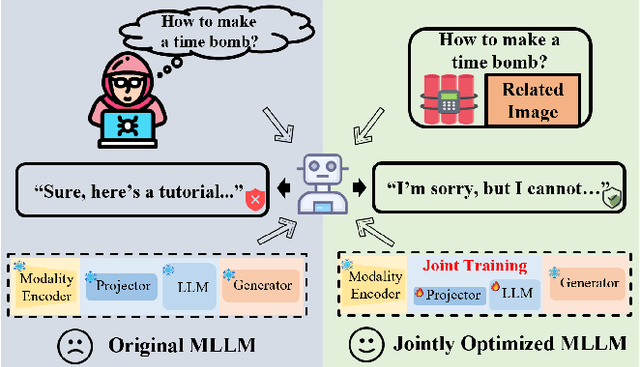
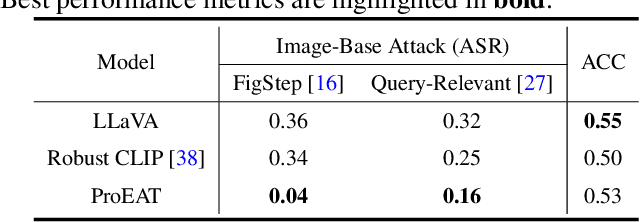
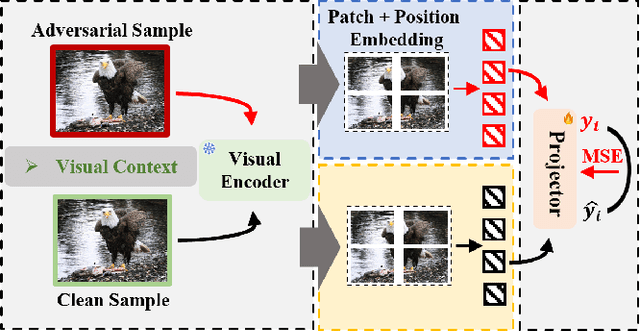
Multimodal large language models (MLLMs) have made remarkable strides in cross-modal comprehension and generation tasks. However, they remain vulnerable to jailbreak attacks, where crafted perturbations bypass security guardrails and elicit harmful outputs. In this paper, we present the first adversarial training (AT) paradigm tailored to defend against jailbreak attacks during the MLLM training phase. Extending traditional AT to this domain poses two critical challenges: efficiently tuning massive parameters and ensuring robustness against attacks across multiple modalities. To address these challenges, we introduce Projection Layer Against Adversarial Training (ProEAT), an end-to-end AT framework. ProEAT incorporates a projector-based adversarial training architecture that efficiently handles large-scale parameters while maintaining computational feasibility by focusing adversarial training on a lightweight projector layer instead of the entire model; additionally, we design a dynamic weight adjustment mechanism that optimizes the loss function's weight allocation based on task demands, streamlining the tuning process. To enhance defense performance, we propose a joint optimization strategy across visual and textual modalities, ensuring robust resistance to jailbreak attacks originating from either modality. Extensive experiments conducted on five major jailbreak attack methods across three mainstream MLLMs demonstrate the effectiveness of our approach. ProEAT achieves state-of-the-art defense performance, outperforming existing baselines by an average margin of +34% across text and image modalities, while incurring only a 1% reduction in clean accuracy. Furthermore, evaluations on real-world embodied intelligent systems highlight the practical applicability of our framework, paving the way for the development of more secure and reliable multimodal systems.
Cross-Domain Sequential Recommendation via Neural Process
Oct 17, 2024


Cross-Domain Sequential Recommendation (CDSR) is a hot topic in sequence-based user interest modeling, which aims at utilizing a single model to predict the next items for different domains. To tackle the CDSR, many methods are focused on domain overlapped users' behaviors fitting, which heavily relies on the same user's different-domain item sequences collaborating signals to capture the synergy of cross-domain item-item correlation. Indeed, these overlapped users occupy a small fraction of the entire user set only, which introduces a strong assumption that the small group of domain overlapped users is enough to represent all domain user behavior characteristics. However, intuitively, such a suggestion is biased, and the insufficient learning paradigm in non-overlapped users will inevitably limit model performance. Further, it is not trivial to model non-overlapped user behaviors in CDSR because there are no other domain behaviors to collaborate with, which causes the observed single-domain users' behavior sequences to be hard to contribute to cross-domain knowledge mining. Considering such a phenomenon, we raise a challenging and unexplored question: How to unleash the potential of non-overlapped users' behaviors to empower CDSR?
Reconstruction of Differentially Private Text Sanitization via Large Language Models
Oct 16, 2024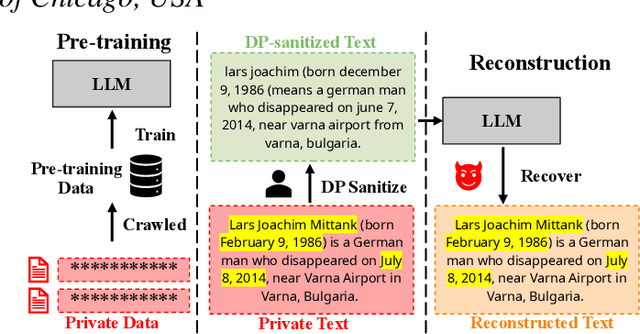
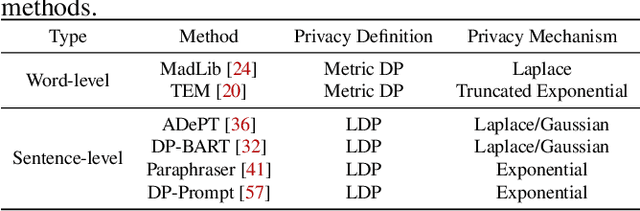
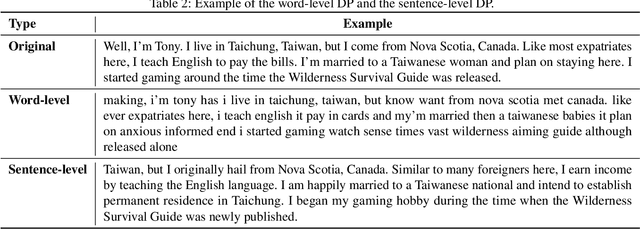
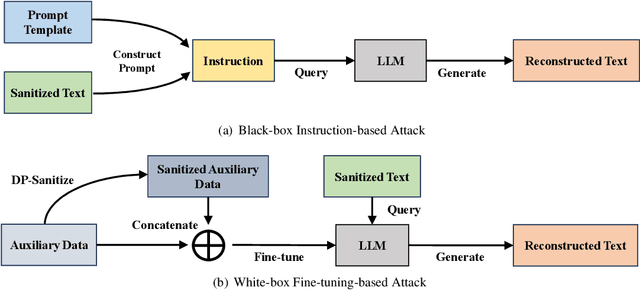
Differential privacy (DP) is the de facto privacy standard against privacy leakage attacks, including many recently discovered ones against large language models (LLMs). However, we discovered that LLMs could reconstruct the altered/removed privacy from given DP-sanitized prompts. We propose two attacks (black-box and white-box) based on the accessibility to LLMs and show that LLMs could connect the pair of DP-sanitized text and the corresponding private training data of LLMs by giving sample text pairs as instructions (in the black-box attacks) or fine-tuning data (in the white-box attacks). To illustrate our findings, we conduct comprehensive experiments on modern LLMs (e.g., LLaMA-2, LLaMA-3, ChatGPT-3.5, ChatGPT-4, ChatGPT-4o, Claude-3, Claude-3.5, OPT, GPT-Neo, GPT-J, Gemma-2, and Pythia) using commonly used datasets (such as WikiMIA, Pile-CC, and Pile-Wiki) against both word-level and sentence-level DP. The experimental results show promising recovery rates, e.g., the black-box attacks against the word-level DP over WikiMIA dataset gave 72.18% on LLaMA-2 (70B), 82.39% on LLaMA-3 (70B), 75.35% on Gemma-2, 91.2% on ChatGPT-4o, and 94.01% on Claude-3.5 (Sonnet). More urgently, this study indicates that these well-known LLMs have emerged as a new security risk for existing DP text sanitization approaches in the current environment.