 Add to Chrome
 Add to Firefox
 Add to Edge
Scaling Reasoning, Losing Control: Evaluating Instruction Following in Large Reasoning Models
May 20, 2025
Instruction-following is essential for aligning large language models (LLMs) with user intent. While recent reasoning-oriented models exhibit impressive performance on complex mathematical problems, their ability to adhere to natural language instructions remains underexplored. In this work, we introduce MathIF, a dedicated benchmark for evaluating instruction-following in mathematical reasoning tasks. Our empirical analysis reveals a consistent tension between scaling up reasoning capacity and maintaining controllability, as models that reason more effectively often struggle to comply with user directives. We find that models tuned on distilled long chains-of-thought or trained with reasoning-oriented reinforcement learning often degrade in instruction adherence, especially when generation length increases. Furthermore, we show that even simple interventions can partially recover obedience, though at the cost of reasoning performance. These findings highlight a fundamental tension in current LLM training paradigms and motivate the need for more instruction-aware reasoning models. We release the code and data at https://github.com/TingchenFu/MathIF.

Occult: Optimizing Collaborative Communication across Experts for Accelerated Parallel MoE Training and Inference
May 19, 2025Mixture-of-experts (MoE) architectures could achieve impressive computational efficiency with expert parallelism, which relies heavily on all-to-all communication across devices. Unfortunately, such communication overhead typically constitutes a significant portion of the total runtime, hampering the scalability of distributed training and inference for modern MoE models (consuming over $40\%$ runtime in large-scale training). In this paper, we first define collaborative communication to illustrate this intrinsic limitation, and then propose system- and algorithm-level innovations to reduce communication costs. Specifically, given a pair of experts co-activated by one token, we call them "collaborated", which comprises $2$ cases as intra- and inter-collaboration, depending on whether they are kept on the same device. Our pilot investigations reveal that augmenting the proportion of intra-collaboration can accelerate expert parallelism at scale. It motivates us to strategically optimize collaborative communication for accelerated MoE training and inference, dubbed Occult. Our designs are capable of either delivering exact results with reduced communication cost or controllably minimizing the cost with collaboration pruning, materialized by modified fine-tuning. Comprehensive experiments on various MoE-LLMs demonstrate that Occult can be faster than popular state-of-the-art inference or training frameworks (more than $1.5\times$ speed up across multiple tasks and models) with comparable or superior quality compared to the standard fine-tuning. Code is available at $\href{https://github.com/UNITES-Lab/Occult}{https://github.com/UNITES-Lab/Occult}$.
SMFusion: Semantic-Preserving Fusion of Multimodal Medical Images for Enhanced Clinical Diagnosis
May 18, 2025Multimodal medical image fusion plays a crucial role in medical diagnosis by integrating complementary information from different modalities to enhance image readability and clinical applicability. However, existing methods mainly follow computer vision standards for feature extraction and fusion strategy formulation, overlooking the rich semantic information inherent in medical images. To address this limitation, we propose a novel semantic-guided medical image fusion approach that, for the first time, incorporates medical prior knowledge into the fusion process. Specifically, we construct a publicly available multimodal medical image-text dataset, upon which text descriptions generated by BiomedGPT are encoded and semantically aligned with image features in a high-dimensional space via a semantic interaction alignment module. During this process, a cross attention based linear transformation automatically maps the relationship between textual and visual features to facilitate comprehensive learning. The aligned features are then embedded into a text-injection module for further feature-level fusion. Unlike traditional methods, we further generate diagnostic reports from the fused images to assess the preservation of medical information. Additionally, we design a medical semantic loss function to enhance the retention of textual cues from the source images. Experimental results on test datasets demonstrate that the proposed method achieves superior performance in both qualitative and quantitative evaluations while preserving more critical medical information.
OpenThinkIMG: Learning to Think with Images via Visual Tool Reinforcement Learning
May 13, 2025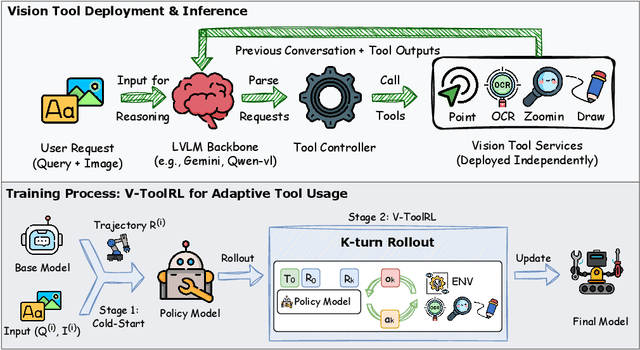
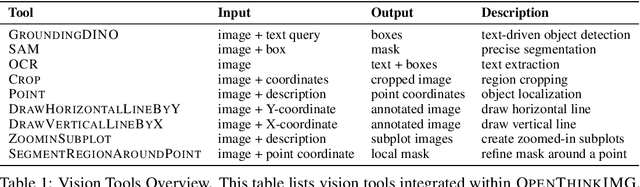
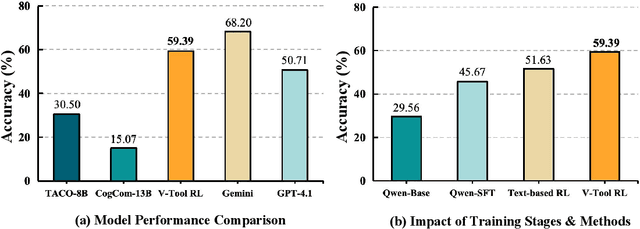
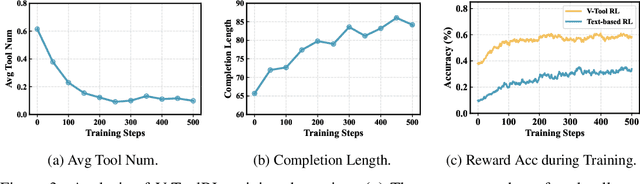
While humans can flexibly leverage interactive visual cognition for complex problem-solving, enabling Large Vision-Language Models (LVLMs) to learn similarly adaptive behaviors with visual tools remains challenging. A significant hurdle is the current lack of standardized infrastructure, which hinders integrating diverse tools, generating rich interaction data, and training robust agents effectively. To address these gaps, we introduce OpenThinkIMG, the first open-source, comprehensive end-to-end framework for tool-augmented LVLMs. It features standardized vision tool interfaces, scalable trajectory generation for policy initialization, and a flexible training environment. Furthermore, considering supervised fine-tuning (SFT) on static demonstrations offers limited policy generalization for dynamic tool invocation, we propose a novel reinforcement learning (RL) framework V-ToolRL to train LVLMs to learn adaptive policies for invoking external vision tools. V-ToolRL enables LVLMs to autonomously discover optimal tool-usage strategies by directly optimizing for task success using feedback from tool interactions. We empirically validate V-ToolRL on challenging chart reasoning tasks. Our RL-trained agent, built upon a Qwen2-VL-2B, significantly outperforms its SFT-initialized counterpart (+28.83 points) and surpasses established supervised tool-learning baselines like Taco and CogCom by an average of +12.7 points. Notably, it also surpasses prominent closed-source models like GPT-4.1 by +8.68 accuracy points. We hope OpenThinkIMG can serve as a foundational framework for advancing dynamic, tool-augmented visual reasoning, helping the community develop AI agents that can genuinely "think with images".
Visually Interpretable Subtask Reasoning for Visual Question Answering
May 12, 2025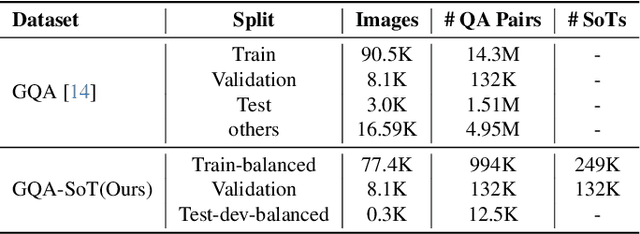

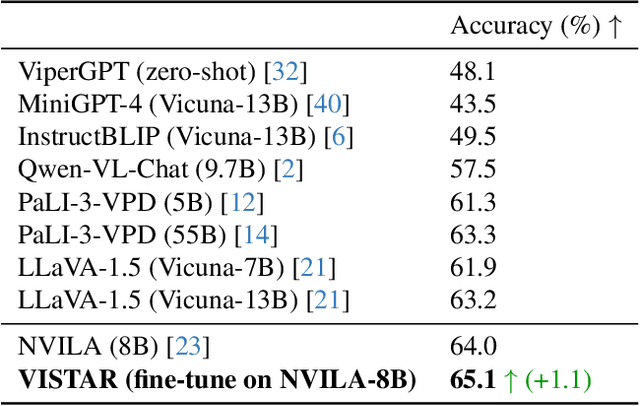
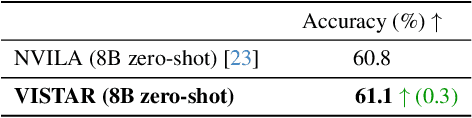
Answering complex visual questions like `Which red furniture can be used for sitting?' requires multi-step reasoning, including object recognition, attribute filtering, and relational understanding. Recent work improves interpretability in multimodal large language models (MLLMs) by decomposing tasks into sub-task programs, but these methods are computationally expensive and less accurate due to poor adaptation to target data. To address this, we introduce VISTAR (Visually Interpretable Subtask-Aware Reasoning Model), a subtask-driven training framework that enhances both interpretability and reasoning by generating textual and visual explanations within MLLMs. Instead of relying on external models, VISTAR fine-tunes MLLMs to produce structured Subtask-of-Thought rationales (step-by-step reasoning sequences). Experiments on two benchmarks show that VISTAR consistently improves reasoning accuracy while maintaining interpretability. Our code and dataset will be available at https://github.com/ChengJade/VISTAR.
Emergent Multi-View Fidelity in Autonomous UAV Swarm Sport Injury Detection
May 10, 2025Accurate, real-time collision detection is essential for ensuring player safety and effective refereeing in high-contact sports such as rugby, particularly given the severe risks associated with traumatic brain injuries (TBI). Traditional collision-monitoring methods employing fixed cameras or wearable sensors face limitations in visibility, coverage, and responsiveness. Previously, we introduced a framework using unmanned aerial vehicles (UAVs) for monitoring and real time kinematics extraction from videos of collision events. In this paper, we show that the strategies operating on the objective of ensuring at least one UAV captures every incident on the pitch have an emergent property of fulfilling a stronger key condition for successful kinematics extraction. Namely, they ensure that almost all collisions are captured by multiple drones, establishing multi-view fidelity and redundancy, while not requiring any drone-to-drone communication.
TileLang: A Composable Tiled Programming Model for AI Systems
Apr 24, 2025Modern AI workloads rely heavily on optimized computing kernels for both training and inference. These AI kernels follow well-defined data-flow patterns, such as moving tiles between DRAM and SRAM and performing a sequence of computations on those tiles. However, writing high-performance kernels remains complex despite the clarity of these patterns. Achieving peak performance requires careful, hardware-centric optimizations to fully leverage modern accelerators. While domain-specific compilers attempt to reduce the burden of writing high-performance kernels, they often struggle with usability and expressiveness gaps. In this paper, we present TileLang, a generalized tiled programming model for more efficient AI Kernel programming. TileLang decouples scheduling space (thread binding, layout, tensorize and pipeline) from dataflow, and encapsulated them as a set of customization annotations and primitives. This approach allows users to focus on the kernel's data-flow itself, while leaving most other optimizations to compilers. We conduct comprehensive experiments on commonly-used devices, across numerous experiments, our evaluation shows that TileLang can achieve state-of-the-art performance in key kernels, demonstrating that its unified block-and-thread paradigm and transparent scheduling capabilities deliver both the power and flexibility demanded by modern AI system development.
Text-to-Decision Agent: Learning Generalist Policies from Natural Language Supervision
Apr 22, 2025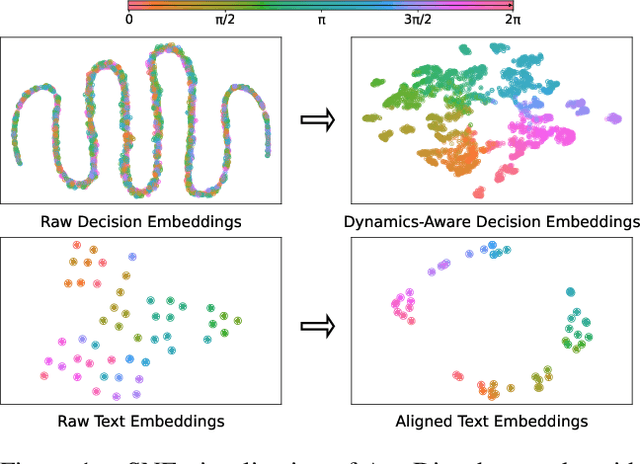

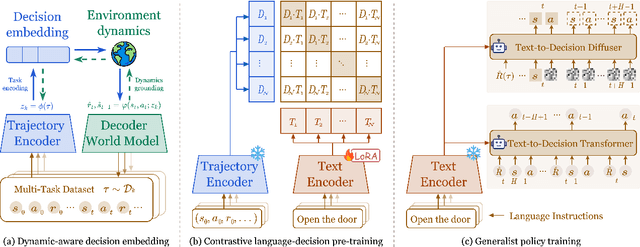
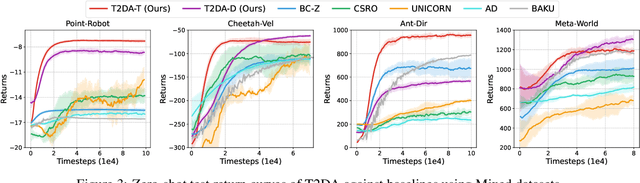
RL systems usually tackle generalization by inferring task beliefs from high-quality samples or warmup explorations. The restricted form limits their generality and usability since these supervision signals are expensive and even infeasible to acquire in advance for unseen tasks. Learning directly from the raw text about decision tasks is a promising alternative to leverage a much broader source of supervision. In the paper, we propose Text-to-Decision Agent (T2DA), a simple and scalable framework that supervises generalist policy learning with natural language. We first introduce a generalized world model to encode multi-task decision data into a dynamics-aware embedding space. Then, inspired by CLIP, we predict which textual description goes with which decision embedding, effectively bridging their semantic gap via contrastive language-decision pre-training and aligning the text embeddings to comprehend the environment dynamics. After training the text-conditioned generalist policy, the agent can directly realize zero-shot text-to-decision generation in response to language instructions. Comprehensive experiments on MuJoCo and Meta-World benchmarks show that T2DA facilitates high-capacity zero-shot generalization and outperforms various types of baselines.
Learning to Reason under Off-Policy Guidance
Apr 22, 2025Recent advances in large reasoning models (LRMs) demonstrate that sophisticated behaviors such as multi-step reasoning and self-reflection can emerge via reinforcement learning (RL) with simple rule-based rewards. However, existing zero-RL approaches are inherently ``on-policy'', limiting learning to a model's own outputs and failing to acquire reasoning abilities beyond its initial capabilities. We introduce LUFFY (Learning to reason Under oFF-policY guidance), a framework that augments zero-RL with off-policy reasoning traces. LUFFY dynamically balances imitation and exploration by combining off-policy demonstrations with on-policy rollouts during training. Notably, we propose policy shaping via regularized importance sampling to avoid superficial and rigid imitation during mixed-policy training. Remarkably, LUFFY achieves an over +7.0 average gain across six math benchmarks and an advantage of over +6.2 points in out-of-distribution tasks. It also substantially surpasses imitation-based supervised fine-tuning (SFT), particularly in generalization. Analysis shows LUFFY not only imitates effectively but also explores beyond demonstrations, offering a scalable path to train generalizable reasoning models with off-policy guidance.
A Deep Learning Framework for Sequence Mining with Bidirectional LSTM and Multi-Scale Attention
Apr 21, 2025This paper addresses the challenges of mining latent patterns and modeling contextual dependencies in complex sequence data. A sequence pattern mining algorithm is proposed by integrating Bidirectional Long Short-Term Memory (BiLSTM) with a multi-scale attention mechanism. The BiLSTM captures both forward and backward dependencies in sequences, enhancing the model's ability to perceive global contextual structures. At the same time, the multi-scale attention module assigns adaptive weights to key feature regions under different window sizes. This improves the model's responsiveness to both local and global important information. Extensive experiments are conducted on a publicly available multivariate time series dataset. The proposed model is compared with several mainstream sequence modeling methods. Results show that it outperforms existing models in terms of accuracy, precision, and recall. This confirms the effectiveness and robustness of the proposed architecture in complex pattern recognition tasks. Further ablation studies and sensitivity analyses are carried out to investigate the effects of attention scale and input sequence length on model performance. These results provide empirical support for structural optimization of the model.