 Add to Chrome
 Add to Firefox
 Add to Edge
Multi-Decoder OneRec: Controllable Generative Retrieval for Multi-Objective Industrial Recommendation
Jul 29, 2026
Industrial recommender systems build candidate pools by assigning explicit quotas to objective-specific retrieval routes. This design offers quota control but increasingly fragments modeling, training, and serving as the route set grows. Semantic-ID-based generative retrieval provides a unified alternative, yet a single decoder entangles objective policies and limits candidate complementarity. We propose Multi-Decoder OneRec, a controllable framework that combines shared representations, isolated objective adaptation, and coordinated decoding. All objectives share a user-context module and the General Decoder, while each objective adds an isolated, parameter-efficient LoRA expert. During training, exposure-sample next-token prediction (NTP) updates the shared base, target-filtered NTP updates the event-based experts, and Kullback-Leibler (KL)-regularized policy optimization updates the Watch-time expert; gradient routing isolates these updates, and the General Decoder supplies a stop-gradient reference. At inference, explicit route quotas allocate the fixed budget and Multi-Decoder Constrained Beam Search reduces cross-route overlap. We publicly release Kwai26, a large-scale multi-objective benchmark with 1.31 billion raw item-level records, 31.85 million Item-ID entries, and 25.03 million items with valid Semantic IDs, together with predefined splits and an evaluation protocol. Under the same 512-item retrieval budget, Multi-Decoder OneRec improves over the single-decoder OneRec baseline by 1.69%-5.62% across four Recall@512 metrics. In a production A/B test, it yields relative gains of 0.37% in app usage time per device, 0.19% in Day-7 retained users, 0.19% in devices with at least one share, and 2.09% in new-content Cold-Start. These results show that generative retrieval can combine shared modeling with objective-specific control and complementary candidate generation.

NavCMPO: Critic-Guided MeanFlow Policy Optimization for Adaptive Navigation
Jul 16, 2026End-to-end diffusion-based policies have demonstrated strong performance in mapless visual navigation, but their iterative denoising process introduces substantial inference latency, while behavior cloning limits performance to the quality of expert demonstrations. We present NavCMPO, a two-stage adaptive navigation framework that combines few-step MeanFlow trajectory generation, critic-guided refinement, and reinforcement learning fine-tuning. During pre-training, an obstacle proximity prediction task encourages the visual representation to capture obstacle-aware spatial information. To compensate for the degradation in obstacle avoidance caused by few-step generation, Critic-Guided Trajectory Refinement (CGTR) uses gradients from a critic trained with obstacle-point-cloud supervision to refine intermediate trajectories. During adaptation, the MeanFlow policy is fine-tuned using Proximal Policy Optimization with behavior-cloning regularization, while the critic is updated to accommodate embodiment-specific observation changes. Under a matched training budget on the InternVLA-N1 benchmark, NavCMPO achieves an average success rate of 74.7\%, exceeding the retrained NavDP baseline by 6.4 percentage points, while reducing inference latency from 85\,ms to 60\,ms. Experiments on a Unitree Go2 further demonstrate effective sim-to-real transfer.
SoftNav: Injecting 3D Scene Tokens into VLMs for Embodied Navigation
Jul 16, 2026In goal-directed embodied navigation, where an agent must locate a specified target in an unseen environment, 3D scene understanding and navigation reasoning must work in concert. Current approaches transmit 3D scene information to vision-language models (VLMs) through text, suggesting a representation gap in our tested configurations; a controlled ablation confirms that direct embedding-level transfer significantly outperforms the evaluated text serialization formats. We introduce SoftNav, which injects entity-level 3D continuous representations -- one token per detected object or frontier -- into a VLM's hidden space as soft tokens through a lightweight projector. With the 3D encoder and VLM frozen, only ~1,200 samples and ~17M trainable parameters are needed. On HM3D-OVON, SoftNav achieves 74.2%/68.3%/66.7% SR across three splits, surpassing all prior methods in both SR and SPL; the same navigation policy transfers zero-shot to GOAT-Bench (67.2% SR), SG3D (47.2% s-SR), and real-world robot deployment without retraining or architectural modification. Injecting 3D scene tokens directly into VLMs bridges the representation gap, enabling transferable navigation with minimal training.
GoLF-NRT: Integrating Global Context and Local Geometry for Few-Shot View Synthesis
May 26, 2025Neural Radiance Fields (NeRF) have transformed novel view synthesis by modeling scene-specific volumetric representations directly from images. While generalizable NeRF models can generate novel views across unknown scenes by learning latent ray representations, their performance heavily depends on a large number of multi-view observations. However, with limited input views, these methods experience significant degradation in rendering quality. To address this limitation, we propose GoLF-NRT: a Global and Local feature Fusion-based Neural Rendering Transformer. GoLF-NRT enhances generalizable neural rendering from few input views by leveraging a 3D transformer with efficient sparse attention to capture global scene context. In parallel, it integrates local geometric features extracted along the epipolar line, enabling high-quality scene reconstruction from as few as 1 to 3 input views. Furthermore, we introduce an adaptive sampling strategy based on attention weights and kernel regression, improving the accuracy of transformer-based neural rendering. Extensive experiments on public datasets show that GoLF-NRT achieves state-of-the-art performance across varying numbers of input views, highlighting the effectiveness and superiority of our approach. Code is available at https://github.com/KLMAV-CUC/GoLF-NRT.
Balancing Multi-Target Semi-Supervised Medical Image Segmentation with Collaborative Generalist and Specialists
Apr 01, 2025Despite the promising performance achieved by current semi-supervised models in segmenting individual medical targets, many of these models suffer a notable decrease in performance when tasked with the simultaneous segmentation of multiple targets. A vital factor could be attributed to the imbalanced scales among different targets: during simultaneously segmenting multiple targets, large targets dominate the loss, leading to small targets being misclassified as larger ones. To this end, we propose a novel method, which consists of a Collaborative Generalist and several Specialists, termed CGS. It is centered around the idea of employing a specialist for each target class, thus avoiding the dominance of larger targets. The generalist performs conventional multi-target segmentation, while each specialist is dedicated to distinguishing a specific target class from the remaining target classes and the background. Based on a theoretical insight, we demonstrate that CGS can achieve a more balanced training. Moreover, we develop cross-consistency losses to foster collaborative learning between the generalist and the specialists. Lastly, regarding their intrinsic relation that the target class of any specialized head should belong to the remaining classes of the other heads, we introduce an inter-head error detection module to further enhance the quality of pseudo-labels. Experimental results on three popular benchmarks showcase its superior performance compared to state-of-the-art methods.
A Joint Prediction Method of Multi-Agent to Reduce Collision Rate
Nov 23, 2024
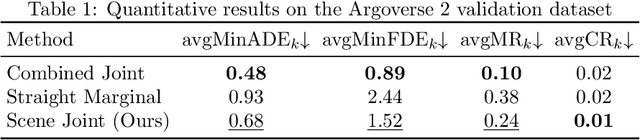
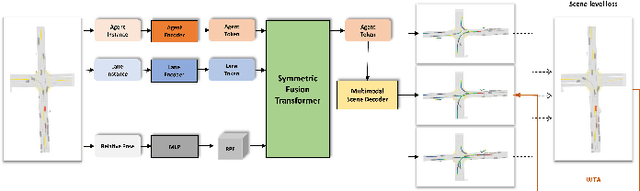
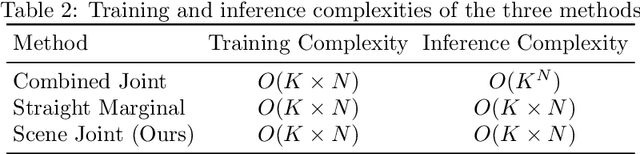
Predicting future motions of road participants is an important task for driving autonomously. Most existing models excel at predicting the marginal trajectory of a single agent, but predicting joint trajectories for multiple agents that are consistent within a scene remains a challenge. Previous research has often focused on marginal predictions, but the importance of joint predictions has become increasingly apparent. Joint prediction aims to generate trajectories that are consistent across the entire scene. Our research builds upon the SIMPL baseline to explore methods for generating scene-consistent trajectories. We tested our algorithm on the Argoverse 2 dataset, and experimental results demonstrate that our approach can generate scene-consistent trajectories. Compared to the SIMPL baseline, our method significantly reduces the collision rate of joint trajectories within the scene.
A Simple Multi-agent Joint Prediction Method for Autonomous Driving
Nov 12, 2024Predicting future motions of road participants is an important task for driving autonomously. Most existing models excel at predicting the marginal trajectory of a single agent, but predicting joint trajectories for multiple agents that are consistent within a scene remains a challenge. Previous research has often focused on marginal predictions, but the importance of joint predictions has become increasingly apparent. Joint prediction aims to generate trajectories that are consistent across the entire scene. Our research builds upon the SIMPL baseline to explore methods for generating scene-consistent trajectories. We tested our algorithm on the Argoverse 2 dataset, and experimental results demonstrate that our approach can generate scene-consistent trajectories. Compared to the SIMPL baseline, our method significantly reduces the collision rate of joint trajectories within the scene.
SOMTP: Self-Supervised Learning-Based Optimizer for MPC-Based Safe Trajectory Planning Problems in Robotics
May 15, 2024Model Predictive Control (MPC)-based trajectory planning has been widely used in robotics, and incorporating Control Barrier Function (CBF) constraints into MPC can greatly improve its obstacle avoidance efficiency. Unfortunately, traditional optimizers are resource-consuming and slow to solve such non-convex constrained optimization problems (COPs) while learning-based methods struggle to satisfy the non-convex constraints. In this paper, we propose SOMTP algorithm, a self-supervised learning-based optimizer for CBF-MPC trajectory planning. Specifically, first, SOMTP employs problem transcription to satisfy most of the constraints. Then the differentiable SLPG correction is proposed to move the solution closer to the safe set and is then converted as the guide policy in the following training process. After that, inspired by the Augmented Lagrangian Method (ALM), our training algorithm integrated with guide policy constraints is proposed to enable the optimizer network to converge to a feasible solution. Finally, experiments show that the proposed algorithm has better feasibility than other learning-based methods and can provide solutions much faster than traditional optimizers with similar optimality.
Adaptive Model Prediction Control-Based Multi-Terrain Trajectory Tracking Framework for Mobile Spherical Robots
Mar 31, 2023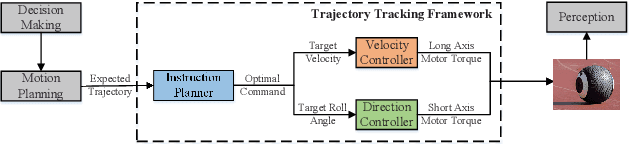
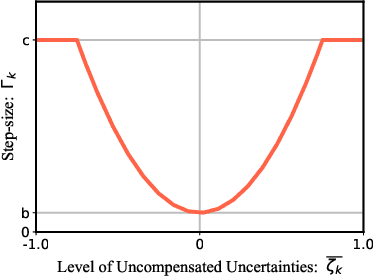
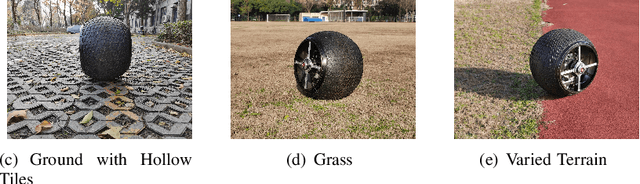
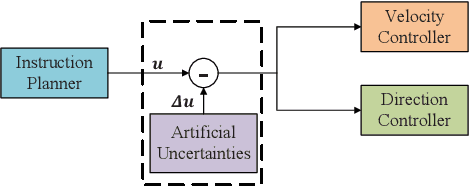
Owing to uncertainties in both kinematics and dynamics, the current trajectory tracking framework for mobile robots like spherical robots cannot function effectively on multiple terrains, especially uneven and unknown ones. Since this is a prerequisite for robots to execute tasks in the wild, we enhance our previous hierarchical trajectory tracking framework to handle this issue. First, a modified adaptive RBF neural network (RBFNN) is proposed to represent all uncertainties in kinodynamics. Then the Lyapunov function is utilized to design its adaptive law, and a variable step-size algorithm is employed in the weights update procedure to accelerate convergence and improve stability. Hence, a new adaptive model prediction control-based instruction planner (VAN-MPC) is proposed. Without modifying the bottom controllers, we finally develop the multi-terrain trajectory tracking framework by employing the new instruction planner VAN-MPC. The practical experiments demonstrate its effectiveness and robustness.
An MPC-based Optimal Motion Control Framework for Pendulum-driven Spherical Robots
Feb 17, 2023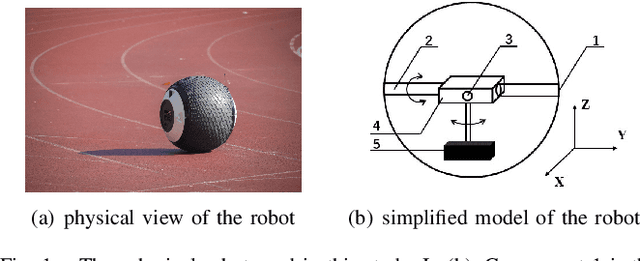
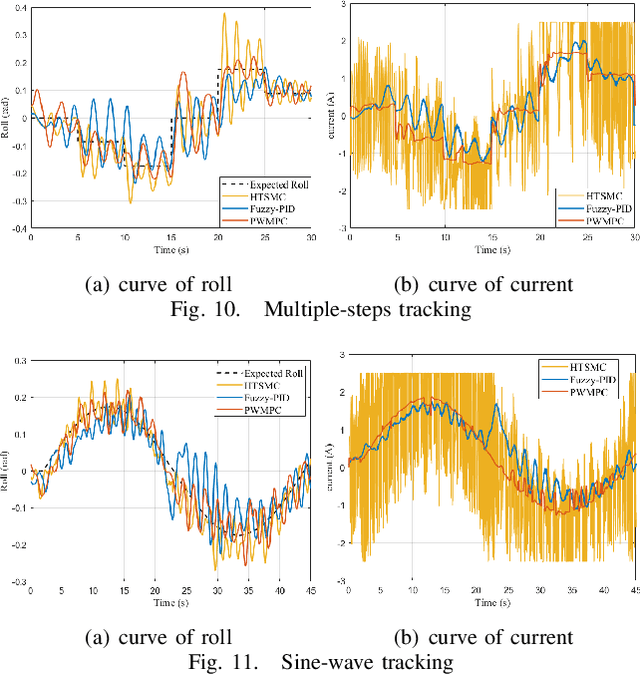
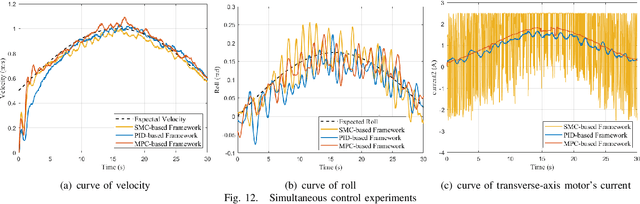
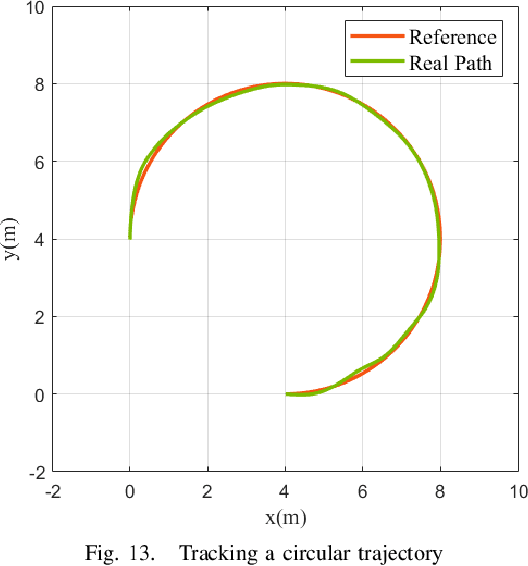
Motion control is essential for all autonomous mobile robots, and even more so for spherical robots. Due to the uniqueness of the spherical robot, its motion control must not only ensure accurate tracking of the target commands, but also minimize fluctuations in the robot's attitude and motors' current while tracking. In this paper, model predictive control (MPC) is applied to the control of spherical robots and an MPC-based motion control framework is designed. There are two controllers in the framework, an optimal velocity controller ESO-MPC which combines extend states observers (ESO) and MPC, and an optimal orientation controller that uses multilayer perceptron (MLP) to generate accurate trajectories and MPC with changing weights to achieve optimal control. Finally, the performance of individual controllers and the whole control framework are verified by physical experiments. The experimental results show that the MPC-based motion control framework proposed in this work is much better than PID in terms of rapidity and accuracy, and has great advantages over sliding mode controller (SMC) for overshoot, attitude stability, current stability and energy consumption.