 Add to Chrome
 Add to Firefox
 Add to Edge
OneReason Technical Report
Jun 04, 2026
Generative recommendation models in the OneRec family have been widely deployed in many real-world services, such as short-video, live-streaming, advertising, and e-commerce. However, these generative models can only benefit from the scaling advantage, while their reasoning ability is hard to activate, since we cannot construct meaningful Chain-of-Thought (CoT) sequences consisting of itemic tokens only. Inspired by the success of the reasoning-style ``think before answer'' paradigm in the LLM field, we conduct preliminary studies (i.e., OneRec-Think, OpenOneRec) to explore reasoning capability in generative recommendation. Nevertheless, we notice an unexpected phenomenon: the thinking mode does not show advantages over the non-thinking mode. Drawing insights from recent findings on CoT robustness in multi-modal language models, we argue that effective reasoning in recommendation rests on two factors: perception, the ability to ground itemic tokens in their underlying language semantics, and cognition, the ability to reorganize a user's behavior sequence into coherent latent interest points. We therefore propose OneReason, which includes: (1) strong itemic token perception in pre-training, (2) a three-level cognition-enhanced CoT format for recommendation tasks in SFT, and (3) a specialize-then-unify training recipe in RL to enhance the thinking ability.

CAPTS: Channel-Aware, Preference-Aligned Trigger Selection for Multi-Channel Item-to-Item Retrieval
Feb 13, 2026Large-scale industrial recommender systems commonly adopt multi-channel retrieval for candidate generation, combining direct user-to-item (U2I) retrieval with two-hop user-to-item-to-item (U2I2I) pipelines. In U2I2I, the system selects a small set of historical interactions as triggers to seed downstream item-to-item (I2I) retrieval across multiple channels. In production, triggers are often selected using rule-based policies or learned scorers and tuned in a channel-by-channel manner. However, these practices face two persistent challenges: biased value attribution that values triggers by on-trigger feedback rather than their downstream utility as retrieval seeds, and uncoordinated multi-channel routing where channels select triggers independently under a shared quota, increasing cross-channel overlap. To address these challenges, we propose Channel-Aware, Preference-Aligned Trigger Selection (CAPTS), a unified and flexible framework that treats multi-channel trigger selection as a learnable routing problem. CAPTS introduces a Value Attribution Module (VAM) that provides look-ahead supervision by crediting each trigger with the subsequent engagement generated by items retrieved from it on each I2I channel, and a Channel-Adaptive Trigger Routing (CATR) module that coordinates trigger-to-channel assignment to maximize the overall value of multi-channel retrieval. Extensive offline experiments and large-scale online A/B tests on Kwai, Kuaishou's international short-video platform, show that CAPTS consistently improves multi-channel recall offline and delivers a +0.351% lift in average time spent per device online.
SARM: LLM-Augmented Semantic Anchor for End-to-End Live-Streaming Ranking
Feb 10, 2026Large-scale live-streaming recommendation requires precise modeling of non-stationary content semantics under strict real-time serving constraints. In industrial deployment, two common approaches exhibit fundamental limitations: discrete semantic abstractions sacrifice descriptive precision through clustering, while dense multimodal embeddings are extracted independently and remain weakly aligned with ranking optimization, limiting fine-grained content-aware ranking. To address these limitations, we propose \textbf{SARM}, an end-to-end ranking architecture that integrates natural-language semantic anchors directly into ranking optimization, enabling fine-grained author representations conditioned on multimodal content. Each semantic anchor is represented as learnable text tokens jointly optimized with ranking features, allowing the model to adapt content descriptions to ranking objectives. A lightweight dual-token gated design captures domain-specific live-streaming semantics, while an asymmetric deployment strategy preserves low-latency online training and serving. Extensive offline evaluation and large-scale A/B tests show consistent improvements over production baselines. SARM is fully deployed and serves over 400 million users daily.
MARM: Unlocking the Future of Recommendation Systems through Memory Augmentation and Scalable Complexity
Nov 14, 2024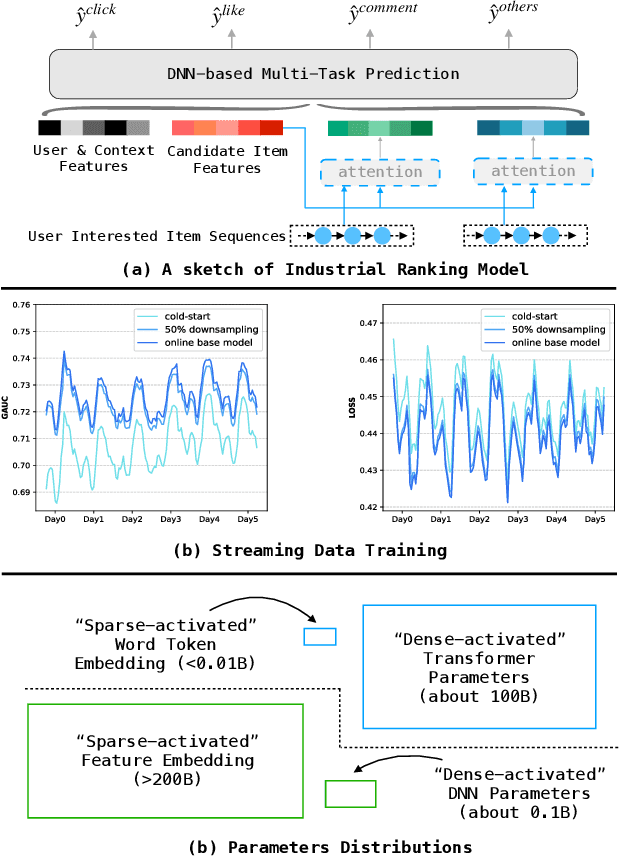
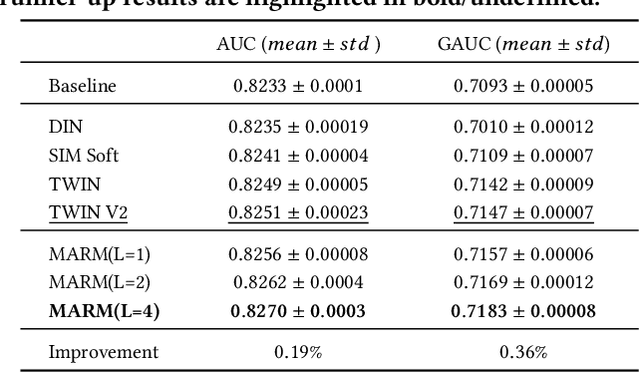
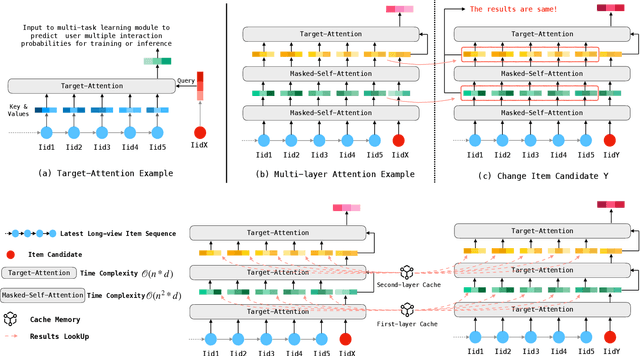

Scaling-law has guided the language model designing for past years, however, it is worth noting that the scaling laws of NLP cannot be directly applied to RecSys due to the following reasons: (1) The amount of training samples and model parameters is typically not the bottleneck for the model. Our recommendation system can generate over 50 billion user samples daily, and such a massive amount of training data can easily allow our model parameters to exceed 200 billion, surpassing many LLMs (about 100B). (2) To ensure the stability and robustness of the recommendation system, it is essential to control computational complexity FLOPs carefully. Considering the above differences with LLM, we can draw a conclusion that: for a RecSys model, compared to model parameters, the computational complexity FLOPs is a more expensive factor that requires careful control. In this paper, we propose our milestone work, MARM (Memory Augmented Recommendation Model), which explores a new cache scaling-laws successfully.