 Add to Chrome
 Add to Firefox
 Add to Edge
Remember When It Matters: Proactive Memory Agent for Long-Horizon Agents
Jul 09, 2026
In long-horizon tasks, decision-relevant state is often scattered across an expanding trajectory, while the action agent must surface it and act. As trajectories grow, task requirements, environment facts, prior attempts, diagnoses, and open subgoals can be buried in the context window or pushed beyond it, failing to influence decisions when needed. We call this failure mode "behavioral state decay". We study memory as an active intervention mechanism rather than passive retrieval. A separate memory agent runs alongside an unmodified action agent, updating a structured memory bank from the recent trajectory and deciding whether to inject a memory-grounded reminder or remain silent. The module is plug-and-play with frontier action agents and existing agent harnesses. Across Terminal-Bench 2.0 and $τ^2$-Bench, it improves pass@1 for both weaker and stronger action agents, with gains of +8.3 pp on Terminal-Bench and +6.8 pp on $τ^2$-Bench. Ablations show that selective intervention outperforms passive bank exposure, always-on injection, advisor-only guidance, and general retrieval. As an early step toward open-weight memory policies, we train Qwen3.5-27B on SETA using SFT and GRPO, improving validation reward and achieving partial transfer to Terminal-Bench.

Rethinking AI-Generated Text Detection: A Strong Baseline and the Distribution-Shift Problem That Remains
Jul 04, 2026Recent AI-generated text detection work often introduces a new benchmark together with a specialized detector tailored to it. We revisit this practice from a baseline-first perspective. Across several benchmarks, we show that a plain, fully fine-tuned RoBERTa matches or exceeds the specialized detectors those benchmarks are built around. This suggests that much of the recent architectural complexity is not what drives strong in-distribution detection. The remaining challenge is the distribution shift. The same strong baseline degrades sharply when the topic domain or generating model changes at test time, and simply adding more source data does not close the gap. We identify a key failure mode: under distribution shift, the detector can assign high-confidence machine labels to human-written text from unseen domains. We then study two lightweight domain adaptation methods to address this problem: $K$-shot adaptation with first-order MAML over LoRA adapters, and a per-sample confidence-weighted ensemble built on top of the adapted detector. Overall, our results suggest that progress in AI-generated text detection should be measured not only by in-distribution performance, but also by robustness under distribution shift.
SAGE-OPD: Selective Agent-Guided Intervention for Multi-Turn On-Policy Distillation
Jun 17, 2026On-policy distillation (OPD) improves student models by training them on trajectories induced by their own policy, making it a promising approach for mitigating exposure bias in agent training. However, most OPD studies focus on single-turn settings, while realistic LLM agents interact with environments over multiple turns. In this regime, early errors can alter future observations and compound across the trajectory, and standard dense token-level OPD becomes brittle, as it may over-penalize semantically valid alternatives, reinforce local degeneracies such as repeated actions, and propagate unreliable teacher supervision on off-distribution histories. We propose SAGE-OPD, a verifier-free selective intervention framework specifically designed for multi-turn OPD. Instead of applying teacher supervision uniformly across all turns, SAGE-OPD first observes environment feedback and uses teacher judgment to decide whether each student response should be skipped or intervened on. To further address compounding errors, SAGE-OPD weights token-level distillation by teacher confidence, reducing the influence of uncertain teacher distributions on corrupted or ambiguous histories. Finally, SAGE-OPD applies loss normalization to preserve the overall loss scale of standard OPD while retaining selective turn-level weighting. Experiments on agent tasks show that SAGE-OPD consistently improves over baselines, achieving up to a 13.3% relative improvement in ALFWorld unseen success rate over standard OPD. Ablation studies further demonstrate that turn-level intervention, teacher confidence weighting, and loss normalization provide complementary benefits. Our results suggest that effective multi-turn OPD should remain on-policy, but teacher supervision should be selectively allocated to turns where intervention is necessary and reliable.
OmniOPD: Logit-Free On-Policy Distillation via Speculative Verification
May 31, 2026On-Policy Distillation (OPD) trains a student model on its own generative trajectories under dense token-level feedback from a stronger teacher, mitigating both the off-policy distribution shift of Supervised Fine-Tuning (SFT) and the sparse credit assignment of Reinforcement Learning (RL). However, standard OPD faces two coupled limitations. First, it requires direct access to the teacher's token-level logits, excluding a broad class of capable proprietary models from serving as teachers. Second, the token-level logit signal itself is brittle, depending on a narrow overlap of plausible next tokens between teacher and student, and prone to amplifying degenerate patterns such as repetition loops. In this paper, we introduce OmniOPD, a novel framework that addresses both limitations through a logit-free, chunk-level supervision signal. OmniOPD replaces deterministic logit matching with Monte Carlo rollouts that approximate the teacher's local preferences through a continuous semantic similarity metric over multi-token chunks, and concentrates this supervision via a peak-entropy scheduler that audits the student only at its high-uncertainty reasoning forks. A Dirichlet-Multinomial Bayesian prior and a base-model KL anchor further bound the variance of discrete sampling and prevent policy collapse across unaudited tokens. Across competitive benchmarks, OmniOPD surpasses the standard OPD approach by up to +28.64% on math, confirming that chunk-level semantic verification extracts a more reliable learning signal than token-level logit matching, whose high information density is offset by significant noise and brittleness. Furthermore, when paired with stronger black-box teachers such as Claude-4.5-Haiku and Gemini-2.5-Flash, OmniOPD achieves an additional +9.54% relative on math over its open-weight teacher counterpart, advancing the student past the performance of self-exploratory RL.
Detector-Evasive LLM Paraphrasing via Constrained Policy Optimization
May 29, 2026AI-text detectors are vulnerable to paraphrasing and detector-guided paraphrasing attacks, but existing detector-evasion methods often lack precise control over semantic preservation. In particular, optimizing directly for detector evasion can degrade fine-grained semantics, whereas scalarized reward designs provide only indirect, weight-sensitive control over the evasion-semantics trade-off. We address this limitation by formulating detector-evasive LLM paraphrasing as a Constrained Markov Decision Process, where detector evasion is the primary objective and semantic preservation is enforced as an explicit constraint. We propose Detector Evasion Policy Optimization (DEPO), a Lagrangian primal-dual reinforcement learning algorithm with a novel GRPO-style group-based policy update. DEPO adaptively balances semantic preservation and detector evasion during training, enabling the policy to improve attack success within a prescribed semantic-preservation region. Experiments on MAGE, M4, RAID, and peer-review datasets, evaluated against MAGE, RoBERTa, RADAR, Binoculars, and Fast-DetectGPT detectors, show that DEPO achieves strong detector evasion while precisely satisfying the semantic preservation constraint. DEPO also exhibits cross-domain, cross-detector, and prompt-level robustness.
LLM-Driven Reasoning for Constraint-Aware Feature Selection in Industrial Systems
Mar 26, 2026Feature selection is a crucial step in large-scale industrial machine learning systems, directly affecting model accuracy, efficiency, and maintainability. Traditional feature selection methods rely on labeled data and statistical heuristics, making them difficult to apply in production environments where labeled data are limited and multiple operational constraints must be satisfied. To address this, we propose Model Feature Agent (MoFA), a model-driven framework that performs sequential, reasoning-based feature selection using both semantic and quantitative feature information. MoFA incorporates feature definitions, importance scores, correlations, and metadata (e.g., feature groups or types) into structured prompts and selects features through interpretable, constraint-aware reasoning. We evaluate MoFA in three real-world industrial applications: (1) True Interest and Time-Worthiness Prediction, where it improves accuracy while reducing feature group complexity, (2) Value Model Enhancement, where it discovers high-order interaction terms that yield substantial engagement gains in online experiments, and (3) Notification Behavior Prediction, where it selects compact, high-value feature subsets that improve both model accuracy and inference efficiency. Together, these results demonstrate the practicality and effectiveness of LLM-based reasoning for feature selection in real production systems.
A Joint Prediction Method of Multi-Agent to Reduce Collision Rate
Nov 23, 2024
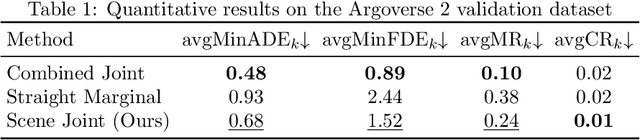
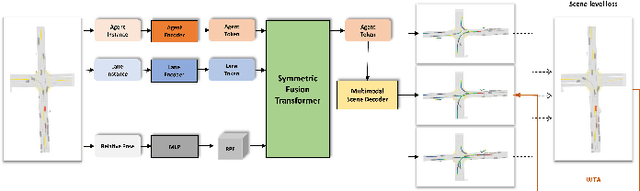
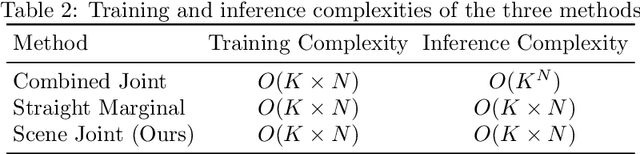
Predicting future motions of road participants is an important task for driving autonomously. Most existing models excel at predicting the marginal trajectory of a single agent, but predicting joint trajectories for multiple agents that are consistent within a scene remains a challenge. Previous research has often focused on marginal predictions, but the importance of joint predictions has become increasingly apparent. Joint prediction aims to generate trajectories that are consistent across the entire scene. Our research builds upon the SIMPL baseline to explore methods for generating scene-consistent trajectories. We tested our algorithm on the Argoverse 2 dataset, and experimental results demonstrate that our approach can generate scene-consistent trajectories. Compared to the SIMPL baseline, our method significantly reduces the collision rate of joint trajectories within the scene.
A Simple Multi-agent Joint Prediction Method for Autonomous Driving
Nov 12, 2024Predicting future motions of road participants is an important task for driving autonomously. Most existing models excel at predicting the marginal trajectory of a single agent, but predicting joint trajectories for multiple agents that are consistent within a scene remains a challenge. Previous research has often focused on marginal predictions, but the importance of joint predictions has become increasingly apparent. Joint prediction aims to generate trajectories that are consistent across the entire scene. Our research builds upon the SIMPL baseline to explore methods for generating scene-consistent trajectories. We tested our algorithm on the Argoverse 2 dataset, and experimental results demonstrate that our approach can generate scene-consistent trajectories. Compared to the SIMPL baseline, our method significantly reduces the collision rate of joint trajectories within the scene.