 Add to Chrome
 Add to Firefox
 Add to Edge
HFS: Holistic Query-Aware Frame Selection for Efficient Video Reasoning
Dec 12, 2025
Key frame selection in video understanding presents significant challenges. Traditional top-K selection methods, which score frames independently, often fail to optimize the selection as a whole. This independent scoring frequently results in selecting frames that are temporally clustered and visually redundant. Additionally, training lightweight selectors using pseudo labels generated offline by Multimodal Large Language Models (MLLMs) prevents the supervisory signal from dynamically adapting to task objectives. To address these limitations, we propose an end-to-end trainable, task-adaptive framework for frame selection. A Chain-of-Thought approach guides a Small Language Model (SLM) to generate task-specific implicit query vectors, which are combined with multimodal features to enable dynamic frame scoring. We further define a continuous set-level objective function that incorporates relevance, coverage, and redundancy, enabling differentiable optimization via Gumbel-Softmax to select optimal frame combinations at the set level. Finally, student-teacher mutual learning is employed, where the student selector (SLM) and teacher reasoner (MLLM) are trained to align their frame importance distributions via KL divergence. Combined with cross-entropy loss, this enables end-to-end optimization, eliminating reliance on static pseudo labels. Experiments across various benchmarks, including Video-MME, LongVideoBench, MLVU, and NExT-QA, demonstrate that our method significantly outperforms existing approaches.

EmoQ: Speech Emotion Recognition via Speech-Aware Q-Former and Large Language Model
Sep 19, 2025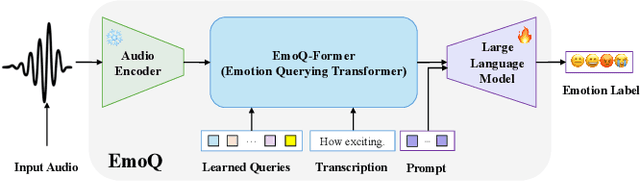
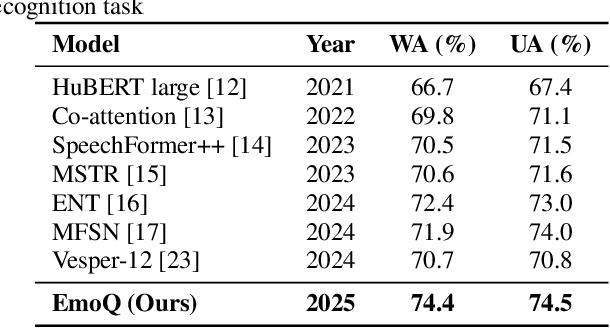
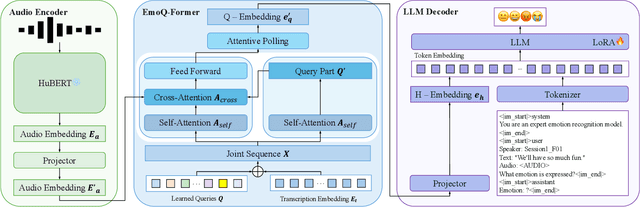
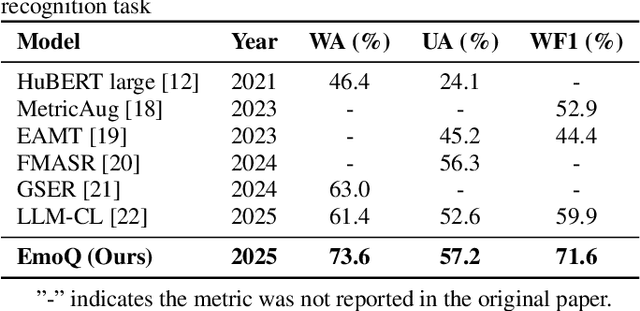
The performance of speech emotion recognition (SER) is limited by the insufficient emotion information in unimodal systems and the feature alignment difficulties in multimodal systems. Recently, multimodal large language models (MLLMs) have made progress in SER. However, MLLMs still suffer from hallucination and misclassification problems in complex emotion reasoning. To address these problems, we propose an MLLM-based framework called EmoQ, which generates query embeddings that fuse multimodal information through an EmoQ-Former and uses multi-objective affective learning (MAL) to achieve co-optimization. The framework also provides a soft-prompt injection strategy to inject multimodal representations into the LLM. This end-to-end architecture achieves state-of-the-art performance on the IEMOCAP and MELD datasets, providing a new multimodal fusion paradigm for SER.
Learning Multi-Stage Pick-and-Place with a Legged Mobile Manipulator
Sep 04, 2025Quadruped-based mobile manipulation presents significant challenges in robotics due to the diversity of required skills, the extended task horizon, and partial observability. After presenting a multi-stage pick-and-place task as a succinct yet sufficiently rich setup that captures key desiderata for quadruped-based mobile manipulation, we propose an approach that can train a visuo-motor policy entirely in simulation, and achieve nearly 80\% success in the real world. The policy efficiently performs search, approach, grasp, transport, and drop into actions, with emerged behaviors such as re-grasping and task chaining. We conduct an extensive set of real-world experiments with ablation studies highlighting key techniques for efficient training and effective sim-to-real transfer. Additional experiments demonstrate deployment across a variety of indoor and outdoor environments. Demo videos and additional resources are available on the project page: https://horizonrobotics.github.io/gail/SLIM.