 Add to Chrome
 Add to Firefox
 Add to Edge
BehaveGPT: A Foundation Model for Large-scale User Behavior Modeling
May 23, 2025
In recent years, foundational models have revolutionized the fields of language and vision, demonstrating remarkable abilities in understanding and generating complex data; however, similar advances in user behavior modeling have been limited, largely due to the complexity of behavioral data and the challenges involved in capturing intricate temporal and contextual relationships in user activities. To address this, we propose BehaveGPT, a foundational model designed specifically for large-scale user behavior prediction. Leveraging transformer-based architecture and a novel pretraining paradigm, BehaveGPT is trained on vast user behavior datasets, allowing it to learn complex behavior patterns and support a range of downstream tasks, including next behavior prediction, long-term generation, and cross-domain adaptation. Our approach introduces the DRO-based pretraining paradigm tailored for user behavior data, which improves model generalization and transferability by equitably modeling both head and tail behaviors. Extensive experiments on real-world datasets demonstrate that BehaveGPT outperforms state-of-the-art baselines, achieving more than a 10% improvement in macro and weighted recall, showcasing its ability to effectively capture and predict user behavior. Furthermore, we measure the scaling law in the user behavior domain for the first time on the Honor dataset, providing insights into how model performance scales with increased data and parameter sizes.

Tuning Language Models for Robust Prediction of Diverse User Behaviors
May 23, 2025Predicting user behavior is essential for intelligent assistant services, yet deep learning models often struggle to capture long-tailed behaviors. Large language models (LLMs), with their pretraining on vast corpora containing rich behavioral knowledge, offer promise. However, existing fine-tuning approaches tend to overfit to frequent ``anchor'' behaviors, reducing their ability to predict less common ``tail'' behaviors. In this paper, we introduce BehaviorLM, a progressive fine-tuning approach that addresses this issue. In the first stage, LLMs are fine-tuned on anchor behaviors while preserving general behavioral knowledge. In the second stage, fine-tuning uses a balanced subset of all behaviors based on sample difficulty to improve tail behavior predictions without sacrificing anchor performance. Experimental results on two real-world datasets demonstrate that BehaviorLM robustly predicts both anchor and tail behaviors and effectively leverages LLM behavioral knowledge to master tail behavior prediction with few-shot examples.
Psychology-driven LLM Agents for Explainable Panic Prediction on Social Media during Sudden Disaster Events
May 22, 2025During sudden disaster events, accurately predicting public panic sentiment on social media is crucial for proactive governance and crisis management. Current efforts on this problem face three main challenges: lack of finely annotated data hinders emotion prediction studies, unmodeled risk perception causes prediction inaccuracies, and insufficient interpretability of panic formation mechanisms. We address these issues by proposing a Psychology-driven generative Agent framework (PsychoAgent) for explainable panic prediction based on emotion arousal theory. Specifically, we first construct a fine-grained open panic emotion dataset (namely COPE) via human-large language models (LLMs) collaboration to mitigate semantic bias. Then, we develop a framework integrating cross-domain heterogeneous data grounded in psychological mechanisms to model risk perception and cognitive differences in emotion generation. To enhance interpretability, we design an LLM-based role-playing agent that simulates individual psychological chains through dedicatedly designed prompts. Experimental results on our annotated dataset show that PsychoAgent improves panic emotion prediction performance by 12.6% to 21.7% compared to baseline models. Furthermore, the explainability and generalization of our approach is validated. Crucially, this represents a paradigm shift from opaque "data-driven fitting" to transparent "role-based simulation with mechanistic interpretation" for panic emotion prediction during emergencies. Our implementation is publicly available at: https://anonymous.4open.science/r/PsychoAgent-19DD.
Satellites Reveal Mobility: A Commuting Origin-destination Flow Generator for Global Cities
May 21, 2025Commuting Origin-destination~(OD) flows, capturing daily population mobility of citizens, are vital for sustainable development across cities around the world. However, it is challenging to obtain the data due to the high cost of travel surveys and privacy concerns. Surprisingly, we find that satellite imagery, publicly available across the globe, contains rich urban semantic signals to support high-quality OD flow generation, with over 98\% expressiveness of traditional multisource hard-to-collect urban sociodemographic, economics, land use, and point of interest data. This inspires us to design a novel data generator, GlODGen, which can generate OD flow data for any cities of interest around the world. Specifically, GlODGen first leverages Vision-Language Geo-Foundation Models to extract urban semantic signals related to human mobility from satellite imagery. These features are then combined with population data to form region-level representations, which are used to generate OD flows via graph diffusion models. Extensive experiments on 4 continents and 6 representative cities show that GlODGen has great generalizability across diverse urban environments on different continents and can generate OD flow data for global cities highly consistent with real-world mobility data. We implement GlODGen as an automated tool, seamlessly integrating data acquisition and curation, urban semantic feature extraction, and OD flow generation together. It has been released at https://github.com/tsinghua-fib-lab/generate-od-pubtools.
Multiple Weaks Win Single Strong: Large Language Models Ensemble Weak Reinforcement Learning Agents into a Supreme One
May 21, 2025Model ensemble is a useful approach in reinforcement learning (RL) for training effective agents. Despite wide success of RL, training effective agents remains difficult due to the multitude of factors requiring careful tuning, such as algorithm selection, hyperparameter settings, and even random seed choices, all of which can significantly influence an agent's performance. Model ensemble helps overcome this challenge by combining multiple weak agents into a single, more powerful one, enhancing overall performance. However, existing ensemble methods, such as majority voting and Boltzmann addition, are designed as fixed strategies and lack a semantic understanding of specific tasks, limiting their adaptability and effectiveness. To address this, we propose LLM-Ens, a novel approach that enhances RL model ensemble with task-specific semantic understandings driven by large language models (LLMs). Given a task, we first design an LLM to categorize states in this task into distinct 'situations', incorporating high-level descriptions of the task conditions. Then, we statistically analyze the strengths and weaknesses of each individual agent to be used in the ensemble in each situation. During the inference time, LLM-Ens dynamically identifies the changing task situation and switches to the agent that performs best in the current situation, ensuring dynamic model selection in the evolving task condition. Our approach is designed to be compatible with agents trained with different random seeds, hyperparameter settings, and various RL algorithms. Extensive experiments on the Atari benchmark show that LLM-Ens significantly improves the RL model ensemble, surpassing well-known baselines by up to 20.9%. For reproducibility, our code is open-source at https://anonymous.4open.science/r/LLM4RLensemble-F7EE.
LLM-Explorer: A Plug-in Reinforcement Learning Policy Exploration Enhancement Driven by Large Language Models
May 21, 2025Policy exploration is critical in reinforcement learning (RL), where existing approaches include greedy, Gaussian process, etc. However, these approaches utilize preset stochastic processes and are indiscriminately applied in all kinds of RL tasks without considering task-specific features that influence policy exploration. Moreover, during RL training, the evolution of such stochastic processes is rigid, which typically only incorporates a decay in the variance, failing to adjust flexibly according to the agent's real-time learning status. Inspired by the analyzing and reasoning capability of large language models (LLMs), we design LLM-Explorer to adaptively generate task-specific exploration strategies with LLMs, enhancing the policy exploration in RL. In our design, we sample the learning trajectory of the agent during the RL training in a given task and prompt the LLM to analyze the agent's current policy learning status and then generate a probability distribution for future policy exploration. Updating the probability distribution periodically, we derive a stochastic process specialized for the particular task and dynamically adjusted to adapt to the learning process. Our design is a plug-in module compatible with various widely applied RL algorithms, including the DQN series, DDPG, TD3, and any possible variants developed based on them. Through extensive experiments on the Atari and MuJoCo benchmarks, we demonstrate LLM-Explorer's capability to enhance RL policy exploration, achieving an average performance improvement up to 37.27%. Our code is open-source at https://anonymous.4open.science/r/LLM-Explorer-19BE for reproducibility.
RL of Thoughts: Navigating LLM Reasoning with Inference-time Reinforcement Learning
May 20, 2025Despite rapid advancements in large language models (LLMs), the token-level autoregressive nature constrains their complex reasoning capabilities. To enhance LLM reasoning, inference-time techniques, including Chain/Tree/Graph-of-Thought(s), successfully improve the performance, as they are fairly cost-effective by guiding reasoning through sophisticated logical structures without modifying LLMs' parameters. However, these manually predefined, task-agnostic frameworks are applied uniformly across diverse tasks, lacking adaptability. To improve this, we propose RL-of-Thoughts (RLoT), where we train a lightweight navigator model with reinforcement learning (RL) to adaptively enhance LLM reasoning at inference time. Specifically, we design five basic logic blocks from the perspective of human cognition. During the reasoning process, the trained RL navigator dynamically selects the suitable logic blocks and combines them into task-specific logical structures according to problem characteristics. Experiments across multiple reasoning benchmarks (AIME, MATH, GPQA, etc.) with multiple LLMs (GPT, Llama, Qwen, and DeepSeek) illustrate that RLoT outperforms established inference-time techniques by up to 13.4%. Remarkably, with less than 3K parameters, our RL navigator is able to make sub-10B LLMs comparable to 100B-scale counterparts. Moreover, the RL navigator demonstrates strong transferability: a model trained on one specific LLM-task pair can effectively generalize to unseen LLMs and tasks. Our code is open-source at https://anonymous.4open.science/r/RL-LLM-Reasoning-1A30 for reproducibility.
DIMM: Decoupled Multi-hierarchy Kalman Filter for 3D Object Tracking
May 18, 2025State estimation is challenging for 3D object tracking with high maneuverability, as the target's state transition function changes rapidly, irregularly, and is unknown to the estimator. Existing work based on interacting multiple model (IMM) achieves more accurate estimation than single-filter approaches through model combination, aligning appropriate models for different motion modes of the target object over time. However, two limitations of conventional IMM remain unsolved. First, the solution space of the model combination is constrained as the target's diverse kinematic properties in different directions are ignored. Second, the model combination weights calculated by the observation likelihood are not accurate enough due to the measurement uncertainty. In this paper, we propose a novel framework, DIMM, to effectively combine estimates from different motion models in each direction, thus increasing the 3D object tracking accuracy. First, DIMM extends the model combination solution space of conventional IMM from a hyperplane to a hypercube by designing a 3D-decoupled multi-hierarchy filter bank, which describes the target's motion with various-order linear models. Second, DIMM generates more reliable combination weight matrices through a differentiable adaptive fusion network for importance allocation rather than solely relying on the observation likelihood; it contains an attention-based twin delayed deep deterministic policy gradient (TD3) method with a hierarchical reward. Experiments demonstrate that DIMM significantly improves the tracking accuracy of existing state estimation methods by 31.61%~99.23%.
MRGRP: Empowering Courier Route Prediction in Food Delivery Service with Multi-Relational Graph
May 17, 2025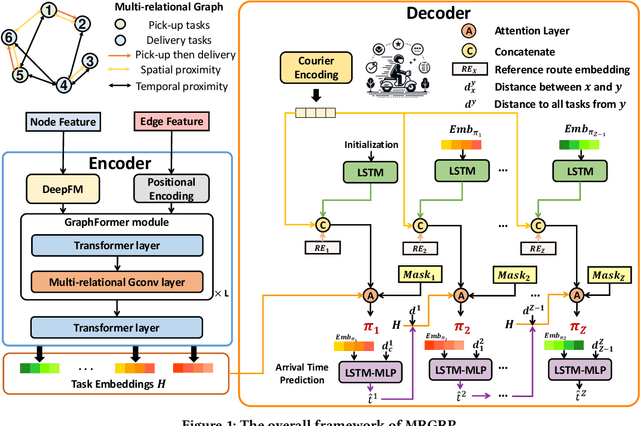
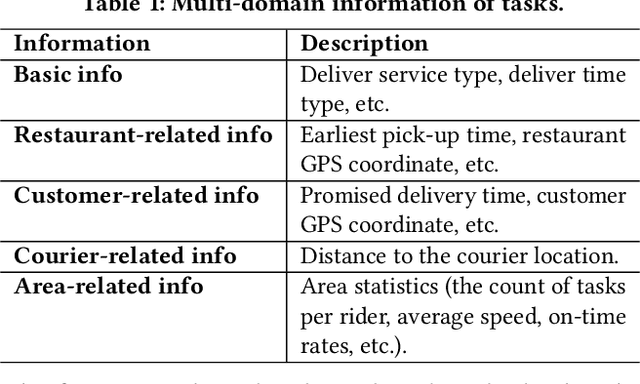
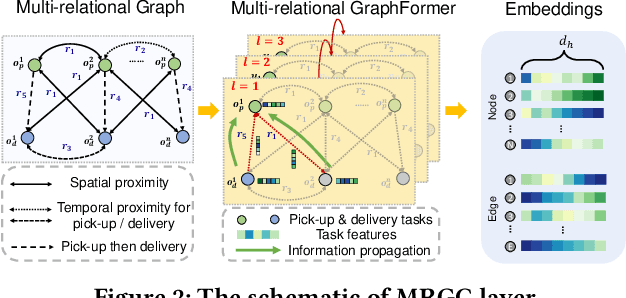
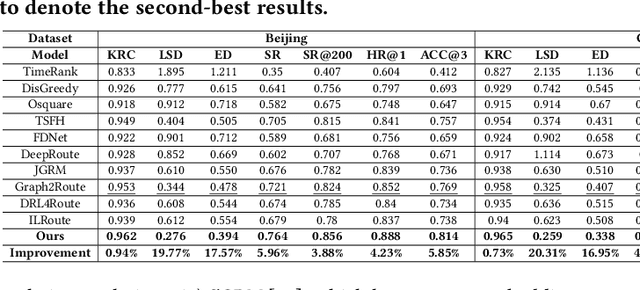
Instant food delivery has become one of the most popular web services worldwide due to its convenience in daily life. A fundamental challenge is accurately predicting courier routes to optimize task dispatch and improve delivery efficiency. This enhances satisfaction for couriers and users and increases platform profitability. The current heuristic prediction method uses only limited human-selected task features and ignores couriers preferences, causing suboptimal results. Additionally, existing learning-based methods do not fully capture the diverse factors influencing courier decisions or the complex relationships among them. To address this, we propose a Multi-Relational Graph-based Route Prediction (MRGRP) method that models fine-grained correlations among tasks affecting courier decisions for accurate prediction. We encode spatial and temporal proximity, along with pickup-delivery relationships, into a multi-relational graph and design a GraphFormer architecture to capture these complex connections. We also introduce a route decoder that leverages courier information and dynamic distance and time contexts for prediction, using existing route solutions as references to improve outcomes. Experiments show our model achieves state-of-the-art route prediction on offline data from cities of various sizes. Deployed on the Meituan Turing platform, it surpasses the current heuristic algorithm, reaching a high route prediction accuracy of 0.819, essential for courier and user satisfaction in instant food delivery.
Towards Autonomous UAV Visual Object Search in City Space: Benchmark and Agentic Methodology
May 14, 2025Aerial Visual Object Search (AVOS) tasks in urban environments require Unmanned Aerial Vehicles (UAVs) to autonomously search for and identify target objects using visual and textual cues without external guidance. Existing approaches struggle in complex urban environments due to redundant semantic processing, similar object distinction, and the exploration-exploitation dilemma. To bridge this gap and support the AVOS task, we introduce CityAVOS, the first benchmark dataset for autonomous search of common urban objects. This dataset comprises 2,420 tasks across six object categories with varying difficulty levels, enabling comprehensive evaluation of UAV agents' search capabilities. To solve the AVOS tasks, we also propose PRPSearcher (Perception-Reasoning-Planning Searcher), a novel agentic method powered by multi-modal large language models (MLLMs) that mimics human three-tier cognition. Specifically, PRPSearcher constructs three specialized maps: an object-centric dynamic semantic map enhancing spatial perception, a 3D cognitive map based on semantic attraction values for target reasoning, and a 3D uncertainty map for balanced exploration-exploitation search. Also, our approach incorporates a denoising mechanism to mitigate interference from similar objects and utilizes an Inspiration Promote Thought (IPT) prompting mechanism for adaptive action planning. Experimental results on CityAVOS demonstrate that PRPSearcher surpasses existing baselines in both success rate and search efficiency (on average: +37.69% SR, +28.96% SPL, -30.69% MSS, and -46.40% NE). While promising, the performance gap compared to humans highlights the need for better semantic reasoning and spatial exploration capabilities in AVOS tasks. This work establishes a foundation for future advances in embodied target search. Dataset and source code are available at https://anonymous.4open.science/r/CityAVOS-3DF8.