 Add to Chrome
 Add to Firefox
 Add to Edge
Enhancing Domain Generalization in 3D Human Pose Estimation through Controllable Generative Augmentation
May 12, 2026
Pedestrian motion, due to its causal nature, is strongly influenced by domain gaps arising from discrepancies between training and testing data distributions. Focusing on 3D human pose estimation, this work presents a controllable human pose generation framework that synthesizes diverse video data by systematically varying poses, backgrounds, and camera viewpoints. This generative augmentation enriches training datasets, enhances model generalization, and alleviates the limitations of existing methods in handling domain discrepancies. By leveraging both indoor/real-world and outdoor/virtual datasets, we perform cross-domain data fusion and controllable video generation to construct enriched training data, tailored to realistic deployment settings. Extensive experiments show that the augmented datasets significantly improve model performance on unseen scenarios and datasets, validating the effectiveness of the proposed approach.

Any3DAvatar: Fast and High-Quality Full-Head 3D Avatar Reconstruction from Single Portrait Image
Apr 15, 2026Reconstructing a complete 3D head from a single portrait remains challenging because existing methods still face a sharp quality-speed trade-off: high-fidelity pipelines often rely on multi-stage processing and per-subject optimization, while fast feed-forward models struggle with complete geometry and fine appearance details. To bridge this gap, we propose Any3DAvatar, a fast and high-quality method for single-image 3D Gaussian head avatar generation, whose fastest setting reconstructs a full head in under one second while preserving high-fidelity geometry and texture. First, we build AnyHead, a unified data suite that combines identity diversity, dense multi-view supervision, and realistic accessories, filling the main gaps of existing head data in coverage, full-head geometry, and complex appearance. Second, rather than sampling unstructured noise, we initialize from a Plücker-aware structured 3D Gaussian scaffold and perform one-step conditional denoising, formulating full-head reconstruction into a single forward pass while retaining high fidelity. Third, we introduce auxiliary view-conditioned appearance supervision on the same latent tokens alongside 3D Gaussian reconstruction, improving novel-view texture details at zero extra inference cost. Experiments show that Any3DAvatar outperforms prior single-image full-head reconstruction methods in rendering fidelity while remaining substantially faster.
Evolution-Inspired Sample Competition for Deep Neural Network Optimization
Apr 14, 2026Conventional deep network training generally optimizes all samples under a largely uniform learning paradigm, without explicitly modeling the heterogeneous competition among them. Such an oversimplified treatment can lead to several well-known issues, including bias under class imbalance, insufficient learning of hard samples, and the erroneous reinforcement of noisy samples. In this work, we present \textit{Natural Selection} (NS), a novel evolution-inspired optimization method that explicitly incorporates competitive interactions into deep network training. Unlike conventional sample reweighting strategies that rely mainly on predefined heuristics or static criteria, NS estimates the competitive status of each sample in a group-wise context and uses it to adaptively regulate its training contribution. Specifically, NS first assembles multiple samples into a composite image and rescales it to the original input size for model inference. Based on the resulting predictions, a natural selection score is computed for each sample to characterize its relative competitive variation within the constructed group. These scores are then used to dynamically reweight the sample-wise loss, thereby introducing an explicit competition-driven mechanism into the optimization process. In this way, NS provides a simple yet effective means of moving beyond uniform sample treatment and enables more adaptive and balanced model optimization. Extensive experiments on 12 public datasets across four image classification tasks demonstrate the effectiveness of the proposed method. Moreover, NS is compatible with diverse network architectures and does not depend on task-specific assumptions, indicating its strong generality and practical potential. The code will be made publicly available.
Bottleneck Tokens for Unified Multimodal Retrieval
Apr 13, 2026Adapting decoder-only multimodal large language models (MLLMs) for unified multimodal retrieval faces two structural gaps. First, existing methods rely on implicit pooling, which overloads the hidden state of a standard vocabulary token (e.g., <EOS>) as the sequence-level representation, a mechanism never designed for information aggregation. Second, contrastive fine-tuning specifies what the embedding should match but provides no token-level guidance on how information should be compressed into it. We address both gaps with two complementary components. Architecturally, we introduce Bottleneck Tokens (BToks), a small set of learnable tokens that serve as a fixed-capacity explicit pooling mechanism. For training, we propose Generative Information Condensation: a next-token prediction objective coupled with a Condensation Mask that severs the direct attention path from target tokens to query tokens. All predictive signals are thereby forced through the BToks, converting the generative loss into dense, token-level supervision for semantic compression. At inference time, only the input and BToks are processed in a single forward pass with negligible overhead over conventional last-token pooling. On MMEB-V2 (78 datasets, 3 modalities, 9 meta-tasks), our approach achieves state-of-the-art among 2B-scale methods under comparable data conditions, attaining an Overall score of 59.0 (+3.6 over VLM2Vec-V2) with substantial gains on semantically demanding tasks (e.g., +12.6 on Video-QA).
ProCal: Probability Calibration for Neighborhood-Guided Source-Free Domain Adaptation
Mar 19, 2026Source-Free Domain Adaptation (SFDA) adapts pre-trained models to unlabeled target domains without requiring access to source data. Although state-of-the-art methods leveraging local neighborhood structures show promise for SFDA, they tend to over-rely on prediction similarity among neighbors. This over-reliance accelerates the forgetting of source knowledge and increases susceptibility to local noise overfitting. To address these issues, we introduce ProCal, a probability calibration method that dynamically calibrates neighborhood-based predictions through a dual-model collaborative prediction mechanism. ProCal integrates the source model's initial predictions with the current model's online outputs to effectively calibrate neighbor probabilities. This strategy not only mitigates the interference of local noise but also preserves the discriminative information from the source model, thereby achieving a balance between knowledge retention and domain adaptation. Furthermore, we design a joint optimization objective that combines a soft supervision loss with a diversity loss to guide the target model. Our theoretical analysis shows that ProCal converges to an equilibrium where source knowledge and target information are effectively fused, reducing both knowledge forgetting and overfitting. We validate the effectiveness of our approach through extensive experiments on 31 cross-domain tasks across four public datasets. Our code is available at: https://github.com/zhengyinghit/ProCal.
DOCFORGE-BENCH: A Comprehensive Benchmark for Document Forgery Detection and Analysis
Mar 02, 2026We present DOCFORGE-BENCH, the first unified zero-shot benchmark for document forgery detection, evaluating 14 methods across eight datasets spanning text tampering, receipt forgery, and identity document manipulation. Unlike fine-tuning-oriented evaluations such as ForensicHub [Du et al., 2025], DOCFORGE-BENCH applies all methods with their published pretrained weights and no domain adaptation -- a deliberate design choice that reflects the realistic deployment scenario where practitioners lack labeled document training data. Our central finding is a pervasive calibration failure invisible under single-threshold protocols: methods achieve moderate Pixel-AUC (>=0.76) yet near-zero Pixel-F1. This AUC-F1 gap is not a discrimination failure but a score-distribution shift: tampered regions occupy only 0.27-4.17% of pixels in document images -- an order of magnitude less than in natural image benchmarks -- making the standard tau=0.5 threshold catastrophically miscalibrated. Oracle-F1 is 2-10x higher than fixed-threshold Pixel-F1, confirming that calibration, not representation, is the bottleneck. A controlled calibration experiment validates this: adapting a single threshold on N=10 domain images recovers 39-55% of the Oracle-F1 gap, demonstrating that threshold adaptation -- not retraining -- is the key missing step for practical deployment. Overall, no evaluated method works reliably out-of-the-box on diverse document types, underscoring that document forgery detection remains an unsolved problem. We further note that all eight datasets predate the era of generative AI editing; benchmarks covering diffusion- and LLM-based document forgeries represent a critical open gap on the modern attack surface.
MEJO: MLLM-Engaged Surgical Triplet Recognition via Inter- and Intra-Task Joint Optimization
Sep 16, 2025Surgical triplet recognition, which involves identifying instrument, verb, target, and their combinations, is a complex surgical scene understanding challenge plagued by long-tailed data distribution. The mainstream multi-task learning paradigm benefiting from cross-task collaborative promotion has shown promising performance in identifying triples, but two key challenges remain: 1) inter-task optimization conflicts caused by entangling task-generic and task-specific representations; 2) intra-task optimization conflicts due to class-imbalanced training data. To overcome these difficulties, we propose the MLLM-Engaged Joint Optimization (MEJO) framework that empowers both inter- and intra-task optimization for surgical triplet recognition. For inter-task optimization, we introduce the Shared-Specific-Disentangled (S$^2$D) learning scheme that decomposes representations into task-shared and task-specific components. To enhance task-shared representations, we construct a Multimodal Large Language Model (MLLM) powered probabilistic prompt pool to dynamically augment visual features with expert-level semantic cues. Additionally, comprehensive task-specific cues are modeled via distinct task prompts covering the temporal-spatial dimensions, effectively mitigating inter-task ambiguities. To tackle intra-task optimization conflicts, we develop a Coordinated Gradient Learning (CGL) strategy, which dissects and rebalances the positive-negative gradients originating from head and tail classes for more coordinated learning behaviors. Extensive experiments on the CholecT45 and CholecT50 datasets demonstrate the superiority of our proposed framework, validating its effectiveness in handling optimization conflicts.
Perceiving and Acting in First-Person: A Dataset and Benchmark for Egocentric Human-Object-Human Interactions
Aug 06, 2025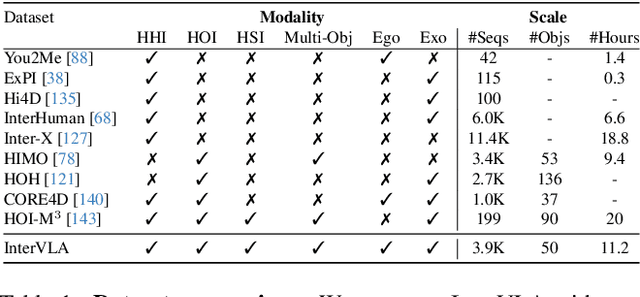
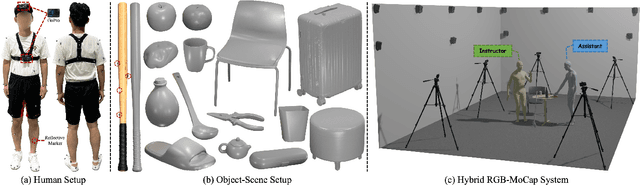
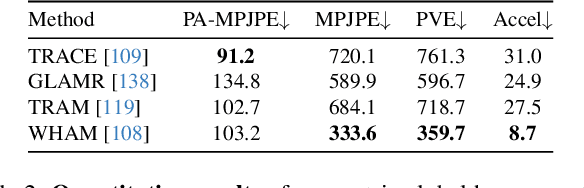
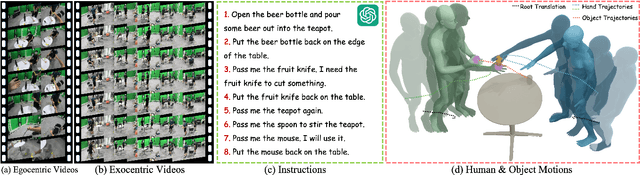
Learning action models from real-world human-centric interaction datasets is important towards building general-purpose intelligent assistants with efficiency. However, most existing datasets only offer specialist interaction category and ignore that AI assistants perceive and act based on first-person acquisition. We urge that both the generalist interaction knowledge and egocentric modality are indispensable. In this paper, we embed the manual-assisted task into a vision-language-action framework, where the assistant provides services to the instructor following egocentric vision and commands. With our hybrid RGB-MoCap system, pairs of assistants and instructors engage with multiple objects and the scene following GPT-generated scripts. Under this setting, we accomplish InterVLA, the first large-scale human-object-human interaction dataset with 11.4 hours and 1.2M frames of multimodal data, spanning 2 egocentric and 5 exocentric videos, accurate human/object motions and verbal commands. Furthermore, we establish novel benchmarks on egocentric human motion estimation, interaction synthesis, and interaction prediction with comprehensive analysis. We believe that our InterVLA testbed and the benchmarks will foster future works on building AI agents in the physical world.
Scaling Offline RL via Efficient and Expressive Shortcut Models
May 28, 2025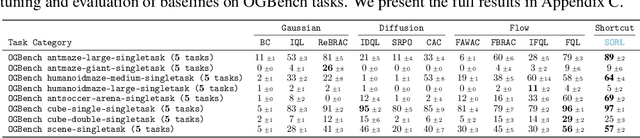
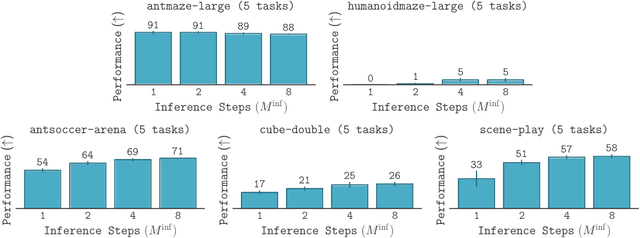
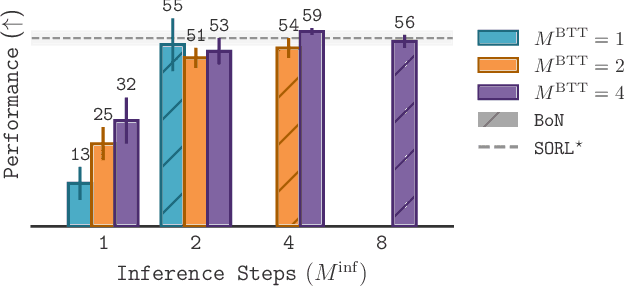
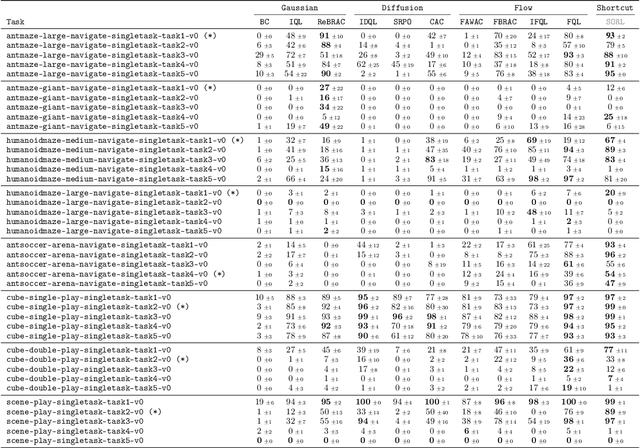
Diffusion and flow models have emerged as powerful generative approaches capable of modeling diverse and multimodal behavior. However, applying these models to offline reinforcement learning (RL) remains challenging due to the iterative nature of their noise sampling processes, making policy optimization difficult. In this paper, we introduce Scalable Offline Reinforcement Learning (SORL), a new offline RL algorithm that leverages shortcut models - a novel class of generative models - to scale both training and inference. SORL's policy can capture complex data distributions and can be trained simply and efficiently in a one-stage training procedure. At test time, SORL introduces both sequential and parallel inference scaling by using the learned Q-function as a verifier. We demonstrate that SORL achieves strong performance across a range of offline RL tasks and exhibits positive scaling behavior with increased test-time compute. We release the code at nico-espinosadice.github.io/projects/sorl.
Convergence Of Consistency Model With Multistep Sampling Under General Data Assumptions
May 06, 2025Diffusion models accomplish remarkable success in data generation tasks across various domains. However, the iterative sampling process is computationally expensive. Consistency models are proposed to learn consistency functions to map from noise to data directly, which allows one-step fast data generation and multistep sampling to improve sample quality. In this paper, we study the convergence of consistency models when the self-consistency property holds approximately under the training distribution. Our analysis requires only mild data assumption and applies to a family of forward processes. When the target data distribution has bounded support or has tails that decay sufficiently fast, we show that the samples generated by the consistency model are close to the target distribution in Wasserstein distance; when the target distribution satisfies some smoothness assumption, we show that with an additional perturbation step for smoothing, the generated samples are close to the target distribution in total variation distance. We provide two case studies with commonly chosen forward processes to demonstrate the benefit of multistep sampling.