 Add to Chrome
 Add to Firefox
 Add to Edge
Bottleneck Tokens for Unified Multimodal Retrieval
Apr 13, 2026
Adapting decoder-only multimodal large language models (MLLMs) for unified multimodal retrieval faces two structural gaps. First, existing methods rely on implicit pooling, which overloads the hidden state of a standard vocabulary token (e.g., <EOS>) as the sequence-level representation, a mechanism never designed for information aggregation. Second, contrastive fine-tuning specifies what the embedding should match but provides no token-level guidance on how information should be compressed into it. We address both gaps with two complementary components. Architecturally, we introduce Bottleneck Tokens (BToks), a small set of learnable tokens that serve as a fixed-capacity explicit pooling mechanism. For training, we propose Generative Information Condensation: a next-token prediction objective coupled with a Condensation Mask that severs the direct attention path from target tokens to query tokens. All predictive signals are thereby forced through the BToks, converting the generative loss into dense, token-level supervision for semantic compression. At inference time, only the input and BToks are processed in a single forward pass with negligible overhead over conventional last-token pooling. On MMEB-V2 (78 datasets, 3 modalities, 9 meta-tasks), our approach achieves state-of-the-art among 2B-scale methods under comparable data conditions, attaining an Overall score of 59.0 (+3.6 over VLM2Vec-V2) with substantial gains on semantically demanding tasks (e.g., +12.6 on Video-QA).

High-Quality 3D Head Reconstruction from Any Single Portrait Image
Mar 11, 2025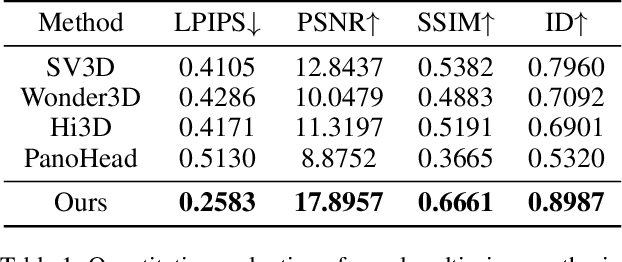
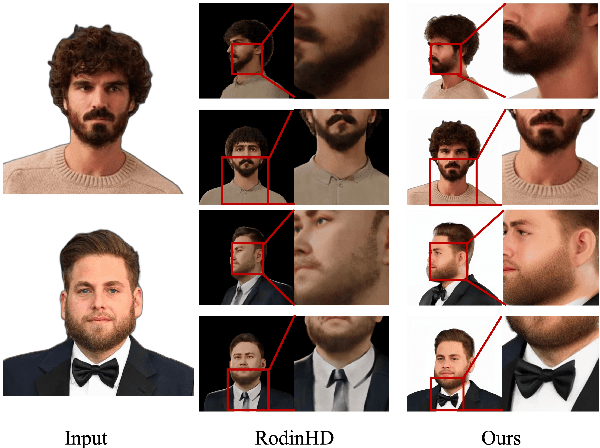
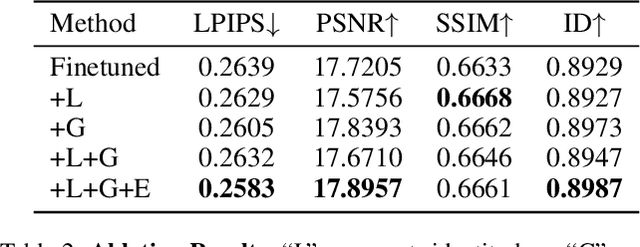
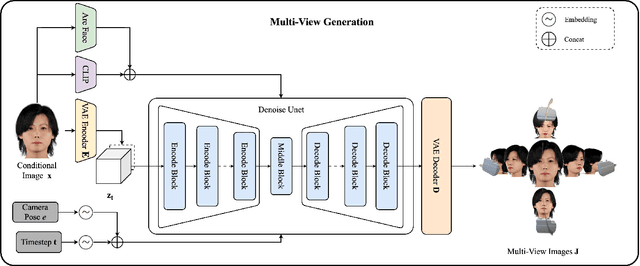
In this work, we introduce a novel high-fidelity 3D head reconstruction method from a single portrait image, regardless of perspective, expression, or accessories. Despite significant efforts in adapting 2D generative models for novel view synthesis and 3D optimization, most methods struggle to produce high-quality 3D portraits. The lack of crucial information, such as identity, expression, hair, and accessories, limits these approaches in generating realistic 3D head models. To address these challenges, we construct a new high-quality dataset containing 227 sequences of digital human portraits captured from 96 different perspectives, totalling 21,792 frames, featuring diverse expressions and accessories. To further improve performance, we integrate identity and expression information into the multi-view diffusion process to enhance facial consistency across views. Specifically, we apply identity- and expression-aware guidance and supervision to extract accurate facial representations, which guide the model and enforce objective functions to ensure high identity and expression consistency during generation. Finally, we generate an orbital video around the portrait consisting of 96 multi-view frames, which can be used for 3D portrait model reconstruction. Our method demonstrates robust performance across challenging scenarios, including side-face angles and complex accessories