 Add to Chrome
 Add to Firefox
 Add to Edge
AeroCopilotBench: A Two-Tier Benchmark for Evaluating LLM Agents as Aviation Copilots in an Interactive Virtual Cockpit Environment
Aug 17, 2026
Large language model (LLM) agents may assist flight crews with complex decisions and task execution, but existing aviation evaluations centered on static knowledge do not support systematic testing of procedural execution and safety compliance in interactive environments. This paper presents the AeroCopilot Operational Environment (ACOE), a reproducible interactive virtual-cockpit test environment, and AeroCopilotBench, a two-tier aviation agent evaluation benchmark. Tier-1 evaluates aviation knowledge using 1,200 multiple-choice questions, while Tier-2 comprises 73 emergency and abnormal tasks derived from the manufacturers' Pilot's Operating Handbooks (POHs) and instantiated in ACOE. ACOE converts natural-language procedures into executable state transitions, final-state goal conditions, and hard safety constraints, enabling models to interpret cockpit state, diagnose faults, and operate aircraft systems through standardized tool interfaces. We establish a safety-gated evaluation framework in which a trajectory succeeds only when all task goals are achieved without violating any hard safety constraint, while safe goal progress and trajectory safety are measured separately. Across 12 models, the highest Tier-2 success rate is 72.6%, while static knowledge performance does not consistently translate into procedural execution. Analysis of 451 failed episodes from 3 representative models identifies recurring failures in procedural completeness, use of state feedback, and long-horizon execution management. These findings motivate state-aware agent orchestration, joint assessment of task completion and trajectory safety, and repeated regression testing. ACOE and AeroCopilotBench provide a reproducible foundation for testing knowledge application, interactive execution, and operational safety in aviation agents.

Abstention as an Action Can Kill Both the Reward Gradient and the KL Anchor: Collapse Law and Repair for Error-Penalized Reinforcement Learning
Jul 31, 2026Error-penalized scoring rules ($+1$ for a correct answer, $-λ$ for a wrong one, $0$ for abstaining) are increasingly prescribed against hallucination: a rational agent facing such a rule answers exactly when its correctness probability exceeds Chow's threshold $t^\ast=λ/(1+λ)$. We prove that a KL-anchored gradient learner can do the opposite. When abstention is a discrete action, the reward gradient and the anchor's restoring force are throttled by the same gate-saturation factor and die together: under explicit conditions (among them, blanket answering loses score in expectation and prompts share a bounded readout) the model drifts toward refusing everything, its mean training reward rising to zero like $1/t$ in training time $t$, so the curve reads as improvement while coverage collapses. The advantage estimator compounds the failure: in its sparse-answer regime, group normalization silently replaces every designed penalty with an effective penalty of one, moving the learned threshold from $t^\ast$ to $1/2$. The repair is structural: train a mandatory confidence report with a strictly proper score plus a correctness reward, and abstain only at deployment by thresholding the report. The always-emitted report has no gate to saturate, so no shared factor can kill its reward gradient and its anchor together, and its calibrated optimum is attracting. Simulations confirm every prediction, and experiments on language models at two scales confirm the mechanism live: the rule silences questions the models demonstrably still solve within ten optimizer steps, an ablation isolates the cause, and report-level training raises coverage, accuracy, and calibration together.
MUX-USCT: A Noise-Robust Neural Network for Ultrasound Computed Tomography
Jul 12, 2026Deep neural networks (DNNs) have shown strong potential for ultrasound computed tomography (USCT) reconstruction in ideal noise-free environments, yet existing DNNs are vulnerable to the noisy conditions in clinical practice, as they equally treat inputs that suffer mild, moderate, or severe noise. More challenging, the distributions of noise shift along with the environment, indicating the less effectiveness of noise-aware training, which injects a specific noise distribution into the training data. We rethink these challenges and observe that the DNN models can become more robust to noise if we know the noise sources and filter them out. This filtering operation is very alike the Multiplexers (or MUX), a fundamental combinational circuit in digital logic design. However, the challenge here is that noise can happen randomly during inference; as a result, the manually predefined MUX cannot work. To address these challenges, we propose MUX-USCT, a novel encoder-decoder DNN architecture that encodes the known acoustic acquisition geometry with an "adaptive MUX" that can automatically identify and filter noise, where the attention mechanism is applied in reconstructing the speed-of-sound map. On the OpenPros benchmark, MUX-USCT reaches 6.88 m/s MAE with 17% fewer parameters than the leading baseline with 7.65 m/s of MAE. Under simulated clinical noise, it remains stable across diverse degradation types that cause geometry-agnostic baselines to fail. Results show that the attention distributions in MUX-USCT provide interpretable indicators of the signal quality between pairs of transducers.
Metis: Learning to Jailbreak LLMs via Self-Evolving Metacognitive Policy Optimization
May 11, 2026Red teaming is critical for uncovering vulnerabilities in Large Language Models (LLMs). While automated methods have improved scalability, existing approaches often rely on static heuristics or stochastic search, rendering them brittle against advanced safety alignment. To address this, we introduce Metis, a framework that reformulates jailbreaking as inference-time policy optimization within an adversarial Partially Observable Markov Decision Process (POMDP). Metis employs a self-evolving metacognitive loop to perform causal diagnosis of a target's defense logic and leverages structured feedback as a semantic gradient to refine its policy, offering enhanced interpretability through transparent reasoning traces. Extensive evaluations across 10 diverse models demonstrate that Metis achieves the strongest average Attack Success Rate (ASR) among compared methods at 89.2%, maintaining high efficacy on resilient frontier models (e.g., 76.0% on O1 and 78.0% on GPT-5-chat) where traditional baselines exhibit substantial performance degradation. By replacing redundant exploration with directed optimization, Metis reduces token costs by an average of 8.2x and up to 11.4x. Our analysis reveals that current defenses remain vulnerable to internally-steered, closed-loop reasoning trajectories under the tested settings, highlighting a critical need for next-generation defenses capable of reasoning about safety dynamically during inference.
Two Teachers Better Than One: Hardware-Physics Co-Guided Distributed Scientific Machine Learning
Mar 10, 2026Scientific machine learning (SciML) is increasingly applied to in-field processing, controlling, and monitoring; however, wide-area sensing, real-time demands, and strict energy and reliability constraints make centralized SciML implementation impractical. Most SciML models assume raw data aggregation at a central node, incurring prohibitively high communication latency and energy costs; yet, distributing models developed for general-purpose ML often breaks essential physical principles, resulting in degraded performance. To address these challenges, we introduce EPIC, a hardware- and physics-co-guided distributed SciML framework, using full-waveform inversion (FWI) as a representative task. EPIC performs lightweight local encoding on end devices and physics-aware decoding at a central node. By transmitting compact latent features rather than high-volume raw data and by using cross-attention to capture inter-receiver wavefield coupling, EPIC significantly reduces communication cost while preserving physical fidelity. Evaluated on a distributed testbed with five end devices and one central node, and across 10 datasets from OpenFWI, EPIC reduces latency by 8.9$\times$ and communication energy by 33.8$\times$, while even improving reconstruction fidelity on 8 out of 10 datasets.
The RoboSense Challenge: Sense Anything, Navigate Anywhere, Adapt Across Platforms
Jan 08, 2026Autonomous systems are increasingly deployed in open and dynamic environments -- from city streets to aerial and indoor spaces -- where perception models must remain reliable under sensor noise, environmental variation, and platform shifts. However, even state-of-the-art methods often degrade under unseen conditions, highlighting the need for robust and generalizable robot sensing. The RoboSense 2025 Challenge is designed to advance robustness and adaptability in robot perception across diverse sensing scenarios. It unifies five complementary research tracks spanning language-grounded decision making, socially compliant navigation, sensor configuration generalization, cross-view and cross-modal correspondence, and cross-platform 3D perception. Together, these tasks form a comprehensive benchmark for evaluating real-world sensing reliability under domain shifts, sensor failures, and platform discrepancies. RoboSense 2025 provides standardized datasets, baseline models, and unified evaluation protocols, enabling large-scale and reproducible comparison of robust perception methods. The challenge attracted 143 teams from 85 institutions across 16 countries, reflecting broad community engagement. By consolidating insights from 23 winning solutions, this report highlights emerging methodological trends, shared design principles, and open challenges across all tracks, marking a step toward building robots that can sense reliably, act robustly, and adapt across platforms in real-world environments.
MEJO: MLLM-Engaged Surgical Triplet Recognition via Inter- and Intra-Task Joint Optimization
Sep 16, 2025Surgical triplet recognition, which involves identifying instrument, verb, target, and their combinations, is a complex surgical scene understanding challenge plagued by long-tailed data distribution. The mainstream multi-task learning paradigm benefiting from cross-task collaborative promotion has shown promising performance in identifying triples, but two key challenges remain: 1) inter-task optimization conflicts caused by entangling task-generic and task-specific representations; 2) intra-task optimization conflicts due to class-imbalanced training data. To overcome these difficulties, we propose the MLLM-Engaged Joint Optimization (MEJO) framework that empowers both inter- and intra-task optimization for surgical triplet recognition. For inter-task optimization, we introduce the Shared-Specific-Disentangled (S$^2$D) learning scheme that decomposes representations into task-shared and task-specific components. To enhance task-shared representations, we construct a Multimodal Large Language Model (MLLM) powered probabilistic prompt pool to dynamically augment visual features with expert-level semantic cues. Additionally, comprehensive task-specific cues are modeled via distinct task prompts covering the temporal-spatial dimensions, effectively mitigating inter-task ambiguities. To tackle intra-task optimization conflicts, we develop a Coordinated Gradient Learning (CGL) strategy, which dissects and rebalances the positive-negative gradients originating from head and tail classes for more coordinated learning behaviors. Extensive experiments on the CholecT45 and CholecT50 datasets demonstrate the superiority of our proposed framework, validating its effectiveness in handling optimization conflicts.
Medical Large Vision Language Models with Multi-Image Visual Ability
May 25, 2025Medical large vision-language models (LVLMs) have demonstrated promising performance across various single-image question answering (QA) benchmarks, yet their capability in processing multi-image clinical scenarios remains underexplored. Unlike single image based tasks, medical tasks involving multiple images often demand sophisticated visual understanding capabilities, such as temporal reasoning and cross-modal analysis, which are poorly supported by current medical LVLMs. To bridge this critical gap, we present the Med-MIM instruction dataset, comprising 83.2K medical multi-image QA pairs that span four types of multi-image visual abilities (temporal understanding, reasoning, comparison, co-reference). Using this dataset, we fine-tune Mantis and LLaVA-Med, resulting in two specialized medical VLMs: MIM-LLaVA-Med and Med-Mantis, both optimized for multi-image analysis. Additionally, we develop the Med-MIM benchmark to comprehensively evaluate the medical multi-image understanding capabilities of LVLMs. We assess eight popular LVLMs, including our two models, on the Med-MIM benchmark. Experimental results show that both Med-Mantis and MIM-LLaVA-Med achieve superior performance on the held-in and held-out subsets of the Med-MIM benchmark, demonstrating that the Med-MIM instruction dataset effectively enhances LVLMs' multi-image understanding capabilities in the medical domain.
MedHallTune: An Instruction-Tuning Benchmark for Mitigating Medical Hallucination in Vision-Language Models
Feb 28, 2025The increasing use of vision-language models (VLMs) in healthcare applications presents great challenges related to hallucinations, in which the models may generate seemingly plausible results that are in fact incorrect. Such hallucinations can jeopardize clinical decision making, potentially harming the diagnosis and treatments. In this work, we propose MedHallTune, a large-scale benchmark designed specifically to evaluate and mitigate hallucinations in medical VLMs. Comprising over 100,000 images and 1,000,000 instruction pairs, MedHallTune includes both hallucination and non-hallucination samples, each with ground-truth annotations. We conduct a comprehensive evaluation of current medical and general VLMs using MedHallTune, assessing their performance across key metrics, including clinical accuracy, relevance, detail level, and risk level. The experimental results show that fine-tuning with MedHallTune successfully improves the ability of several existing models to manage hallucinations and boost their zero-shot performance on downstream visual-question-answering (VQA) tasks, making them more reliable for practical medical applications. Our work contributes to the development of more trustworthy VLMs. Codes and dataset will be available at \href{https://github.com/russellyq/MedHallTune}{MedHallTune}.
Multi-scale Spatio-temporal Transformer-based Imbalanced Longitudinal Learning for Glaucoma Forecasting from Irregular Time Series Images
Feb 21, 2024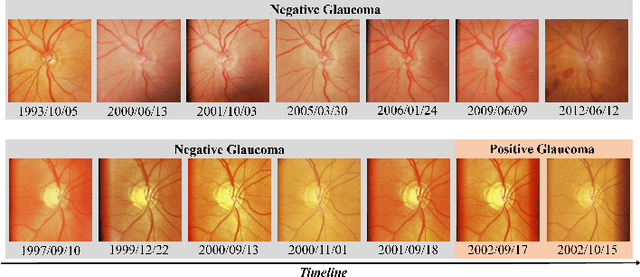
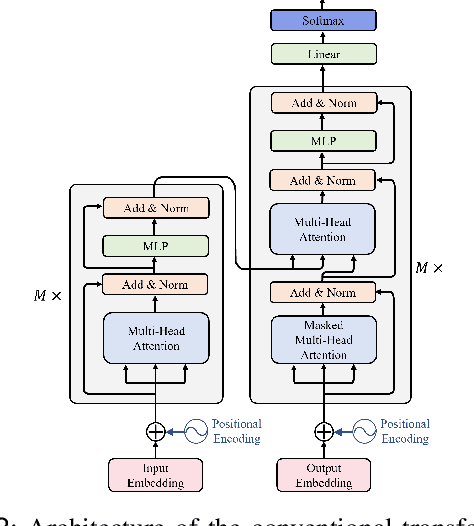
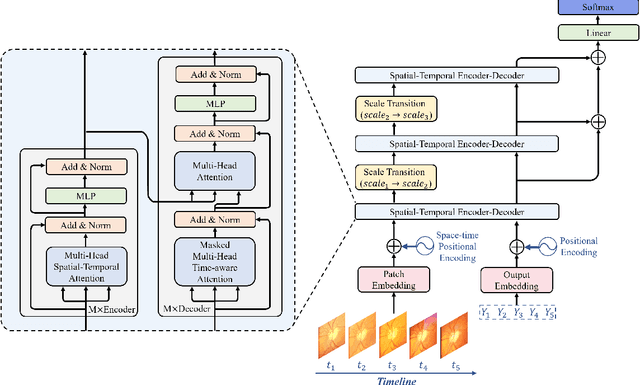
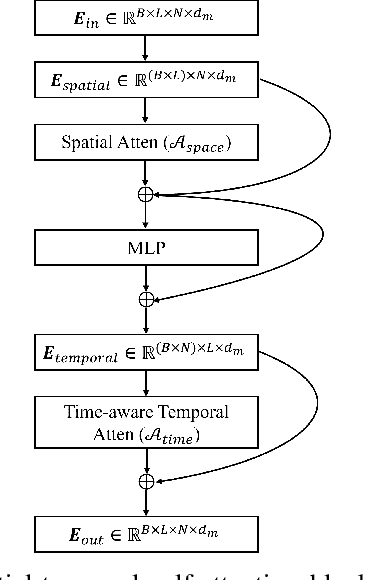
Glaucoma is one of the major eye diseases that leads to progressive optic nerve fiber damage and irreversible blindness, afflicting millions of individuals. Glaucoma forecast is a good solution to early screening and intervention of potential patients, which is helpful to prevent further deterioration of the disease. It leverages a series of historical fundus images of an eye and forecasts the likelihood of glaucoma occurrence in the future. However, the irregular sampling nature and the imbalanced class distribution are two challenges in the development of disease forecasting approaches. To this end, we introduce the Multi-scale Spatio-temporal Transformer Network (MST-former) based on the transformer architecture tailored for sequential image inputs, which can effectively learn representative semantic information from sequential images on both temporal and spatial dimensions. Specifically, we employ a multi-scale structure to extract features at various resolutions, which can largely exploit rich spatial information encoded in each image. Besides, we design a time distance matrix to scale time attention in a non-linear manner, which could effectively deal with the irregularly sampled data. Furthermore, we introduce a temperature-controlled Balanced Softmax Cross-entropy loss to address the class imbalance issue. Extensive experiments on the Sequential fundus Images for Glaucoma Forecast (SIGF) dataset demonstrate the superiority of the proposed MST-former method, achieving an AUC of 98.6% for glaucoma forecasting. Besides, our method shows excellent generalization capability on the Alzheimer's Disease Neuroimaging Initiative (ADNI) MRI dataset, with an accuracy of 90.3% for mild cognitive impairment and Alzheimer's disease prediction, outperforming the compared method by a large margin.