 Add to Chrome
 Add to Firefox
 Add to Edge
GEAR: Generative Expansion and Real Anchoring for Two-Stage Distillation of Tabular Foundation Models
Aug 19, 2026
Tabular foundation models (TFMs) achieve strong performance through in-context learning, but context-dependent inference imposes substantial latency and memory costs, hindering large-scale deployment. We propose GEAR (\emph{Generative Expansion and Real Anchoring}), a modular two-stage framework that distills TFMs into lightweight MLP or tree-based predictors that can be deployed on commodity CPUs. Stage 1 uses synthetic covariates solely as teacher-query locations and trains the student on soft TFM targets, expanding coverage beyond observed rows. Stage 2 re-anchors the student to the target distribution using real labels and out-of-fold teacher predictions, whitch avoids self-labeling leakage. We further derive a risk certificate characterizing the trade-off between generated-query volume and generator fidelity. Experiments on TALENT and TabArena demonstrate the broad applicability of GEAR. Two-stage MLPs outperform supervised MLPs by 1.81--2.00 AUC points on binary tasks and 1.19--1.35 points on multiclass tasks, with additional gains over real-data-only distillation of 1.76--2.19 and 2.09--2.40 points, respectively. On binary tasks, the gains also transfer to LightGBM and XGBoost, and all three student families outperform CatBoost, the strongest non-TFM baseline, in mean AUC. Ablations show gains beyond longer training or alternative warm starts, greater stability from staged than mixed optimization, and generator-dependent diminishing returns as query volume increases. Finally, GEAR reduces median inference time by 57--2866 times and peak prediction memory by 1.9--3.3 times, while retaining higher AUC than matched supervised baselines.

HydroAgent: Formalizing Forecaster Expertise into Skill-Orchestrated Flood Forecasting Workflows
Jul 27, 2026Operational flood forecasting depends on tacit forecaster expertise that is difficult to formalize, audit, and transfer. Although artificial intelligence methods have advanced flood prediction and model-error correction, most existing studies have not explicitly represented the tacit expert rules, review checkpoints, and workflow constraints that connect model outputs to operational warning decisions. To address this issue, we propose HydroAgent, a skill-orchestrated agent framework that embeds Large Language Models (LLMs) into a model-driven flood forecasting workflow, where each skill encodes explicit rules to bound LLM reasoning. We validated its effectiveness using five state-of-the-art LLMs in the South Yamhill River basin. Our results demonstrate that prior judgment captures observed peak flow and flood volume within 5% tolerance in 10 and 11 out of 14 events, with 5-fold cross-validation over 129 events yielding Pearson correlations of 0.62 and 0.84. Building on a high-baseline scheme library (average KGE 0.890), the guided scheme selection further improves KGE by 0.023-0.154, with simulated peak flow and flood volume falling within the prior judgment ranges for 14 and 13 out of 14 events. All five tested LLMs successfully execute the HydroAgent workflow with comparable judgment accuracy (40%-80%), while showing moderate performance variation and substantial cost differences. HydroAgent does not aim to replace human forecasters; instead, it translates their tacit expertise into an auditable and reproducible workflow, streamlining analytical steps and supporting more informed decision-making. This skill-orchestrated paradigm demonstrates how explicit rule boundaries can guide language model reasoning to complement physically based simulation in next-generation flood forecasting.
IG-GAN: A Generative Adversarial Network for Aerodynamic Data Generation Based on Intrinsic Geometry
Jul 13, 2026Existing generative models learn data distributions in flat Euclidean space. However, most data in our real world are manifolds embedded in high dimensional Euclidean space. Therefore, we propose an intrinsic-geometry-based generative adversarial network (IG-GAN) for data generation in the field of aerodynamics. The generator of the IG-GAN represents aerodynamic data as a piecewise smooth manifold constructed by Bézier surfaces, and the generator tries to learn the coefficients of each Bézier surface to further combine multiple Bézier surfaces into a smooth manifold automatically. The discriminator in the IG-GAN is a radial-basis-function based discriminator (RBF-D). Experimental results show that IG-GAN achieves lower predicted Mean Squared Errors (MSEs) than those of three baselines. Specifically, on the Burgers' equation dataset, IG-GAN reduces the predicted MSE of velocity u by 97.41% compared with state of the art SSL-Transformer. Additionally, on the ONERA M6 aircraft dataset, IG-GAN reduces the overall MSE of nine aerodynamic coefficients by 82.95% compared with SSL-Transformer.
AgenticDataBench: A Comprehensive Benchmark for Data Agents
Jul 02, 2026Data science aims to derive actionable insights from heterogeneous raw data, unlocking the value of the massive amounts of data generated in modern society. Automating this process is essential to reducing labor-intensive efforts for data scientists and enabling scalable data-driven applications. Recently, large language model (LLM)-based data agents have emerged as a promising solution to automate data science workflows. However, the field lacks comprehensive benchmarks to rigorously evaluate these agents across diverse scenarios with fine-grained granularity. To address this gap, we propose AgenticDataBench, a comprehensive benchmark featuring realistic tasks spanning diverse domains with fine-grained ground-truth labels. This enables evaluations to capture the diversity and complexity of data science workflows and the detailed performance of agents. First, to cover diverse domains, we collect real datasets and tasks from 15 vertical domains, including 5 real-world B2B use cases from a leading fintech company. Second, to remove redundancy in real-world tasks and generate high-quality tasks for domains lacking real data, we introduce data science skills, recurring data-centric operational patterns, and quantify benchmark coverage by the number of skills included. Representative skills are extracted from large-scale task solutions on Stack Overflow using skill-aligned hierarchical clustering. Third, for real-world business tasks, we select task-solution pairs that maximize diversity in skill composition, ensuring broad coverage of practical scenarios. Fourth, to generate realistic tasks for devise domains without real tasks, we propose a systematic LLM-based task generation approach to create workflows and tasks based on these skills. Finally, we evaluate state-of-the-art data agents using our annotated benchmark and open-sourced testbed, providing detailed skill-level insights.
Visual-Seeker: Towards Visual-Native Multimodal Agentic Search via Active Visual Reasoning
Jun 13, 2026Multimodal large language models (MLLMs) have demonstrated impressive capabilities in many visual tasks, but they often struggle with factual grounding when confronted with complex, open-world scenarios. While recent multimodal deep search agents attempt to address this issue by utilizing external tools, the visual-native search paradigm remains underexplored. Existing methods primarily rely on simple images with explicit semantics and text-only evidence trajectories, limiting the agent's ability to perform multi-hop, cross-modal reasoning and search. To address these limitations, we propose Visual-Seeker, a visual-native multimodal deep search agent via active visual reasoning. Rather than treating vision as a static input, our agent actively attends to fine-grained visual details, dynamically harvests visual evidence throughout the search process. To unlock its visual-native potential, we design an active visual reasoning data pipeline and synthesize 5K high-quality multimodal trajectories for model training. Extensive experiments demonstrate the state-of-the-art performance across five challenging multimodal search benchmarks, even surpassing several proprietary models, validating robust visual-native reasoning and search in real-world web environments. The code and data can be accessed at: https://github.com/ZhengboZhang/Visual-Seeker.
Agents' Last Exam
Jun 03, 2026Recent AI systems have achieved strong results on a wide range of benchmarks, yet these gains have not translated into economically meaningful deployment across many professional domains. We argue that this gap is largely an evaluation problem: widely used benchmarks lack sustained performance measurement on real and economically valuable workflows. This paper introduces Agents' Last Exam (ALE), a benchmark designed to evaluate AI agents on long-horizon, economically valuable, real-world tasks with verifiable outcomes. Developed in collaboration with 250+ industry experts, ALE covers non-physical industries defined with reference to O*NET / SOC 2018 (the U.S. federal occupational taxonomy). It is organized around a task taxonomy with 55 subfields grouped into 13 industry clusters covering 1K+ tasks. Current results show that the hardest tier remains far from saturated: across mainstream harness and backbone configurations, the average full pass rate is 2.6%. ALE is designed as a living benchmark: its task pool grows continuously as new workflows and industries are onboarded. More broadly, ALE is intended not merely as another leaderboard, but as an instrument for closing the gap between benchmark success and GDP-relevant impact.
VisBrowse-Bench: Benchmarking Visual-Native Search for Multimodal Browsing Agents
Mar 17, 2026The rapid advancement of Multimodal Large Language Models (MLLMs) has enabled browsing agents to acquire and reason over multimodal information in the real world. But existing benchmarks suffer from two limitations: insufficient evaluation of visual reasoning ability and the neglect of native visual information of web pages in the reasoning chains. To address these challenges, we introduce a new benchmark for visual-native search, VisBrowse-Bench. It contains 169 VQA instances covering multiple domains and evaluates the models' visual reasoning capabilities during the search process through multimodal evidence cross-validation via text-image retrieval and joint reasoning. These data were constructed by human experts using a multi-stage pipeline and underwent rigorous manual verification. We additionally propose an agent workflow that can effectively drive the browsing agent to actively collect and reason over visual information during the search process. We comprehensively evaluated both open-source and closed-source models in this workflow. Experimental results show that even the best-performing model, Claude-4.6-Opus only achieves an accuracy of 47.6%, while the proprietary Deep Research model, o3-deep-research only achieves an accuracy of 41.1%. The code and data can be accessed at: https://github.com/ZhengboZhang/VisBrowse-Bench
XEmoRAG: Cross-Lingual Emotion Transfer with Controllable Intensity Using Retrieval-Augmented Generation
Aug 12, 2025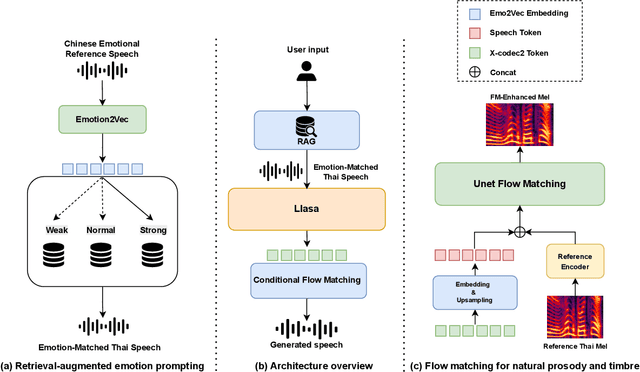
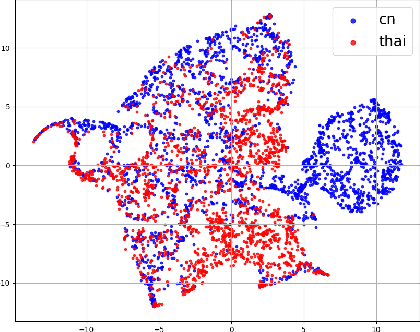
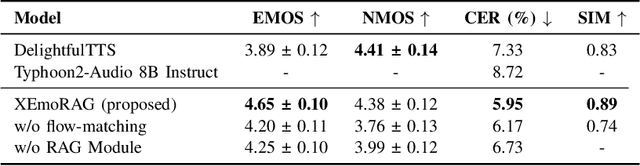
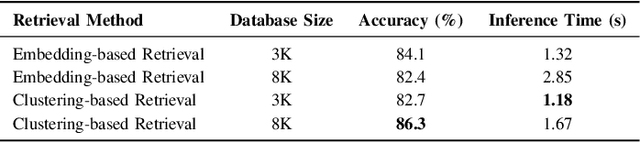
Zero-shot emotion transfer in cross-lingual speech synthesis refers to generating speech in a target language, where the emotion is expressed based on reference speech from a different source language. However, this task remains challenging due to the scarcity of parallel multilingual emotional corpora, the presence of foreign accent artifacts, and the difficulty of separating emotion from language-specific prosodic features. In this paper, we propose XEmoRAG, a novel framework to enable zero-shot emotion transfer from Chinese to Thai using a large language model (LLM)-based model, without relying on parallel emotional data. XEmoRAG extracts language-agnostic emotional embeddings from Chinese speech and retrieves emotionally matched Thai utterances from a curated emotional database, enabling controllable emotion transfer without explicit emotion labels. Additionally, a flow-matching alignment module minimizes pitch and duration mismatches, ensuring natural prosody. It also blends Chinese timbre into the Thai synthesis, enhancing rhythmic accuracy and emotional expression, while preserving speaker characteristics and emotional consistency. Experimental results show that XEmoRAG synthesizes expressive and natural Thai speech using only Chinese reference audio, without requiring explicit emotion labels. These results highlight XEmoRAG's capability to achieve flexible and low-resource emotional transfer across languages. Our demo is available at https://tlzuo-lesley.github.io/Demo-page/ .
Weakly Supervised Data Refinement and Flexible Sequence Compression for Efficient Thai LLM-based ASR
May 28, 2025Despite remarkable achievements, automatic speech recognition (ASR) in low-resource scenarios still faces two challenges: high-quality data scarcity and high computational demands. This paper proposes EThai-ASR, the first to apply large language models (LLMs) to Thai ASR and create an efficient LLM-based ASR system. EThai-ASR comprises a speech encoder, a connection module and a Thai LLM decoder. To address the data scarcity and obtain a powerful speech encoder, EThai-ASR introduces a self-evolving data refinement strategy to refine weak labels, yielding an enhanced speech encoder. Moreover, we propose a pluggable sequence compression module used in the connection module with three modes designed to reduce the sequence length, thus decreasing computational demands while maintaining decent performance. Extensive experiments demonstrate that EThai-ASR has achieved state-of-the-art accuracy in multiple datasets. We release our refined text transcripts to promote further research.
FreeV: Free Lunch For Vocoders Through Pseudo Inversed Mel Filter
Jun 12, 2024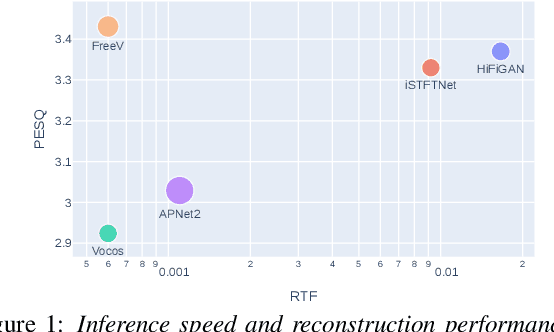
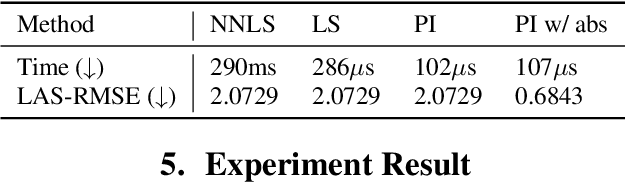
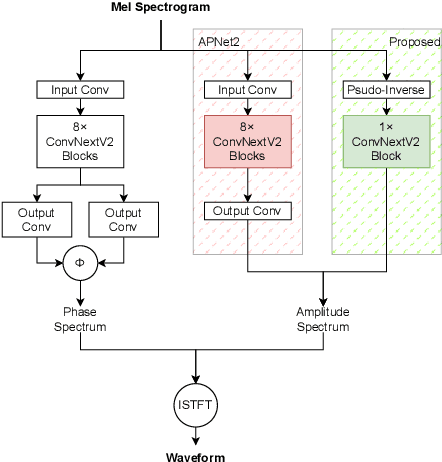
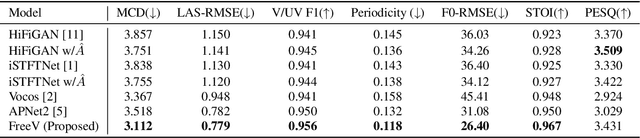
Vocoders reconstruct speech waveforms from acoustic features and play a pivotal role in modern TTS systems. Frequent-domain GAN vocoders like Vocos and APNet2 have recently seen rapid advancements, outperforming time-domain models in inference speed while achieving comparable audio quality. However, these frequency-domain vocoders suffer from large parameter sizes, thus introducing extra memory burden. Inspired by PriorGrad and SpecGrad, we employ pseudo-inverse to estimate the amplitude spectrum as the initialization roughly. This simple initialization significantly mitigates the parameter demand for vocoder. Based on APNet2 and our streamlined Amplitude prediction branch, we propose our FreeV, compared with its counterpart APNet2, our FreeV achieves 1.8 times inference speed improvement with nearly half parameters. Meanwhile, our FreeV outperforms APNet2 in resynthesis quality, marking a step forward in pursuing real-time, high-fidelity speech synthesis. Code and checkpoints is available at: https://github.com/BakerBunker/FreeV