 Add to Chrome
 Add to Firefox
 Add to Edge
Towards Unified Song Generation and Singing Voice Conversion with Accompaniment Co-Generation
Jun 05, 2026
While song generation and singing voice conversion (SVC) have evolved significantly, they have long been developed isolated: the former lacks zero-shot speaker cloning, while the latter overlooks vocal-accompaniment synergy. To bridge this gap, we propose UniSinger, the first end-to-end framework unifying speaker cloning song generation and accompaniment co-generation SVC. Building on the multimodal diffusion transformer, we construct a unified speaker embedding space transferring speaker representation from SVC to song generation, endowing fine-grained cross-task timbre control. To mitigate multi-task optimization conflicts, we design a curriculum learning strategy using task-specific modality masking to guide the model to gradually master the generative mechanisms among semantic content, vocal timbre, and accompaniment. Experiments show state-of-the-art performance on both tasks and realizes complementary benefits, offering new possibilities for intelligent music production.

XEmoRAG: Cross-Lingual Emotion Transfer with Controllable Intensity Using Retrieval-Augmented Generation
Aug 12, 2025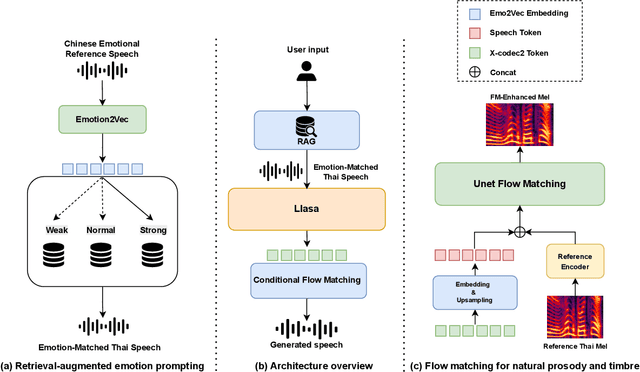
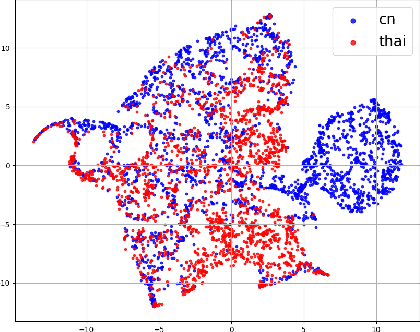
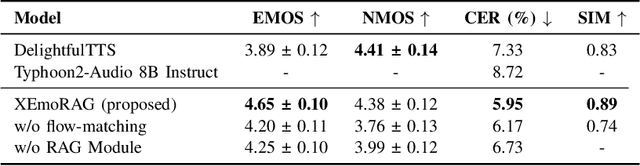
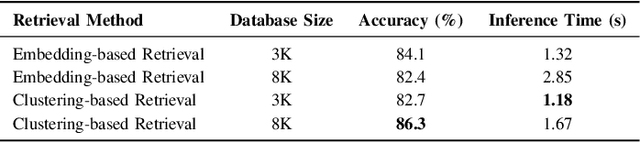
Zero-shot emotion transfer in cross-lingual speech synthesis refers to generating speech in a target language, where the emotion is expressed based on reference speech from a different source language. However, this task remains challenging due to the scarcity of parallel multilingual emotional corpora, the presence of foreign accent artifacts, and the difficulty of separating emotion from language-specific prosodic features. In this paper, we propose XEmoRAG, a novel framework to enable zero-shot emotion transfer from Chinese to Thai using a large language model (LLM)-based model, without relying on parallel emotional data. XEmoRAG extracts language-agnostic emotional embeddings from Chinese speech and retrieves emotionally matched Thai utterances from a curated emotional database, enabling controllable emotion transfer without explicit emotion labels. Additionally, a flow-matching alignment module minimizes pitch and duration mismatches, ensuring natural prosody. It also blends Chinese timbre into the Thai synthesis, enhancing rhythmic accuracy and emotional expression, while preserving speaker characteristics and emotional consistency. Experimental results show that XEmoRAG synthesizes expressive and natural Thai speech using only Chinese reference audio, without requiring explicit emotion labels. These results highlight XEmoRAG's capability to achieve flexible and low-resource emotional transfer across languages. Our demo is available at https://tlzuo-lesley.github.io/Demo-page/ .