 Add to Chrome
 Add to Firefox
 Add to Edge
HydroAgent: Formalizing Forecaster Expertise into Skill-Orchestrated Flood Forecasting Workflows
Jul 27, 2026
Operational flood forecasting depends on tacit forecaster expertise that is difficult to formalize, audit, and transfer. Although artificial intelligence methods have advanced flood prediction and model-error correction, most existing studies have not explicitly represented the tacit expert rules, review checkpoints, and workflow constraints that connect model outputs to operational warning decisions. To address this issue, we propose HydroAgent, a skill-orchestrated agent framework that embeds Large Language Models (LLMs) into a model-driven flood forecasting workflow, where each skill encodes explicit rules to bound LLM reasoning. We validated its effectiveness using five state-of-the-art LLMs in the South Yamhill River basin. Our results demonstrate that prior judgment captures observed peak flow and flood volume within 5% tolerance in 10 and 11 out of 14 events, with 5-fold cross-validation over 129 events yielding Pearson correlations of 0.62 and 0.84. Building on a high-baseline scheme library (average KGE 0.890), the guided scheme selection further improves KGE by 0.023-0.154, with simulated peak flow and flood volume falling within the prior judgment ranges for 14 and 13 out of 14 events. All five tested LLMs successfully execute the HydroAgent workflow with comparable judgment accuracy (40%-80%), while showing moderate performance variation and substantial cost differences. HydroAgent does not aim to replace human forecasters; instead, it translates their tacit expertise into an auditable and reproducible workflow, streamlining analytical steps and supporting more informed decision-making. This skill-orchestrated paradigm demonstrates how explicit rule boundaries can guide language model reasoning to complement physically based simulation in next-generation flood forecasting.

Data-driven solar forecasting enables near-optimal economic decisions
Sep 08, 2025Solar energy adoption is critical to achieving net-zero emissions. However, it remains difficult for many industrial and commercial actors to decide on whether they should adopt distributed solar-battery systems, which is largely due to the unavailability of fast, low-cost, and high-resolution irradiance forecasts. Here, we present SunCastNet, a lightweight data-driven forecasting system that provides 0.05$^\circ$, 10-minute resolution predictions of surface solar radiation downwards (SSRD) up to 7 days ahead. SunCastNet, coupled with reinforcement learning (RL) for battery scheduling, reduces operational regret by 76--93\% compared to robust decision making (RDM). In 25-year investment backtests, it enables up to five of ten high-emitting industrial sectors per region to cross the commercial viability threshold of 12\% Internal Rate of Return (IRR). These results show that high-resolution, long-horizon solar forecasts can directly translate into measurable economic gains, supporting near-optimal energy operations and accelerating renewable deployment.
N15News: A New Dataset for Multimodal News Classification
Aug 30, 2021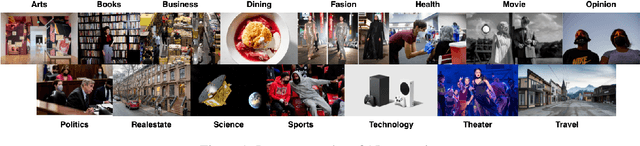
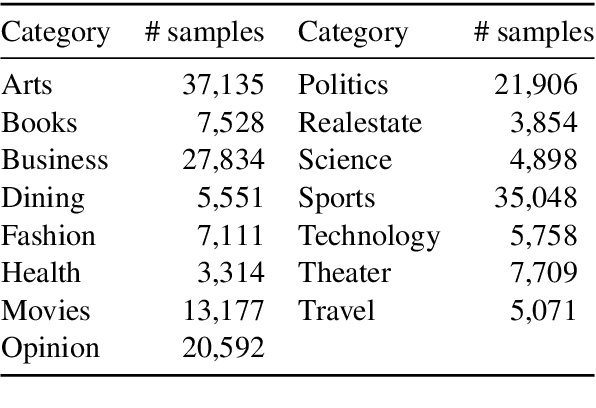
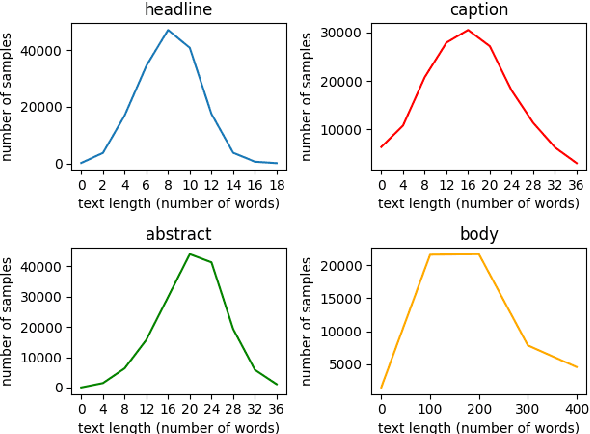
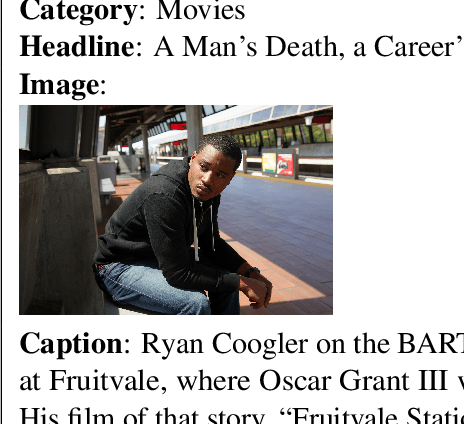
Current news datasets merely focus on text features on the news and rarely leverage the feature of images, excluding numerous essential features for news classification. In this paper, we propose a new dataset, N15News, which is generated from New York Times with 15 categories and contains both text and image information in each news. We design a novel multitask multimodal network with different fusion methods, and experiments show multimodal news classification performs better than text-only news classification. Depending on the length of the text, the classification accuracy can be increased by up to 5.8%. Our research reveals the relationship between the performance of a multimodal classifier and its sub-classifiers, and also the possible improvements when applying multimodal in news classification. N15News is shown to have great potential to prompt the multimodal news studies.