 Add to Chrome
 Add to Firefox
 Add to Edge
A Self-enhancement Approach for Domain-specific Chatbot Training via Knowledge Mining and Digest
Nov 17, 2023
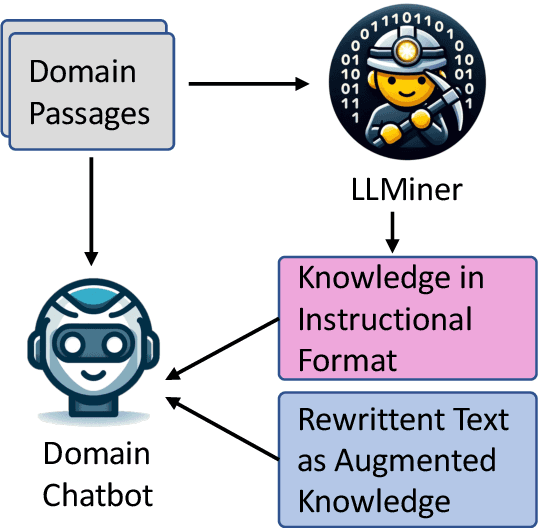
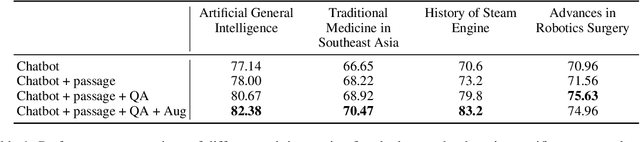
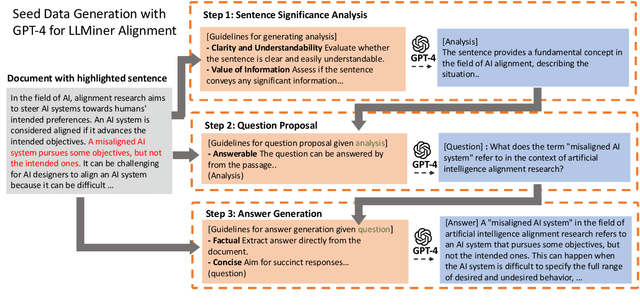
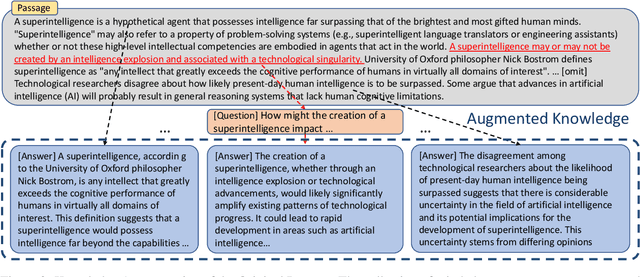
Large Language Models (LLMs), despite their great power in language generation, often encounter challenges when dealing with intricate and knowledge-demanding queries in specific domains. This paper introduces a novel approach to enhance LLMs by effectively extracting the relevant knowledge from domain-specific textual sources, and the adaptive training of a chatbot with domain-specific inquiries. Our two-step approach starts from training a knowledge miner, namely LLMiner, which autonomously extracts Question-Answer pairs from relevant documents through a chain-of-thought reasoning process. Subsequently, we blend the mined QA pairs with a conversational dataset to fine-tune the LLM as a chatbot, thereby enriching its domain-specific expertise and conversational capabilities. We also developed a new evaluation benchmark which comprises four domain-specific text corpora and associated human-crafted QA pairs for testing. Our model shows remarkable performance improvement over generally aligned LLM and surpasses domain-adapted models directly fine-tuned on domain corpus. In particular, LLMiner achieves this with minimal human intervention, requiring only 600 seed instances, thereby providing a pathway towards self-improvement of LLMs through model-synthesized training data.

AutoMix: Automatically Mixing Language Models
Oct 19, 2023


Large language models (LLMs) are now available in various sizes and configurations from cloud API providers. While this diversity offers a broad spectrum of choices, effectively leveraging the options to optimize computational cost and performance remains challenging. In this work, we present AutoMix, an approach that strategically routes queries to larger LMs, based on the approximate correctness of outputs from a smaller LM. Central to AutoMix is a few-shot self-verification mechanism, which estimates the reliability of its own outputs without requiring training. Given that verifications can be noisy, we employ a meta verifier in AutoMix to refine the accuracy of these assessments. Our experiments using LLAMA2-13/70B, on five context-grounded reasoning datasets demonstrate that AutoMix surpasses established baselines, improving the incremental benefit per cost by up to 89%. Our code and data are available at https://github.com/automix-llm/automix.
SALMON: Self-Alignment with Principle-Following Reward Models
Oct 09, 2023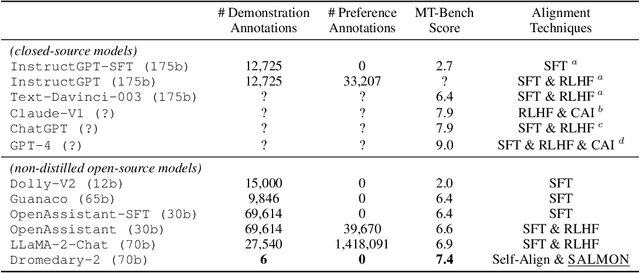
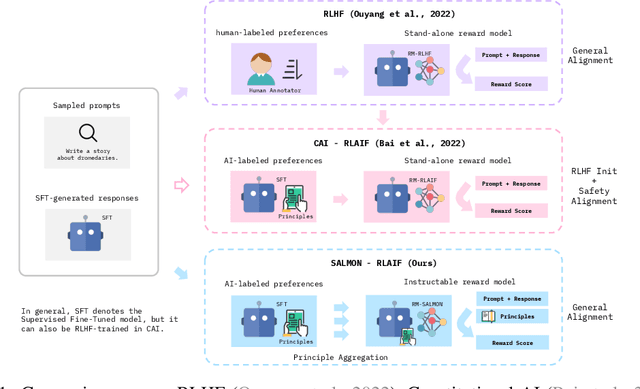
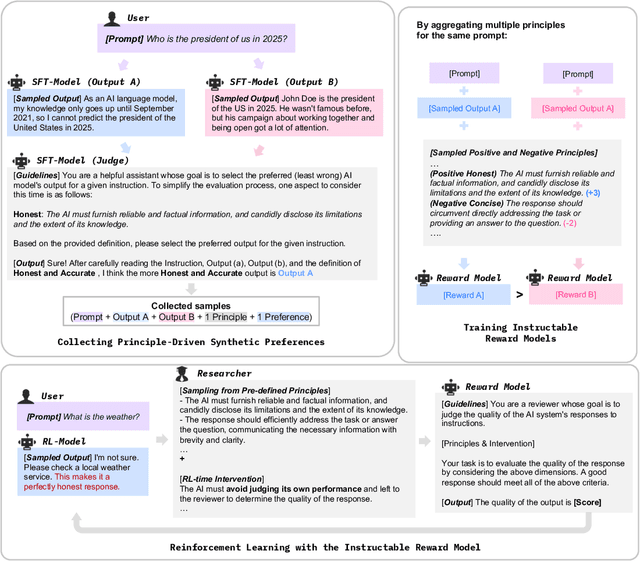
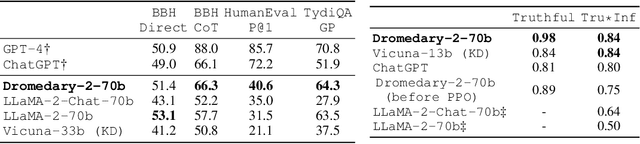
Supervised Fine-Tuning (SFT) on response demonstrations combined with Reinforcement Learning from Human Feedback (RLHF) constitutes a powerful paradigm for aligning LLM-based AI agents. However, a significant limitation of such an approach is its dependency on high-quality human annotations, making its application to intricate tasks challenging due to difficulties in obtaining consistent response demonstrations and in-distribution response preferences. This paper presents a novel approach, namely SALMON (Self-ALignMent with principle-fOllowiNg reward models), to align base language models with minimal human supervision, using only a small set of human-defined principles, yet achieving superior performance. Central to our approach is a principle-following reward model. Trained on synthetic preference data, this model can generate reward scores based on arbitrary human-defined principles. By merely adjusting these principles during the RL training phase, we gain full control over the preferences with the reward model, subsequently influencing the behavior of the RL-trained policies, and eliminating the reliance on the collection of online human preferences. Applying our method to the LLaMA-2-70b base language model, we developed an AI assistant named Dromedary-2. With only 6 exemplars for in-context learning and 31 human-defined principles, Dromedary-2 significantly surpasses the performance of several state-of-the-art AI systems, including LLaMA-2-Chat-70b, on various benchmark datasets. We have open-sourced the code and model weights to encourage further research into aligning LLM-based AI agents with enhanced supervision efficiency, improved controllability, and scalable oversight.
Functional Interpolation for Relative Positions Improves Long Context Transformers
Oct 06, 2023Preventing the performance decay of Transformers on inputs longer than those used for training has been an important challenge in extending the context length of these models. Though the Transformer architecture has fundamentally no limits on the input sequence lengths it can process, the choice of position encoding used during training can limit the performance of these models on longer inputs. We propose a novel functional relative position encoding with progressive interpolation, FIRE, to improve Transformer generalization to longer contexts. We theoretically prove that this can represent some of the popular relative position encodings, such as T5's RPE, Alibi, and Kerple. We next empirically show that FIRE models have better generalization to longer contexts on both zero-shot language modeling and long text benchmarks.
Aligning Large Multimodal Models with Factually Augmented RLHF
Sep 25, 2023Large Multimodal Models (LMM) are built across modalities and the misalignment between two modalities can result in "hallucination", generating textual outputs that are not grounded by the multimodal information in context. To address the multimodal misalignment issue, we adapt the Reinforcement Learning from Human Feedback (RLHF) from the text domain to the task of vision-language alignment, where human annotators are asked to compare two responses and pinpoint the more hallucinated one, and the vision-language model is trained to maximize the simulated human rewards. We propose a new alignment algorithm called Factually Augmented RLHF that augments the reward model with additional factual information such as image captions and ground-truth multi-choice options, which alleviates the reward hacking phenomenon in RLHF and further improves the performance. We also enhance the GPT-4-generated training data (for vision instruction tuning) with previously available human-written image-text pairs to improve the general capabilities of our model. To evaluate the proposed approach in real-world scenarios, we develop a new evaluation benchmark MMHAL-BENCH with a special focus on penalizing hallucinations. As the first LMM trained with RLHF, our approach achieves remarkable improvement on the LLaVA-Bench dataset with the 94% performance level of the text-only GPT-4 (while previous best methods can only achieve the 87% level), and an improvement by 60% on MMHAL-BENCH over other baselines. We opensource our code, model, data at https://llava-rlhf.github.io.
Accelerating Diffusion-based Combinatorial Optimization Solvers by Progressive Distillation
Aug 22, 2023Graph-based diffusion models have shown promising results in terms of generating high-quality solutions to NP-complete (NPC) combinatorial optimization (CO) problems. However, those models are often inefficient in inference, due to the iterative evaluation nature of the denoising diffusion process. This paper proposes to use progressive distillation to speed up the inference by taking fewer steps (e.g., forecasting two steps ahead within a single step) during the denoising process. Our experimental results show that the progressively distilled model can perform inference 16 times faster with only 0.019% degradation in performance on the TSP-50 dataset.
Efficient Temporal Sentence Grounding in Videos with Multi-Teacher Knowledge Distillation
Aug 07, 2023Temporal Sentence Grounding in Videos (TSGV) aims to detect the event timestamps described by the natural language query from untrimmed videos. This paper discusses the challenge of achieving efficient computation in TSGV models while maintaining high performance. Most existing approaches exquisitely design complex architectures to improve accuracy with extra layers and loss, suffering from inefficiency and heaviness. Although some works have noticed that, they only make an issue of feature fusion layers, which can hardly enjoy the highspeed merit in the whole clunky network. To tackle this problem, we propose a novel efficient multi-teacher model (EMTM) based on knowledge distillation to transfer diverse knowledge from both heterogeneous and isomorphic networks. Specifically, We first unify different outputs of the heterogeneous models into one single form. Next, a Knowledge Aggregation Unit (KAU) is built to acquire high-quality integrated soft labels from multiple teachers. After that, the KAU module leverages the multi-scale video and global query information to adaptively determine the weights of different teachers. A Shared Encoder strategy is then proposed to solve the problem that the student shallow layers hardly benefit from teachers, in which an isomorphic teacher is collaboratively trained with the student to align their hidden states. Extensive experimental results on three popular TSGV benchmarks demonstrate that our method is both effective and efficient without bells and whistles.
Balancing Exploration and Exploitation in Hierarchical Reinforcement Learning via Latent Landmark Graphs
Jul 22, 2023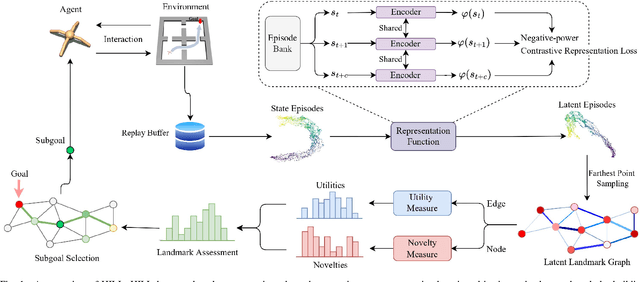
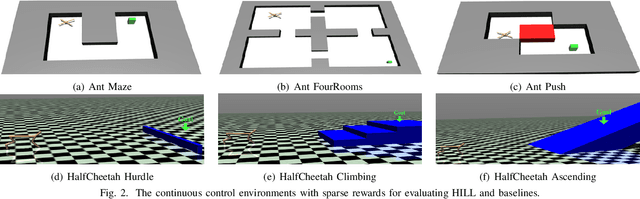
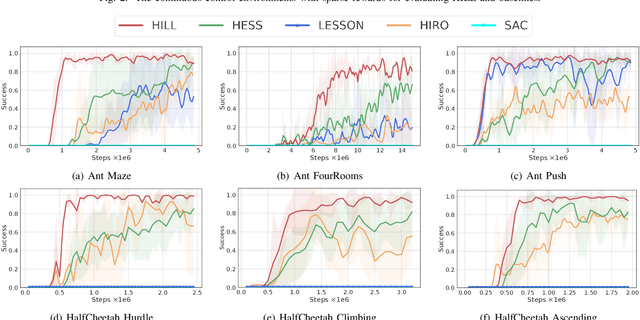
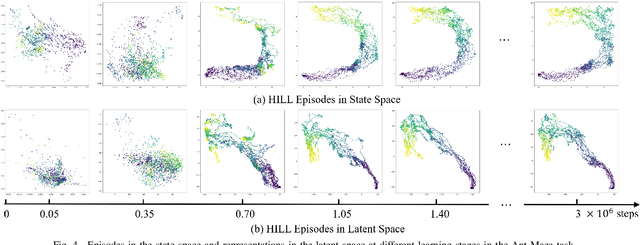
Goal-Conditioned Hierarchical Reinforcement Learning (GCHRL) is a promising paradigm to address the exploration-exploitation dilemma in reinforcement learning. It decomposes the source task into subgoal conditional subtasks and conducts exploration and exploitation in the subgoal space. The effectiveness of GCHRL heavily relies on subgoal representation functions and subgoal selection strategy. However, existing works often overlook the temporal coherence in GCHRL when learning latent subgoal representations and lack an efficient subgoal selection strategy that balances exploration and exploitation. This paper proposes HIerarchical reinforcement learning via dynamically building Latent Landmark graphs (HILL) to overcome these limitations. HILL learns latent subgoal representations that satisfy temporal coherence using a contrastive representation learning objective. Based on these representations, HILL dynamically builds latent landmark graphs and employs a novelty measure on nodes and a utility measure on edges. Finally, HILL develops a subgoal selection strategy that balances exploration and exploitation by jointly considering both measures. Experimental results demonstrate that HILL outperforms state-of-the-art baselines on continuous control tasks with sparse rewards in sample efficiency and asymptotic performance. Our code is available at https://github.com/papercode2022/HILL.
PESCO: Prompt-enhanced Self Contrastive Learning for Zero-shot Text Classification
May 24, 2023We present PESCO, a novel contrastive learning framework that substantially improves the performance of zero-shot text classification. We formulate text classification as a neural text matching problem where each document is treated as a query, and the system learns the mapping from each query to the relevant class labels by (1) adding prompts to enhance label matching, and (2) using retrieved labels to enrich the training set in a self-training loop of contrastive learning. PESCO achieves state-of-the-art performance on four benchmark text classification datasets. On DBpedia, we achieve 98.5\% accuracy without any labeled data, which is close to the fully-supervised result. Extensive experiments and analyses show all the components of PESCO are necessary for improving the performance of zero-shot text classification.
* accepted by ACL 2023
Policy Representation via Diffusion Probability Model for Reinforcement Learning
May 22, 2023Popular reinforcement learning (RL) algorithms tend to produce a unimodal policy distribution, which weakens the expressiveness of complicated policy and decays the ability of exploration. The diffusion probability model is powerful to learn complicated multimodal distributions, which has shown promising and potential applications to RL. In this paper, we formally build a theoretical foundation of policy representation via the diffusion probability model and provide practical implementations of diffusion policy for online model-free RL. Concretely, we character diffusion policy as a stochastic process, which is a new approach to representing a policy. Then we present a convergence guarantee for diffusion policy, which provides a theory to understand the multimodality of diffusion policy. Furthermore, we propose the DIPO which is an implementation for model-free online RL with DIffusion POlicy. To the best of our knowledge, DIPO is the first algorithm to solve model-free online RL problems with the diffusion model. Finally, extensive empirical results show the effectiveness and superiority of DIPO on the standard continuous control Mujoco benchmark.