 Add to Chrome
 Add to Firefox
 Add to Edge
Avatar-Forever: Decoupled Parallel Training for High-Quality Real-Time Infinite Avatars
Aug 12, 2026
Existing streaming video systems often rely on sequential, distillation-centered training pipelines to enable few-step long-video generation. However, this paradigm suffers from two limitations. First, failures or distribution shifts introduced in earlier stages affect later optimization, complicating the training process to converge. Second, the distillation-centric objective favours short-term generation but is prone to quality degradation when autoregressive errors accumulate over long rollouts. We propose Avatar-Forever, a decoupled parallel training framework for high-quality real-time infinite interactive avatars. Instead of coupling generation efficiency and long-horizon robustness under a sequential distillation pipeline, we treat them as two independent capabilities that can be trained in parallel. One branch performs full-parameter distillation to train an efficient generator with high visual quality, while another trains a lightweight long-horizon adapter via Recovery-oriented Rollout Training (RRT), which improves generation robustness under long-horizon inference conditions. Our decoupled parallel training design simplifies the overall training process and avoids unnecessary objective conflicts between few-step generation and long-horizon adaptation. We further introduce ForeverCache, a chunk-wise feature caching mechanism to substantially reduce redundant history computation during streaming inference. Built upon a 22B video foundation model, Avatar-Forever supports unbounded audio-driven avatar generation while maintaining identity consistency, motion coherence, and visual fidelity, enabling an end-to-end throughput of high-resolution 768x512 videos at 27.2 FPS on a single H100 GPU and providing a practical path toward stable digital humans.

Long-Horizon Streaming Video Generation via Hybrid Attention with Decoupled Distillation
Apr 11, 2026Streaming video generation (SVG) distills a pretrained bidirectional video diffusion model into an autoregressive model equipped with sliding window attention (SWA). However, SWA inevitably loses distant history during long video generation, and its computational overhead remains a critical challenge to real-time deployment. In this work, we propose Hybrid Forcing, which jointly optimizes temporal information retention and computational efficiency through a hybrid attention design. First, we introduce lightweight linear temporal attention to preserve long-range dependencies beyond the sliding window. In particular, we maintain a compact key-value state to incrementally absorb evicted tokens, retaining temporal context with negligible memory and computational overhead. Second, we incorporate block-sparse attention into the local sliding window to reduce redundant computation within short-range modeling, reallocating computational capacity toward more critical dependencies. Finally, we introduce a decoupled distillation strategy tailored to the hybrid attention design. A few-step initial distillation is performed under dense attention, then the distillation of our proposed linear temporal and block-sparse attention is activated for streaming modeling, ensuring stable optimization. Extensive experiments on both short- and long-form video generation benchmarks demonstrate that Hybrid Forcing consistently achieves state-of-the-art performance. Notably, our model achieves real-time, unbounded 832x480 video generation at 29.5 FPS on a single NVIDIA H100 GPU without quantization or model compression. The source code and trained models are available at https://github.com/leeruibin/hybrid-forcing.
A Self-enhancement Approach for Domain-specific Chatbot Training via Knowledge Mining and Digest
Nov 17, 2023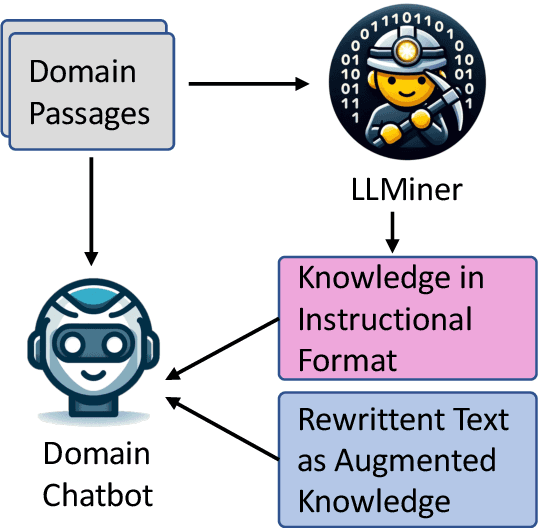
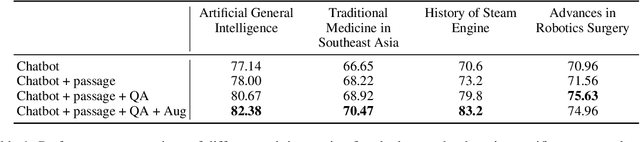
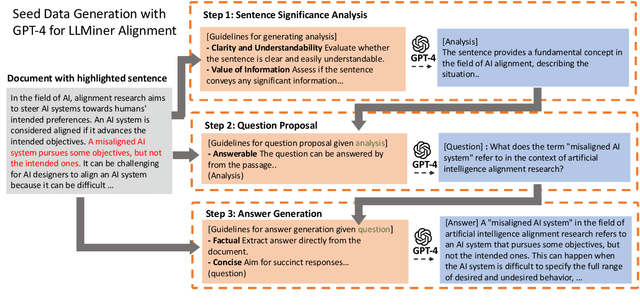
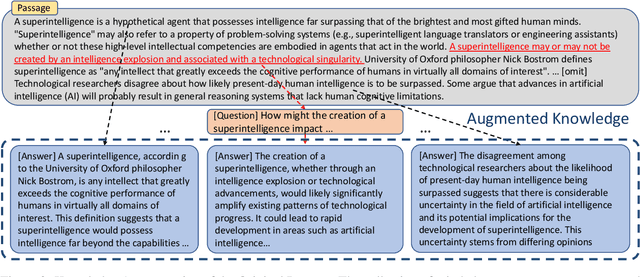
Large Language Models (LLMs), despite their great power in language generation, often encounter challenges when dealing with intricate and knowledge-demanding queries in specific domains. This paper introduces a novel approach to enhance LLMs by effectively extracting the relevant knowledge from domain-specific textual sources, and the adaptive training of a chatbot with domain-specific inquiries. Our two-step approach starts from training a knowledge miner, namely LLMiner, which autonomously extracts Question-Answer pairs from relevant documents through a chain-of-thought reasoning process. Subsequently, we blend the mined QA pairs with a conversational dataset to fine-tune the LLM as a chatbot, thereby enriching its domain-specific expertise and conversational capabilities. We also developed a new evaluation benchmark which comprises four domain-specific text corpora and associated human-crafted QA pairs for testing. Our model shows remarkable performance improvement over generally aligned LLM and surpasses domain-adapted models directly fine-tuned on domain corpus. In particular, LLMiner achieves this with minimal human intervention, requiring only 600 seed instances, thereby providing a pathway towards self-improvement of LLMs through model-synthesized training data.