 Add to Chrome
 Add to Firefox
 Add to Edge
Towards Reliable Fetal Ultrasound Interpretation with Multi-Agent Collaboration
May 25, 2026
Automated fetal ultrasound interpretation requires a workflow from visual perception, including plane recognition and anatomical segmentation, to clinical understanding, including biometric measurement and diagnostic reporting. However, the prevailing "one-task, one-model" paradigm limits systematic integration of evidence across this multi-step process. Although multimodal large language models (MLLMs) show promising visual understanding, their limited domain-specific grounding and hallucination risks restrict reliability in fetal ultrasound analysis. To address these limitations, we propose FetUSAgents, a tool-augmented multi-agent system for comprehensive fetal ultrasound interpretation, supporting visual question answering (VQA), report generation, image captioning, and video summarization. FetUSAgents coordinates task-specific visual tools through collaborative LLM agents and decomposes clinical queries into subtasks that progress from anatomical recognition to quantitative measurement. We further introduce Dual-Path Evidence Arbitration (DPEA), which integrates LLM-based deliberative reasoning with structured computational evidence from specialized visual tools. A retrieval-enhanced evidence bank consolidates intermediate findings to support traceable and clinically grounded conclusions. In addition, we construct FetUS-VQA, a dedicated VQA benchmark for fetal ultrasound, comprising 1,892 images and 3,205 question-answer pairs across 10 clinical tasks. Extensive out-of-distribution experiments show that FetUSAgents outperforms general and medical MLLMs, exceeding the strongest baseline by more than 25 percent in VQA accuracy. These results suggest a scalable route toward evidence-driven clinical assistants for prenatal imaging. Code is available.

FetalAgents: A Multi-Agent System for Fetal Ultrasound Image and Video Analysis
Mar 10, 2026Fetal ultrasound (US) is the primary imaging modality for prenatal screening, yet its interpretation relies heavily on the expertise of the clinician. Despite advances in deep learning and foundation models, existing automated tools for fetal US analysis struggle to balance task-specific accuracy with the whole-process versatility required to support end-to-end clinical workflows. To address these limitations, we propose FetalAgents, the first multi-agent system for comprehensive fetal US analysis. Through a lightweight, agentic coordination framework, FetalAgents dynamically orchestrates specialized vision experts to maximize performance across diagnosis, measurement, and segmentation. Furthermore, FetalAgents advances beyond static image analysis by supporting end-to-end video stream summarization, where keyframes are automatically identified across multiple anatomical planes, analyzed by coordinated experts, and synthesized with patient metadata into a structured clinical report. Extensive multi-center external evaluations across eight clinical tasks demonstrate that FetalAgents consistently delivers the most robust and accurate performance when compared against specialized models and multimodal large language models (MLLMs), ultimately providing an auditable, workflow-aligned solution for fetal ultrasound analysis and reporting.
ChatTracker: Enhancing Visual Tracking Performance via Chatting with Multimodal Large Language Model
Nov 04, 2024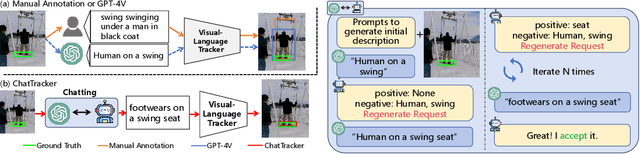


Visual object tracking aims to locate a targeted object in a video sequence based on an initial bounding box. Recently, Vision-Language~(VL) trackers have proposed to utilize additional natural language descriptions to enhance versatility in various applications. However, VL trackers are still inferior to State-of-The-Art (SoTA) visual trackers in terms of tracking performance. We found that this inferiority primarily results from their heavy reliance on manual textual annotations, which include the frequent provision of ambiguous language descriptions. In this paper, we propose ChatTracker to leverage the wealth of world knowledge in the Multimodal Large Language Model (MLLM) to generate high-quality language descriptions and enhance tracking performance. To this end, we propose a novel reflection-based prompt optimization module to iteratively refine the ambiguous and inaccurate descriptions of the target with tracking feedback. To further utilize semantic information produced by MLLM, a simple yet effective VL tracking framework is proposed and can be easily integrated as a plug-and-play module to boost the performance of both VL and visual trackers. Experimental results show that our proposed ChatTracker achieves a performance comparable to existing methods.
Accelerating Diffusion-based Combinatorial Optimization Solvers by Progressive Distillation
Aug 22, 2023Graph-based diffusion models have shown promising results in terms of generating high-quality solutions to NP-complete (NPC) combinatorial optimization (CO) problems. However, those models are often inefficient in inference, due to the iterative evaluation nature of the denoising diffusion process. This paper proposes to use progressive distillation to speed up the inference by taking fewer steps (e.g., forecasting two steps ahead within a single step) during the denoising process. Our experimental results show that the progressively distilled model can perform inference 16 times faster with only 0.019% degradation in performance on the TSP-50 dataset.