 Add to Chrome
 Add to Firefox
 Add to Edge
Self-Adapting Improvement Loops for Robotic Learning
Jun 07, 2025
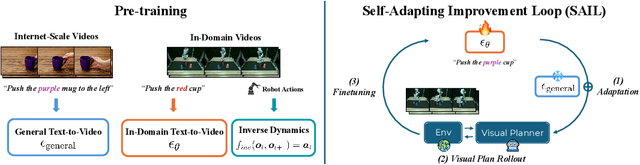
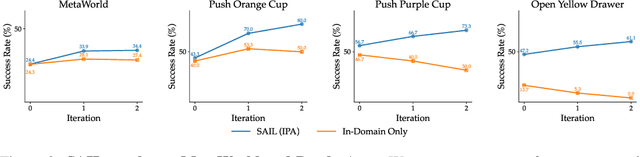
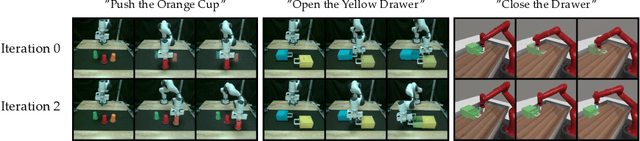
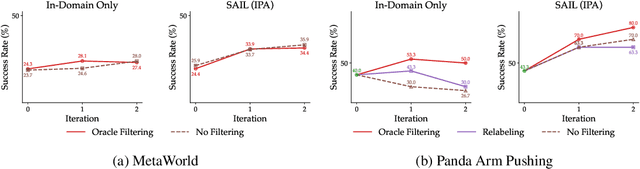
Video generative models trained on expert demonstrations have been utilized as performant text-conditioned visual planners for solving robotic tasks. However, generalization to unseen tasks remains a challenge. Whereas improved generalization may be facilitated by leveraging learned prior knowledge from additional pre-collected offline data sources, such as web-scale video datasets, in the era of experience we aim to design agents that can continuously improve in an online manner from self-collected behaviors. In this work we thus propose the Self-Adapting Improvement Loop (SAIL), where an in-domain video model iteratively updates itself on self-produced trajectories, collected through adaptation with an internet-scale pretrained video model, and steadily improves its performance for a specified task of interest. We apply SAIL to a diverse suite of MetaWorld tasks, as well as two manipulation tasks on a real robot arm, and find that performance improvements continuously emerge over multiple iterations for novel tasks initially unseen during original in-domain video model training. Furthermore, we discover that SAIL is surprisingly robust regarding if and how the self-collected experience is filtered, and the quality of the initial in-domain demonstrations. Through adaptation with summarized internet-scale data, and learning through online experience, we thus demonstrate a way to iteratively bootstrap a high-performance video model for solving novel robotic tasks through self-improvement.

Inference-time Scaling of Diffusion Models through Classical Search
May 29, 2025Classical search algorithms have long underpinned modern artificial intelligence. In this work, we tackle the challenge of inference-time control in diffusion models -- adapting generated outputs to meet diverse test-time objectives -- using principles from classical search. We propose a general framework that orchestrates local and global search to efficiently navigate the generative space. It employs a theoretically grounded local search via annealed Langevin MCMC and performs compute-efficient global exploration using breadth-first and depth-first tree search. We evaluate our approach on a range of challenging domains, including planning, offline reinforcement learning, and image generation. Across all tasks, we observe significant gains in both performance and efficiency. These results show that classical search provides a principled and practical foundation for inference-time scaling in diffusion models. Project page at diffusion-inference-scaling.github.io.
Toward Memory-Aided World Models: Benchmarking via Spatial Consistency
May 29, 2025The ability to simulate the world in a spatially consistent manner is a crucial requirements for effective world models. Such a model enables high-quality visual generation, and also ensures the reliability of world models for downstream tasks such as simulation and planning. Designing a memory module is a crucial component for addressing spatial consistency: such a model must not only retain long-horizon observational information, but also enables the construction of explicit or implicit internal spatial representations. However, there are no dataset designed to promote the development of memory modules by explicitly enforcing spatial consistency constraints. Furthermore, most existing benchmarks primarily emphasize visual coherence or generation quality, neglecting the requirement of long-range spatial consistency. To bridge this gap, we construct a dataset and corresponding benchmark by sampling 150 distinct locations within the open-world environment of Minecraft, collecting about 250 hours (20 million frames) of loop-based navigation videos with actions. Our dataset follows a curriculum design of sequence lengths, allowing models to learn spatial consistency on increasingly complex navigation trajectories. Furthermore, our data collection pipeline is easily extensible to new Minecraft environments and modules. Four representative world model baselines are evaluated on our benchmark. Dataset, benchmark, and code are open-sourced to support future research.
Compositional Scene Understanding through Inverse Generative Modeling
May 29, 2025Generative models have demonstrated remarkable abilities in generating high-fidelity visual content. In this work, we explore how generative models can further be used not only to synthesize visual content but also to understand the properties of a scene given a natural image. We formulate scene understanding as an inverse generative modeling problem, where we seek to find conditional parameters of a visual generative model to best fit a given natural image. To enable this procedure to infer scene structure from images substantially different than those seen during training, we further propose to build this visual generative model compositionally from smaller models over pieces of a scene. We illustrate how this procedure enables us to infer the set of objects in a scene, enabling robust generalization to new test scenes with an increased number of objects of new shapes. We further illustrate how this enables us to infer global scene factors, likewise enabling robust generalization to new scenes. Finally, we illustrate how this approach can be directly applied to existing pretrained text-to-image generative models for zero-shot multi-object perception. Code and visualizations are at https://energy-based-model.github.io/compositional-inference.
Anomalies by Synthesis: Anomaly Detection using Generative Diffusion Models for Off-Road Navigation
May 28, 2025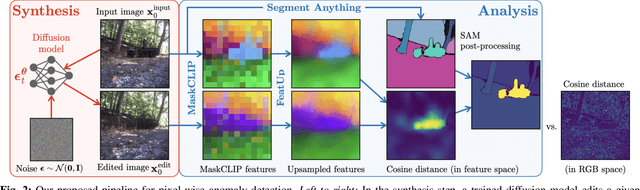

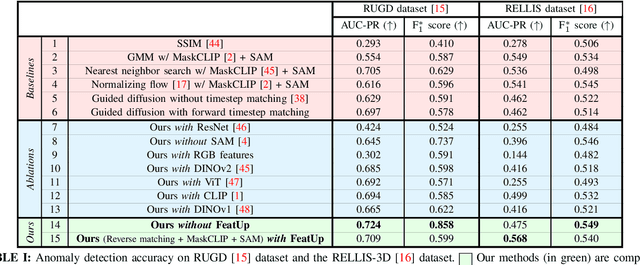
In order to navigate safely and reliably in off-road and unstructured environments, robots must detect anomalies that are out-of-distribution (OOD) with respect to the training data. We present an analysis-by-synthesis approach for pixel-wise anomaly detection without making any assumptions about the nature of OOD data. Given an input image, we use a generative diffusion model to synthesize an edited image that removes anomalies while keeping the remaining image unchanged. Then, we formulate anomaly detection as analyzing which image segments were modified by the diffusion model. We propose a novel inference approach for guided diffusion by analyzing the ideal guidance gradient and deriving a principled approximation that bootstraps the diffusion model to predict guidance gradients. Our editing technique is purely test-time that can be integrated into existing workflows without the need for retraining or fine-tuning. Finally, we use a combination of vision-language foundation models to compare pixels in a learned feature space and detect semantically meaningful edits, enabling accurate anomaly detection for off-road navigation. Project website: https://siddancha.github.io/anomalies-by-diffusion-synthesis/
Win Fast or Lose Slow: Balancing Speed and Accuracy in Latency-Sensitive Decisions of LLMs
May 26, 2025Large language models (LLMs) have shown remarkable performance across diverse reasoning and generation tasks, and are increasingly deployed as agents in dynamic environments such as code generation and recommendation systems. However, many real-world applications, such as high-frequency trading and real-time competitive gaming, require decisions under strict latency constraints, where faster responses directly translate into higher rewards. Despite the importance of this latency quality trade off, it remains underexplored in the context of LLM based agents. In this work, we present the first systematic study of this trade off in real time decision making tasks. To support our investigation, we introduce two new benchmarks: HFTBench, a high frequency trading simulation, and StreetFighter, a competitive gaming platform. Our analysis reveals that optimal latency quality balance varies by task, and that sacrificing quality for lower latency can significantly enhance downstream performance. To address this, we propose FPX, an adaptive framework that dynamically selects model size and quantization level based on real time demands. Our method achieves the best performance on both benchmarks, improving win rate by up to 80% in Street Fighter and boosting daily yield by up to 26.52% in trading, underscoring the need for latency aware evaluation and deployment strategies for LLM based agents. These results demonstrate the critical importance of latency aware evaluation and deployment strategies for real world LLM based agents. Our benchmarks are available at Latency Sensitive Benchmarks.
Follow the Energy, Find the Path: Riemannian Metrics from Energy-Based Models
May 23, 2025What is the shortest path between two data points lying in a high-dimensional space? While the answer is trivial in Euclidean geometry, it becomes significantly more complex when the data lies on a curved manifold -- requiring a Riemannian metric to describe the space's local curvature. Estimating such a metric, however, remains a major challenge in high dimensions. In this work, we propose a method for deriving Riemannian metrics directly from pretrained Energy-Based Models (EBMs) -- a class of generative models that assign low energy to high-density regions. These metrics define spatially varying distances, enabling the computation of geodesics -- shortest paths that follow the data manifold's intrinsic geometry. We introduce two novel metrics derived from EBMs and show that they produce geodesics that remain closer to the data manifold and exhibit lower curvature distortion, as measured by alignment with ground-truth trajectories. We evaluate our approach on increasingly complex datasets: synthetic datasets with known data density, rotated character images with interpretable geometry, and high-resolution natural images embedded in a pretrained VAE latent space. Our results show that EBM-derived metrics consistently outperform established baselines, especially in high-dimensional settings. Our work is the first to derive Riemannian metrics from EBMs, enabling data-aware geodesics and unlocking scalable, geometry-driven learning for generative modeling and simulation.
Learning 3D Persistent Embodied World Models
May 05, 2025
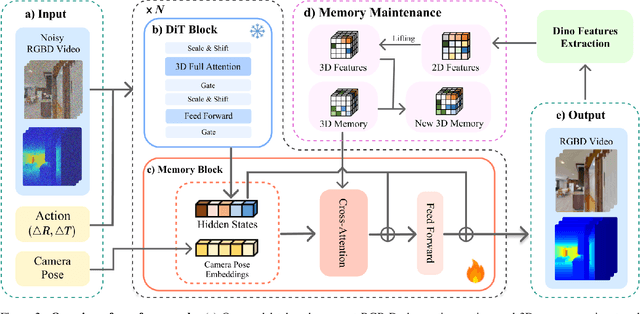
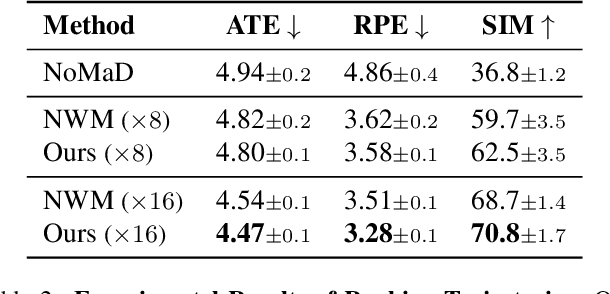
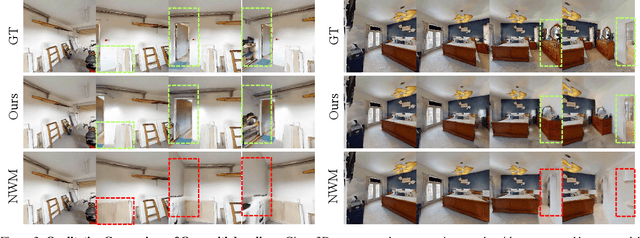
The ability to simulate the effects of future actions on the world is a crucial ability of intelligent embodied agents, enabling agents to anticipate the effects of their actions and make plans accordingly. While a large body of existing work has explored how to construct such world models using video models, they are often myopic in nature, without any memory of a scene not captured by currently observed images, preventing agents from making consistent long-horizon plans in complex environments where many parts of the scene are partially observed. We introduce a new persistent embodied world model with an explicit memory of previously generated content, enabling much more consistent long-horizon simulation. During generation time, our video diffusion model predicts RGB-D video of the future observations of the agent. This generation is then aggregated into a persistent 3D map of the environment. By conditioning the video model on this 3D spatial map, we illustrate how this enables video world models to faithfully simulate both seen and unseen parts of the world. Finally, we illustrate the efficacy of such a world model in downstream embodied applications, enabling effective planning and policy learning.
TesserAct: Learning 4D Embodied World Models
Apr 29, 2025
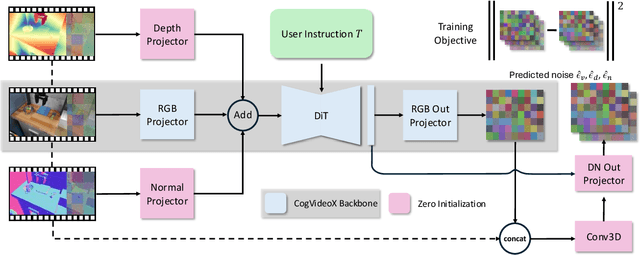
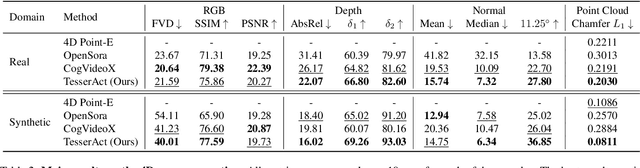
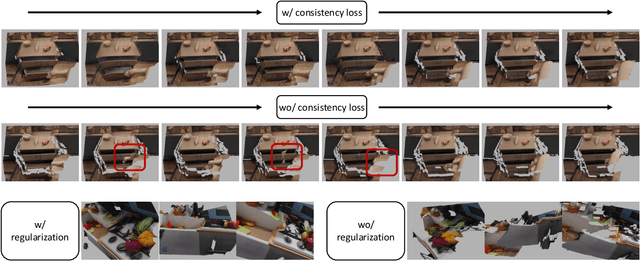
This paper presents an effective approach for learning novel 4D embodied world models, which predict the dynamic evolution of 3D scenes over time in response to an embodied agent's actions, providing both spatial and temporal consistency. We propose to learn a 4D world model by training on RGB-DN (RGB, Depth, and Normal) videos. This not only surpasses traditional 2D models by incorporating detailed shape, configuration, and temporal changes into their predictions, but also allows us to effectively learn accurate inverse dynamic models for an embodied agent. Specifically, we first extend existing robotic manipulation video datasets with depth and normal information leveraging off-the-shelf models. Next, we fine-tune a video generation model on this annotated dataset, which jointly predicts RGB-DN (RGB, Depth, and Normal) for each frame. We then present an algorithm to directly convert generated RGB, Depth, and Normal videos into a high-quality 4D scene of the world. Our method ensures temporal and spatial coherence in 4D scene predictions from embodied scenarios, enables novel view synthesis for embodied environments, and facilitates policy learning that significantly outperforms those derived from prior video-based world models.
Generative AI in Embodied Systems: System-Level Analysis of Performance, Efficiency and Scalability
Apr 26, 2025Embodied systems, where generative autonomous agents engage with the physical world through integrated perception, cognition, action, and advanced reasoning powered by large language models (LLMs), hold immense potential for addressing complex, long-horizon, multi-objective tasks in real-world environments. However, deploying these systems remains challenging due to prolonged runtime latency, limited scalability, and heightened sensitivity, leading to significant system inefficiencies. In this paper, we aim to understand the workload characteristics of embodied agent systems and explore optimization solutions. We systematically categorize these systems into four paradigms and conduct benchmarking studies to evaluate their task performance and system efficiency across various modules, agent scales, and embodied tasks. Our benchmarking studies uncover critical challenges, such as prolonged planning and communication latency, redundant agent interactions, complex low-level control mechanisms, memory inconsistencies, exploding prompt lengths, sensitivity to self-correction and execution, sharp declines in success rates, and reduced collaboration efficiency as agent numbers increase. Leveraging these profiling insights, we suggest system optimization strategies to improve the performance, efficiency, and scalability of embodied agents across different paradigms. This paper presents the first system-level analysis of embodied AI agents, and explores opportunities for advancing future embodied system design.