 Add to Chrome
 Add to Firefox
 Add to Edge
GigaBrain-0.7: Scaling Embodied Foundation Models to Emergent Capabilities with a Three-System Architecture
Aug 16, 2026
Vision-language-action (VLA) models have become a dominant paradigm for generalist embodied agents, demonstrating strong complex and long-horizon task completion in structured settings. Yet it remains an open question whether current VLA systems can benefit from more effective architectural design, scale to substantially larger and more heterogeneous data regimes, and achieve broader generalization across tasks and embodiments. To this end, we present GigaBrain-0.7, an embodied foundation model with substantially improved generalization across diverse robot embodiments. Specifically, GigaBrain-0.7 unifies understanding, prediction, and action through a three-system architecture, scales pretraining to over 37,000 hours of heterogeneous embodied data, and introduces one-stage alignment training that jointly optimizes vision-language understanding and multi-embodiment action generation. Compared with the preceding GigaBrain-0 series and prior state-of-the-art models including $π_{0.5}$, GigaBrain-0.7 achieves substantial improvements in foundation zero-shot capabilities, language-conditioned instruction following, and post-training task success rates. In particular, on our in-house Maker H01 platform and mainstream robot embodiments, GigaBrain-0.7 demonstrates strong task adaptability and completion ability across both home and industrial scenarios. All training code and pretrained model weights will be released.

EMBER: Efficient Memory via Budgeted Evidence Retention for Long-Horizon Agents
Jun 04, 2026Long-horizon agents can archive large histories, but future answers still incur retrieval, rereading, and context costs. When retained memory misses answer-relevant evidence, the system must return to larger portions of the raw history. We study budgeted evidence survival: before the query is known, which source evidence should be retained so that it remains recoverable and usable under a fixed retained source-evidence token budget? We instantiate this setting as Budgeted Pre-Query Retention, where memory is written during ingestion and later read without access to the full raw stream. We introduce EMBER, a learned retention policy that constructs a compact, source-backed evidence state. EMBER stores evidence capsules: verbatim source excerpts paired with retrieval keys and update metadata, preserving both grounding and read-time access. Post-query outcome feedback trains the writer to preserve evidence across the ingestion-retrieval-answer chain. On LongMemEval-RR, our LongMemEval-derived retained-evidence protocol, EMBER-14B reaches 0.3017 F1 at the 8192-token retained-evidence comparison point, compared with 0.1765 for the strongest non-EMBER budgeted baseline. Across retained source-evidence budgets, EMBER improves F1, Retain-Recall, and Read-Recall, indicating that long-horizon memory depends on retaining evidence within the budget rather than rereading larger histories.
Cast a Wider Net: Coordinated Pass@K Policy Optimization for Code Reasoning
May 26, 2026Repeated sampling with a verifier is the standard way to allocate test-time compute for code generation, with pass@$K$ as the canonical metric. Yet the standard policy class draws $K$ independent samples from a single answer distribution, so attempts often collapse onto near-duplicate reasoning paths and waste the budget on redundant rollouts. This failure is costly in competitive programming, where many problems admit multiple distinct algorithmic strategies and pass@$K$ requires only one correct attempt. We propose Coordinated Pass@$K$ Policy Optimization (CPPO), which turns pass@$K$ generation into joint exploration over strategies: a planner emits a tuple of $K{=}4$ alternative high-level methods, and a shared solver attempts one solution per method. CPPO trains this joint policy with a multiplicative planner reward, $R_{\mathrm{plan}} = J_ψ\cdot R_{\mathrm{out}}$, assigning credit only to valid strategy tuples that lead to verifier-confirmed pass@$K$ success. Across APPS, CodeContests, and LiveCodeBench-v6, CPPO improves pass@$4$ over direct sampling, planning baselines, planner-only SFT, and pass@$K$-oriented RL under the same $K{=}4$ solver-attempt budget, with statistically significant gains on six of nine model--benchmark cells. The largest single gain is $+0.16$ on Qwen3.5-9B LiveCodeBench-v6 over the strongest baseline, PKPO ($0.588 \rightarrow 0.748$; paired bootstrap, $p < 0.05$).
BlitzGS: City-Scale Gaussian Splatting at Lightning Speed
May 13, 2026We present BlitzGS, a distributed 3DGS framework that reduces active Gaussian workload for fast city-scale reconstruction. BlitzGS manages this workload at three coupled levels. At the system level, the framework shards Gaussians across GPUs by index parity rather than spatial blocks. This approach mitigates the cross-block visibility redundancy inherent in spatial partitioning. Furthermore, it distributes each rendering step through a single cross-GPU exchange that routes projected Gaussians to their tile owners. At the model level, scheduled importance-scoring passes shrink the global Gaussian population. During these passes, the framework generates a per-Gaussian visibility weight to bias density-control updates toward contributing primitives and a per-view importance mask for the view-level renderer. At the view level, BlitzGS trims each camera's active set with a distance-based LOD gate to exclude excessively fine primitives for the current frustum and the importance-based culling mask to skip Gaussians with negligible cross-view contribution. On large-scale benchmarks, BlitzGS matches the rendering quality of recent large-scale baselines while delivering an order-of-magnitude speedup, training city-scale scenes in tens of minutes. Our code is available at https: //github.com/AkierRaee/BlitzGS.
GigaBrain-0.5M*: a VLA That Learns From World Model-Based Reinforcement Learning
Feb 12, 2026Vision-language-action (VLA) models that directly predict multi-step action chunks from current observations face inherent limitations due to constrained scene understanding and weak future anticipation capabilities. In contrast, video world models pre-trained on web-scale video corpora exhibit robust spatiotemporal reasoning and accurate future prediction, making them a natural foundation for enhancing VLA learning. Therefore, we propose \textit{GigaBrain-0.5M*}, a VLA model trained via world model-based reinforcement learning. Built upon \textit{GigaBrain-0.5}, which is pre-trained on over 10,000 hours of robotic manipulation data, whose intermediate version currently ranks first on the international RoboChallenge benchmark. \textit{GigaBrain-0.5M*} further integrates world model-based reinforcement learning via \textit{RAMP} (Reinforcement leArning via world Model-conditioned Policy) to enable robust cross-task adaptation. Empirical results demonstrate that \textit{RAMP} achieves substantial performance gains over the RECAP baseline, yielding improvements of approximately 30\% on challenging tasks including \texttt{Laundry Folding}, \texttt{Box Packing}, and \texttt{Espresso Preparation}. Critically, \textit{GigaBrain-0.5M$^*$} exhibits reliable long-horizon execution, consistently accomplishing complex manipulation tasks without failure as validated by real-world deployment videos on our \href{https://gigabrain05m.github.io}{project page}.
GVGS: Gaussian Visibility-Aware Multi-View Geometry for Accurate Surface Reconstruction
Jan 28, 20263D Gaussian Splatting enables efficient optimization and high-quality rendering, yet accurate surface reconstruction remains challenging. Prior methods improve surface reconstruction by refining Gaussian depth estimates, either via multi-view geometric consistency or through monocular depth priors. However, multi-view constraints become unreliable under large geometric discrepancies, while monocular priors suffer from scale ambiguity and local inconsistency, ultimately leading to inaccurate Gaussian depth supervision. To address these limitations, we introduce a Gaussian visibility-aware multi-view geometric consistency constraint that aggregates the visibility of shared Gaussian primitives across views, enabling more accurate and stable geometric supervision. In addition, we propose a progressive quadtree-calibrated Monocular depth constraint that performs block-wise affine calibration from coarse to fine spatial scales, mitigating the scale ambiguity of depth priors while preserving fine-grained surface details. Extensive experiments on DTU and TNT datasets demonstrate consistent improvements in geometric accuracy over prior Gaussian-based and implicit surface reconstruction methods. Codes are available at an anonymous repository: https://github.com/GVGScode/GVGS.
Cross-Task Experiential Learning on LLM-based Multi-Agent Collaboration
May 29, 2025Large Language Model-based multi-agent systems (MAS) have shown remarkable progress in solving complex tasks through collaborative reasoning and inter-agent critique. However, existing approaches typically treat each task in isolation, resulting in redundant computations and limited generalization across structurally similar tasks. To address this, we introduce multi-agent cross-task experiential learning (MAEL), a novel framework that endows LLM-driven agents with explicit cross-task learning and experience accumulation. We model the task-solving workflow on a graph-structured multi-agent collaboration network, where agents propagate information and coordinate via explicit connectivity. During the experiential learning phase, we quantify the quality for each step in the task-solving workflow and store the resulting rewards along with the corresponding inputs and outputs into each agent's individual experience pool. During inference, agents retrieve high-reward, task-relevant experiences as few-shot examples to enhance the effectiveness of each reasoning step, thereby enabling more accurate and efficient multi-agent collaboration. Experimental results on diverse datasets demonstrate that MAEL empowers agents to learn from prior task experiences effectively-achieving faster convergence and producing higher-quality solutions on current tasks.
FL-PLAS: Federated Learning with Partial Layer Aggregation for Backdoor Defense Against High-Ratio Malicious Clients
May 17, 2025Federated learning (FL) is gaining increasing attention as an emerging collaborative machine learning approach, particularly in the context of large-scale computing and data systems. However, the fundamental algorithm of FL, Federated Averaging (FedAvg), is susceptible to backdoor attacks. Although researchers have proposed numerous defense algorithms, two significant challenges remain. The attack is becoming more stealthy and harder to detect, and current defense methods are unable to handle 50\% or more malicious users or assume an auxiliary server dataset. To address these challenges, we propose a novel defense algorithm, FL-PLAS, \textbf{F}ederated \textbf{L}earning based on \textbf{P}artial\textbf{ L}ayer \textbf{A}ggregation \textbf{S}trategy. In particular, we divide the local model into a feature extractor and a classifier. In each iteration, the clients only upload the parameters of a feature extractor after local training. The server then aggregates these local parameters and returns the results to the clients. Each client retains its own classifier layer, ensuring that the backdoor labels do not impact other clients. We assess the effectiveness of FL-PLAS against state-of-the-art (SOTA) backdoor attacks on three image datasets and compare our approach to six defense strategies. The results of the experiment demonstrate that our methods can effectively protect local models from backdoor attacks. Without requiring any auxiliary dataset for the server, our method achieves a high main-task accuracy with a lower backdoor accuracy even under the condition of 90\% malicious users with the attacks of trigger, semantic and edge-case.
HUG: Hierarchical Urban Gaussian Splatting with Block-Based Reconstruction
Apr 23, 2025As urban 3D scenes become increasingly complex and the demand for high-quality rendering grows, efficient scene reconstruction and rendering techniques become crucial. We present HUG, a novel approach to address inefficiencies in handling large-scale urban environments and intricate details based on 3D Gaussian splatting. Our method optimizes data partitioning and the reconstruction pipeline by incorporating a hierarchical neural Gaussian representation. We employ an enhanced block-based reconstruction pipeline focusing on improving reconstruction quality within each block and reducing the need for redundant training regions around block boundaries. By integrating neural Gaussian representation with a hierarchical architecture, we achieve high-quality scene rendering at a low computational cost. This is demonstrated by our state-of-the-art results on public benchmarks, which prove the effectiveness and advantages in large-scale urban scene representation.
PalmBench: A Comprehensive Benchmark of Compressed Large Language Models on Mobile Platforms
Oct 05, 2024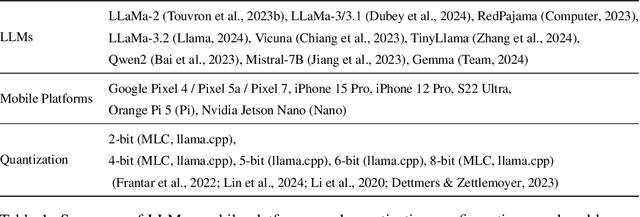

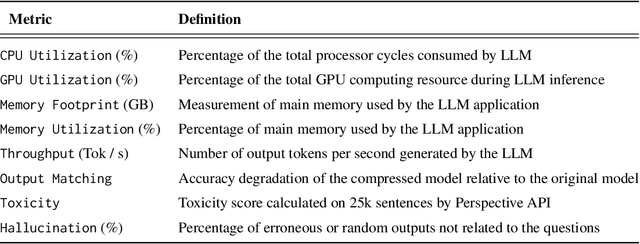

Deploying large language models (LLMs) locally on mobile devices is advantageous in scenarios where transmitting data to remote cloud servers is either undesirable due to privacy concerns or impractical due to network connection. Recent advancements (MLC, 2023a; Gerganov, 2023) have facilitated the local deployment of LLMs. However, local deployment also presents challenges, particularly in balancing quality (generative performance), latency, and throughput within the hardware constraints of mobile devices. In this paper, we introduce our lightweight, all-in-one automated benchmarking framework that allows users to evaluate LLMs on mobile devices. We provide a comprehensive benchmark of various popular LLMs with different quantization configurations (both weights and activations) across multiple mobile platforms with varying hardware capabilities. Unlike traditional benchmarks that assess full-scale models on high-end GPU clusters, we focus on evaluating resource efficiency (memory and power consumption) and harmful output for compressed models on mobile devices. Our key observations include i) differences in energy efficiency and throughput across mobile platforms; ii) the impact of quantization on memory usage, GPU execution time, and power consumption; and iii) accuracy and performance degradation of quantized models compared to their non-quantized counterparts; and iv) the frequency of hallucinations and toxic content generated by compressed LLMs on mobile devices.