 Add to Chrome
 Add to Firefox
 Add to Edge
GigaBrain-0.7: Scaling Embodied Foundation Models to Emergent Capabilities with a Three-System Architecture
Aug 16, 2026
Vision-language-action (VLA) models have become a dominant paradigm for generalist embodied agents, demonstrating strong complex and long-horizon task completion in structured settings. Yet it remains an open question whether current VLA systems can benefit from more effective architectural design, scale to substantially larger and more heterogeneous data regimes, and achieve broader generalization across tasks and embodiments. To this end, we present GigaBrain-0.7, an embodied foundation model with substantially improved generalization across diverse robot embodiments. Specifically, GigaBrain-0.7 unifies understanding, prediction, and action through a three-system architecture, scales pretraining to over 37,000 hours of heterogeneous embodied data, and introduces one-stage alignment training that jointly optimizes vision-language understanding and multi-embodiment action generation. Compared with the preceding GigaBrain-0 series and prior state-of-the-art models including $π_{0.5}$, GigaBrain-0.7 achieves substantial improvements in foundation zero-shot capabilities, language-conditioned instruction following, and post-training task success rates. In particular, on our in-house Maker H01 platform and mainstream robot embodiments, GigaBrain-0.7 demonstrates strong task adaptability and completion ability across both home and industrial scenarios. All training code and pretrained model weights will be released.

TD^2-Net: Toward Denoising and Debiasing for Dynamic Scene Graph Generation
Jan 23, 2024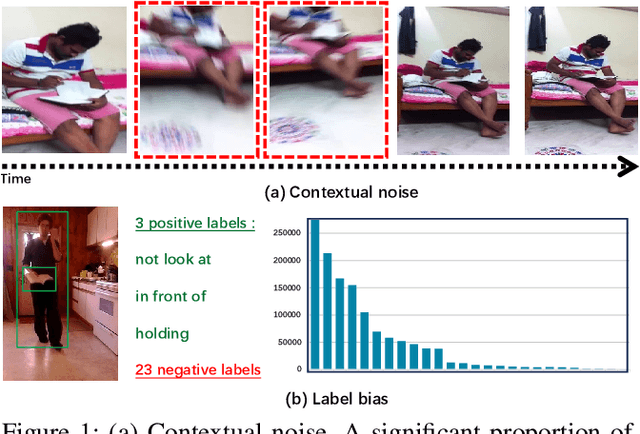
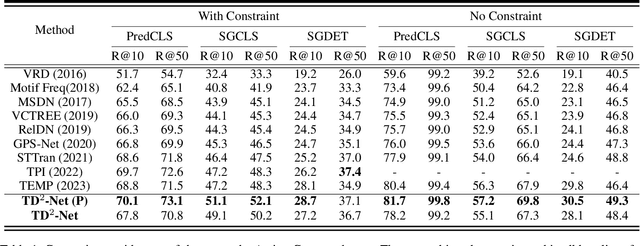
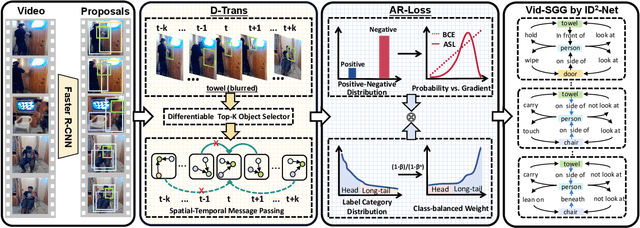
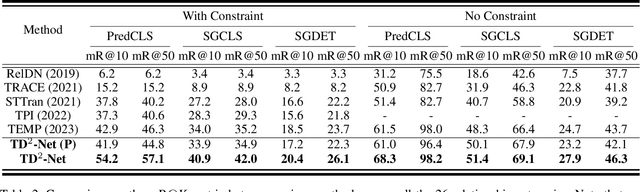
Dynamic scene graph generation (SGG) focuses on detecting objects in a video and determining their pairwise relationships. Existing dynamic SGG methods usually suffer from several issues, including 1) Contextual noise, as some frames might contain occluded and blurred objects. 2) Label bias, primarily due to the high imbalance between a few positive relationship samples and numerous negative ones. Additionally, the distribution of relationships exhibits a long-tailed pattern. To address the above problems, in this paper, we introduce a network named TD$^2$-Net that aims at denoising and debiasing for dynamic SGG. Specifically, we first propose a denoising spatio-temporal transformer module that enhances object representation with robust contextual information. This is achieved by designing a differentiable Top-K object selector that utilizes the gumbel-softmax sampling strategy to select the relevant neighborhood for each object. Second, we introduce an asymmetrical reweighting loss to relieve the issue of label bias. This loss function integrates asymmetry focusing factors and the volume of samples to adjust the weights assigned to individual samples. Systematic experimental results demonstrate the superiority of our proposed TD$^2$-Net over existing state-of-the-art approaches on Action Genome databases. In more detail, TD$^2$-Net outperforms the second-best competitors by 12.7 \% on mean-Recall@10 for predicate classification.