 Add to Chrome
 Add to Firefox
 Add to Edge
Camel: Frame-Level Bandwidth Estimation for Low-Latency Live Streaming under Video Bitrate Undershooting
Feb 10, 2026
Low-latency live streaming (LLS) has emerged as a popular web application, with many platforms adopting real-time protocols such as WebRTC to minimize end-to-end latency. However, we observe a counter-intuitive phenomenon: even when the actual encoded bitrate does not fully utilize the available bandwidth, stalling events remain frequent. This insufficient bandwidth utilization arises from the intrinsic temporal variations of real-time video encoding, which cause conventional packet-level congestion control algorithms to misestimate available bandwidth. When a high-bitrate frame is suddenly produced, sending at the wrong rate can either trigger packet loss or increase queueing delay, resulting in playback stalls. To address these issues, we present Camel, a novel frame-level congestion control algorithm (CCA) tailored for LLS. Our insight is to use frame-level network feedback to capture the true network capacity, immune to the irregular sending pattern caused by encoding. Camel comprises three key modules: the Bandwidth and Delay Estimator and the Congestion Detector, which jointly determine the average sending rate, and the Bursting Length Controller, which governs the emission pattern to prevent packet loss. We evaluate Camel on both large-scale real-world deployments and controlled simulations. In the real-world platform with 250M users and 2B sessions across 150+ countries, Camel achieves up to a 70.8% increase in 1080P resolution ratio, a 14.4% increase in media bitrate, and up to a 14.1% reduction in stalling ratio. In simulations under undershooting, shallow buffers, and network jitter, Camel outperforms existing congestion control algorithms, with up to 19.8% higher bitrate, 93.0% lower stalling ratio, and 23.9% improvement in bandwidth estimation accuracy.
* 8 pages, 20 figures, to appear in WWW 2026

DoLLM: How Large Language Models Understanding Network Flow Data to Detect Carpet Bombing DDoS
May 13, 2024

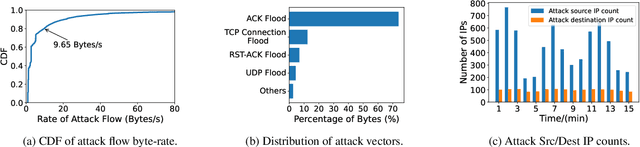
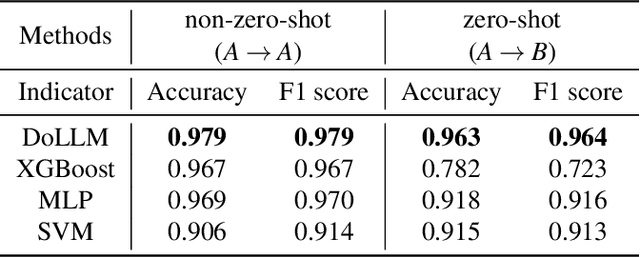
It is an interesting question Can and How Large Language Models (LLMs) understand non-language network data, and help us detect unknown malicious flows. This paper takes Carpet Bombing as a case study and shows how to exploit LLMs' powerful capability in the networking area. Carpet Bombing is a new DDoS attack that has dramatically increased in recent years, significantly threatening network infrastructures. It targets multiple victim IPs within subnets, causing congestion on access links and disrupting network services for a vast number of users. Characterized by low-rates, multi-vectors, these attacks challenge traditional DDoS defenses. We propose DoLLM, a DDoS detection model utilizes open-source LLMs as backbone. By reorganizing non-contextual network flows into Flow-Sequences and projecting them into LLMs semantic space as token embeddings, DoLLM leverages LLMs' contextual understanding to extract flow representations in overall network context. The representations are used to improve the DDoS detection performance. We evaluate DoLLM with public datasets CIC-DDoS2019 and real NetFlow trace from Top-3 countrywide ISP. The tests have proven that DoLLM possesses strong detection capabilities. Its F1 score increased by up to 33.3% in zero-shot scenarios and by at least 20.6% in real ISP traces.