 Add to Chrome
 Add to Firefox
 Add to Edge
Evaluating and Pricing Advertisements in AI-Generated Responses
Jul 30, 2026
As search increasingly shifts toward LLM-driven answer engines, advertising is becoming embedded within the generated response itself and should therefore be evaluated for both user utility and commercial value. The key challenge is click-through intent: behavioural logs are unavailable, human annotation resists calibration, and frontier LLM judges conflate intent with linguistic fluency. These gaps compound, as principled pricing presupposes a continuous intent signal, while generating such a signal presupposes supervision that is currently unavailable. We construct the missing supervision through a psychologically grounded agent simulation framework, and distil it into a parameter-efficient evaluator that predicts click-through intent, together with the three companion dimensions of ad quality, as smooth, differentiable estimates. Validated through sign-certain behavioural perturbations, the evaluator surpasses frontier zero-shot judges on relevance sensitivity (79% versus 60-67%), tracks graded content degradation, generalises without error to 103 fictional products, and agrees with human preference in 86% of pairwise judgements across five annotators, with agreement rising in the evaluator's confidence. Upon its estimates we build the pricing layer directly, deriving the unique payment rule under which truthful bidding is optimal, demonstrating it on a best-of-k allocation, and extending the mechanism to non-monotone allocations. The same differentiable signal stands ready as a training objective for ad generation.

NaiAD: Initiate Data-Driven Research for LLM Advertising
May 11, 2026Reconciling platform revenue with user experience in LLM advertising motivates a data-centric foundation. We introduce NaiAD, the first comprehensive dataset for LLM-native advertising comprising 58,999 carefully constructed ad-embedded responses paired with user queries. NaiAD is organized around theoretically grounded evaluation metrics that separately and comprehensively capture user and commercial utility. To mitigate the dimensional collinearity of aligned LLMs, we propose a decoupled generation pipeline that produces structurally diverse samples, ranging from responses that explicitly disentangle stakeholder utilities to responses that are uniformly strong or weak across dimensions. We further provide score labels calibrated by a Variance-Calibrated Prediction-Powered Inference (VC-PPI) framework, aligning automated scoring with human annotations. Mechanistic analyses reveal that successful ad integration relies on reasoning paths that cluster into four distinct semantic strategies. Models leveraging NaiAD internalize these strategies to simultaneously improve user and commercial utility, while enabling independent control over these distinct objectives via in-context learning. Together, these results position NaiAD as a foundational infrastructure for developing future LLM-native ad systems.
AMA-Bench: Evaluating Long-Horizon Memory for Agentic Applications
Feb 26, 2026Large Language Models (LLMs) are deployed as autonomous agents in increasingly complex applications, where enabling long-horizon memory is critical for achieving strong performance. However, a significant gap exists between practical applications and current evaluation standards for agent memory: existing benchmarks primarily focus on dialogue-centric, human-agent interactions. In reality, agent memory consists of a continuous stream of agent-environment interactions that are primarily composed of machine-generated representations. To bridge this gap, we introduce AMA-Bench (Agent Memory with Any length), which evaluates long-horizon memory for LLMs in real agentic applications. It features two key components: (1) a set of real-world agentic trajectories across representative agentic applications, paired with expert-curated QA, and (2) a set of synthetic agentic trajectories that scale to arbitrary horizons, paired with rule-based QA. Our comprehensive study shows that existing memory systems underperform on AMA-Bench primarily because they lack causality and objective information and are constrained by the lossy nature of similarity-based retrieval employed by many memory systems. To address these limitations, we propose AMA-Agent, an effective memory system featuring a causality graph and tool-augmented retrieval. Our results demonstrate that AMA-Agent achieves 57.22% average accuracy on AMA-Bench, surpassing the strongest memory system baselines by 11.16%.
MM-OPERA: Benchmarking Open-ended Association Reasoning for Large Vision-Language Models
Oct 30, 2025Large Vision-Language Models (LVLMs) have exhibited remarkable progress. However, deficiencies remain compared to human intelligence, such as hallucination and shallow pattern matching. In this work, we aim to evaluate a fundamental yet underexplored intelligence: association, a cornerstone of human cognition for creative thinking and knowledge integration. Current benchmarks, often limited to closed-ended tasks, fail to capture the complexity of open-ended association reasoning vital for real-world applications. To address this, we present MM-OPERA, a systematic benchmark with 11,497 instances across two open-ended tasks: Remote-Item Association (RIA) and In-Context Association (ICA), aligning association intelligence evaluation with human psychometric principles. It challenges LVLMs to resemble the spirit of divergent thinking and convergent associative reasoning through free-form responses and explicit reasoning paths. We deploy tailored LLM-as-a-Judge strategies to evaluate open-ended outputs, applying process-reward-informed judgment to dissect reasoning with precision. Extensive empirical studies on state-of-the-art LVLMs, including sensitivity analysis of task instances, validity analysis of LLM-as-a-Judge strategies, and diversity analysis across abilities, domains, languages, cultures, etc., provide a comprehensive and nuanced understanding of the limitations of current LVLMs in associative reasoning, paving the way for more human-like and general-purpose AI. The dataset and code are available at https://github.com/MM-OPERA-Bench/MM-OPERA.
KABB: Knowledge-Aware Bayesian Bandits for Dynamic Expert Coordination in Multi-Agent Systems
Feb 11, 2025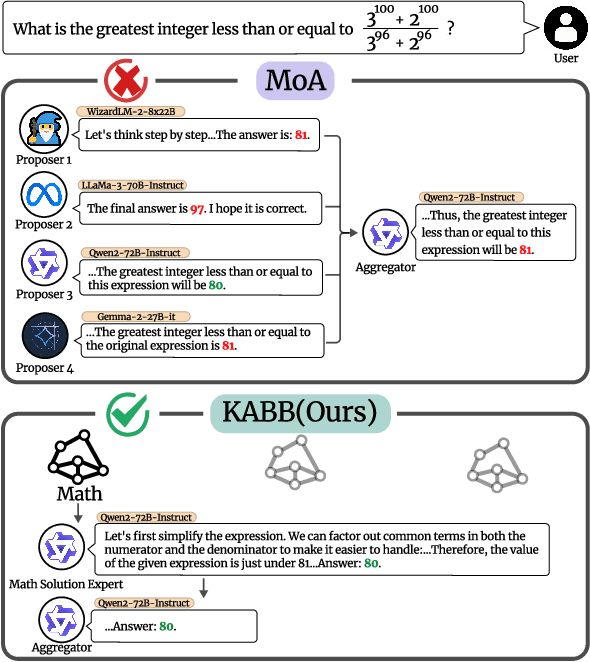
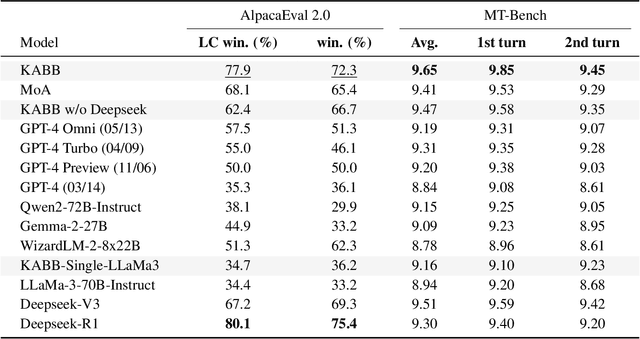
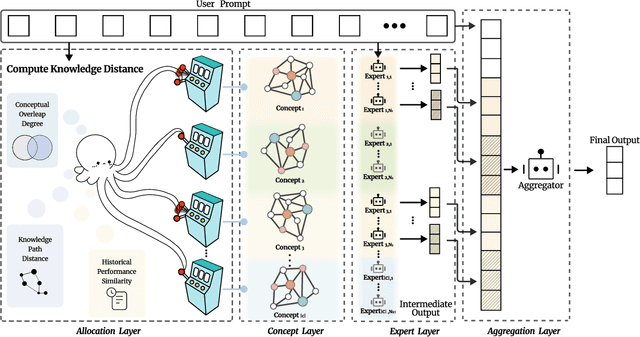
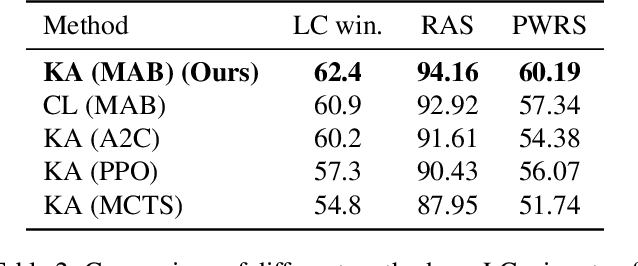
As scaling large language models faces prohibitive costs, multi-agent systems emerge as a promising alternative, though challenged by static knowledge assumptions and coordination inefficiencies. We introduces Knowledge-Aware Bayesian Bandits (KABB), a novel framework that enhances multi-agent system coordination through semantic understanding and dynamic adaptation. The framework features three key innovations: a three-dimensional knowledge distance model for deep semantic understanding, a dual-adaptation mechanism for continuous expert optimization, and a knowledge-aware Thompson Sampling strategy for efficient expert selection. Extensive evaluation demonstrates KABB achieves an optimal cost-performance balance, maintaining high performance while keeping computational demands relatively low in multi-agent coordination.