 Add to Chrome
 Add to Firefox
 Add to Edge
Thinned Mean Field Langevin Dynamics
May 27, 2026
Several important learning tasks can be formulated as minimizing an entropy-regularized objective over an appropriate space of probability distributions. Mean-field Langevin dynamics (MFLD) facilitate computation in this general context, casting the minimizer as the invariant distribution of a McKean--Vlasov process, which can be numerically discretized using $N$ particles and thus simulated. However, simulating this interacting particle system has computational complexity of order $N^2$. Motivated by recent research into \emph{kernel thinning}, we propose \texttt{KT-MFLD}, in which each particle interacts only with a thinned particle coreset of size $\mathcal{O}(N^{\frac{1}{2}})$. \texttt{KT-MFLD} thus reduces the computational complexity to order $N^{\frac{3}{2}}$ while, under mild regularity conditions, achieving the same convergence guarantees (up to logarithmic factors) as MFLD. Our theoretical analysis is empirically confirmed on tasks including the training of student-teacher neural networks, quantization with maximum mean discrepancy, and computation of predictively-oriented posteriors in a post-Bayesian framework.

Sobolev Regularized MMD Gradient Flow
May 12, 2026We propose Sobolev-regularized Maximum Mean Discrepancy (SrMMD) gradient flow, a regularized variant of maximum mean discrepancy (MMD) gradient flow based on a gradient penalty on the witness function. The proposed regularization mitigates the non-convexity of the MMD objective and yields provable \emph{global} convergence guarantees in MMD in both continuous and discrete time. A more surprising appeal is that our convergence analysis does not rely on isoperimetric assumptions on the target distribution. Instead, it is based on a regularity condition on the difference between kernel mean embeddings. A key highlight of the proposed flow is that it is applicable in both sampling (from an unnormalized target distribution) -- using Stein kernels -- and generative modeling settings, unlike previous works, where a gradient flow is suitable for only generative modeling or sampling but not both. The effectiveness of the proposed flow is empirically verified on a broad range of tasks in both generative modelling and sampling.
Fisher Decorator: Refining Flow Policy via A Local Transport Map
Apr 20, 2026Recent advances in flow-based offline reinforcement learning (RL) have achieved strong performance by parameterizing policies via flow matching. However, they still face critical trade-offs among expressiveness, optimality, and efficiency. In particular, existing flow policies interpret the $L_2$ regularization as an upper bound of the 2-Wasserstein distance ($W_2$), which can be problematic in offline settings. This issue stems from a fundamental geometric mismatch: the behavioral policy manifold is inherently anisotropic, whereas the $L_2$ (or upper bound of $W_2$) regularization is isotropic and density-insensitive, leading to systematically misaligned optimization directions. To address this, we revisit offline RL from a geometric perspective and show that policy refinement can be formulated as a local transport map: an initial flow policy augmented by a residual displacement. By analyzing the induced density transformation, we derive a local quadratic approximation of the KL-constrained objective governed by the Fisher information matrix, enabling a tractable anisotropic optimization formulation. By leveraging the score function embedded in the flow velocity, we obtain a corresponding quadratic constraint for efficient optimization. Our results reveal that the optimality gap in prior methods arises from their isotropic approximation. In contrast, our framework achieves a controllable approximation error within a provable neighborhood of the optimal solution. Extensive experiments demonstrate state-of-the-art performance across diverse offline RL benchmarks. See project page: https://github.com/ARC0127/Fisher-Decorator.
The Fourth Challenge on Image Super-Resolution ($\times$4) at NTIRE 2026: Benchmark Results and Method Overview
Apr 16, 2026This paper presents the NTIRE 2026 image super-resolution ($\times$4) challenge, one of the associated competitions of the NTIRE 2026 Workshop at CVPR 2026. The challenge aims to reconstruct high-resolution (HR) images from low-resolution (LR) inputs generated through bicubic downsampling with a $\times$4 scaling factor. The objective is to develop effective super-resolution solutions and analyze recent advances in the field. To reflect the evolving objectives of image super-resolution, the challenge includes two tracks: (1) a restoration track, which emphasizes pixel-wise fidelity and ranks submissions based on PSNR; and (2) a perceptual track, which focuses on visual realism and evaluates results using a perceptual score. A total of 194 participants registered for the challenge, with 31 teams submitting valid entries. This report summarizes the challenge design, datasets, evaluation protocol, main results, and methods of participating teams. The challenge provides a unified benchmark and offers insights into current progress and future directions in image super-resolution.
Degradation-Aware and Structure-Preserving Diffusion for Real-World Image Super-Resolution
Apr 13, 2026Real-world image super-resolution is particularly challenging for diffusion models because real degradations are complex, heterogeneous, and rarely modeled explicitly. We propose a degradation-aware and structure-preserving diffusion framework for real-world SR. Specifically, we introduce Degradation-aware Token Injection, which encodes lightweight degradation statistics from low-resolution inputs and fuses them with semantic conditioning features, enabling explicit degradation-aware restoration. We further propose Spatially Asymmetric Noise Injection, which modulates diffusion noise with local edge strength to better preserve structural regions during training. Both modules are lightweight add-ons to the adopted diffusion SR framework, requiring only minor modifications to the conditioning pipeline. Experiments on DIV2K and RealSR show that our method delivers competitive no-reference perceptual quality and visually more realistic restoration results than recent baselines, while maintaining a favorable perception--distortion trade-off. Ablations confirm the effectiveness of each module and their complementary gains when combined. The code and model are publicly available at https://github.com/jiyang0315/DASP-SR.git.
Efficient Inference for Large Vision-Language Models: Bottlenecks, Techniques, and Prospects
Apr 07, 2026Large Vision-Language Models (LVLMs) enable sophisticated reasoning over images and videos, yet their inference is hindered by a systemic efficiency barrier known as visual token dominance. This overhead is driven by a multi-regime interplay between high-resolution feature extraction, quadratic attention scaling, and memory bandwidth constraints. We present a systematic taxonomy of efficiency techniques structured around the inference lifecycle, consisting of encoding, prefilling, and decoding. Unlike prior reviews focused on isolated optimizations, we analyze the end-to-end pipeline to reveal how upstream decisions dictate downstream bottlenecks, covering compute-bound visual encoding, the intensive prefilling of massive contexts, and the ''visual memory wall'' in bandwidth-bound decoding. By decoupling the efficiency landscape into the axes of shaping information density, managing long-context attention, and overcoming memory limits, this work provides a structured analysis of how isolated optimizations compose to navigate the trade-off between visual fidelity and system efficiency. The survey concludes by outlining four future frontiers supported by pilot empirical insights, including hybrid compression based on functional unit sensitivity, modality-aware decoding with relaxed verification, progressive state management for streaming continuity, and stage-disaggregated serving through hardware-algorithm co-design. The submitted software contains a snapshot of our literature repository, which is designed to be maintained as a living resource for the community.
BayesSum: Bayesian Quadrature in Discrete Spaces
Dec 18, 2025This paper addresses the challenging computational problem of estimating intractable expectations over discrete domains. Existing approaches, including Monte Carlo and Russian Roulette estimators, are consistent but often require a large number of samples to achieve accurate results. We propose a novel estimator, \emph{BayesSum}, which is an extension of Bayesian quadrature to discrete domains. It is more sample efficient than alternatives due to its ability to make use of prior information about the integrand through a Gaussian process. We show this through theory, deriving a convergence rate significantly faster than Monte Carlo in a broad range of settings. We also demonstrate empirically that our proposed method does indeed require fewer samples on several synthetic settings as well as for parameter estimation for Conway-Maxwell-Poisson and Potts models.
Towards a Unified Analysis of Neural Networks in Nonparametric Instrumental Variable Regression: Optimization and Generalization
Nov 18, 2025We establish the first global convergence result of neural networks for two stage least squares (2SLS) approach in nonparametric instrumental variable regression (NPIV). This is achieved by adopting a lifted perspective through mean-field Langevin dynamics (MFLD), unlike standard MFLD, however, our setting of 2SLS entails a \emph{bilevel} optimization problem in the space of probability measures. To address this challenge, we leverage the penalty gradient approach recently developed for bilevel optimization which formulates bilevel optimization as a Lagrangian problem. This leads to a novel fully first-order algorithm, termed \texttt{F$^2$BMLD}. Apart from the convergence bound, we further provide a generalization bound, revealing an inherent trade-off in the choice of the Lagrange multiplier between optimization and statistical guarantees. Finally, we empirically validate the effectiveness of the proposed method on an offline reinforcement learning benchmark.
Stationary MMD Points for Cubature
May 27, 2025Approximation of a target probability distribution using a finite set of points is a problem of fundamental importance, arising in cubature, data compression, and optimisation. Several authors have proposed to select points by minimising a maximum mean discrepancy (MMD), but the non-convexity of this objective precludes global minimisation in general. Instead, we consider \emph{stationary} points of the MMD which, in contrast to points globally minimising the MMD, can be accurately computed. Our main theoretical contribution is the (perhaps surprising) result that, for integrands in the associated reproducing kernel Hilbert space, the cubature error of stationary MMD points vanishes \emph{faster} than the MMD. Motivated by this \emph{super-convergence} property, we consider discretised gradient flows as a practical strategy for computing stationary points of the MMD, presenting a refined convergence analysis that establishes a novel non-asymptotic finite-particle error bound, which may be of independent interest.
Nested Expectations with Kernel Quadrature
Feb 25, 2025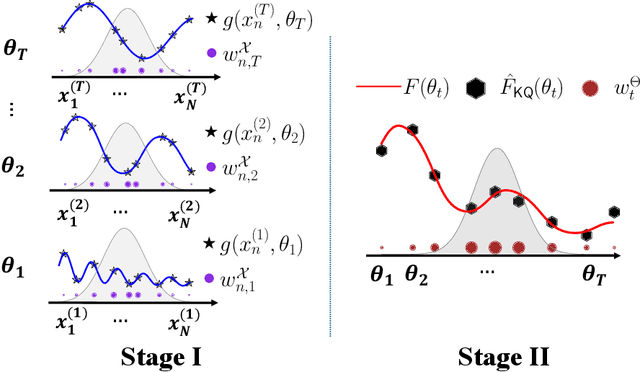
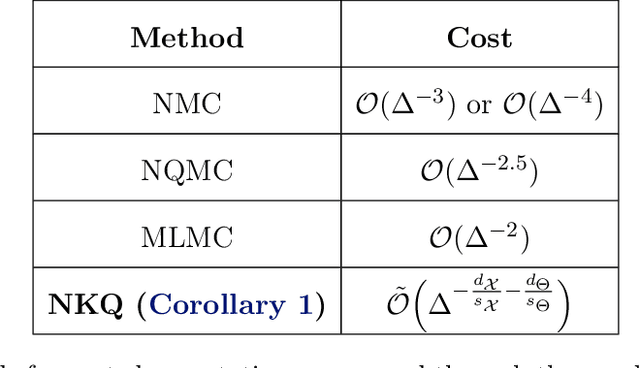
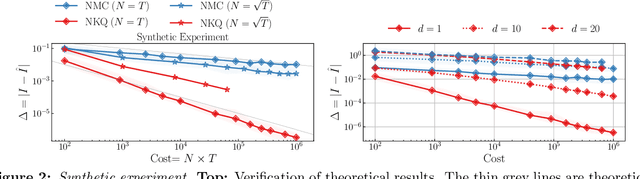
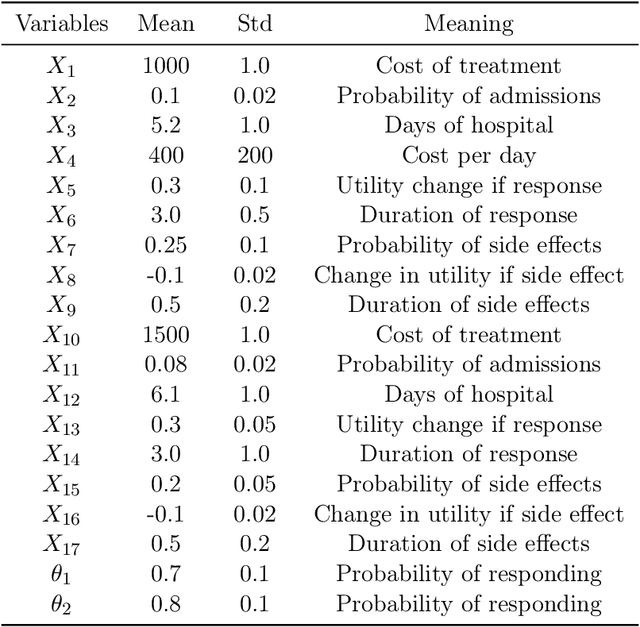
This paper considers the challenging computational task of estimating nested expectations. Existing algorithms, such as nested Monte Carlo or multilevel Monte Carlo, are known to be consistent but require a large number of samples at both inner and outer levels to converge. Instead, we propose a novel estimator consisting of nested kernel quadrature estimators and we prove that it has a faster convergence rate than all baseline methods when the integrands have sufficient smoothness. We then demonstrate empirically that our proposed method does indeed require fewer samples to estimate nested expectations on real-world applications including Bayesian optimisation, option pricing, and health economics.