 Add to Chrome
 Add to Firefox
 Add to Edge
Orthogonal Representation Editing: Decoupling Semantic Entanglement in Batch Knowledge Editing of LLMs
Jun 21, 2026
Knowledge editing aims to efficiently update factual information in Large Language Models (LLMs) without full retraining. However, existing methods still suffer from performance degradation in batch knowledge editing. We identify that semantic representation entanglement, such as overlapping concepts and shared syntactic patterns, accumulates interference in the representation space and reduces editing precision. To bridge this gap, in this paper, we propose Orthogonal Representation Editing (ORE), which performs edits in the hidden representation space of LLMs by constructing a general semantic subspace and enforcing orthogonal constraints on edit vectors, effectively decoupling semantic entanglement. Furthermore, we introduce a gated non-linear representation head to enable adaptive learning of editing locations and precise control over knowledge injection. Extensive experiments show that ORE outperforms existing methods and achieves superior performance in cross-lingual knowledge editing scenarios. We release our code at https://github.com/YVVH/ORE.

Beyond Query Memorization: Large Language Model Routing with Query Decomposition and Historical Matching
May 25, 2026Optimizing the trade-off among predictive performance and computational cost is a central focus in the deployment of Large Language Models (LLMs). Current routing methods primarily rely on direct mapping from queries to models based on surface-level features, making them susceptible to the memorization trap and leading to poor generalizability on out-of-distribution (OOD) data. In this paper, we propose DecoR, a novel routing framework that recasts the routing task as a matching process of sifting similar queries from historical logs, effectively mitigating the memorization trap. To enhance matching accuracy, we introduce a query capability deconstruction method that decouples linguistic surface forms from task-intrinsic requirements, directing matching toward capability dimensions to ground decisions in essential task attributes. Furthermore, we develop CodaSet, a comprehensive benchmark for assessing routing generalization, where experimental results demonstrate that DecoR maintains superior accuracy while substantially lowering inference costs across both in-distribution and OOD settings. All the codes and data are available at https://github.com/lvbotenbest/DecoR.
RouteScan: A Non-Intrusive Approach to Auditing MoE LLMs Safety via Expert Routing Telemetry
May 24, 2026Mixture-of-Experts (MoE) architectures have become an increasingly important paradigm for scaling Large Language Models (LLMs). As MoE models are increasingly deployed in real-world services, safety auditing becomes necessary to verify whether these models produce or facilitate harmful behaviors during operation. However, existing content-based auditing methods typically require access to user prompts, model inputs, or generated outputs, potentially exposing sensitive user information and creating a fundamental tension between LLM safety and user privacy. On the other hand, we observe that, in MoE models, sparse expert routing maps different inputs to activate different expert-execution patterns, producing measurable footprints in low-level GPU execution telemetry. Inspired by this observation, we propose RouteScan, a non-intrusive auditing framework for detecting harmful behaviors through GPU-level expert routing telemetry. Specifically, RouteScan utilizes the number of active GPU threads allocated to expert modules during the prefilling phase as a discriminative micro-architectural fingerprint, and builds a lightweight detection pipeline that isolates cross-domain invariant risk indicators for the precise identification of malicious prompts. Comprehensive evaluations on open-source MoE LLMs with distinct routing designs demonstrate that RouteScan achieves strong generalization, with an AUROC exceeding 0.93 on unseen harmful domains and 0.96 under novel jailbreak wrappers. Moreover, empirical inversion tests show that the collected expert routing telemetry provides limited information for prompt reconstruction, suggesting a practical privacy advantage over content-based auditing methods.
Hy-MT2: A Family of Fast, Efficient and Powerful Multilingual Translation Models in the Wild
May 21, 2026Hy-MT2 is a family of fast-thinking multilingual translation models designed for complex real-world scenarios. It includes three model sizes: 1.8B, 7B, and 30B-A3B (MoE), all of which support translation among 33 languages and effectively follow translation instructions in multiple languages. For on-device deployment, with AngelSlim 1.25-bit extreme quantization, the 1.8B model requires only 440 MB of storage and improves inference speed by 1.5x. Multi-dimensional evaluations show that Hy-MT2 delivers outstanding performance across general, real-world business, domain-specific, and instruction-following translation tasks. The 7B and 30B models outperform open-source models such as DeepSeek-V4-Pro and Kimi K2.6 in fast-thinking mode, while the lightweight 1.8B model also surpasses mainstream commercial APIs from providers such as Microsoft and Doubao overall.
MOGeo: Beyond One-to-One Cross-View Object Geo-localization
Mar 14, 2026Cross-View Object Geo-Localization (CVOGL) aims to locate an object of interest in a query image within a corresponding satellite image. Existing methods typically assume that the query image contains only a single object, which does not align with the complex, multi-object geo-localization requirements in real-world applications, making them unsuitable for practical scenarios. To bridge the gap between the realistic setting and existing task, we propose a new task, called Cross-View Multi-Object Geo-Localization (CVMOGL). To advance the CVMOGL task, we first construct a benchmark, CMLocation, which includes two datasets: CMLocation-V1 and CMLocation-V2. Furthermore, we propose a novel cross-view multi-object geo-localization method, MOGeo, and benchmark it against existing state-of-the-art methods. Extensive experiments are conducted under various application scenarios to validate the effectiveness of our method. The results demonstrate that cross-view object geo-localization in the more realistic setting remains a challenging problem, encouraging further research in this area.
OneLatent: Single-Token Compression for Visual Latent Reasoning
Feb 14, 2026Chain-of-thought (CoT) prompting improves reasoning but often increases inference cost by one to two orders of magnitude. To address these challenges, we present \textbf{OneLatent}, a framework that compresses intermediate reasoning into a single latent token via supervision from rendered CoT images and DeepSeek-OCR hidden states. By rendering textual steps into images, we obtain a deterministic supervision signal that can be inspected and audited without requiring the model to output verbose textual rationales. Across benchmarks, OneLatent reduces average output length by $11\times$ with only a $2.21\%$ average accuracy drop relative to textual CoT, while improving output token contribution (OTC) by $6.8\times$. On long-chain logical reasoning, OneLatent reaches $99.80\%$ on ProntoQA and $97.80\%$ on ProsQA with one latent token, with compression up to $87.4\times$, supporting compression-constrained generalization.
HyCoRA: Hyper-Contrastive Role-Adaptive Learning for Role-Playing
Nov 11, 2025Multi-character role-playing aims to equip models with the capability to simulate diverse roles. Existing methods either use one shared parameterized module across all roles or assign a separate parameterized module to each role. However, the role-shared module may ignore distinct traits of each role, weakening personality learning, while the role-specific module may overlook shared traits across multiple roles, hindering commonality modeling. In this paper, we propose a novel HyCoRA: Hyper-Contrastive Role-Adaptive learning framework, which efficiently improves multi-character role-playing ability by balancing the learning of distinct and shared traits. Specifically, we propose a Hyper-Half Low-Rank Adaptation structure, where one half is a role-specific module generated by a lightweight hyper-network, and the other half is a trainable role-shared module. The role-specific module is devised to represent distinct persona signatures, while the role-shared module serves to capture common traits. Moreover, to better reflect distinct personalities across different roles, we design a hyper-contrastive learning mechanism to help the hyper-network distinguish their unique characteristics. Extensive experimental results on both English and Chinese available benchmarks demonstrate the superiority of our framework. Further GPT-4 evaluations and visual analyses also verify the capability of HyCoRA to capture role characteristics.
GRAPHMOE: Amplifying Cognitive Depth of Mixture-of-Experts Network via Introducing Self-Rethinking Mechanism
Jan 14, 2025
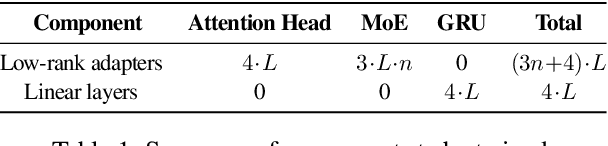

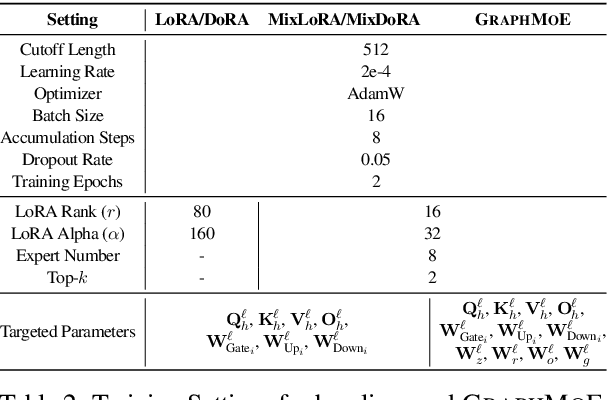
Traditional Mixture-of-Experts (MoE) networks benefit from utilizing multiple smaller expert models as opposed to a single large network. However, these experts typically operate independently, leaving a question open about whether interconnecting these models could enhance the performance of MoE networks. In response, we introduce GRAPHMOE, a novel method aimed at augmenting the cognitive depth of language models via a self-rethinking mechanism constructed on Pseudo GraphMoE networks. GRAPHMOE employs a recurrent routing strategy to simulate iterative thinking steps, thereby facilitating the flow of information among expert nodes. We implement the GRAPHMOE architecture using Low-Rank Adaptation techniques (LoRA) and conduct extensive experiments on various benchmark datasets. The experimental results reveal that GRAPHMOE outperforms other LoRA based models, achieving state-of-the-art (SOTA) performance. Additionally, this study explores a novel recurrent routing strategy that may inspire further advancements in enhancing the reasoning capabilities of language models.
SpecFuse: Ensembling Large Language Models via Next-Segment Prediction
Dec 10, 2024

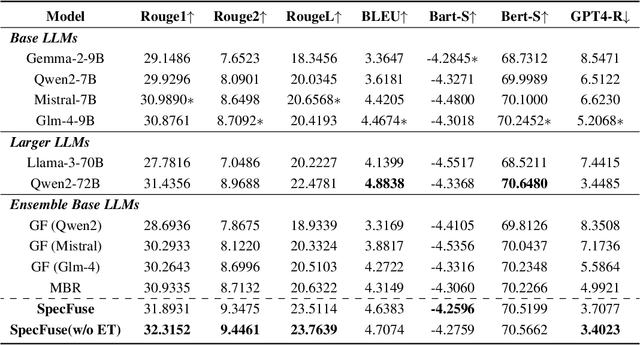

Ensembles of generative large language models (LLMs) can integrate the strengths of different LLMs to compensate for the limitations of individual models. However, recent work has focused on training an additional fusion model to combine complete responses from multiple LLMs, failing to tap into their collaborative potential to generate higher-quality responses. Moreover, as the additional fusion model is trained on a specialized dataset, these methods struggle with generalizing to open-domain queries from online users. In this paper, we propose SpecFuse, a novel ensemble framework that outputs the fused result by iteratively producing the next segment through collaboration among LLMs. This is achieved through cyclic execution of its inference and verification components. In each round, the inference component invokes each base LLM to generate candidate segments in parallel, and the verify component calls these LLMs again to predict the ranking of the segments. The top-ranked segment is then broadcast to all LLMs, encouraging them to generate higher-quality segments in the next round. This approach also allows the base LLMs to be plug-and-play, without any training or adaptation, avoiding generalization limitations. Furthermore, to conserve computational resources, we propose a model exit mechanism that dynamically excludes models exhibiting poor performance in previous rounds during each query response. In this way, it effectively reduces the number of model calls while maintaining overall performance.
KVPruner: Structural Pruning for Faster and Memory-Efficient Large Language Models
Sep 17, 2024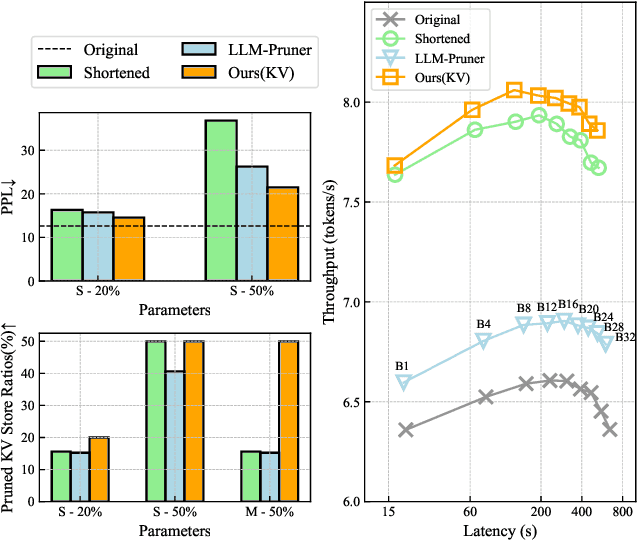
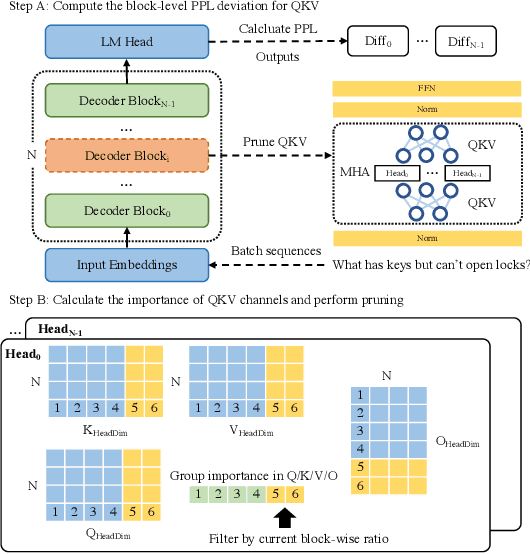
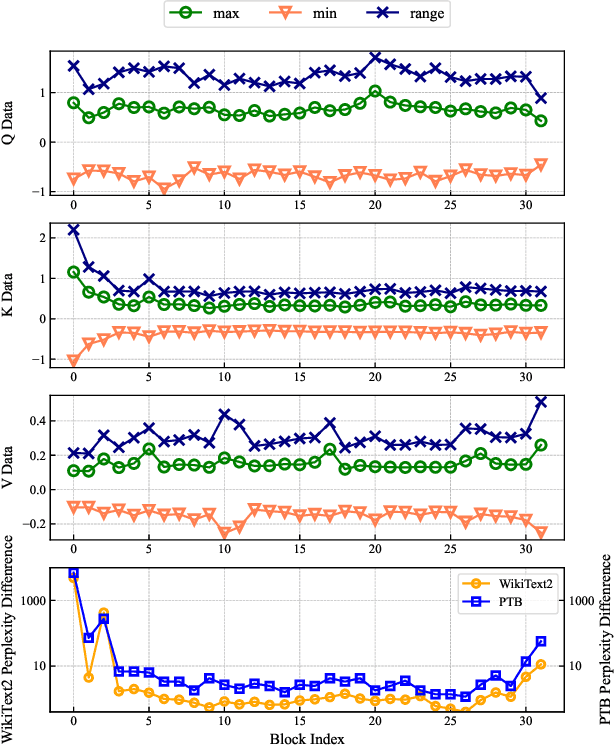
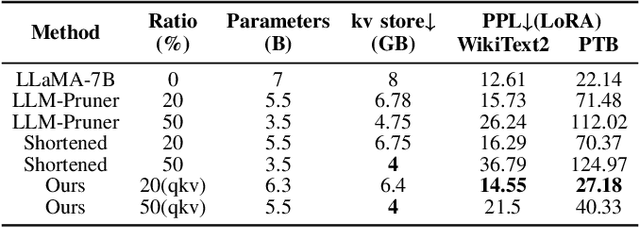
The bottleneck associated with the key-value(KV) cache presents a significant challenge during the inference processes of large language models. While depth pruning accelerates inference, it requires extensive recovery training, which can take up to two weeks. On the other hand, width pruning retains much of the performance but offers slight speed gains. To tackle these challenges, we propose KVPruner to improve model efficiency while maintaining performance. Our method uses global perplexity-based analysis to determine the importance ratio for each block and provides multiple strategies to prune non-essential KV channels within blocks. Compared to the original model, KVPruner reduces runtime memory usage by 50% and boosts throughput by over 35%. Additionally, our method requires only two hours of LoRA fine-tuning on small datasets to recover most of the performance.