 Add to Chrome
 Add to Firefox
 Add to Edge
Mechanistic Circuit-Based Knowledge Editing in Large Language Models
Apr 07, 2026
Deploying Large Language Models (LLMs) in real-world dynamic environments raises the challenge of updating their pre-trained knowledge. While existing knowledge editing methods can reliably patch isolated facts, they frequently suffer from a "Reasoning Gap", where the model recalls the edited fact but fails to utilize it in multi-step reasoning chains. To bridge this gap, we introduce MCircKE (\underline{M}echanistic \underline{Circ}uit-based \underline{K}nowledge \underline{E}diting), a novel framework that enables a precise "map-and-adapt" editing procedure. MCircKE first identifies the causal circuits responsible for a specific reasoning task, capturing both the storage of the fact and the routing of its logical consequences. It then surgically update parameters exclusively within this mapped circuit. Extensive experiments on the MQuAKE-3K benchmark demonstrate the effectiveness of the proposed method for multi-hop reasoning in knowledge editing.

Wired for Overconfidence: A Mechanistic Perspective on Inflated Verbalized Confidence in LLMs
Apr 01, 2026Large language models are often not just wrong, but \emph{confidently wrong}: when they produce factually incorrect answers, they tend to verbalize overly high confidence rather than signal uncertainty. Such verbalized overconfidence can mislead users and weaken confidence scores as a reliable uncertainty signal, yet its internal mechanisms remain poorly understood. We present a circuit-level mechanistic analysis of this inflated verbalized confidence in LLMs, organized around three axes: capturing verbalized confidence as a differentiable internal signal, identifying the circuits that causally inflate it, and leveraging these insights for targeted inference-time recalibration. Across two instruction-tuned LLMs on three datasets, we find that a compact set of MLP blocks and attention heads, concentrated in middle-to-late layers, consistently writes the confidence-inflation signal at the final token position. We further show that targeted inference-time interventions on these circuits substantially improve calibration. Together, our results suggest that verbalized overconfidence in LLMs is driven by identifiable internal circuits and can be mitigated through targeted intervention.
IAPO: Information-Aware Policy Optimization for Token-Efficient Reasoning
Feb 22, 2026Large language models increasingly rely on long chains of thought to improve accuracy, yet such gains come with substantial inference-time costs. We revisit token-efficient post-training and argue that existing sequence-level reward-shaping methods offer limited control over how reasoning effort is allocated across tokens. To bridge the gap, we propose IAPO, an information-theoretic post-training framework that assigns token-wise advantages based on each token's conditional mutual information (MI) with the final answer. This yields an explicit, principled mechanism for identifying informative reasoning steps and suppressing low-utility exploration. We provide a theoretical analysis showing that our IAPO can induce monotonic reductions in reasoning verbosity without harming correctness. Empirically, IAPO consistently improves reasoning accuracy while reducing reasoning length by up to 36%, outperforming existing token-efficient RL methods across various reasoning datasets. Extensive empirical evaluations demonstrate that information-aware advantage shaping is a powerful and general direction for token-efficient post-training. The code is available at https://github.com/YinhanHe123/IAPO.
Global Graph Counterfactual Explanation: A Subgraph Mapping Approach
Oct 25, 2024
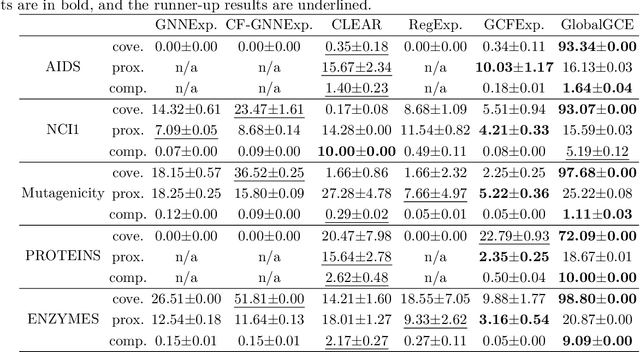

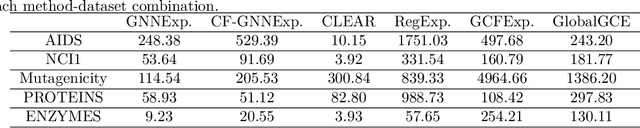
Graph Neural Networks (GNNs) have been widely deployed in various real-world applications. However, most GNNs are black-box models that lack explanations. One strategy to explain GNNs is through counterfactual explanation, which aims to find minimum perturbations on input graphs that change the GNN predictions. Existing works on GNN counterfactual explanations primarily concentrate on the local-level perspective (i.e., generating counterfactuals for each individual graph), which suffers from information overload and lacks insights into the broader cross-graph relationships. To address such issues, we propose GlobalGCE, a novel global-level graph counterfactual explanation method. GlobalGCE aims to identify a collection of subgraph mapping rules as counterfactual explanations for the target GNN. According to these rules, substituting certain significant subgraphs with their counterfactual subgraphs will change the GNN prediction to the desired class for most graphs (i.e., maximum coverage). Methodologically, we design a significant subgraph generator and a counterfactual subgraph autoencoder in our GlobalGCE, where the subgraphs and the rules can be effectively generated. Extensive experiments demonstrate the superiority of our GlobalGCE compared to existing baselines. Our code can be found at https://anonymous.4open.science/r/GlobalGCE-92E8.