 Add to Chrome
 Add to Firefox
 Add to Edge
Implicit Reasoning for Large Language Model-based Generative Recommendation
Jun 12, 2026
Large Language Models (LLMs) are increasingly adopted as backbones for Generative Recommendation (GR), promising access to pretrained world knowledge. Yet reliably invoking this knowledge for GR remains poorly understood. A key obstacle is that LLM-based GR typically represents items with Semantic IDs (SIDs), disrupting LLMs' natural-language reasoning interface because these tokens are unseen by the LLM during pretraining. Existing approaches address this with expensive multi-stage pipelines that ground SIDs and elicit explicit rationales, but offer limited insight into when and why each stage is necessary. In this work, we systematically decompose explicit reasoning training pipelines for LLM-based GR, revealing three key limitations: weakened world-knowledge verbalization, misalignment between SID and natural-language token embedding spaces, and sensitivity to rationale quality, all of which hurt explicit reasoning performance. To circumvent these issues, we propose PauseRec, a lightweight implicit reasoning paradigm tailored for GR. PauseRec is exceptionally practical, avoiding costly reasoning trace acquisition and reasoning alignment training, leading to a multitude of benefits: (1) it outperforms standard explicit CoT methods by up to 6.22%, (2) it reduces training cost by up to 65% GPU hours, and (3) it speeds up inference by up to 71.3%. These results position PauseRec as a lightweight alternative to explicit rationale generation, enabling more effective and efficient LLM-based GR.

Mult-DPO: Multinomial Direct Preference Optimization for Recommender Systems
Jun 08, 2026Direct preference optimization (DPO) is a simple and effective alignment strategy for large language models (LLMs) based on pairwise preferences. In recommender systems, however, user feedback is rarely pairwise. For a given context, e.g., a user, a session, or a conversation, we typically observe set-wise preferences with multiple positive items, where every positive item should outrank every unobserved or explicitly negative item, with no prescribed order among the positives or the negatives themselves. A natural generalization is to use the Plackett-Luce (PL) reward model, which extends the Bradley-Terry reward model underlying vanilla DPO from pairwise preferences to full rankings of candidates. However, we show that adapting the PL model to set-wise preferences requires marginalizing over all positive orderings, where the resulting expression is combinatorial in complexity. To address this fundamental challenge, we propose Mult-DPO, a novel DPO objective with a tractable multinomial surrogate likelihood over set-wise preference events for the user-preference alignment of LLM-based recommender systems. The multinomial construction is not itself a ranking distribution, but it is defined on the same reward-induced weight space and admits a closed-form DPO-style objective, enabling direct alignment of LLMs with multiple candidates through a classification-style objective. In addition, we prove that the multinomial DPO loss is a tractable upper bound on the marginalized PL DPO loss when optimizing against the set-wise preference data. We further characterize the tightness of this bound in terms of the relative total weight of positives versus negatives, which provides insights into tightening the bound with richer or harder negatives. Finally, we extend Mult-DPO to the alignment of LLMs with multiple preference levels. Code is available at https://github.com/yaochenzhu/Mult_DPO
Mechanistic Circuit-Based Knowledge Editing in Large Language Models
Apr 07, 2026Deploying Large Language Models (LLMs) in real-world dynamic environments raises the challenge of updating their pre-trained knowledge. While existing knowledge editing methods can reliably patch isolated facts, they frequently suffer from a "Reasoning Gap", where the model recalls the edited fact but fails to utilize it in multi-step reasoning chains. To bridge this gap, we introduce MCircKE (\underline{M}echanistic \underline{Circ}uit-based \underline{K}nowledge \underline{E}diting), a novel framework that enables a precise "map-and-adapt" editing procedure. MCircKE first identifies the causal circuits responsible for a specific reasoning task, capturing both the storage of the fact and the routing of its logical consequences. It then surgically update parameters exclusively within this mapped circuit. Extensive experiments on the MQuAKE-3K benchmark demonstrate the effectiveness of the proposed method for multi-hop reasoning in knowledge editing.
Wired for Overconfidence: A Mechanistic Perspective on Inflated Verbalized Confidence in LLMs
Apr 01, 2026Large language models are often not just wrong, but \emph{confidently wrong}: when they produce factually incorrect answers, they tend to verbalize overly high confidence rather than signal uncertainty. Such verbalized overconfidence can mislead users and weaken confidence scores as a reliable uncertainty signal, yet its internal mechanisms remain poorly understood. We present a circuit-level mechanistic analysis of this inflated verbalized confidence in LLMs, organized around three axes: capturing verbalized confidence as a differentiable internal signal, identifying the circuits that causally inflate it, and leveraging these insights for targeted inference-time recalibration. Across two instruction-tuned LLMs on three datasets, we find that a compact set of MLP blocks and attention heads, concentrated in middle-to-late layers, consistently writes the confidence-inflation signal at the final token position. We further show that targeted inference-time interventions on these circuits substantially improve calibration. Together, our results suggest that verbalized overconfidence in LLMs is driven by identifiable internal circuits and can be mitigated through targeted intervention.
IAPO: Information-Aware Policy Optimization for Token-Efficient Reasoning
Feb 22, 2026Large language models increasingly rely on long chains of thought to improve accuracy, yet such gains come with substantial inference-time costs. We revisit token-efficient post-training and argue that existing sequence-level reward-shaping methods offer limited control over how reasoning effort is allocated across tokens. To bridge the gap, we propose IAPO, an information-theoretic post-training framework that assigns token-wise advantages based on each token's conditional mutual information (MI) with the final answer. This yields an explicit, principled mechanism for identifying informative reasoning steps and suppressing low-utility exploration. We provide a theoretical analysis showing that our IAPO can induce monotonic reductions in reasoning verbosity without harming correctness. Empirically, IAPO consistently improves reasoning accuracy while reducing reasoning length by up to 36%, outperforming existing token-efficient RL methods across various reasoning datasets. Extensive empirical evaluations demonstrate that information-aware advantage shaping is a powerful and general direction for token-efficient post-training. The code is available at https://github.com/YinhanHe123/IAPO.
Saliency-Aware Multi-Route Thinking: Revisiting Vision-Language Reasoning
Feb 18, 2026Vision-language models (VLMs) aim to reason by jointly leveraging visual and textual modalities. While allocating additional inference-time computation has proven effective for large language models (LLMs), achieving similar scaling in VLMs remains challenging. A key obstacle is that visual inputs are typically provided only once at the start of generation, while textual reasoning (e.g., early visual summaries) is generated autoregressively, causing reasoning to become increasingly text-dominated and allowing early visual grounding errors to accumulate. Moreover, vanilla guidance for visual grounding during inference is often coarse and noisy, making it difficult to steer reasoning over long texts. To address these challenges, we propose \emph{Saliency-Aware Principle} (SAP) selection. SAP operates on high-level reasoning principles rather than token-level trajectories, which enable stable control over discrete generation under noisy feedback while allowing later reasoning steps to re-consult visual evidence when renewed grounding is required. In addition, SAP supports multi-route inference, enabling parallel exploration of diverse reasoning behaviors. SAP is model-agnostic and data-free, requiring no additional training. Empirical results show that SAP achieves competitive performance, especially in reducing object hallucination, under comparable token-generation budgets while yielding more stable reasoning and lower response latency than CoT-style long sequential reasoning.
PhysicsAgentABM: Physics-Guided Generative Agent-Based Modeling
Feb 05, 2026Large language model (LLM)-based multi-agent systems enable expressive agent reasoning but are expensive to scale and poorly calibrated for timestep-aligned state-transition simulation, while classical agent-based models (ABMs) offer interpretability but struggle to integrate rich individual-level signals and non-stationary behaviors. We propose PhysicsAgentABM, which shifts inference to behaviorally coherent agent clusters: state-specialized symbolic agents encode mechanistic transition priors, a multimodal neural transition model captures temporal and interaction dynamics, and uncertainty-aware epistemic fusion yields calibrated cluster-level transition distributions. Individual agents then stochastically realize transitions under local constraints, decoupling population inference from entity-level variability. We further introduce ANCHOR, an LLM agent-driven clustering strategy based on cross-contextual behavioral responses and a novel contrastive loss, reducing LLM calls by up to 6-8 times. Experiments across public health, finance, and social sciences show consistent gains in event-time accuracy and calibration over mechanistic, neural, and LLM baselines. By re-architecting generative ABM around population-level inference with uncertainty-aware neuro-symbolic fusion, PhysicsAgentABM establishes a new paradigm for scalable and calibrated simulation with LLMs.
MolEdit: Knowledge Editing for Multimodal Molecule Language Models
Nov 16, 2025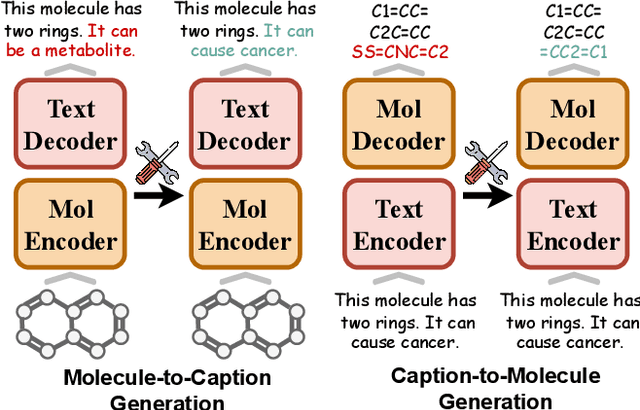
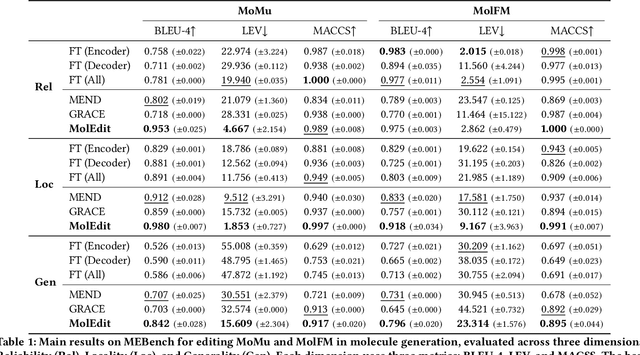
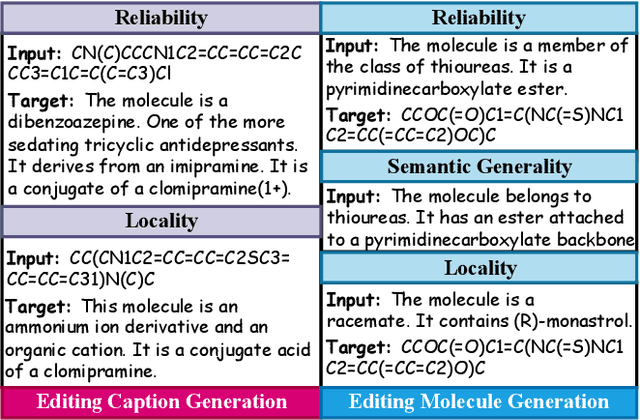
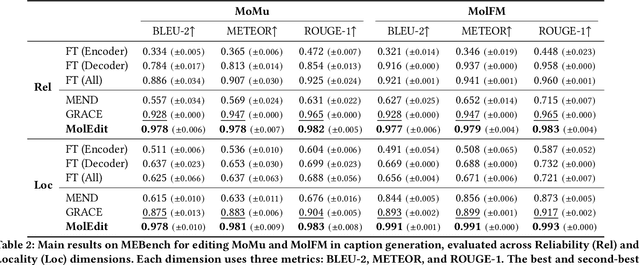
Understanding and continuously refining multimodal molecular knowledge is crucial for advancing biomedicine, chemistry, and materials science. Molecule language models (MoLMs) have become powerful tools in these domains, integrating structural representations (e.g., SMILES strings, molecular graphs) with rich contextual descriptions (e.g., physicochemical properties). However, MoLMs can encode and propagate inaccuracies due to outdated web-mined training corpora or malicious manipulation, jeopardizing downstream discovery pipelines. While knowledge editing has been explored for general-domain AI, its application to MoLMs remains uncharted, presenting unique challenges due to the multifaceted and interdependent nature of molecular knowledge. In this paper, we take the first step toward MoLM editing for two critical tasks: molecule-to-caption generation and caption-to-molecule generation. To address molecule-specific challenges, we propose MolEdit, a powerful framework that enables targeted modifications while preserving unrelated molecular knowledge. MolEdit combines a Multi-Expert Knowledge Adapter that routes edits to specialized experts for different molecular facets with an Expertise-Aware Editing Switcher that activates the adapters only when input closely matches the stored edits across all expertise, minimizing interference with unrelated knowledge. To systematically evaluate editing performance, we introduce MEBench, a comprehensive benchmark assessing multiple dimensions, including Reliability (accuracy of the editing), Locality (preservation of irrelevant knowledge), and Generality (robustness to reformed queries). Across extensive experiments on two popular MoLM backbones, MolEdit delivers up to 18.8% higher Reliability and 12.0% better Locality than baselines while maintaining efficiency. The code is available at: https://github.com/LzyFischer/MolEdit.
Virtual Nodes Can Help: Tackling Distribution Shifts in Federated Graph Learning
Dec 26, 2024
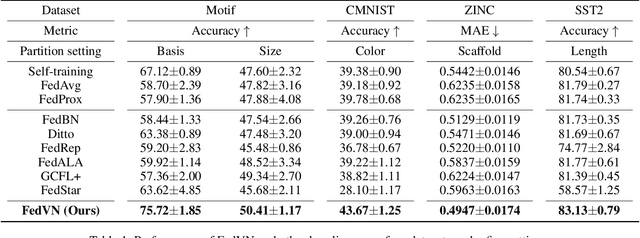
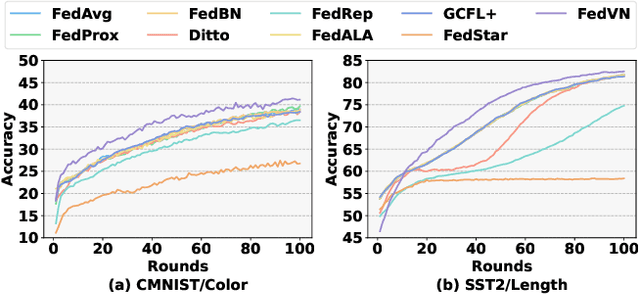
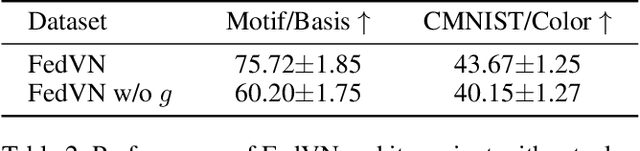
Federated Graph Learning (FGL) enables multiple clients to jointly train powerful graph learning models, e.g., Graph Neural Networks (GNNs), without sharing their local graph data for graph-related downstream tasks, such as graph property prediction. In the real world, however, the graph data can suffer from significant distribution shifts across clients as the clients may collect their graph data for different purposes. In particular, graph properties are usually associated with invariant label-relevant substructures (i.e., subgraphs) across clients, while label-irrelevant substructures can appear in a client-specific manner. The issue of distribution shifts of graph data hinders the efficiency of GNN training and leads to serious performance degradation in FGL. To tackle the aforementioned issue, we propose a novel FGL framework entitled FedVN that eliminates distribution shifts through client-specific graph augmentation strategies with multiple learnable Virtual Nodes (VNs). Specifically, FedVN lets the clients jointly learn a set of shared VNs while training a global GNN model. To eliminate distribution shifts, each client trains a personalized edge generator that determines how the VNs connect local graphs in a client-specific manner. Furthermore, we provide theoretical analyses indicating that FedVN can eliminate distribution shifts of graph data across clients. Comprehensive experiments on four datasets under five settings demonstrate the superiority of our proposed FedVN over nine baselines.
Graph Neural Networks Are More Than Filters: Revisiting and Benchmarking from A Spectral Perspective
Dec 10, 2024Graph Neural Networks (GNNs) have achieved remarkable success in various graph-based learning tasks. While their performance is often attributed to the powerful neighborhood aggregation mechanism, recent studies suggest that other components such as non-linear layers may also significantly affecting how GNNs process the input graph data in the spectral domain. Such evidence challenges the prevalent opinion that neighborhood aggregation mechanisms dominate the behavioral characteristics of GNNs in the spectral domain. To demystify such a conflict, this paper introduces a comprehensive benchmark to measure and evaluate GNNs' capability in capturing and leveraging the information encoded in different frequency components of the input graph data. Specifically, we first conduct an exploratory study demonstrating that GNNs can flexibly yield outputs with diverse frequency components even when certain frequencies are absent or filtered out from the input graph data. We then formulate a novel research problem of measuring and benchmarking the performance of GNNs from a spectral perspective. To take an initial step towards a comprehensive benchmark, we design an evaluation protocol supported by comprehensive theoretical analysis. Finally, we introduce a comprehensive benchmark on real-world datasets, revealing insights that challenge prevalent opinions from a spectral perspective. We believe that our findings will open new avenues for future advancements in this area. Our implementations can be found at: https://github.com/yushundong/Spectral-benchmark.