 Add to Chrome
 Add to Firefox
 Add to Edge
Self-Evolving Code-with-Image Reasoning
Aug 11, 2026
Multimodal models increasingly reach for tools when solving visual tasks (crop, zoom, rotate, brighten), a paradigm known as thinking-with-images. The central challenge is one of perception: tools mostly serve to expose visual evidence, reasoning over that evidence stays in language, and most targets are ones a human could in principle determine by inspection. Some visual questions, however, are not bottlenecked by perception: recovering their answers requires executing a multi-step visual algorithm over the pixels. On such questions a model often names the correct algorithm at once yet still answers wrong, because language can describe an algorithm without being able to run one. Code-with-Image crosses that line: given nothing but a Python interpreter, the model must implement a genuine visual algorithm in code to solve the task; the program itself becomes the reasoning. The bottleneck then shifts from executing code to deciding which algorithm to implement. So we let the model teach itself: a training-free reflection loop studies its own failed programs, tests repairs against constructive ground truth, and keeps what survives as portable skills. On our Code-with-Image Bench (CwI-Bench), thirty task families induced by hidden visual computations with disjoint learning and evaluation splits, even GPT-5.6-luna stays below 30% with tool-free chain of thought; given a bare interpreter it reaches 43%, and with skills evolved through its own executable reflection, 67%. The open 27B model climbs the same ladder (9% $\rightarrow$ 33% $\rightarrow$ 56%), and the skills are plain text, transferable across scales and families. When code carries the reasoning, debugging code becomes debugging reasoning.

SPECTRA: Pushing the KV Cache Beyond the 2-Bit Cliff via Spectral Transform Coding
Aug 08, 2026Large language models (LLMs) increasingly read long inputs in the agentic era, from whole documents and codebases to conversations across many turns. Their inference memory is then dominated by the key-value (KV) cache, the stored attention keys and values of every token the model has read and generated. Because the cache grows with context length and is re-read in full at every generated token, a longer context means more GPU memory. To reduce this cost, most existing methods compress the KV cache by lowering every stored value to the same low precision, a technique known as quantization. They can push this to nearly two bits per value, but rarely further, because quality drops sharply at this 2-bit cliff: four levels are too few for the cache's outlier-heavy values, where a few large entries consume the levels and collapse the rest into noise. A natural remedy is to spend more bits on the channels (feature dimensions) that matter and fewer on the rest, but the raw cache offers no handle: its channels are strongly correlated, so none stands out as more important. Our analysis shows that this handle appears once the cache is rotated into a coordinate system computed from its own statistics, removing these correlations. There, a small fraction of channels carries almost all the information, and spending the budget on those few is far more accurate than spreading it evenly. Guided by this analysis, we develop SPECTRA, a training-free, drop-in codec that re-encodes the cache into this coordinate system and concentrates the bit budget on the channels that carry the signal. On Llama-3.1-8B and Qwen2.5-7B over long-context benchmarks, SPECTRA is near-lossless at 4x compression, competitive at 8x where uniform quantization has collapsed, and reaches up to 12x, pushing usable compression past the 2-bit cliff so the same GPU holds longer contexts and larger batches.
Toward Reliable Context Compression for Long-Horizon Agents: An Empirical Study of Execution Instability
Aug 06, 2026Recurrent context compression controls context growth in long-horizon agents, but its behavioral effects remain poorly understood. In this preliminary empirical study, we show that compression can weaken the influence of recent interactions, increasing blocked actions, repeated exploration, and instability across runs. Motivated by these observations, we introduce TRACE, a verifier-guided framework that evaluates individual compaction events through paired closed-loop continuations from the same environment state and uses summary preferences to optimize a natural-language compression prompt while keeping all models frozen. Initial results on AppWorld show improvements over existing compression baselines in task performance, multi-run reliability, and context--execution efficiency. These findings provide early evidence for boundary-local evaluation as a promising direction for reliable agent context compression.
Field Aware Agent Skill Retrieval
Aug 06, 2026As lifelong learning agents accumulate lifelong growing skill banks, retrieving the correct skill becomes an increasingly important bottleneck. Most current skill retrieval methods treat each skill as one flat document by concatenating fields such as the name, description, and body. However, skills are naturally structured, multi-field objects, where each field provides different information about when and how the skill should be used. In this work, we study whether preserving this structure improves skill retrieval. We represent each skill as its separate components, and compute sparse and dense similarities for each field independently, exposing a naturally tensorized, field-aware representation of the skill bank. We then combine these field-level scores either with uniform weights or with a small learned MLP. Across two different skill retrieval benchmarks, SkillRet and SRA-Bench, we find that keeping fields separate improves hybrid retrieval, and learning over the field-level scores gives the strongest and most consistent results. Our field-aware MLP reaches $77.95$ Recall@10 on SkillRet and $83.78$ Recall@10 on SRA-Bench, outperforming the corresponding concatenated learned baselines. We also find that the advantage grows as the skill bank becomes larger, suggesting that field-aware skill retrieval becomes especially useful in the setting where retrieval is most difficult. Our results show that skill representation itself matters, and that simply preserving the structure already present in skill files can substantially improve retrieval.
WiSP: A Working-Set View of Mixture-of-Experts Serving on Extremely Low-Resource Hardware
Jun 20, 2026Modern Mixture-of-Experts (MoE) models place most of their parameters in expert layers, yet only a small fraction of those experts are used for any token. The unused weights must still be stored where the GPU can reach them. On commodity GPUs the common fix is layer-level CPU offloading, which keeps memory low but streams all of a layer's experts across PCIe on every forward pass, losing much of MoE's sparsity benefit. We cast low-resource MoE serving as a working-set management problem on the GPU: routed expert weights and the key-value (KV) cache are two streams of memory demand competing for limited VRAM. We realize this in WiSP (Working-Set Paging), a routing-aware expert pager that plugs into an unmodified serving engine with byte-identical outputs. Keeping resident only the experts a workload reuses, WiSP reaches up to 1.95x the decode throughput of static offload at the same memory budget when the model does not fit. We also find that prefetching experts from predicted routing helps little in single-stream decode: the bottleneck is PCIe bandwidth, not prediction accuracy. This shifts the question from prefetching to allocation: how should VRAM be split between experts and the KV cache? We answer with MV-WSA (Marginal-Value Working-Set Allocation), which equalizes marginal latency benefit per byte subject to a KV admission floor. MV-WSA runs either as an offline configurator or as an online controller that resizes both pools while serving. In real serving the offline configurator is the only policy we test that does well on both prefill and decode; in trace-driven simulation it stays within a few percent of a per-workflow oracle while fixed splits are about 20% worse. The online controller adds a further 1.20x without changing model outputs.
A Unified Structured Query Understanding Framework for Industrial Semantic Search
May 22, 2026Query understanding in large-scale industrial search systems is typically implemented as a cascade of disparate, task-specific components. While individually optimizable, this fragmented architecture incurs high maintenance overhead and results in inconsistent behaviors, particularly for long-tail queries. In this work, we propose and deploy a unified structured query understanding system that consolidates these heterogeneous functions into a single Small Language Model (SLM) that performs schema-constrained generation. To address the data bottlenecks inherent in unified modeling, we introduce Query Illuminator, a dual-purpose framework serving as: (i) a teacher model for high-quality auto-annotation and distillation, and (ii) a surrogate judge for scalable evaluation where human labels are scarce. We validate this approach through extensive offline and online tests within LinkedIn's Job Search system. Furthermore, we demonstrate the framework's horizontal extensibility through a cross-domain case study on People Search. The results show improved user engagement and reduced operational costs, achieved while satisfying strict low-latency serving constraints on limited GPU resources.
Towards Resilient and Autonomous Networks: A BlueSky Vision on AI-Native 6G
May 20, 2026The proliferation of emerging applications, such as autonomous driving and immersive experiences, demands cellular networks that are not only faster, but fundamentally more resilient and autonomous. This paper presents a BlueSky vision on how Artificial Intelligence will be natively integrated into 6G, shifting the paradigm from \underline{Network for AI} to \underline{AI for Network}. We envision that, unlike 5G's reliance on scattered, ad-hoc models each trained for a single task, native AI in the 6G era will be anchored by a foundation model and and orchestrated via collaborative multi-agent systems, framing network management as a unified, multi-modal, multi-task optimization problem. Built on this vision, we outline two transformative directions. The first focuses on developing a 6G foundation model as a unified backbone, with task-specific knowledge distilled into compact models suited for diverse edge deployments. The second advances multi-agent systems designed to autonomously diagnose, maintain, and recover networks with minimal human intervention. These directions chart a roadmap for 6G to evolve into an intelligent, self-sustaining communication infrastructure.
Understanding and Modeling Job Marketplace with Pretrained Language Models
Aug 08, 2024Job marketplace is a heterogeneous graph composed of interactions among members (job-seekers), companies, and jobs. Understanding and modeling job marketplace can benefit both job seekers and employers, ultimately contributing to the greater good of the society. However, existing graph neural network (GNN)-based methods have shallow understandings of the associated textual features and heterogeneous relations. To address the above challenges, we propose PLM4Job, a job marketplace foundation model that tightly couples pretrained language models (PLM) with job market graph, aiming to fully utilize the pretrained knowledge and reasoning ability to model member/job textual features as well as various member-job relations simultaneously. In the pretraining phase, we propose a heterogeneous ego-graph-based prompting strategy to model and aggregate member/job textual features based on the topological structure around the target member/job node, where entity type embeddings and graph positional embeddings are introduced accordingly to model different entities and their heterogeneous relations. Meanwhile, a proximity-aware attention alignment strategy is designed to dynamically adjust the attention of the PLM on ego-graph node tokens in the prompt, such that the attention can be better aligned with job marketplace semantics. Extensive experiments at LinkedIn demonstrate the effectiveness of PLM4Job.
Learning to Retrieve for Job Matching
Feb 21, 2024
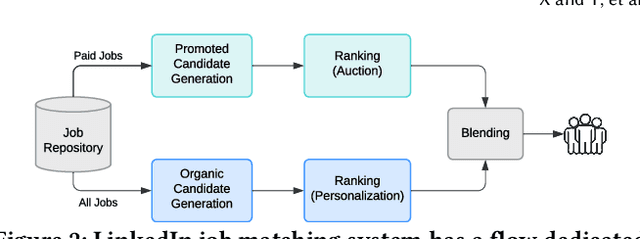
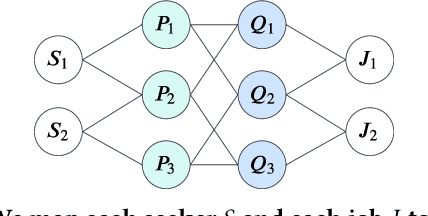
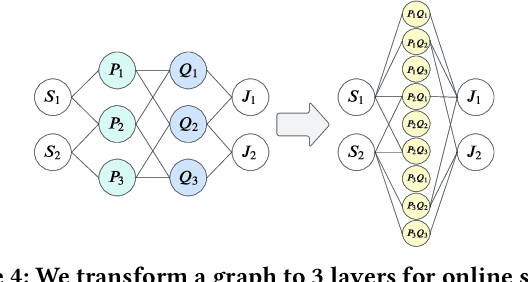
Web-scale search systems typically tackle the scalability challenge with a two-step paradigm: retrieval and ranking. The retrieval step, also known as candidate selection, often involves extracting standardized entities, creating an inverted index, and performing term matching for retrieval. Such traditional methods require manual and time-consuming development of query models. In this paper, we discuss applying learning-to-retrieve technology to enhance LinkedIns job search and recommendation systems. In the realm of promoted jobs, the key objective is to improve the quality of applicants, thereby delivering value to recruiter customers. To achieve this, we leverage confirmed hire data to construct a graph that evaluates a seeker's qualification for a job, and utilize learned links for retrieval. Our learned model is easy to explain, debug, and adjust. On the other hand, the focus for organic jobs is to optimize seeker engagement. We accomplished this by training embeddings for personalized retrieval, fortified by a set of rules derived from the categorization of member feedback. In addition to a solution based on a conventional inverted index, we developed an on-GPU solution capable of supporting both KNN and term matching efficiently.
LLM-Enhanced User-Item Interactions: Leveraging Edge Information for Optimized Recommendations
Feb 14, 2024


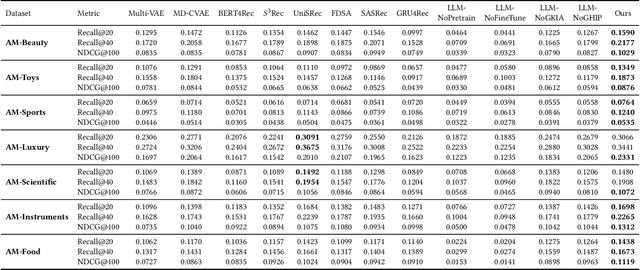
The extraordinary performance of large language models has not only reshaped the research landscape in the field of NLP but has also demonstrated its exceptional applicative potential in various domains. However, the potential of these models in mining relationships from graph data remains under-explored. Graph neural networks, as a popular research area in recent years, have numerous studies on relationship mining. Yet, current cutting-edge research in graph neural networks has not been effectively integrated with large language models, leading to limited efficiency and capability in graph relationship mining tasks. A primary challenge is the inability of LLMs to deeply exploit the edge information in graphs, which is critical for understanding complex node relationships. This gap limits the potential of LLMs to extract meaningful insights from graph structures, limiting their applicability in more complex graph-based analysis. We focus on how to utilize existing LLMs for mining and understanding relationships in graph data, applying these techniques to recommendation tasks. We propose an innovative framework that combines the strong contextual representation capabilities of LLMs with the relationship extraction and analysis functions of GNNs for mining relationships in graph data. Specifically, we design a new prompt construction framework that integrates relational information of graph data into natural language expressions, aiding LLMs in more intuitively grasping the connectivity information within graph data. Additionally, we introduce graph relationship understanding and analysis functions into LLMs to enhance their focus on connectivity information in graph data. Our evaluation on real-world datasets demonstrates the framework's ability to understand connectivity information in graph data.