 Add to Chrome
 Add to Firefox
 Add to Edge
EviGraph: Evidence-Guided Autonomous Research Agents
Aug 06, 2026
Autonomous research agents can generate hypotheses, execute experiments, and draft manuscripts, yet their outputs often contain unsupported claims and inconsistencies between research questions, experiments, results, and conclusions. We argue that this problem is partly architectural: existing systems organize research as sequential pipelines but do not explicitly maintain or validate the evolving claim-evidence structure across stages. In this paper, we introduce EviGraph, an autonomous research framework that represents the research process as a typed evidence graph containing Problem, Gap, Hypothesis, Experiment, Finding, and Claim nodes. The graph serves as the operational state of the agent rather than a post-hoc record. EviGraph inspects evidence chains for missing dependencies, semantic misalignment, and result-claim inconsistencies, localizes the earliest weak node, and regenerates its affected downstream subgraph. Graph checkpointing prevents unsuccessful repairs from corrupting previously validated evidence. Manuscripts are generated only after every retained claim is grounded in a validated evidence chain. Experiments on ARC-Bench-ML and NanoResearch-20 show that EviGraph outperforms the compared end-to-end research-agent baselines in overall research performance, improves Claim Support Rate by 40.19% over the strongest baseline, and achieves 87.73% Experimental Data Consistency. These results demonstrate the value of explicit evidence-state maintenance for reliable autonomous research.

Merge, Ensemble, and Cooperate! A Survey on Collaborative Strategies in the Era of Large Language Models
Jul 08, 2024

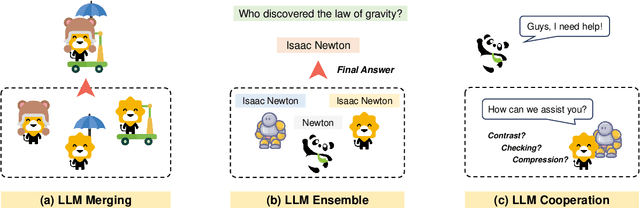
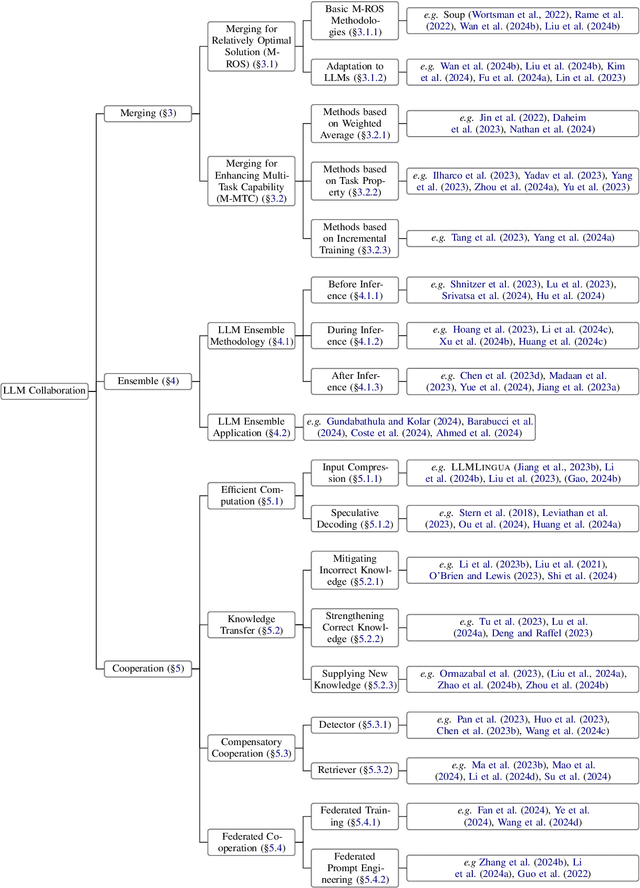
The remarkable success of Large Language Models (LLMs) has ushered natural language processing (NLP) research into a new era. Despite their diverse capabilities, LLMs trained on different corpora exhibit varying strengths and weaknesses, leading to challenges in maximizing their overall efficiency and versatility. To address these challenges, recent studies have explored collaborative strategies for LLMs. This paper provides a comprehensive overview of this emerging research area, highlighting the motivation behind such collaborations. Specifically, we categorize collaborative strategies into three primary approaches: Merging, Ensemble, and Cooperation. Merging involves integrating multiple LLMs in the parameter space. Ensemble combines the outputs of various LLMs. Cooperation} leverages different LLMs to allow full play to their diverse capabilities for specific tasks. We provide in-depth introductions to these methods from different perspectives and discuss their potential applications. Additionally, we outline future research directions, hoping this work will catalyze further studies on LLM collaborations and paving the way for advanced NLP applications.