 Add to Chrome
 Add to Firefox
 Add to Edge
MindMemOS: A Portable and Self-Evolving Memory Operating Layer for AI Agents
Aug 12, 2026
Memory is a core component of AI agents, enabling them to accumulate experience, maintain personalization, and adapt over long-term interactions. However, existing memory systems often remain fixed after development, limiting their ability to adapt their memory models, organization strategies, and procedural knowledge through continued use. We present MindMemOS, a portable and self-evolving memory operating layer that organizes open-world information using a unified entity property timestructure. MindMemOS supports scenario-adaptive memory modeling, higher-order pattern discovery, autonomous memory refinement, and continuous skill evolution. Its MindMemEvolve algorithm employs validation-driven evolutionary search to optimize memory schemas for target scenarios, whiledreaming consolidates accumulated memories by merging redundant records and resolving conflicts. In addition, implicit corrective feedback serves as a human-in-the-loop signal for identifying and revising potentially inaccurate or misaligned memories. Its MindSkillEvolve algorithm further transforms agent execution trajectories into reusable and progressively refined skills. MindMemOS achieves 94.03% accuracy on LOCOMO and 70.63% on PersonaMem. MindSkillEvolve improves SpreadsheetBench success by 9.2 percentage points over the initial-skill baseline.

Retain or Consolidate? Budget-Dependent Operator Selection for Language Agent Memory
Jul 21, 2026Language agents depend on memory across interactions. However, the limited context windows of large language models (LLMs) and their inference costs constrain how much memory can be used at once. Existing systems mainly follow two strategies: memory retention and memory consolidation. Retention keeps raw records and preserves exact details, but relevant evidence may not fit under a tight budget; consolidation compresses and combines records, improving coverage per token but risking the loss of query-critical details. Neither strategy is universally preferable. This raises two central questions: when should consolidation replace retention, and which operator -- Merge, Abstract, or Rewrite -- should be selected? We formalize this decision by decomposing each operator's utility into a coverage effect on evidence omitted by retention and a signed replacement effect on raw evidence that already fits. Their balance explains why the preferred action changes with relative budget pressure. We implement this mechanism with Offline Abstraction-Safety (OAS), a lightweight learner that estimates action utilities from pre-generation features with held-out harm calibration. The public LongMemEval and LoCoMo benchmarks show the same budget-dependent pattern. On LongMemEval, consolidation improves absolute accuracy by up to 48% under tight budgets, whereas retention is preferable under loose budgets; LoCoMo replicates this crossover at a smaller budget, consistent with its shorter evidence. On both datasets, cross-note abstraction and merging generally outperform local rewriting when compression is necessary.
EvoOptiGraph: Weakness-Driven Coevolution via Graph-Based Structural Generation for Optimization Modeling
Jun 25, 2026Automating optimization modeling from natural language with large language models (LLMs) faces two key challenges. First, training corpora lack structural diversity. Second, data generation pipelines remain static and decoupled from model learning. To address these challenges, we propose EvoOptiGraph, a novel framework where data and model co-evolve, driven by model weaknesses. EvoOptiGraph represents each mixed-integer linear program (MILP) as an attributed bipartite graph and applies validity-preserving evolutionary operators to generate structurally diverse instances. The evolved graphs are converted into solver code and natural language via deterministic compilation and verified back-translation. Training proceeds in two stages: supervised fine-tuning (SFT) on an initial dataset, followed by reinforcement learning with verifiable rewards (RLVR), where graph-derived weakness signals guide the generation of new instances targeting the model's failures. This forms a closed loop that continuously updates the training distribution. Empirical results on six public datasets show that EvoOptiGraph significantly outperforms larger generalist models, agentic methods, and specialized baselines in accuracy, executability, and generalization. These results demonstrate that targeted data-model coevolution is an effective strategy for improving LLMs on optimization modeling tasks.
Learning What to Remember: Observability-Safe Memory Retention via Constrained Optimization for Long-Horizon Language Agents
Jun 09, 2026Long-horizon language agents accumulate observations, reasoning traces, and retrieved facts that exceed their finite context windows, making memory retention a fundamental resource-allocation problem. Existing memory systems improve management through heuristic scoring, retrieval optimization, or learned compression, but largely treat retention as a local decision problem and do not explicitly model its long-term consequences under realistic observability constraints. To fill this gap, we formulate memory retention as a constrained stochastic optimization problem with explicit budget feasibility, evidence utility, and delayed costs including miss penalties, reacquisition delays, and stale-information risk. We then propose OSL-MR (Observability-Safe Learning for Memory Retention), a novel framework that enforces a strict separation between online-observable features and offline-available supervision (OAS). OSL-MR combines an evidence learner trained from realized evidence supervision with a Mixed-Score heuristic that serves both as a deployable online-safe baseline and as a structured inductive prior for learning. The resulting policy learns query-conditioned evidence value directly from interaction data while remaining deployable under the same observability constraints. Experiments on LOCOMO and LongMemEval show that OSL-MR consistently outperforms recency-based methods, Generative Agents-style scoring, and other heuristic baselines, particularly under tight memory budgets. The Mixed-Score prior further improves precision while preserving recall, and sensitivity analysis demonstrates robustness across a wide range of cost configurations.
YouZhi: Towards High-Concurrency Financial LLMs via Adaptive GQA-to-MLA Transition
Jun 04, 2026Large language models (LLMs) drive significant financial innovations, yet their high-concurrency deployment is severely bottlenecked by KV cache memory overhead, which inflates infrastructure costs and throttles scalability. To address this, we propose YouZhi-LLM, a highly efficient financial LLM empowered by a comprehensive structural transition and training pipeline natively built on the Huawei Ascend ecosystem. At its algorithmic core, YouZhi-LLM features a layer-adaptive GQA-to-MLA transition framework that dynamically assigns per-layer FreqFold sizes, maximizing KV-cache compression while minimizing perplexity degradation. To recover representation capacity and inject domain expertise, the Ascend-based training pipeline seamlessly integrates generalized knowledge distillation with financial-specific supervised fine-tuning. Evaluations demonstrate the superiority of this systematic approach, with the adaptive transition reducing perplexity degradation by up to 35% over uniform baselines. Crucially, when evaluated on Ascend NPUs via vLLM-Ascend, the massive KV-cache reduction translates directly into deployment efficiency. Compared to their respective base models, YouZhi-7B yields a 12.3% improvement in average financial benchmark score alongside a 2.69$\times$ increase in maximum concurrency; similarly, YouZhi-14B achieves a 7.0% accuracy gain and a 2.43$\times$ concurrency boost, establishing a new paradigm for cost-effective, high-throughput financial inference.
From Long News to Accurate Forecast: Importance-Aware Fusion and PRM-Guided Reflection for Time Series Forecasting
Jun 02, 2026Incorporating news into time series forecasting is appealing because news can reveal abrupt exogenous events that historical values alone cannot recover. However, existing LLM-based news-forecasting pipelines face two practical limitations: relevant news articles often exceed the model's context window, and iterative retrieval of supplementary news is typically unguided, leading to redundant updates and slow convergence. We address these issues with a novel framework that combines importance-aware news compression and process-level retrieval supervision. First, we train an importance reward model that estimates the forecasting utility of each article and uses this signal to allocate compression budgets during sequential pairwise fusion, preserving informative content within a fixed context limit. Second, we introduce a process reward model (PRM) that ranks multiple supplementary-news candidates conditioned on the current error profile and the history of previously selected articles, replacing one-shot blind retrieval with quality-controlled selection. Both components are trained offline using historical data with ground truth; inference uses the frozen filtering logic and compression modules without any reflection loop. Experiments on finance, energy, traffic, and bitcoin forecasting benchmarks show that our method improves prediction accuracy over strong baselines, significantly reduces the number of refinement iterations compared to the iterative baseline, and remains effective when relevant articles span thousands of tokens.
ReThinker: Scientific Reasoning by Rethinking with Guided Reflection and Confidence Control
Feb 04, 2026Expert-level scientific reasoning remains challenging for large language models, particularly on benchmarks such as Humanity's Last Exam (HLE), where rigid tool pipelines, brittle multi-agent coordination, and inefficient test-time scaling often limit performance. We introduce ReThinker, a confidence-aware agentic framework that orchestrates retrieval, tool use, and multi-agent reasoning through a stage-wise Solver-Critic-Selector architecture. Rather than following a fixed pipeline, ReThinker dynamically allocates computation based on model confidence, enabling adaptive tool invocation, guided multi-dimensional reflection, and robust confidence-weighted selection. To support scalable training without human annotation, we further propose a reverse data synthesis pipeline and an adaptive trajectory recycling strategy that transform successful reasoning traces into high-quality supervision. Experiments on HLE, GAIA, and XBench demonstrate that ReThinker consistently outperforms state-of-the-art foundation models with tools and existing deep research systems, achieving state-of-the-art results on expert-level reasoning tasks.
SCOPE: Prompt Evolution for Enhancing Agent Effectiveness
Dec 17, 2025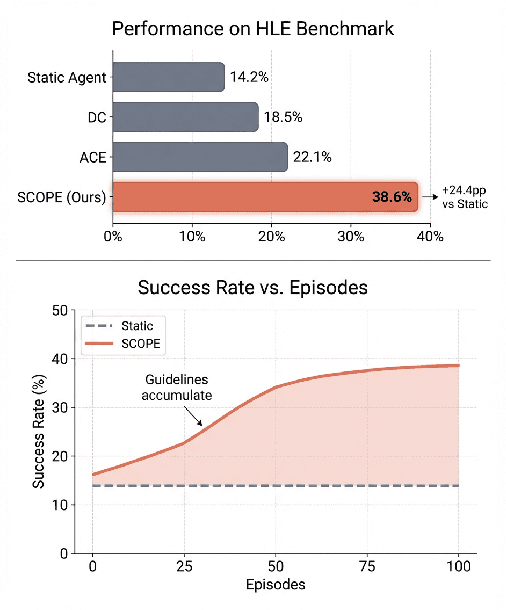
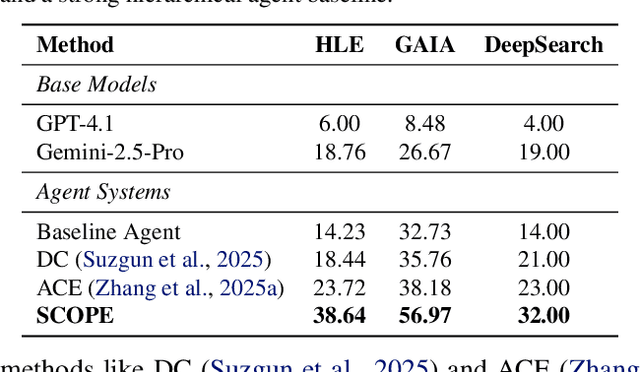
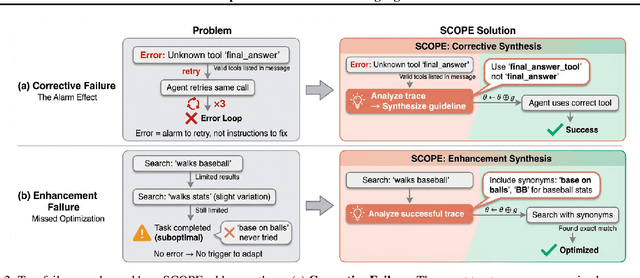
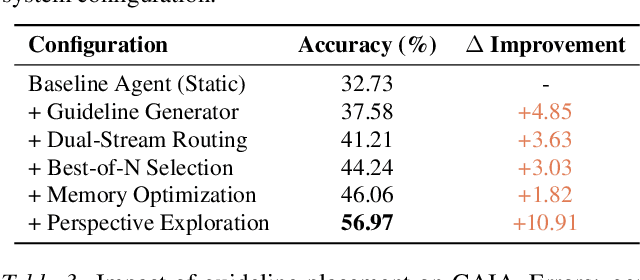
Large Language Model (LLM) agents are increasingly deployed in environments that generate massive, dynamic contexts. However, a critical bottleneck remains: while agents have access to this context, their static prompts lack the mechanisms to manage it effectively, leading to recurring Corrective and Enhancement failures. To address this capability gap, we introduce \textbf{SCOPE} (Self-evolving Context Optimization via Prompt Evolution). SCOPE frames context management as an \textit{online optimization} problem, synthesizing guidelines from execution traces to automatically evolve the agent's prompt. We propose a Dual-Stream mechanism that balances tactical specificity (resolving immediate errors) with strategic generality (evolving long-term principles). Furthermore, we introduce Perspective-Driven Exploration to maximize strategy coverage, increasing the likelihood that the agent has the correct strategy for any given task. Experiments on the HLE benchmark show that SCOPE improves task success rates from 14.23\% to 38.64\% without human intervention. We make our code publicly available at https://github.com/JarvisPei/SCOPE.
Re$^{\text{2}}$MaP: Macro Placement by Recursively Prototyping and Packing Tree-based Relocating
Nov 11, 2025This work introduces the Re$^{\text{2}}$MaP method, which generates expert-quality macro placements through recursively prototyping and packing tree-based relocating. We first perform multi-level macro grouping and PPA-aware cell clustering to produce a unified connection matrix that captures both wirelength and dataflow among macros and clusters. Next, we use DREAMPlace to build a mixed-size placement prototype and obtain reference positions for each macro and cluster. Based on this prototype, we introduce ABPlace, an angle-based analytical method that optimizes macro positions on an ellipse to distribute macros uniformly near chip periphery, while optimizing wirelength and dataflow. A packing tree-based relocating procedure is then designed to jointly adjust the locations of macro groups and the macros within each group, by optimizing an expertise-inspired cost function that captures various design constraints through evolutionary search. Re$^{\text{2}}$MaP repeats the above process: Only a subset of macro groups are positioned in each iteration, and the remaining macros are deferred to the next iteration to improve the prototype's accuracy. Using a well-established backend flow with sufficient timing optimizations, Re$^{\text{2}}$MaP achieves up to 22.22% (average 10.26%) improvement in worst negative slack (WNS) and up to 97.91% (average 33.97%) improvement in total negative slack (TNS) compared to the state-of-the-art academic placer Hier-RTLMP. It also ranks higher on WNS, TNS, power, design rule check (DRC) violations, and runtime than the conference version ReMaP, across seven tested cases. Our code is available at https://github.com/lamda-bbo/Re2MaP.
E2ESlack: An End-to-End Graph-Based Framework for Pre-Routing Slack Prediction
Jan 14, 2025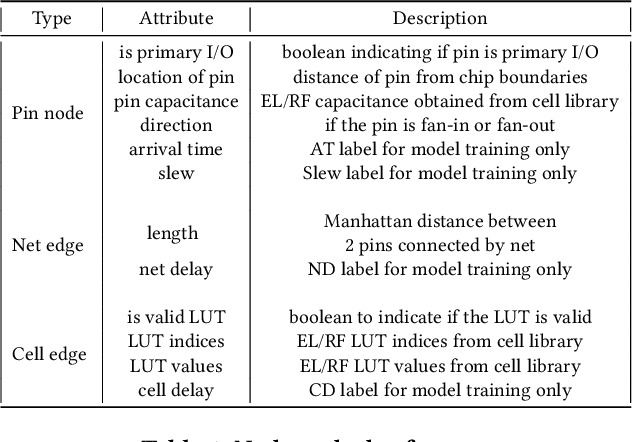
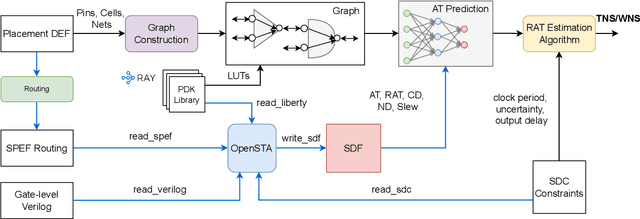
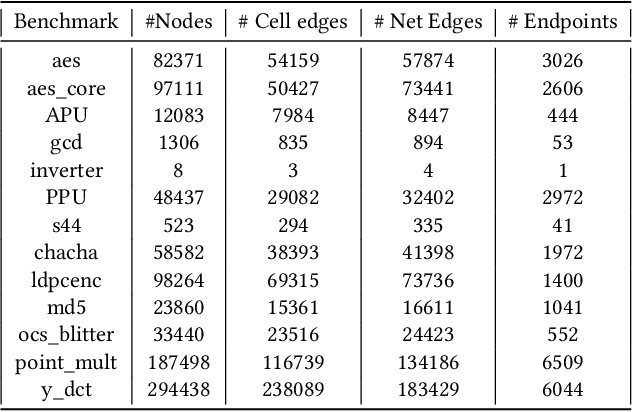
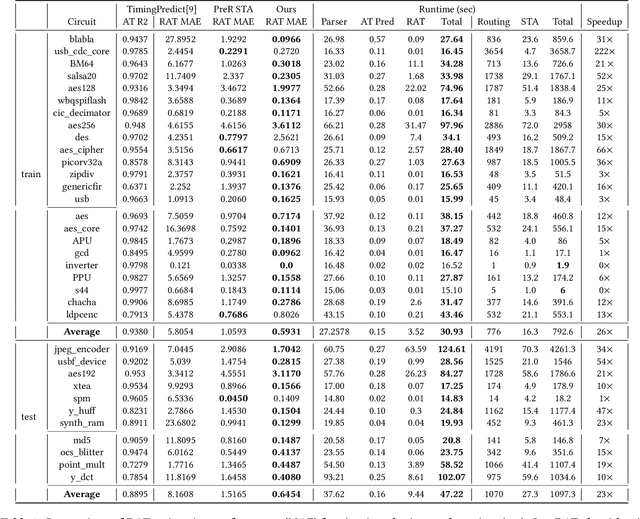
Pre-routing slack prediction remains a critical area of research in Electronic Design Automation (EDA). Despite numerous machine learning-based approaches targeting this task, there is still a lack of a truly end-to-end framework that engineers can use to obtain TNS/WNS metrics from raw circuit data at the placement stage. Existing works have demonstrated effectiveness in Arrival Time (AT) prediction but lack a mechanism for Required Arrival Time (RAT) prediction, which is essential for slack prediction and obtaining TNS/WNS metrics. In this work, we propose E2ESlack, an end-to-end graph-based framework for pre-routing slack prediction. The framework includes a TimingParser that supports DEF, SDF and LIB files for feature extraction and graph construction, an arrival time prediction model and a fast RAT estimation module. To the best of our knowledge, this is the first work capable of predicting path-level slacks at the pre-routing stage. We perform extensive experiments and demonstrate that our proposed RAT estimation method outperforms the SOTA ML-based prediction method and also pre-routing STA tool. Additionally, the proposed E2ESlack framework achieves TNS/WNS values comparable to post-routing STA results while saving up to 23x runtime.