 Add to Chrome
 Add to Firefox
 Add to Edge
Tied & Reduced RNN-T Decoder
Sep 15, 2021
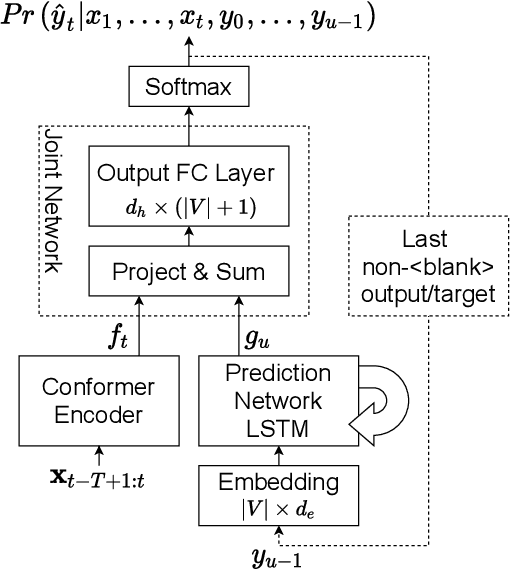
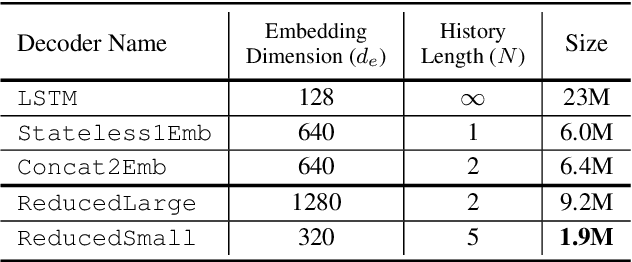
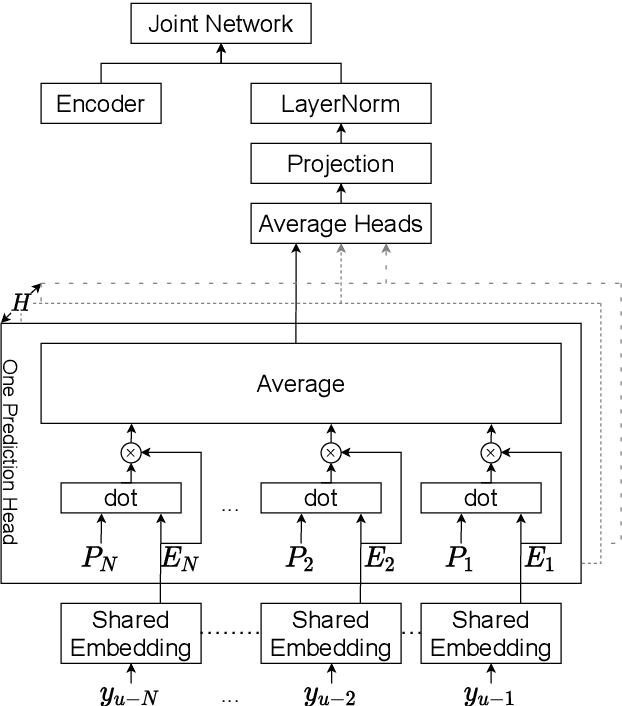
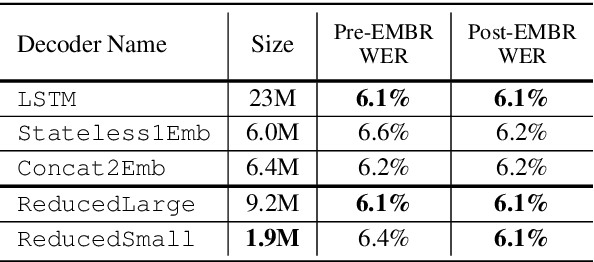
Previous works on the Recurrent Neural Network-Transducer (RNN-T) models have shown that, under some conditions, it is possible to simplify its prediction network with little or no loss in recognition accuracy (arXiv:2003.07705 [eess.AS], [2], arXiv:2012.06749 [cs.CL]). This is done by limiting the context size of previous labels and/or using a simpler architecture for its layers instead of LSTMs. The benefits of such changes include reduction in model size, faster inference and power savings, which are all useful for on-device applications. In this work, we study ways to make the RNN-T decoder (prediction network + joint network) smaller and faster without degradation in recognition performance. Our prediction network performs a simple weighted averaging of the input embeddings, and shares its embedding matrix weights with the joint network's output layer (a.k.a. weight tying, commonly used in language modeling arXiv:1611.01462 [cs.LG]). This simple design, when used in conjunction with additional Edit-based Minimum Bayes Risk (EMBR) training, reduces the RNN-T Decoder from 23M parameters to just 2M, without affecting word-error rate (WER).

Multi-user VoiceFilter-Lite via Attentive Speaker Embedding
Jul 02, 2021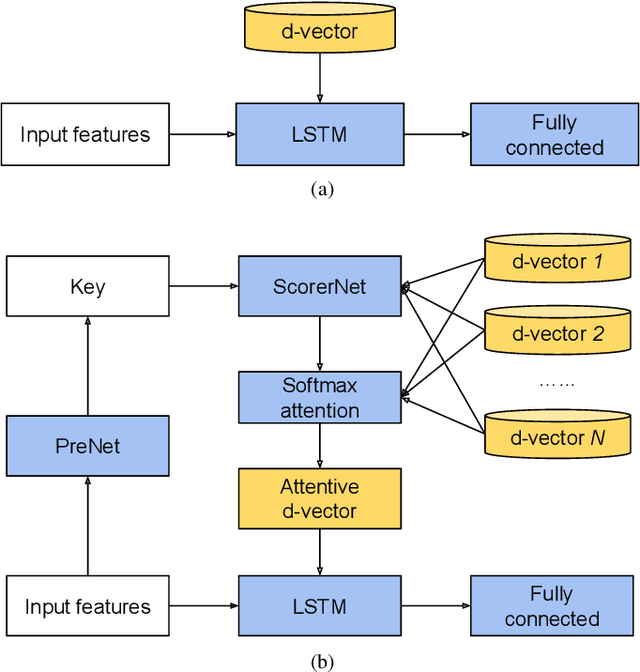
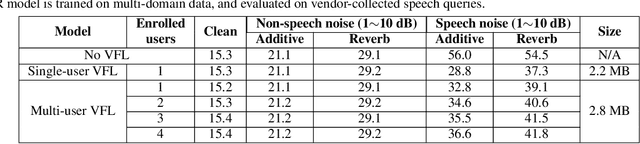
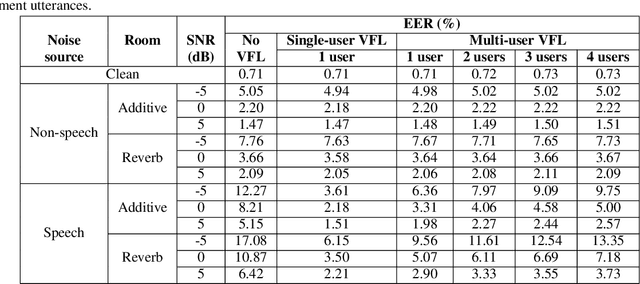
In this paper, we propose a solution to allow speaker conditioned speech models, such as VoiceFilter-Lite, to support an arbitrary number of enrolled users in a single pass. This is achieved by using an attention mechanism on multiple speaker embeddings to compute a single attentive embedding, which is then used as a side input to the model. We implemented multi-user VoiceFilter-Lite and evaluated it for three tasks: (1) a streaming automatic speech recognition (ASR) task; (2) a text-independent speaker verification task; and (3) a personalized keyphrase detection task, where ASR has to detect keyphrases from multiple enrolled users in a noisy environment. Our experiments show that, with up to four enrolled users, multi-user VoiceFilter-Lite is able to significantly reduce speech recognition and speaker verification errors when there is overlapping speech, without affecting performance under other acoustic conditions. This attentive speaker embedding approach can also be easily applied to other speaker-conditioned models such as personal VAD and personalized ASR.
Personalized Keyphrase Detection using Speaker and Environment Information
Apr 28, 2021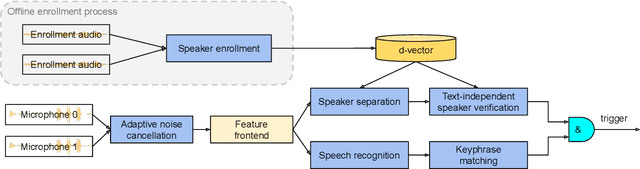
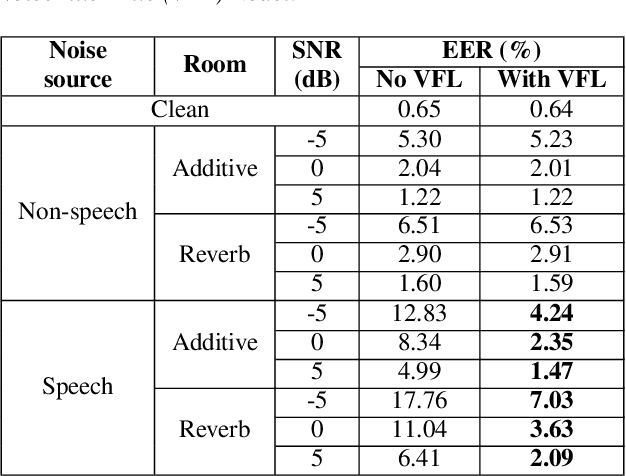
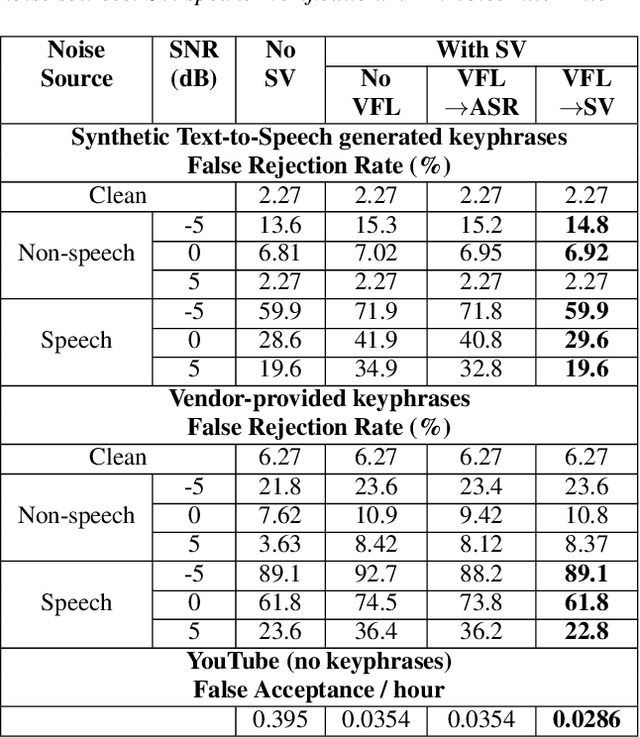
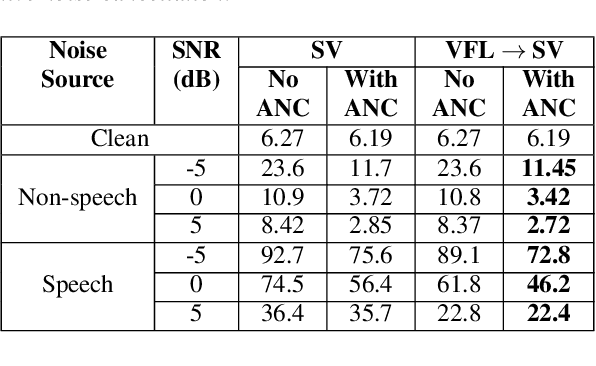
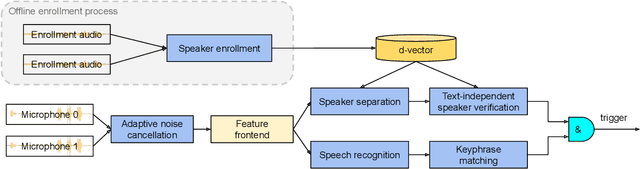
In this paper, we introduce a streaming keyphrase detection system that can be easily customized to accurately detect any phrase composed of words from a large vocabulary. The system is implemented with an end-to-end trained automatic speech recognition (ASR) model and a text-independent speaker verification model. To address the challenge of detecting these keyphrases under various noisy conditions, a speaker separation model is added to the feature frontend of the speaker verification model, and an adaptive noise cancellation (ANC) algorithm is included to exploit cross-microphone noise coherence. Our experiments show that the text-independent speaker verification model largely reduces the false triggering rate of the keyphrase detection, while the speaker separation model and adaptive noise cancellation largely reduce false rejections.
Multi-Task Learning for End-to-End ASR Word and Utterance Confidence with Deletion Prediction
Apr 26, 2021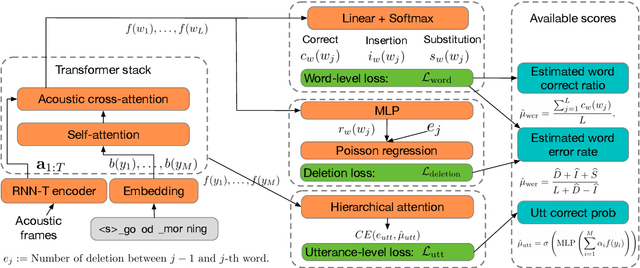
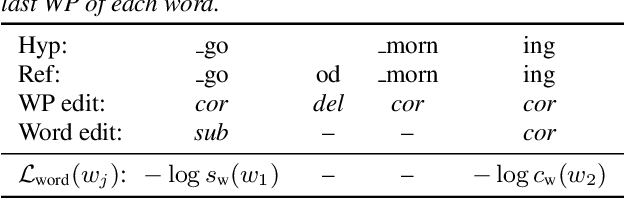
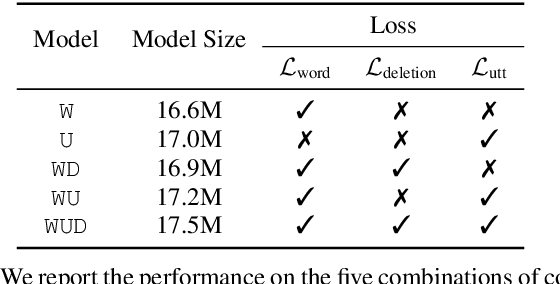
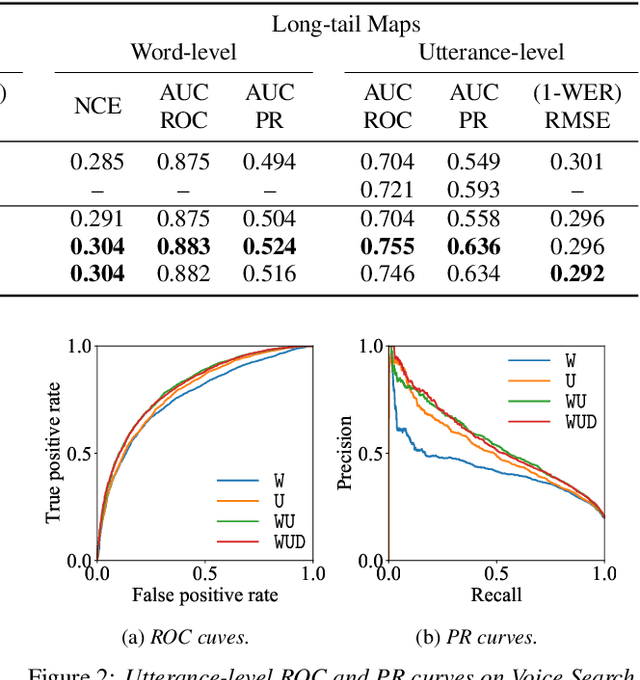
Confidence scores are very useful for downstream applications of automatic speech recognition (ASR) systems. Recent works have proposed using neural networks to learn word or utterance confidence scores for end-to-end ASR. In those studies, word confidence by itself does not model deletions, and utterance confidence does not take advantage of word-level training signals. This paper proposes to jointly learn word confidence, word deletion, and utterance confidence. Empirical results show that multi-task learning with all three objectives improves confidence metrics (NCE, AUC, RMSE) without the need for increasing the model size of the confidence estimation module. Using the utterance-level confidence for rescoring also decreases the word error rates on Google's Voice Search and Long-tail Maps datasets by 3-5% relative, without needing a dedicated neural rescorer.
Learning Word-Level Confidence For Subword End-to-End ASR
Mar 11, 2021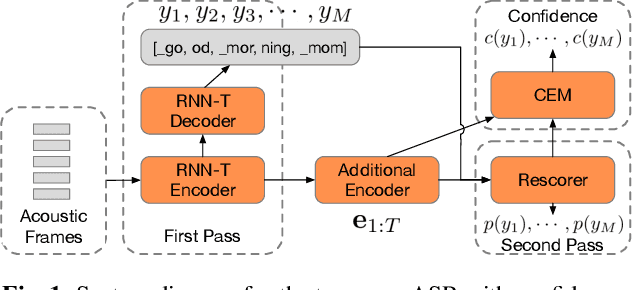
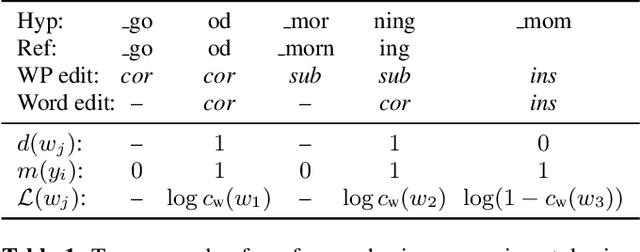
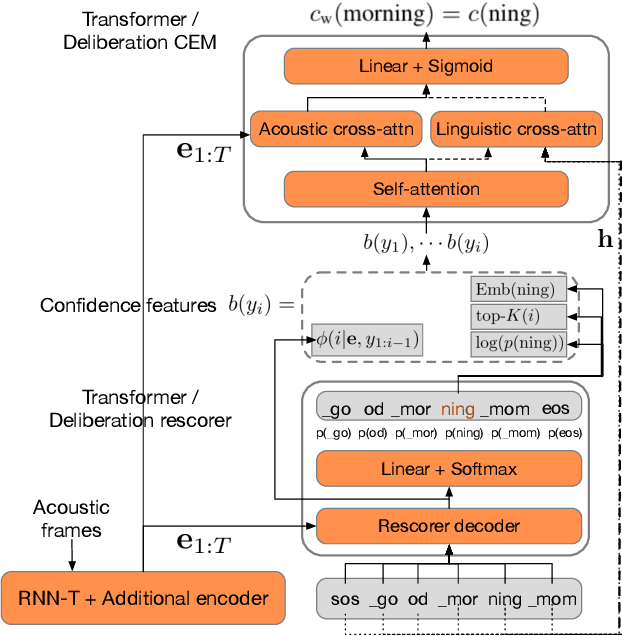
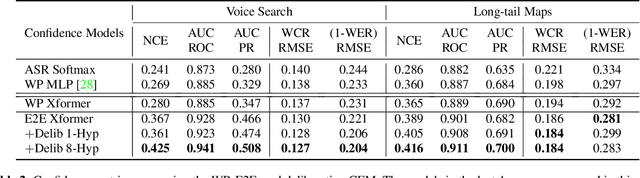
We study the problem of word-level confidence estimation in subword-based end-to-end (E2E) models for automatic speech recognition (ASR). Although prior works have proposed training auxiliary confidence models for ASR systems, they do not extend naturally to systems that operate on word-pieces (WP) as their vocabulary. In particular, ground truth WP correctness labels are needed for training confidence models, but the non-unique tokenization from word to WP causes inaccurate labels to be generated. This paper proposes and studies two confidence models of increasing complexity to solve this problem. The final model uses self-attention to directly learn word-level confidence without needing subword tokenization, and exploits full context features from multiple hypotheses to improve confidence accuracy. Experiments on Voice Search and long-tail test sets show standard metrics (e.g., NCE, AUC, RMSE) improving substantially. The proposed confidence module also enables a model selection approach to combine an on-device E2E model with a hybrid model on the server to address the rare word recognition problem for the E2E model.
Less Is More: Improved RNN-T Decoding Using Limited Label Context and Path Merging
Dec 12, 2020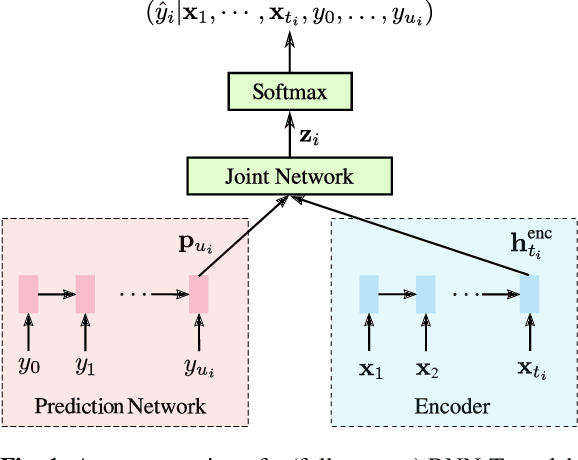
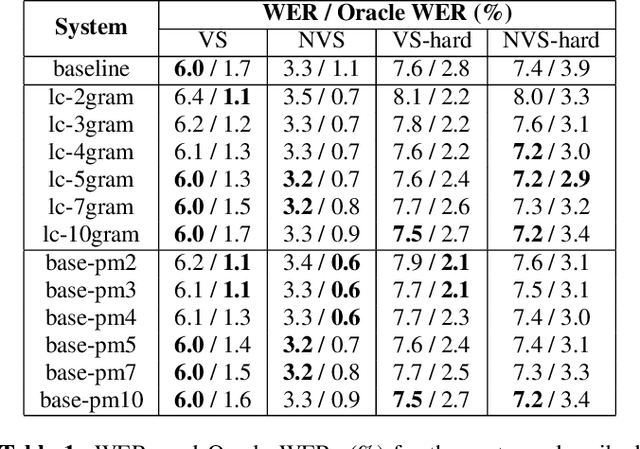
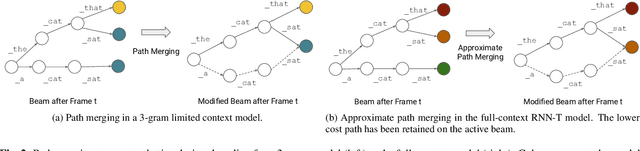
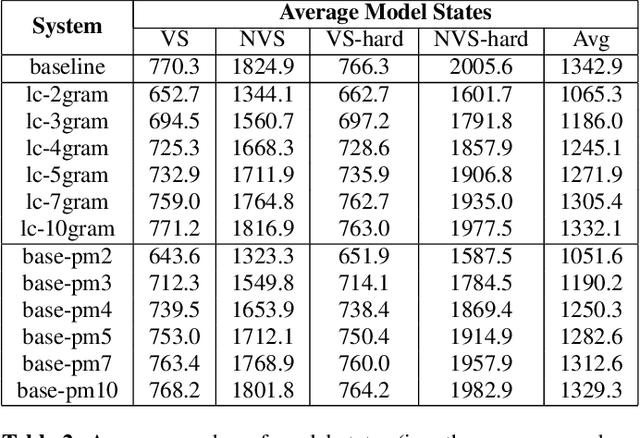
End-to-end models that condition the output label sequence on all previously predicted labels have emerged as popular alternatives to conventional systems for automatic speech recognition (ASR). Since unique label histories correspond to distinct models states, such models are decoded using an approximate beam-search process which produces a tree of hypotheses. In this work, we study the influence of the amount of label context on the model's accuracy, and its impact on the efficiency of the decoding process. We find that we can limit the context of the recurrent neural network transducer (RNN-T) during training to just four previous word-piece labels, without degrading word error rate (WER) relative to the full-context baseline. Limiting context also provides opportunities to improve the efficiency of the beam-search process during decoding by removing redundant paths from the active beam, and instead retaining them in the final lattice. This path-merging scheme can also be applied when decoding the baseline full-context model through an approximation. Overall, we find that the proposed path-merging scheme is extremely effective allowing us to improve oracle WERs by up to 36% over the baseline, while simultaneously reducing the number of model evaluations by up to 5.3% without any degradation in WER.
Confidence Estimation for Attention-based Sequence-to-sequence Models for Speech Recognition
Oct 23, 2020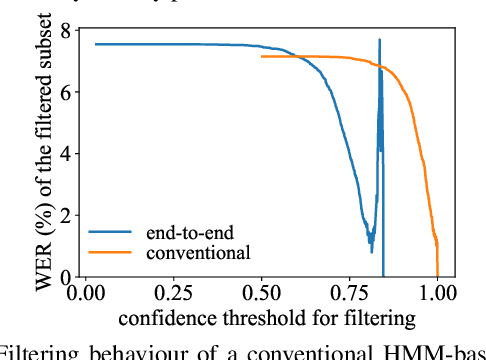
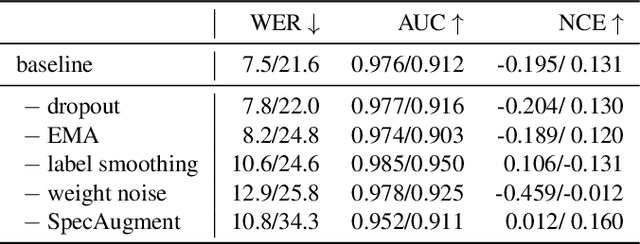
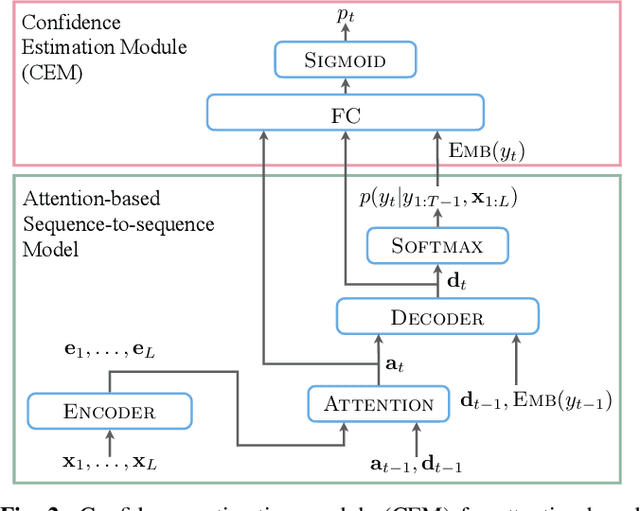
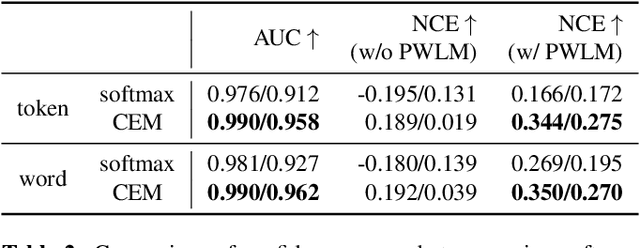
For various speech-related tasks, confidence scores from a speech recogniser are a useful measure to assess the quality of transcriptions. In traditional hidden Markov model-based automatic speech recognition (ASR) systems, confidence scores can be reliably obtained from word posteriors in decoding lattices. However, for an ASR system with an auto-regressive decoder, such as an attention-based sequence-to-sequence model, computing word posteriors is difficult. An obvious alternative is to use the decoder softmax probability as the model confidence. In this paper, we first examine how some commonly used regularisation methods influence the softmax-based confidence scores and study the overconfident behaviour of end-to-end models. Then we propose a lightweight and effective approach named confidence estimation module (CEM) on top of an existing end-to-end ASR model. Experiments on LibriSpeech show that CEM can mitigate the overconfidence problem and can produce more reliable confidence scores with and without shallow fusion of a language model. Further analysis shows that CEM generalises well to speech from a moderately mismatched domain and can potentially improve downstream tasks such as semi-supervised learning.
FastEmit: Low-latency Streaming ASR with Sequence-level Emission Regularization
Oct 21, 2020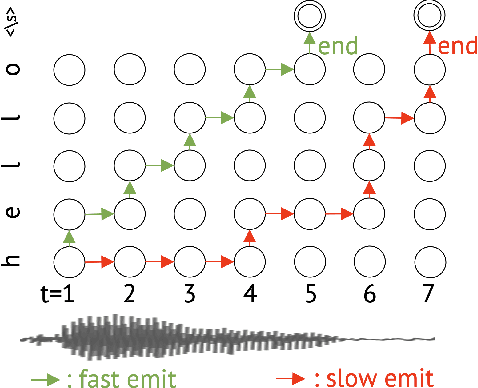
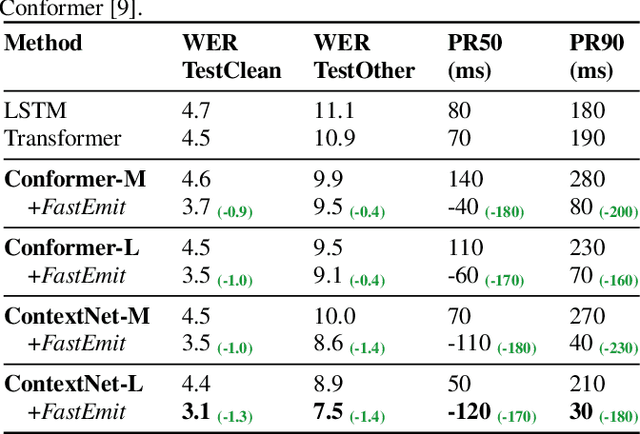

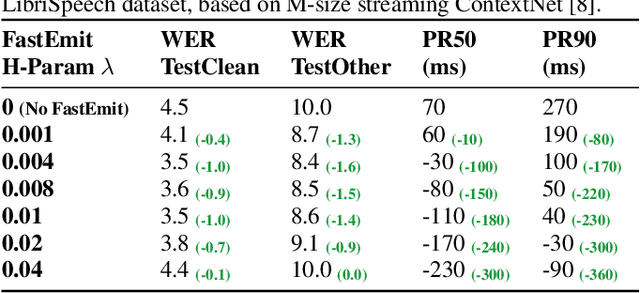
Streaming automatic speech recognition (ASR) aims to emit each hypothesized word as quickly and accurately as possible. However, emitting fast without degrading quality, as measured by word error rate (WER), is highly challenging. Existing approaches including Early and Late Penalties and Constrained Alignments penalize emission delay by manipulating per-token or per-frame probability prediction in sequence transducer models. While being successful in reducing delay, these approaches suffer from significant accuracy regression and also require additional word alignment information from an existing model. In this work, we propose a sequence-level emission regularization method, named FastEmit, that applies latency regularization directly on per-sequence probability in training transducer models, and does not require any alignment. We demonstrate that FastEmit is more suitable to the sequence-level optimization of transducer models for streaming ASR by applying it on various end-to-end streaming ASR networks including RNN-Transducer, Transformer-Transducer, ConvNet-Transducer and Conformer-Transducer. We achieve 150-300 ms latency reduction with significantly better accuracy over previous techniques on a Voice Search test set. FastEmit also improves streaming ASR accuracy from 4.4%/8.9% to 3.1%/7.5% WER, meanwhile reduces 90th percentile latency from 210 ms to only 30 ms on LibriSpeech.
VoiceFilter-Lite: Streaming Targeted Voice Separation for On-Device Speech Recognition
Sep 09, 2020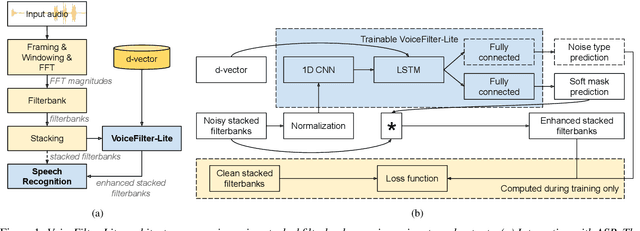
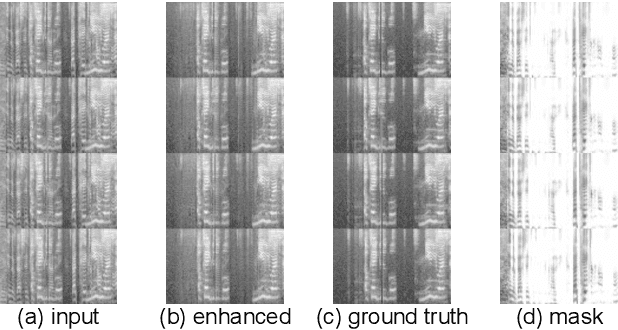
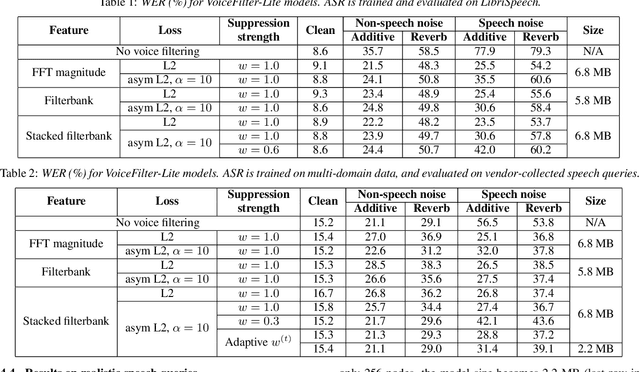
We introduce VoiceFilter-Lite, a single-channel source separation model that runs on the device to preserve only the speech signals from a target user, as part of a streaming speech recognition system. Delivering such a model presents numerous challenges: It should improve the performance when the input signal consists of overlapped speech, and must not hurt the speech recognition performance under all other acoustic conditions. Besides, this model must be tiny, fast, and perform inference in a streaming fashion, in order to have minimal impact on CPU, memory, battery and latency. We propose novel techniques to meet these multi-faceted requirements, including using a new asymmetric loss, and adopting adaptive runtime suppression strength. We also show that such a model can be quantized as a 8-bit integer model and run in realtime.
Parallel Rescoring with Transformer for Streaming On-Device Speech Recognition
Sep 02, 2020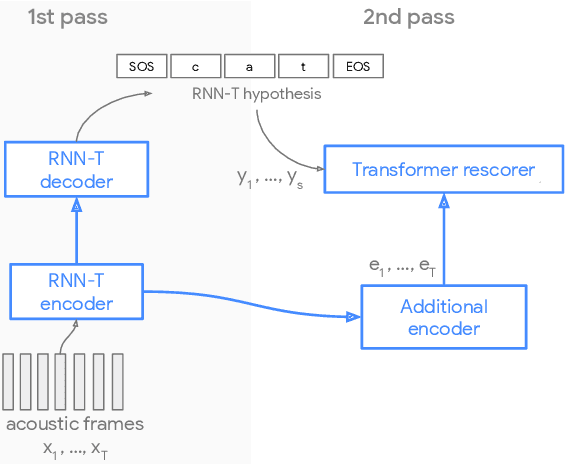
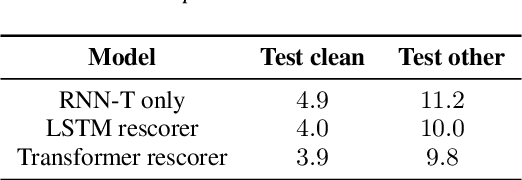
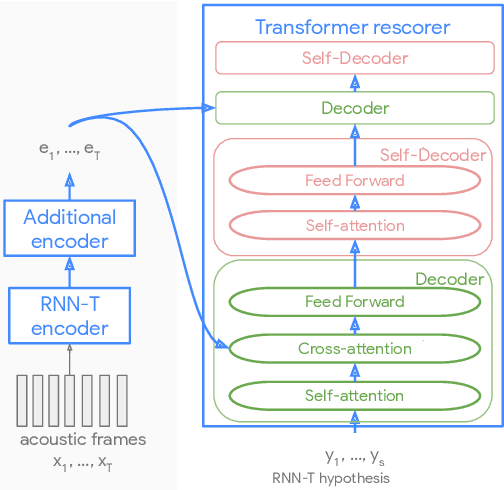
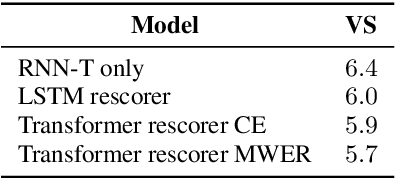
Recent advances of end-to-end models have outperformed conventional models through employing a two-pass model. The two-pass model provides better speed-quality trade-offs for on-device speech recognition, where a 1st-pass model generates hypotheses in a streaming fashion, and a 2nd-pass model re-scores the hypotheses with full audio sequence context. The 2nd-pass model plays a key role in the quality improvement of the end-to-end model to surpass the conventional model. One main challenge of the two-pass model is the computation latency introduced by the 2nd-pass model. Specifically, the original design of the two-pass model uses LSTMs for the 2nd-pass model, which are subject to long latency as they are constrained by the recurrent nature and have to run inference sequentially. In this work we explore replacing the LSTM layers in the 2nd-pass rescorer with Transformer layers, which can process the entire hypothesis sequences in parallel and can therefore utilize the on-device computation resources more efficiently. Compared with an LSTM-based baseline, our proposed Transformer rescorer achieves more than 50% latency reduction with quality improvement.