 Add to Chrome
 Add to Firefox
 Add to Edge
LOCUS-DT: Localization via Observation-Conditioned Uncertainty Scoring with Digital Twins
Aug 01, 2026
Accurate indoor localization is essential for emerging applications in robotic navigation and search and rescue. While classical methods typically focus on single-point estimates, complex indoor environments with heavy blockage and multipath propagation often lead to multimodal likelihood surfaces where a single estimate is insufficient. This paper proposes LOCUS-DT (Localization via Observation-Conditioned Uncertainty Scoring with Digital Twins), a framework that treats snapshot localization as posterior inference over the transmitter location. By leveraging a ray-tracing-based digital twin (DT) of the known environment, LOCUS-DT generates synthetic multipath profiles for candidate locations and compares them against the measured channel profile. Central to our approach is a novel learned scoring function designed to compare a fixed number of dominant specular paths, providing robustness against errors in both the DT environment model and the physical channel estimation. Importantly, LOCUS-DT is trained over an ensemble of environments to ensure generalization to unseen layouts. We evaluate the system using a Sionna-based ray-tracing backend, demonstrating that LOCUS-DT captures the sharp, multimodal posterior structures inherent in indoor settings more accurately than standard Gaussian or Gaussian-mixture benchmarks.

STAR-RIS-Assisted Integrated Sensing, Secure Communication, and Power Transfer: A Transmit Power Minimization Framework
Jul 03, 2026Evolving wireless networks call for architectures that unify sensing, communication, and wireless power transfer. Although integrated sensing and communication (ISAC) and simultaneous wireless information and power transfer (SWIPT) have validated dual-function transmission, the combination of integrated sensing, secure communication, and power transfer (ISSCPT) remains largely unexplored, in part due to the tight coupling among design variables. To address this coupling and expand spatial degrees of freedom, we turn to intelligent metasurfaces: while a conventional reconfigurable intelligent surface (cRIS) reflects only to one side and thus limits coverage and flexibility, a simultaneously transmitting and reflecting RIS (STAR-RIS) enables full-space wave control, making it a natural vehicle for power-efficient ISSCPT. We study a STAR-RIS-assisted ISSCPT system and pose a central question: How much transmit power is required to operate such a system? We formulate a transmit-power minimization problem that jointly optimizes transmit and receive beamforming and the STAR-RIS configuration, and solve it via alternating optimization with successive convex approximation, second-order cone programming, and eigenvalue decomposition. Simulations show that the proposed STAR-RIS-assisted design outperforms cRIS and no-RIS baselines, and quantify the additional transmit power required by ISSCPT relative to ISAC and secure SWIPT, clarifying security-sensing-power tradeoffs in metasurface-assisted systems.
Near Field Multi-Band Localization: CRB, Efficient Estimator, and Threshold SNR
Jun 10, 2026This paper presents a theoretical framework for multi-band localization for a single-path single-input multiple-output (SIMO) system. We derive closed-form Cramer-Rao bounds (CRBs) for angle-of-arrival (AoA) and distance for uniform linear arrays (ULAs), and an intermediate matrix-form formulation for arbitrary array shapes. We also develop benchmark single- and multi-band maximum-likelihood (ML) estimators for AoA-Distance, leveraging a structured Levenberg-Marquardt (LM) refinement procedure. A key contribution is an analytical characterization of the threshold SNR (TSNR) for the proposed estimators. This is the SNR threshold at which the estimator transitions from "off the chart" to CRB-approaching performance, for both TDoA and distance estimation. Numerical simulations confirm that the proposed single- and multi-band estimators achieve the CRB at SNRs above the predicted TSNR, and that multi-band processing simultaneously improves estimation accuracy and reduces SNR requirements. The resulting framework provides a rigorous foundation for next-generation multi-band localization and can be readily extended to elevation estimation, distributed arrays, and multi-path environments.
Structured Latent Dynamics in Wireless CSI via Homomorphic World Models
Mar 20, 2026We introduce a self-supervised framework for learning predictive and structured representations of wireless channels by modeling the temporal evolution of channel state information (CSI) in a compact latent space. Our method casts the problem as a world modeling task and leverages the Joint Embedding Predictive Architecture (JEPA) to learn action-conditioned latent dynamics from CSI trajectories. To promote geometric consistency and compositionality, we parameterize transitions using homomorphic updates derived from Lie algebra, yielding a structured latent space that reflects spatial layout and user motion. Evaluations on the DICHASUS dataset show that our approach outperforms strong baselines in preserving topology and forecasting future embeddings across unseen environments. The resulting latent space enables metrically faithful channel charts, offering a scalable foundation for downstream applications such as mobility-aware scheduling, localization, and wireless scene understanding.
Design of Uplink ISAC Systems with Cooperative Sensing: Power Control and Receive Beamforming
Mar 18, 2026Integrated sensing and communication (ISAC) has emerged as a key paradigm for next-generation wireless systems, which allows wireless resources to be used for data transmission and target sensing simultaneously. In this paper, multi-user collaborative target detection in the uplink ISAC system is investigated. To incorporate the target sensing functionality, the system relies on the reuse of uplink signals from the communication users. Specifically, we analyze an uplink multi-user single-input multiple-output (MU-SIMO) communication system with bistatic sensing. Using the channel statistics, we formulate the problem of joint optimal pilot and data power allocation to maximize the uplink ergodic sum rate while meeting communication and sensing quality-of-service (QoS) requirements. To address this non-convex problem, we propose an alternating optimization (AO)-based iterative framework, where the joint power allocation problem is decomposed into two sub-problems. Specifically, the pilot power allocation is optimized using a penalty dual decomposition (PDD)-based gradient ascent algorithm, while the data power allocation is solved via successive convex approximation (SCA). Once the long-term power allocation is determined, the base station (BS) estimates the instantaneous channels using a minimum mean-squared error (MMSE) estimator. Subsequently, based on the estimated instantaneous channel state information (CSI), the receive beamforming for communication users is optimized via another SCA-based method to maximize the sum rate. Meanwhile, the optimal receive beamforming for the target is obtained in closed-form through eigenvalue decomposition (EVD).
Hybrid Radar Fusion with Quantization: CRB-Rate Trade-offs and ADC Dynamic Range
Jan 26, 2026Recent advancements have underscored the relevance of low-resolution analog-to-digital converters (ADCs) in integrated sensing and communication (ISAC) systems. Nevertheless, their specific impact on hybrid radar fusion (HRF) remains largely unexplored. In HRF systems, where uplink (UL) paths carry direct and reflected signals in the same frequency band, the reflected signal is often significantly weaker, making HRF performance particularly sensitive to ADC resolution. To study this effect, we use the quantized Cramér-Rao bound (CRB) to measure sensing accuracy. This work derives an upper bound on the quantized CRB for angle of arrival (AoA) estimation and explores CRB-rate trade-offs through two formulated optimization problems. Simulation results indicate that HRF becomes infeasible when the dynamic range of the received signal exceeds the dynamic range supported by the ADC, which is inherently limited by its resolution. Furthermore, the UL communication rate does not increase significantly when the ADC resolution is raised beyond a certain threshold. These observations highlight a fundamental trade-off between sensing and communication performance: while HRF performance benefits from higher ADC resolutions, the corresponding gains in communication rate plateau. This trade-off is effectively characterized using CRB-rate boundaries derived through simulation.
Flexible Intelligent Metasurface for Downlink Communications under Statistical CSI
Dec 28, 2025Flexible intelligent metasurface (FIM) is a recently developed, groundbreaking hardware technology with promising potential for 6G wireless systems. Unlike conventional rigid antenna array (RAA)-based transmitters, FIM-assisted transmitters can dynamically alter their physical surface through morphing, offering new degrees of freedom to enhance system performance. In this letter, we depart from prior works that rely on instantaneous channel state information (CSI) and instead address the problem of average sum spectral efficiency maximization under statistical CSI in a FIM-assisted downlink multiuser multiple-input single-output setting. To this end, we first derive the spatial correlation matrix for the FIM-aided transmitter and then propose an iterative FIM optimization algorithm based on the gradient projection method. Simulation results show that with statistical CSI, the FIM-aided system provides a significant performance gain over its RAA-based counterpart in scenarios with strong spatial channel correlation, whereas the gain diminishes when the channels are weakly correlated.
From OFDM to AFDM: Enabling Adaptive Integrated Sensing and Communication in High-Mobility Scenarios
Oct 31, 2025Integrated sensing and communication (ISAC) is a key feature of next-generation wireless networks, enabling a wide range of emerging applications such as vehicle-to-everything (V2X) and unmanned aerial vehicles (UAVs), which operate in high-mobility scenarios. Notably, the wireless channels within these applications typically exhibit severe delay and Doppler spreads. The latter causes serious communication performance degradation in the Orthogonal Frequency-Division Multiplexing (OFDM) waveform that is widely adopted in current wireless networks. To address this challenge, the recently proposed Doppler-resilient affine frequency division multiplexing (AFDM) waveform, which uses flexible chirp signals as subcarriers, shows great potential for achieving adaptive ISAC in high-mobility scenarios. This article provides a comprehensive overview of AFDM-ISAC. We begin by presenting the fundamentals of AFDM-ISAC, highlighting its inherent frequency-modulated continuous-wave (FMCW)-like characteristics. Then, we explore its ISAC performance limits by analyzing its diversity order, ambiguity function (AF), and Cramer-Rao Bound (CRB). Finally, we present several effective sensing algorithms and opportunities for AFDM-ISAC, with the aim of sparking new ideas in this emerging field.
3GPP-Compliant Radar Cross Section Characterization of Indoor Factory Targets
May 13, 2025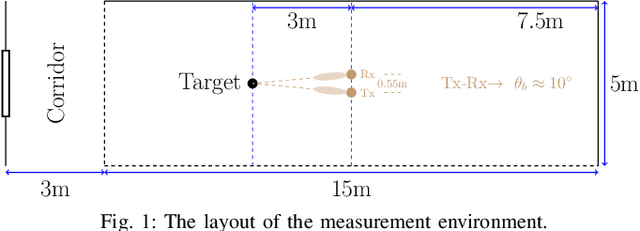
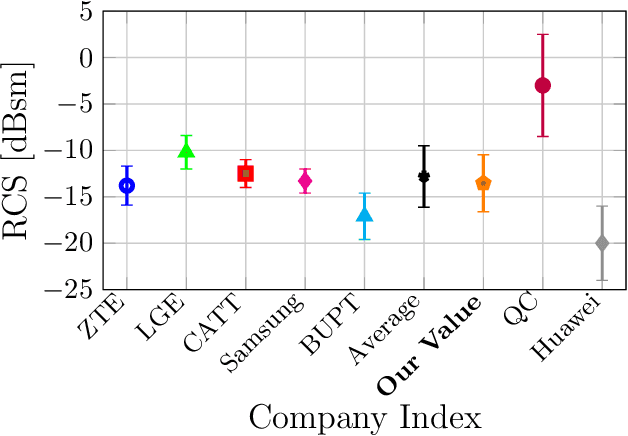
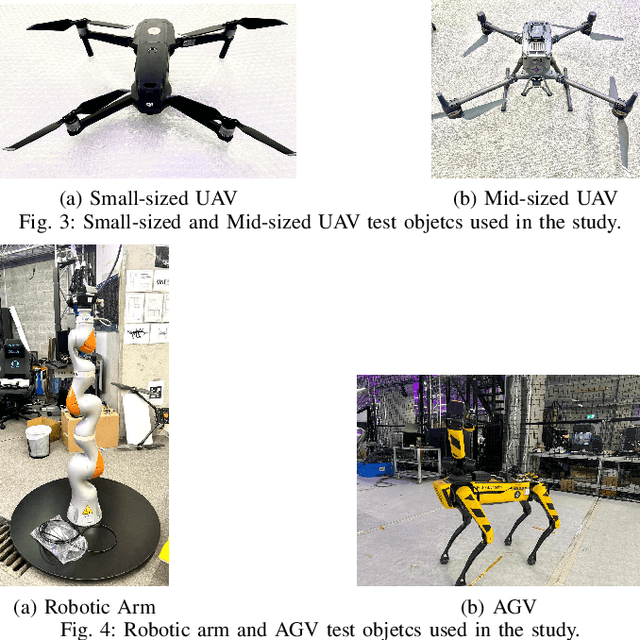
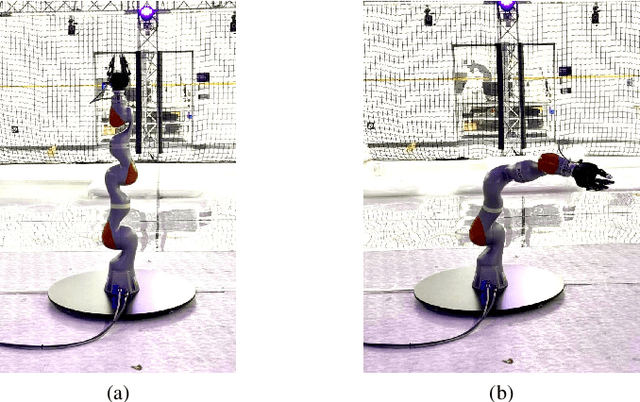
The following paper presents a systematic 3rd Generation Partnership Project (3GPP)-compliant characterization of radar cross section (RCS) for indoor factory (InF) objects, including small and mid-sized unmanned aerial vehicles (UAVs), robotic arms, and automated guided vehicles (AGVs). Through measurements in the 25-28 GHz range, we validate the 3GPP standardized log-normal distribution model for RCS for above-mentioned target objects. The 3GPP-complaint RCS parameters obtained for the small-sized UAV are in close agreement (<1 dB deviation) with 3GPP agreed values. The mid-sized UAVs exhibit higher reflectivity compared to the small-sized UAV due to enhanced specular components attributed to material and lithium-ion battery packs. The robotic arm exhibits dynamic RCS behavior due to mechanical articulation, whereas UAVs show clear size-dependent reflectivity patterns in AGVs. Our findings provide empirical validation for RCS characterization for integrated sensing and communication channel modeling in InF environments.
Towards ISAC RIS-Enabled Passive Radar Target Localization
Feb 26, 2025


Incorporating integrated sensing and communication capabilities into forthcoming 6G wireless networks is crucial for achieving seamless synchronization between the digital and physical worlds. The following paper focuses on a scenario where a passive radar (PR) is subject to weak line-of-sight signals of opportunity, emanating from an access point and subsequently reflecting off targets, ultimately reaching the PR. Furthermore, a normalized least mean squares method is presented for jointly detecting the number of targets and estimating target angles of arrival (AoAs). The algorithm iteratively adjusts the steering vector estimates to minimize a suitable error cost function, while the target AoAs are identified via a peak-finding search conducted on the resulted power spectrum. Simulation results show the capabilities of the proposed localization method, as well as a 14 dB dynamic range reduction that can be achieved at the PR.