 Add to Chrome
 Add to Firefox
 Add to Edge
ISAC with Affine Frequency Division Multiplexing: An FMCW-Based Signal Processing Perspective
Nov 15, 2025
This paper investigates the sensing potential of affine frequency division multiplexing (AFDM) in high-mobility integrated sensing and communication (ISAC) from the perspective of radar waveforms. We introduce an innovative parameter selection criterion that establishes a precise mathematical equivalence between AFDM subcarriers and Nyquist-sampled frequency-modulated continuous-wave (FMCW). This connection not only provides a clear physical insight into AFDM's sensing mechanism but also enables a direct mapping from the DAFT index to delay-Doppler (DD) parameters of wireless channels. Building on this, we develop a novel input-output model in a DD-parameterized DAFT (DD-DAFT) domain for AFDM, which explicitly reveals the inherent DD coupling effect arising from the chirp-channel interaction. Subsequently, we design two matched-filtering sensing algorithms. The first is performed in the time-frequency domain with low complexity, while the second is operated in the DD-DAFT domain to precisely resolve the DD coupling. Simulations show that our algorithms achieve effective pilot-free sensing and demonstrate a fundamental trade-off between sensing performance, communication overhead, and computational complexity. The proposed AFDM outperforms classical AFDM and other variants in most scenarios.

High-Precision Positioning with Continuous Delay and Doppler Shift using AFT-MC Waveforms
May 01, 2024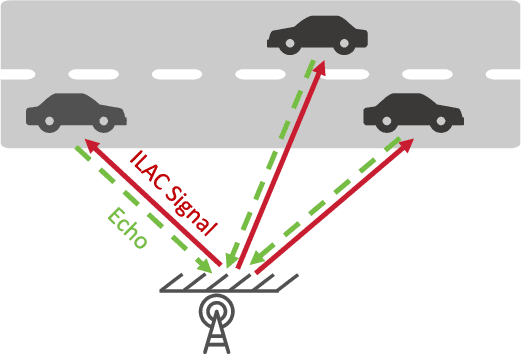
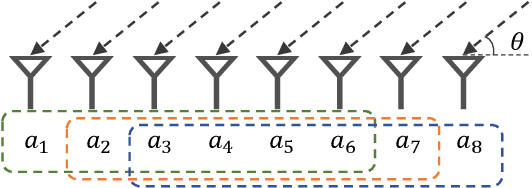
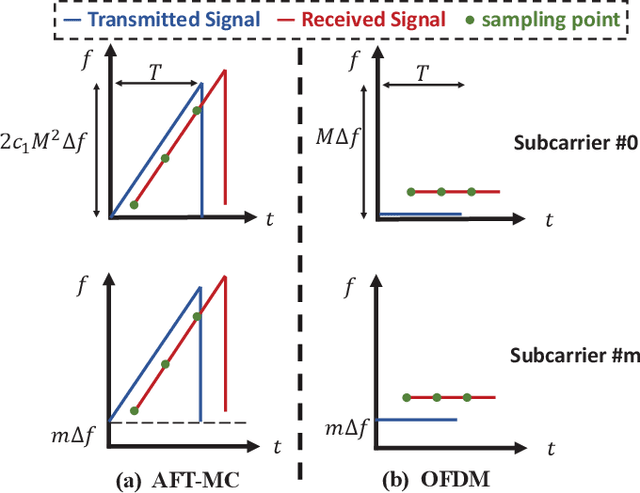
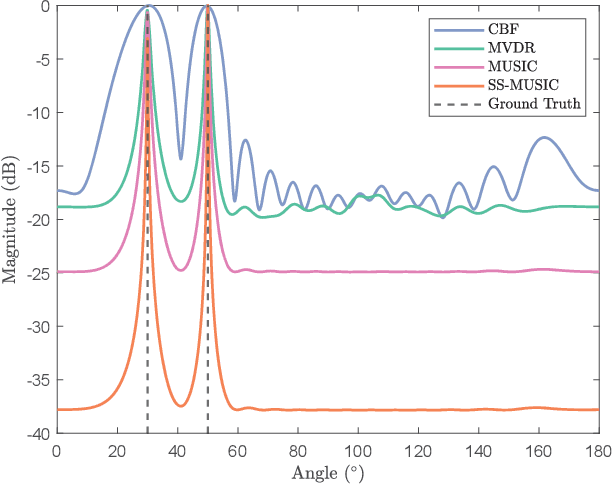
This paper explores a novel integrated localization and communication (ILAC) system using the affine Fourier transform multicarrier (AFT-MC) waveform. Specifically, we consider a multiple-input multiple-output (MIMO) AFT-MC system with ILAC and derive a continuous delay and Doppler shift channel matrix model. Based on the derived signal model, we develop a two-step algorithm with low complexity for estimating channel parameters. Furthermore, we derive the Cram\'er-Rao lower bound (CRLB) of location estimation as the fundamental limit of localization. Finally, we provide some insights about the AFT-MC parameters by explaining the impact of the parameters on localization performance. Simulation results demonstrate that the AFT-MC waveform is able to provide significant localization performance improvement compared to orthogonal frequency division multiplexing (OFDM) while achieving the CRLB of location estimation.