 Add to Chrome
 Add to Firefox
 Add to Edge
Ambiguity Function Analysis of AFDM Under Pulse-Shaped Random ISAC Signaling
Paper and Code
Nov 06, 2025
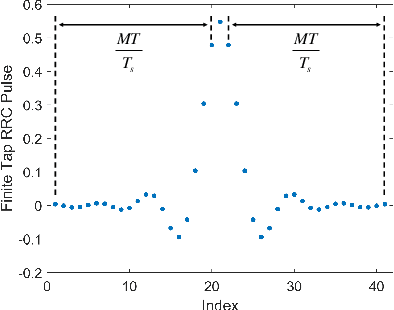
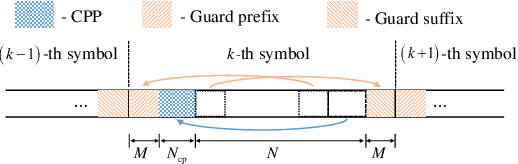
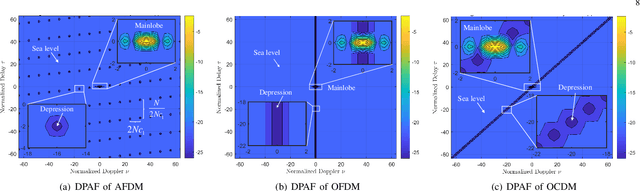
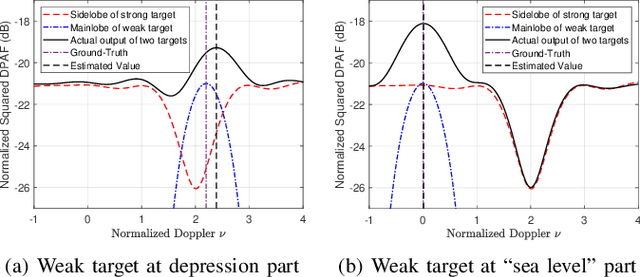
This paper investigates the ambiguity function (AF) of the emerging affine frequency division multiplexing (AFDM) waveform for Integrated Sensing and Communication (ISAC) signaling under a pulse shaping regime. Specifically, we first derive the closed-form expression of the average squared discrete period AF (DPAF) for AFDM waveform without pulse shaping, revealing that the AF depends on the parameter $c_1$ and the kurtosis of random communication data, while being independent of the parameter $c_2$. As a step further, we conduct a comprehensive analysis on the AFs of various waveforms, including AFDM, orthogonal frequency division multiplexing (OFDM) and orthogonal chirp-division multiplexing (OCDM). Our results indicate that all three waveforms exhibit the same number of regular depressions in the sidelobes of their AFs, which incurs performance loss for detecting and estimating weak targets. However, the AFDM waveform can flexibly control the positions of depressions by adjusting the parameter $c_1$, which motivates a novel design approach of the AFDM parameters to mitigate the adverse impact of depressions of the strong target on the weak target. Furthermore, a closed-form expression of the average squared DPAF for pulse-shaped random AFDM waveform is derived, which demonstrates that the pulse shaping filter generates the shaped mainlobe along the delay axis and the rapid roll-off sidelobes along the Doppler axis. Numerical results verify the effectiveness of our theoretical analysis and proposed design methodology for the AFDM modulation.
