 Add to Chrome
 Add to Firefox
 Add to Edge
Scaling Instruction-Finetuned Language Models
Oct 20, 2022
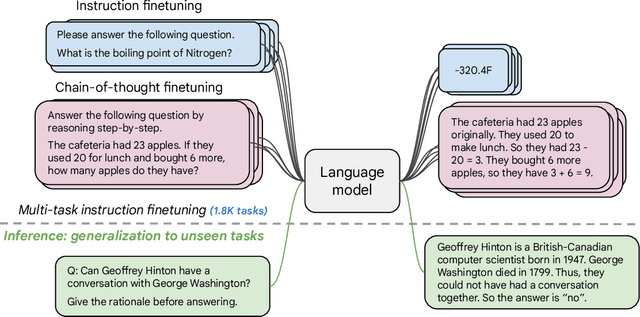
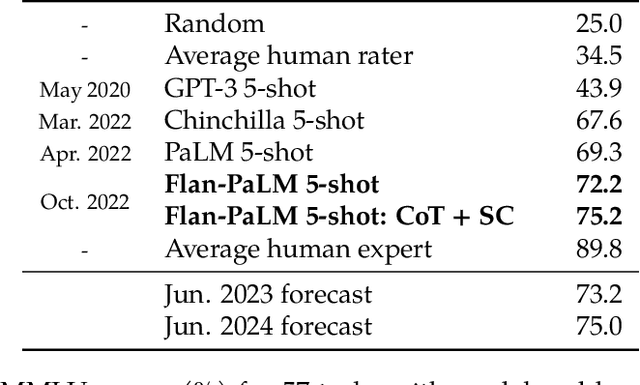
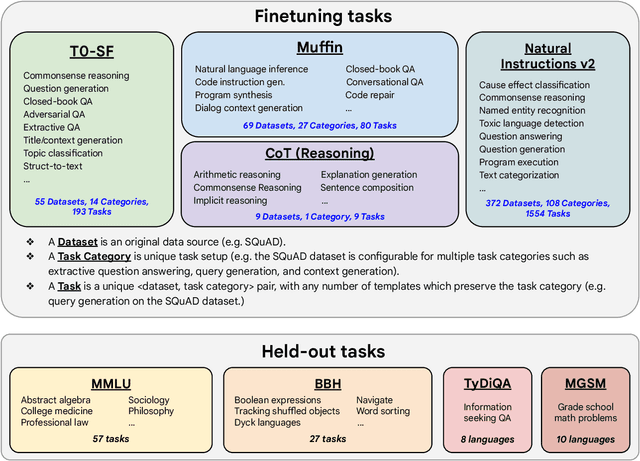
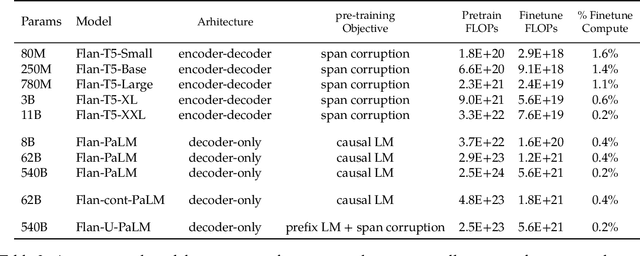
Finetuning language models on a collection of datasets phrased as instructions has been shown to improve model performance and generalization to unseen tasks. In this paper we explore instruction finetuning with a particular focus on (1) scaling the number of tasks, (2) scaling the model size, and (3) finetuning on chain-of-thought data. We find that instruction finetuning with the above aspects dramatically improves performance on a variety of model classes (PaLM, T5, U-PaLM), prompting setups (zero-shot, few-shot, CoT), and evaluation benchmarks (MMLU, BBH, TyDiQA, MGSM, open-ended generation). For instance, Flan-PaLM 540B instruction-finetuned on 1.8K tasks outperforms PALM 540B by a large margin (+9.4% on average). Flan-PaLM 540B achieves state-of-the-art performance on several benchmarks, such as 75.2% on five-shot MMLU. We also publicly release Flan-T5 checkpoints, which achieve strong few-shot performance even compared to much larger models, such as PaLM 62B. Overall, instruction finetuning is a general method for improving the performance and usability of pretrained language models.

Building Machine Translation Systems for the Next Thousand Languages
May 16, 2022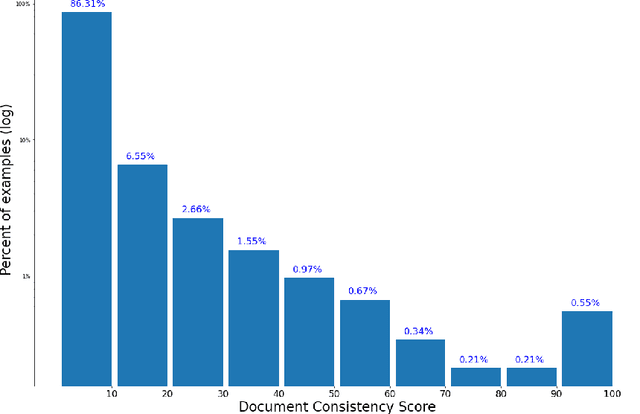
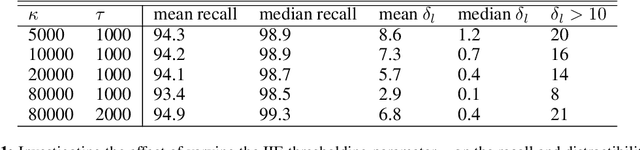

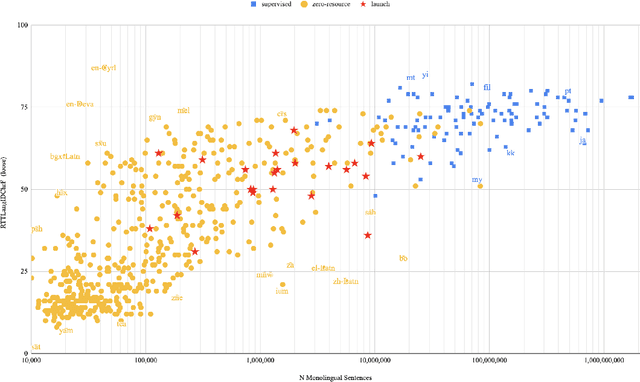
In this paper we share findings from our effort to build practical machine translation (MT) systems capable of translating across over one thousand languages. We describe results in three research domains: (i) Building clean, web-mined datasets for 1500+ languages by leveraging semi-supervised pre-training for language identification and developing data-driven filtering techniques; (ii) Developing practical MT models for under-served languages by leveraging massively multilingual models trained with supervised parallel data for over 100 high-resource languages and monolingual datasets for an additional 1000+ languages; and (iii) Studying the limitations of evaluation metrics for these languages and conducting qualitative analysis of the outputs from our MT models, highlighting several frequent error modes of these types of models. We hope that our work provides useful insights to practitioners working towards building MT systems for currently understudied languages, and highlights research directions that can complement the weaknesses of massively multilingual models in data-sparse settings.
Mixture-of-Experts with Expert Choice Routing
Feb 18, 2022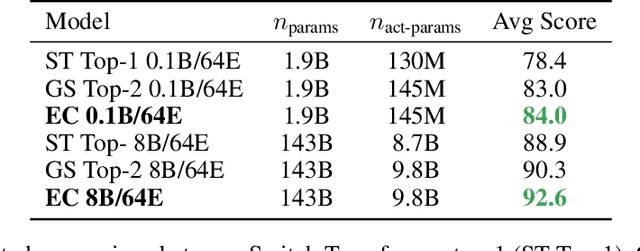
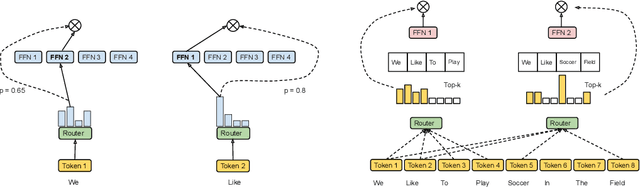
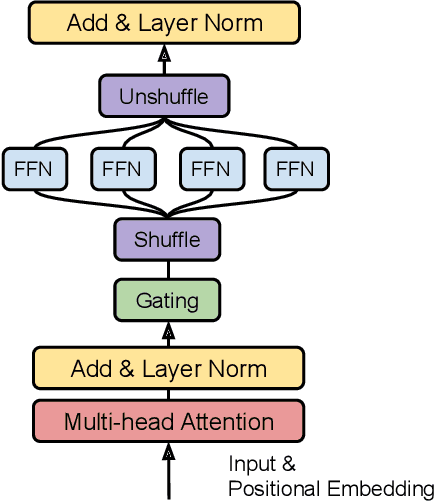
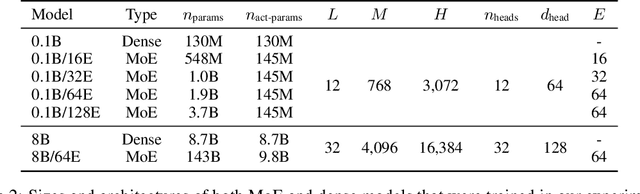
Sparsely-activated Mixture-of-experts (MoE) models allow the number of parameters to greatly increase while keeping the amount of computation for a given token or a given sample unchanged. However, a poor expert routing strategy (e.g. one resulting in load imbalance) can cause certain experts to be under-trained, leading to an expert being under or over-specialized. Prior work allocates a fixed number of experts to each token using a top-k function regardless of the relative importance of different tokens. To address this, we propose a heterogeneous mixture-of-experts employing an expert choice method. Instead of letting tokens select the top-k experts, we have experts selecting the top-k tokens. As a result, each token can be routed to a variable number of experts and each expert can have a fixed bucket size. We systematically study pre-training speedups using the same computational resources of the Switch Transformer top-1 and GShard top-2 gating of prior work and find that our method improves training convergence time by more than 2x. For the same computational cost, our method demonstrates higher performance in fine-tuning 11 selected tasks in the GLUE and SuperGLUE benchmarks. For a smaller activation cost, our method outperforms the T5 dense model in 7 out of the 11 tasks.
Designing Effective Sparse Expert Models
Feb 17, 2022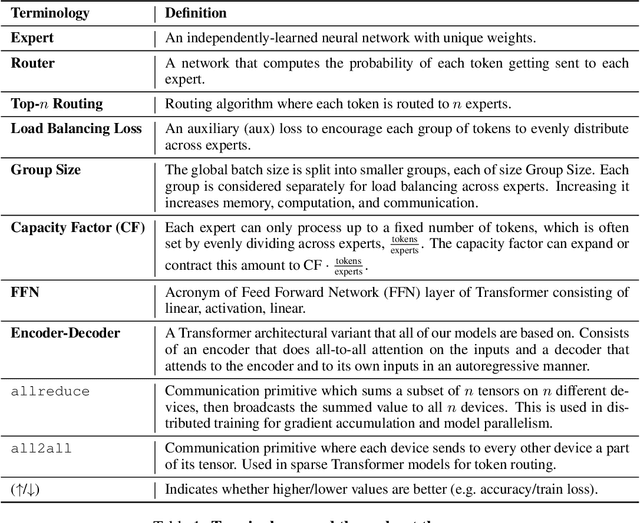
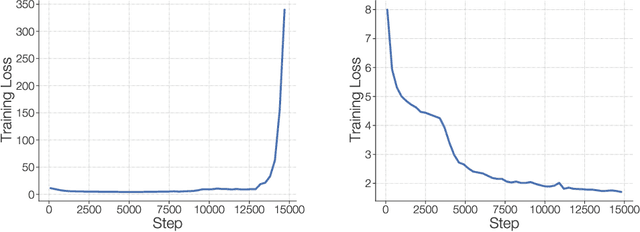
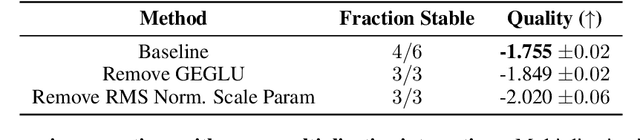
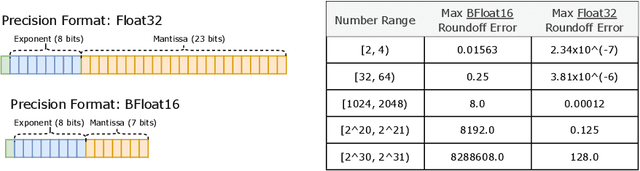
Scale has opened new frontiers in natural language processing -- but at a high cost. In response, Mixture-of-Experts (MoE) and Switch Transformers have been proposed as an energy efficient path to even larger and more capable language models. But advancing the state-of-the-art across a broad set of natural language tasks has been hindered by training instabilities and uncertain quality during fine-tuning. Our work focuses on these issues and acts as a design guide. We conclude by scaling a sparse model to 269B parameters, with a computational cost comparable to a 32B dense encoder-decoder Transformer (Stable and Transferable Mixture-of-Experts or ST-MoE-32B). For the first time, a sparse model achieves state-of-the-art performance in transfer learning, across a diverse set of tasks including reasoning (SuperGLUE, ARC Easy, ARC Challenge), summarization (XSum, CNN-DM), closed book question answering (WebQA, Natural Questions), and adversarially constructed tasks (Winogrande, ANLI R3).
LaMDA: Language Models for Dialog Applications
Feb 10, 2022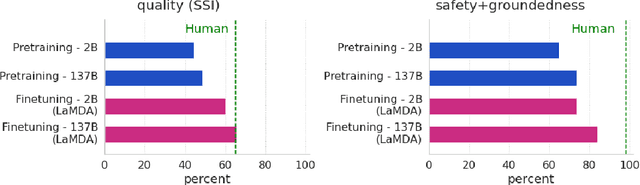
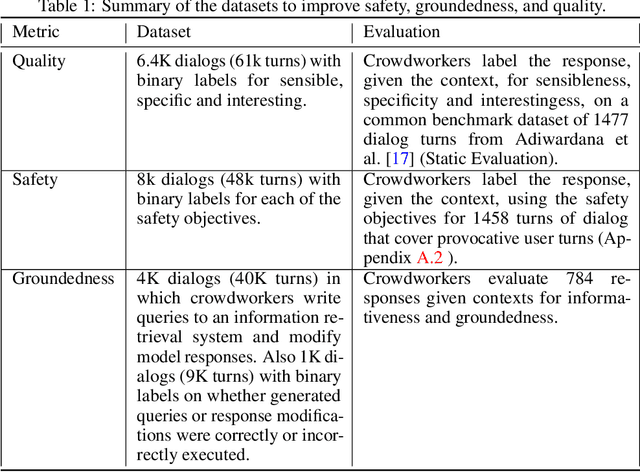
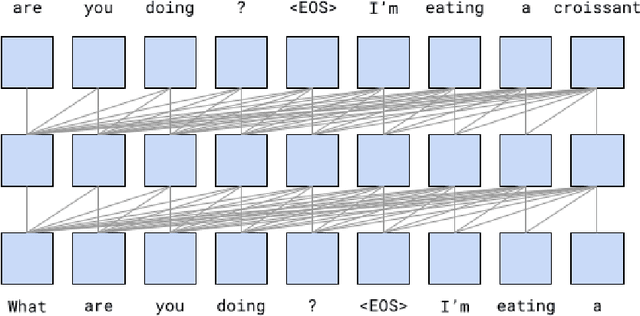

We present LaMDA: Language Models for Dialog Applications. LaMDA is a family of Transformer-based neural language models specialized for dialog, which have up to 137B parameters and are pre-trained on 1.56T words of public dialog data and web text. While model scaling alone can improve quality, it shows less improvements on safety and factual grounding. We demonstrate that fine-tuning with annotated data and enabling the model to consult external knowledge sources can lead to significant improvements towards the two key challenges of safety and factual grounding. The first challenge, safety, involves ensuring that the model's responses are consistent with a set of human values, such as preventing harmful suggestions and unfair bias. We quantify safety using a metric based on an illustrative set of human values, and we find that filtering candidate responses using a LaMDA classifier fine-tuned with a small amount of crowdworker-annotated data offers a promising approach to improving model safety. The second challenge, factual grounding, involves enabling the model to consult external knowledge sources, such as an information retrieval system, a language translator, and a calculator. We quantify factuality using a groundedness metric, and we find that our approach enables the model to generate responses grounded in known sources, rather than responses that merely sound plausible. Finally, we explore the use of LaMDA in the domains of education and content recommendations, and analyze their helpfulness and role consistency.
Alpa: Automating Inter- and Intra-Operator Parallelism for Distributed Deep Learning
Jan 28, 2022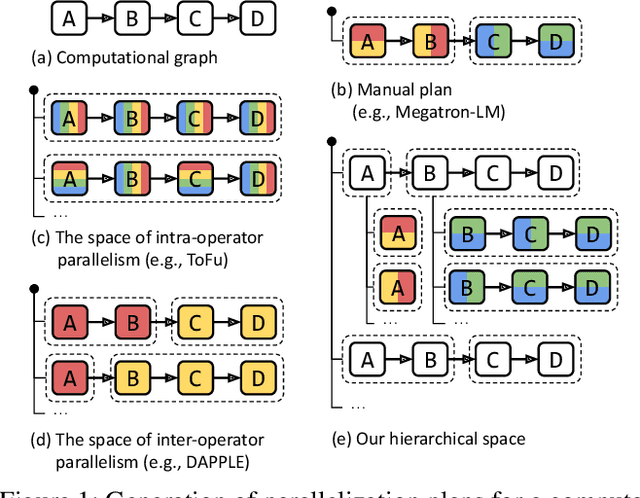
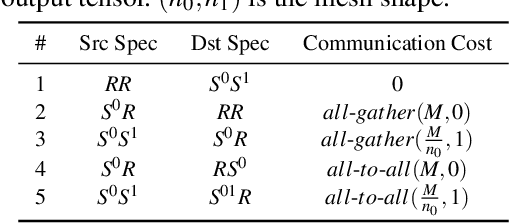

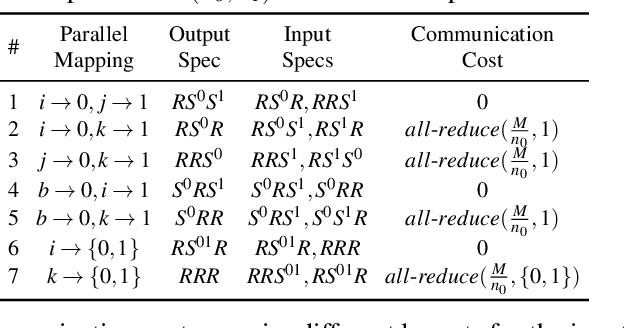
Alpa automates model-parallel training of large deep learning (DL) models by generating execution plans that unify data, operator, and pipeline parallelism. Existing model-parallel training systems either require users to manually create a parallelization plan or automatically generate one from a limited space of model parallelism configurations, which does not suffice to scale out complex DL models on distributed compute devices. Alpa distributes the training of large DL models by viewing parallelisms as two hierarchical levels: inter-operator and intra-operator parallelisms. Based on it, Alpa constructs a new hierarchical space for massive model-parallel execution plans. Alpa designs a number of compilation passes to automatically derive the optimal parallel execution plan in each independent parallelism level and implements an efficient runtime to orchestrate the two-level parallel execution on distributed compute devices. Our evaluation shows Alpa generates parallelization plans that match or outperform hand-tuned model-parallel training systems even on models they are designed for. Unlike specialized systems, Alpa also generalizes to models with heterogeneous architectures and models without manually-designed plans.
GLaM: Efficient Scaling of Language Models with Mixture-of-Experts
Dec 13, 2021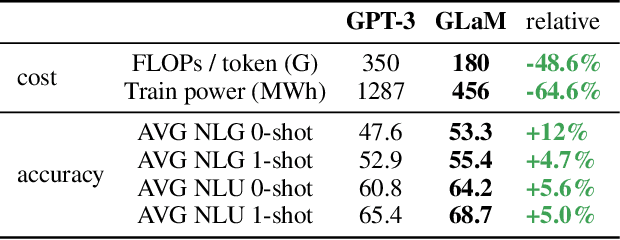
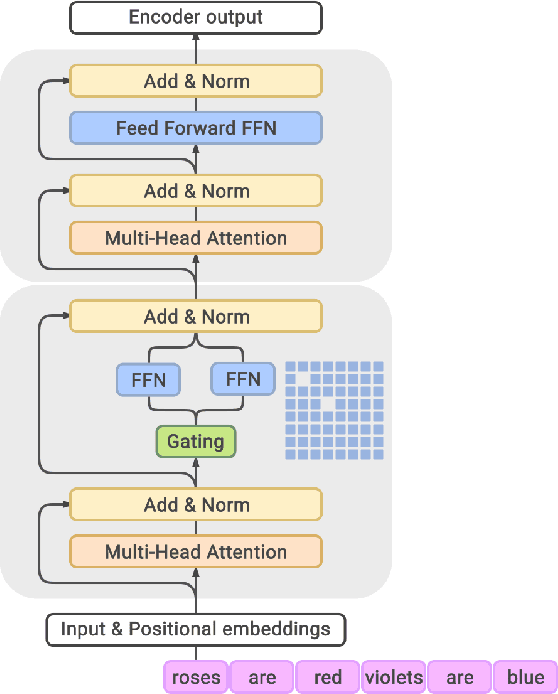
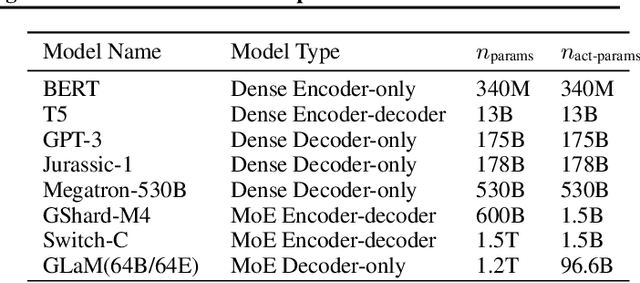
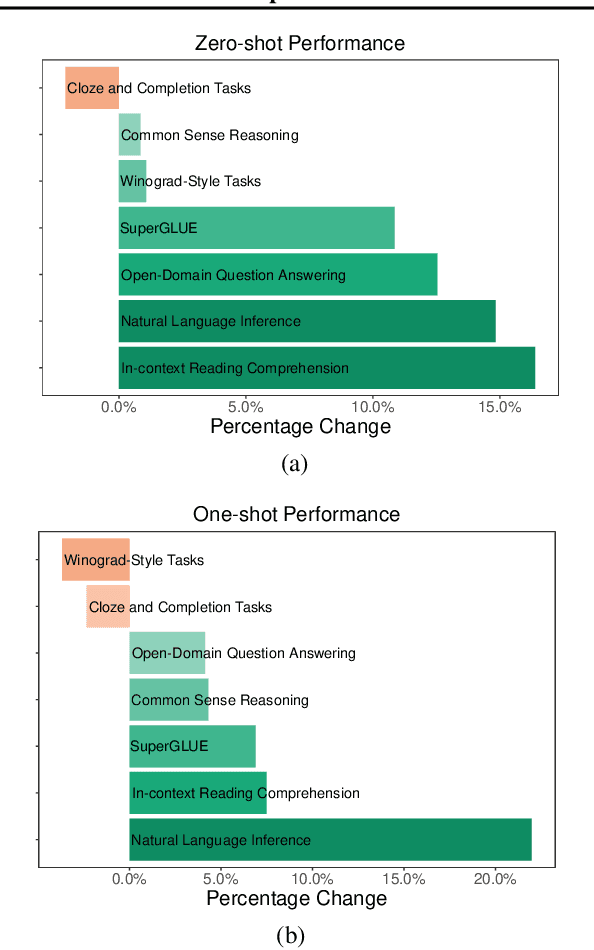
Scaling language models with more data, compute and parameters has driven significant progress in natural language processing. For example, thanks to scaling, GPT-3 was able to achieve strong results on in-context learning tasks. However, training these large dense models requires significant amounts of computing resources. In this paper, we propose and develop a family of language models named GLaM (Generalist Language Model), which uses a sparsely activated mixture-of-experts architecture to scale the model capacity while also incurring substantially less training cost compared to dense variants. The largest GLaM has 1.2 trillion parameters, which is approximately 7x larger than GPT-3. It consumes only 1/3 of the energy used to train GPT-3 and requires half of the computation flops for inference, while still achieving better overall zero-shot and one-shot performance across 29 NLP tasks.
BigSSL: Exploring the Frontier of Large-Scale Semi-Supervised Learning for Automatic Speech Recognition
Oct 01, 2021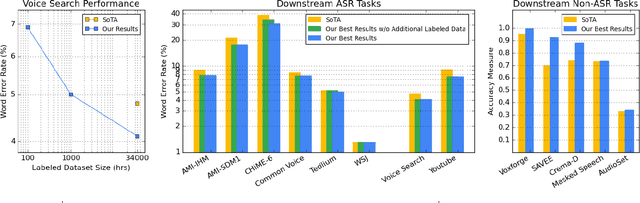
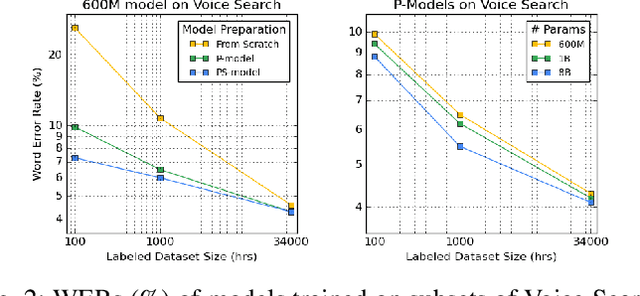
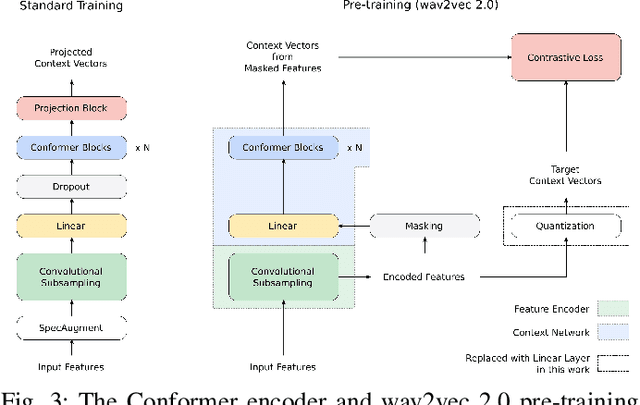
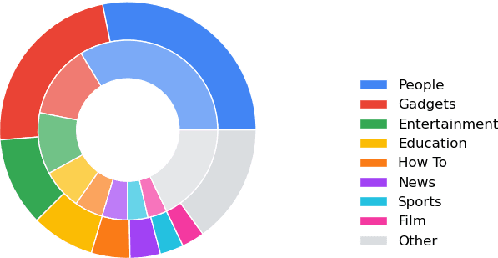
We summarize the results of a host of efforts using giant automatic speech recognition (ASR) models pre-trained using large, diverse unlabeled datasets containing approximately a million hours of audio. We find that the combination of pre-training, self-training and scaling up model size greatly increases data efficiency, even for extremely large tasks with tens of thousands of hours of labeled data. In particular, on an ASR task with 34k hours of labeled data, by fine-tuning an 8 billion parameter pre-trained Conformer model we can match state-of-the-art (SoTA) performance with only 3% of the training data and significantly improve SoTA with the full training set. We also report on the universal benefits gained from using big pre-trained and self-trained models for a large set of downstream tasks that cover a wide range of speech domains and span multiple orders of magnitudes of dataset sizes, including obtaining SoTA performance on many public benchmarks. In addition, we utilize the learned representation of pre-trained networks to achieve SoTA results on non-ASR tasks.
Beyond Distillation: Task-level Mixture-of-Experts for Efficient Inference
Sep 24, 2021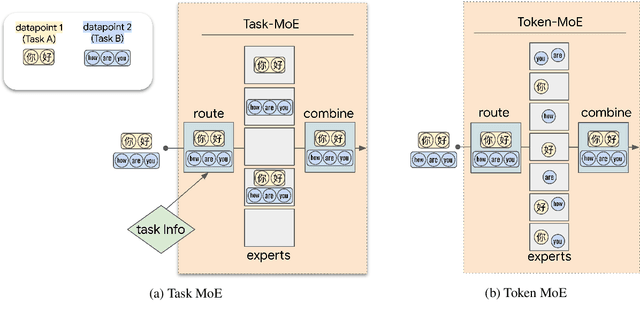
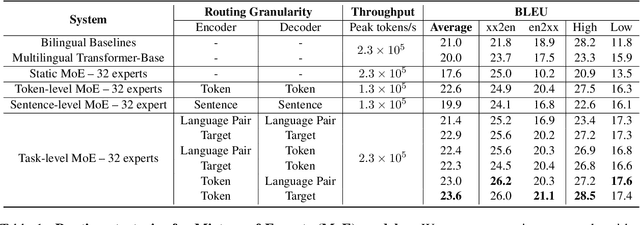
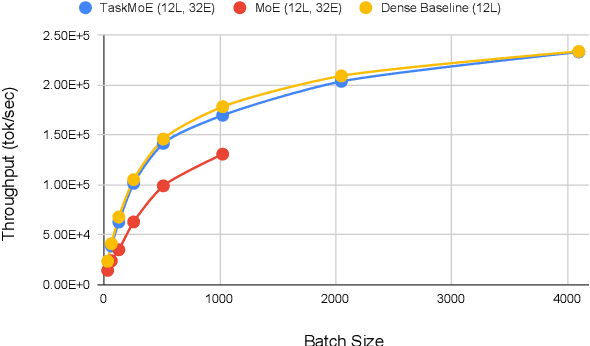

Sparse Mixture-of-Experts (MoE) has been a successful approach for scaling multilingual translation models to billions of parameters without a proportional increase in training computation. However, MoE models are prohibitively large and practitioners often resort to methods such as distillation for serving. In this work, we investigate routing strategies at different granularity (token, sentence, task) in MoE models to bypass distillation. Experiments on WMT and a web-scale dataset suggest that task-level routing (task-MoE) enables us to extract smaller, ready-to-deploy sub-networks from large sparse models. On WMT, our task-MoE with 32 experts (533M parameters) outperforms the best performing token-level MoE model (token-MoE) by +1.0 BLEU on average across 30 language pairs. The peak inference throughput is also improved by a factor of 1.9x when we route by tasks instead of tokens. While distilling a token-MoE to a smaller dense model preserves only 32% of the BLEU gains, our sub-network task-MoE, by design, preserves all the gains with the same inference cost as the distilled student model. Finally, when scaling up to 200 language pairs, our 128-expert task-MoE (13B parameters) performs competitively with a token-level counterpart, while improving the peak inference throughput by a factor of 2.6x.
GSPMD: General and Scalable Parallelization for ML Computation Graphs
May 10, 2021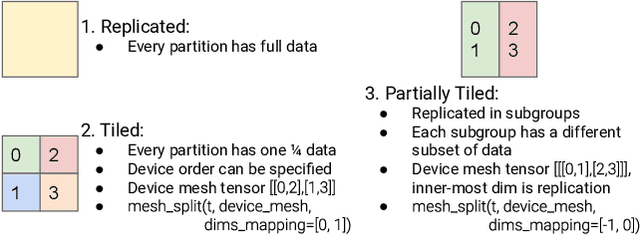

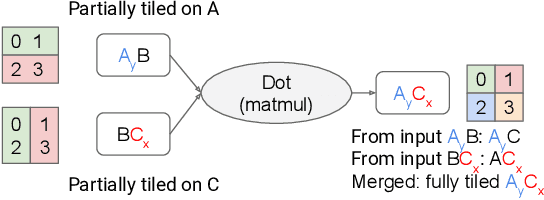
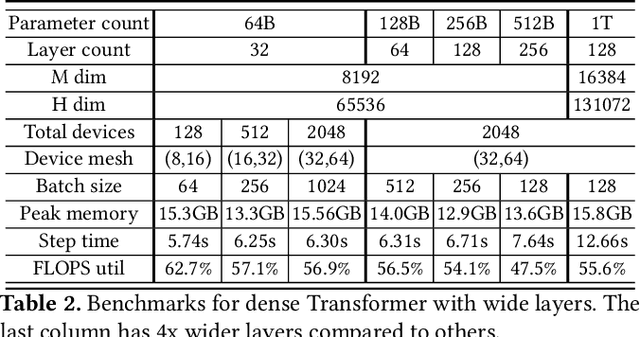
We present GSPMD, an automatic, compiler-based parallelization system for common machine learning computation graphs. It allows users to write programs in the same way as for a single device, then give hints through a few annotations on how to distribute tensors, based on which GSPMD will parallelize the computation. Its representation of partitioning is simple yet general, allowing it to express different or mixed paradigms of parallelism on a wide variety of models. GSPMD infers the partitioning for every operator in the graph based on limited user annotations, making it convenient to scale up existing single-device programs. It solves several technical challenges for production usage, such as static shape constraints, uneven partitioning, exchange of halo data, and nested operator partitioning. These techniques allow GSPMD to achieve 50% to 62% compute utilization on 128 to 2048 Cloud TPUv3 cores for models with up to one trillion parameters. GSPMD produces a single program for all devices, which adjusts its behavior based on a run-time partition ID, and uses collective operators for cross-device communication. This property allows the system itself to be scalable: the compilation time stays constant with increasing number of devices.