 Add to Chrome
 Add to Firefox
 Add to Edge
Spatial Message Passing in Language Space for Pathology Image Interpretation
Aug 14, 2026
Multimodal Large Language Models (MLLMs) can generate pathological descriptions from histological images, but gigapixel Whole Slide Images (WSIs) exceed their visual context limits. The standard tiling workaround makes WSIs tractable yet severs the tissue neighborhoods that define tumor-stroma interfaces and morphology. We introduce Spatial Language Message Passing (SLMP), a framework that performs spatial reasoning entirely in language space, human-readable by construction. SLMP represents a WSI region as a spatial text graph: tiles are nodes initialized with MLLM descriptions, and edges encode spatial adjacency. For each tile, an LLM refines its description by integrating language messages from adjacent tiles under a shared aggregation policy that, on the tile grid, acts as an adaptive local kernel operating on text rather than learned embeddings. This policy is an inspectable prompt that can be refined from model-observed tissue phenotypes via textual gradients, enabling automatic semantic optimization from local cellular context to broader tissue morphology without fine-tuning MLLM weights. On representative HER2 and CAMELYON16 regions, SLMP improves tile-level tumor description accuracy in settings spanning general-purpose and pathology-specialized backbones, with gains of +3.3 to +19.6 percentage points. Random-neighbor ablations confirm that these gains stem from spatial context rather than additional text alone, and inspecting the optimized policies reveals interpretable, tissue-specific decision rules. Besides, without any weight updates or fine-tuning the backbone MLLM, SLMP substantially improves general-purpose MLLMs and narrows its gap to pathology-specialized counterparts, offering a transparent and flexible mechanism for incorporating spatial reasoning into MLLM-based pathology analysis.

Diagram-MMU: A Multi-Modal Benchmark for Scientific Diagrams
Aug 12, 2026Multimodal Large Language Models (MLLMs) have been growing the capability for scientific writing and collaboration. For example, OpenAI Prism is a free workspace for scientific writing and collaboration. One important feature in Prism is turning scientific diagrams directly into LaTeX TikZ code. In this paper, we build a benchmark, Diagram-MMU, a multi-modal benchmark designed to assess MLLMs' ability for scientific diagram parsing and understanding. Diagram-MMU features 3.7k curated diagrams and 18.3k human-validated questions across six domains. It evaluates MLLMs on three tasks common in vibe writing workspaces: diagram-to-code parsing, diagram-to-code editing, and diagram question answering, alongside agentic settings per task. The evaluation of 12 MLLMs reveals that diagram-to-code tasks are more challenging than diagram question answering: models can reason well over diagrams but struggle to parse and edit them, underscoring the need for methods to enhance MLLMs' capability in diagram-to-code generation. Under agentic settings, most models improve parsing and editing performance but degrade on question answering, while Claude-4.6 Opus consistently improves across all three tasks. Project Page: https://vi-ocean.github.io/projects/diagram-mmu.
NCL++: Nested Collaborative Learning for Long-Tailed Visual Recognition
Jun 29, 2023Long-tailed visual recognition has received increasing attention in recent years. Due to the extremely imbalanced data distribution in long-tailed learning, the learning process shows great uncertainties. For example, the predictions of different experts on the same image vary remarkably despite the same training settings. To alleviate the uncertainty, we propose a Nested Collaborative Learning (NCL++) which tackles the long-tailed learning problem by a collaborative learning. To be specific, the collaborative learning consists of two folds, namely inter-expert collaborative learning (InterCL) and intra-expert collaborative learning (IntraCL). In-terCL learns multiple experts collaboratively and concurrently, aiming to transfer the knowledge among different experts. IntraCL is similar to InterCL, but it aims to conduct the collaborative learning on multiple augmented copies of the same image within the single expert. To achieve the collaborative learning in long-tailed learning, the balanced online distillation is proposed to force the consistent predictions among different experts and augmented copies, which reduces the learning uncertainties. Moreover, in order to improve the meticulous distinguishing ability on the confusing categories, we further propose a Hard Category Mining (HCM), which selects the negative categories with high predicted scores as the hard categories. Then, the collaborative learning is formulated in a nested way, in which the learning is conducted on not just all categories from a full perspective but some hard categories from a partial perspective. Extensive experiments manifest the superiority of our method with outperforming the state-of-the-art whether with using a single model or an ensemble. The code will be publicly released.
Rethinking the Open-Loop Evaluation of End-to-End Autonomous Driving in nuScenes
May 17, 2023
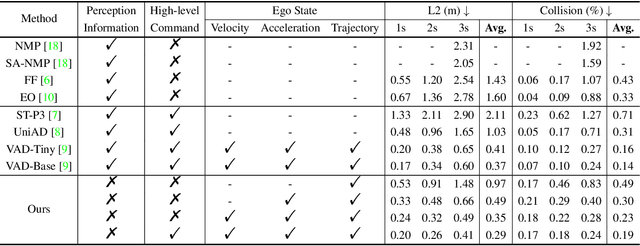
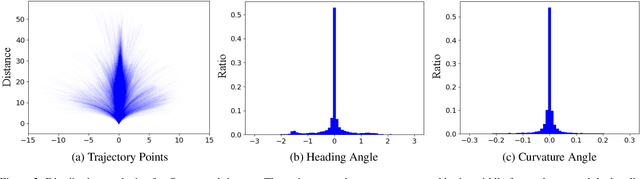
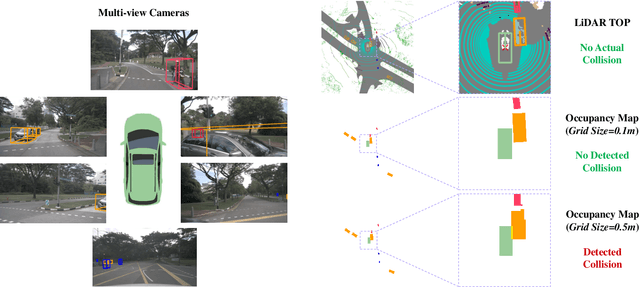
Modern autonomous driving systems are typically divided into three main tasks: perception, prediction, and planning. The planning task involves predicting the trajectory of the ego vehicle based on inputs from both internal intention and the external environment, and manipulating the vehicle accordingly. Most existing works evaluate their performance on the nuScenes dataset using the L2 error and collision rate between the predicted trajectories and the ground truth. In this paper, we reevaluate these existing evaluation metrics and explore whether they accurately measure the superiority of different methods. Specifically, we design an MLP-based method that takes raw sensor data (e.g., past trajectory, velocity, etc.) as input and directly outputs the future trajectory of the ego vehicle, without using any perception or prediction information such as camera images or LiDAR. Surprisingly, such a simple method achieves state-of-the-art end-to-end planning performance on the nuScenes dataset, reducing the average L2 error by about 30%. We further conduct in-depth analysis and provide new insights into the factors that are critical for the success of the planning task on nuScenes dataset. Our observation also indicates that we need to rethink the current open-loop evaluation scheme of end-to-end autonomous driving in nuScenes. Codes are available at https://github.com/E2E-AD/AD-MLP.
Interactive Image Inpainting Using Semantic Guidance
Jan 26, 2022Image inpainting approaches have achieved significant progress with the help of deep neural networks. However, existing approaches mainly focus on leveraging the priori distribution learned by neural networks to produce a single inpainting result or further yielding multiple solutions, where the controllability is not well studied. This paper develops a novel image inpainting approach that enables users to customize the inpainting result by their own preference or memory. Specifically, our approach is composed of two stages that utilize the prior of neural network and user's guidance to jointly inpaint corrupted images. In the first stage, an autoencoder based on a novel external spatial attention mechanism is deployed to produce reconstructed features of the corrupted image and a coarse inpainting result that provides semantic mask as the medium for user interaction. In the second stage, a semantic decoder that takes the reconstructed features as prior is adopted to synthesize a fine inpainting result guided by user's customized semantic mask, so that the final inpainting result will share the same content with user's guidance while the textures and colors reconstructed in the first stage are preserved. Extensive experiments demonstrate the superiority of our approach in terms of inpainting quality and controllability.