 Add to Chrome
 Add to Firefox
 Add to Edge
MCIP: Protecting MCP Safety via Model Contextual Integrity Protocol
May 21, 2025
As Model Context Protocol (MCP) introduces an easy-to-use ecosystem for users and developers, it also brings underexplored safety risks. Its decentralized architecture, which separates clients and servers, poses unique challenges for systematic safety analysis. This paper proposes a novel framework to enhance MCP safety. Guided by the MAESTRO framework, we first analyze the missing safety mechanisms in MCP, and based on this analysis, we propose the Model Contextual Integrity Protocol (MCIP), a refined version of MCP that addresses these gaps. Next, we develop a fine-grained taxonomy that captures a diverse range of unsafe behaviors observed in MCP scenarios. Building on this taxonomy, we develop benchmark and training data that support the evaluation and improvement of LLMs' capabilities in identifying safety risks within MCP interactions. Leveraging the proposed benchmark and training data, we conduct extensive experiments on state-of-the-art LLMs. The results highlight LLMs' vulnerabilities in MCP interactions and demonstrate that our approach substantially improves their safety performance.

Context Reasoner: Incentivizing Reasoning Capability for Contextualized Privacy and Safety Compliance via Reinforcement Learning
May 20, 2025While Large Language Models (LLMs) exhibit remarkable capabilities, they also introduce significant safety and privacy risks. Current mitigation strategies often fail to preserve contextual reasoning capabilities in risky scenarios. Instead, they rely heavily on sensitive pattern matching to protect LLMs, which limits the scope. Furthermore, they overlook established safety and privacy standards, leading to systemic risks for legal compliance. To address these gaps, we formulate safety and privacy issues into contextualized compliance problems following the Contextual Integrity (CI) theory. Under the CI framework, we align our model with three critical regulatory standards: GDPR, EU AI Act, and HIPAA. Specifically, we employ reinforcement learning (RL) with a rule-based reward to incentivize contextual reasoning capabilities while enhancing compliance with safety and privacy norms. Through extensive experiments, we demonstrate that our method not only significantly enhances legal compliance (achieving a +17.64% accuracy improvement in safety/privacy benchmarks) but also further improves general reasoning capability. For OpenThinker-7B, a strong reasoning model that significantly outperforms its base model Qwen2.5-7B-Instruct across diverse subjects, our method enhances its general reasoning capabilities, with +2.05% and +8.98% accuracy improvement on the MMLU and LegalBench benchmark, respectively.
Legal Rule Induction: Towards Generalizable Principle Discovery from Analogous Judicial Precedents
May 20, 2025Legal rules encompass not only codified statutes but also implicit adjudicatory principles derived from precedents that contain discretionary norms, social morality, and policy. While computational legal research has advanced in applying established rules to cases, inducing legal rules from judicial decisions remains understudied, constrained by limitations in model inference efficacy and symbolic reasoning capability. The advent of Large Language Models (LLMs) offers unprecedented opportunities for automating the extraction of such latent principles, yet progress is stymied by the absence of formal task definitions, benchmark datasets, and methodologies. To address this gap, we formalize Legal Rule Induction (LRI) as the task of deriving concise, generalizable doctrinal rules from sets of analogous precedents, distilling their shared preconditions, normative behaviors, and legal consequences. We introduce the first LRI benchmark, comprising 5,121 case sets (38,088 Chinese cases in total) for model tuning and 216 expert-annotated gold test sets. Experimental results reveal that: 1) State-of-the-art LLMs struggle with over-generalization and hallucination; 2) Training on our dataset markedly enhances LLMs capabilities in capturing nuanced rule patterns across similar cases.
From Automation to Autonomy: A Survey on Large Language Models in Scientific Discovery
May 19, 2025Large Language Models (LLMs) are catalyzing a paradigm shift in scientific discovery, evolving from task-specific automation tools into increasingly autonomous agents and fundamentally redefining research processes and human-AI collaboration. This survey systematically charts this burgeoning field, placing a central focus on the changing roles and escalating capabilities of LLMs in science. Through the lens of the scientific method, we introduce a foundational three-level taxonomy-Tool, Analyst, and Scientist-to delineate their escalating autonomy and evolving responsibilities within the research lifecycle. We further identify pivotal challenges and future research trajectories such as robotic automation, self-improvement, and ethical governance. Overall, this survey provides a conceptual architecture and strategic foresight to navigate and shape the future of AI-driven scientific discovery, fostering both rapid innovation and responsible advancement. Github Repository: https://github.com/HKUST-KnowComp/Awesome-LLM-Scientific-Discovery.
MMLongBench: Benchmarking Long-Context Vision-Language Models Effectively and Thoroughly
May 15, 2025The rapid extension of context windows in large vision-language models has given rise to long-context vision-language models (LCVLMs), which are capable of handling hundreds of images with interleaved text tokens in a single forward pass. In this work, we introduce MMLongBench, the first benchmark covering a diverse set of long-context vision-language tasks, to evaluate LCVLMs effectively and thoroughly. MMLongBench is composed of 13,331 examples spanning five different categories of downstream tasks, such as Visual RAG and Many-Shot ICL. It also provides broad coverage of image types, including various natural and synthetic images. To assess the robustness of the models to different input lengths, all examples are delivered at five standardized input lengths (8K-128K tokens) via a cross-modal tokenization scheme that combines vision patches and text tokens. Through a thorough benchmarking of 46 closed-source and open-source LCVLMs, we provide a comprehensive analysis of the current models' vision-language long-context ability. Our results show that: i) performance on a single task is a weak proxy for overall long-context capability; ii) both closed-source and open-source models face challenges in long-context vision-language tasks, indicating substantial room for future improvement; iii) models with stronger reasoning ability tend to exhibit better long-context performance. By offering wide task coverage, various image types, and rigorous length control, MMLongBench provides the missing foundation for diagnosing and advancing the next generation of LCVLMs.
Efficient and Scalable Neural Symbolic Search for Knowledge Graph Complex Query Answering
May 13, 2025Complex Query Answering (CQA) aims to retrieve answer sets for complex logical formulas from incomplete knowledge graphs, which is a crucial yet challenging task in knowledge graph reasoning. While neuro-symbolic search utilized neural link predictions achieve superior accuracy, they encounter significant complexity bottlenecks: (i) Data complexity typically scales quadratically with the number of entities in the knowledge graph, and (ii) Query complexity becomes NP-hard for cyclic queries. Consequently, these approaches struggle to effectively scale to larger knowledge graphs and more complex queries. To address these challenges, we propose an efficient and scalable symbolic search framework. First, we propose two constraint strategies to compute neural logical indices to reduce the domain of variables, thereby decreasing the data complexity of symbolic search. Additionally, we introduce an approximate algorithm based on local search to tackle the NP query complexity of cyclic queries. Experiments on various CQA benchmarks demonstrate that our framework reduces the computational load of symbolic methods by 90\% while maintaining nearly the same performance, thus alleviating both efficiency and scalability issues.
Towards Multi-Agent Reasoning Systems for Collaborative Expertise Delegation: An Exploratory Design Study
May 12, 2025Designing effective collaboration structure for multi-agent LLM systems to enhance collective reasoning is crucial yet remains under-explored. In this paper, we systematically investigate how collaborative reasoning performance is affected by three key design dimensions: (1) Expertise-Domain Alignment, (2) Collaboration Paradigm (structured workflow vs. diversity-driven integration), and (3) System Scale. Our findings reveal that expertise alignment benefits are highly domain-contingent, proving most effective for contextual reasoning tasks. Furthermore, collaboration focused on integrating diverse knowledge consistently outperforms rigid task decomposition. Finally, we empirically explore the impact of scaling the multi-agent system with expertise specialization and study the computational trade off, highlighting the need for more efficient communication protocol design. This work provides concrete guidelines for configuring specialized multi-agent system and identifies critical architectural trade-offs and bottlenecks for scalable multi-agent reasoning. The code will be made available upon acceptance.
Privacy-Preserving Federated Embedding Learning for Localized Retrieval-Augmented Generation
Apr 27, 2025Retrieval-Augmented Generation (RAG) has recently emerged as a promising solution for enhancing the accuracy and credibility of Large Language Models (LLMs), particularly in Question & Answer tasks. This is achieved by incorporating proprietary and private data from integrated databases. However, private RAG systems face significant challenges due to the scarcity of private domain data and critical data privacy issues. These obstacles impede the deployment of private RAG systems, as developing privacy-preserving RAG systems requires a delicate balance between data security and data availability. To address these challenges, we regard federated learning (FL) as a highly promising technology for privacy-preserving RAG services. We propose a novel framework called Federated Retrieval-Augmented Generation (FedE4RAG). This framework facilitates collaborative training of client-side RAG retrieval models. The parameters of these models are aggregated and distributed on a central-server, ensuring data privacy without direct sharing of raw data. In FedE4RAG, knowledge distillation is employed for communication between the server and client models. This technique improves the generalization of local RAG retrievers during the federated learning process. Additionally, we apply homomorphic encryption within federated learning to safeguard model parameters and mitigate concerns related to data leakage. Extensive experiments conducted on the real-world dataset have validated the effectiveness of FedE4RAG. The results demonstrate that our proposed framework can markedly enhance the performance of private RAG systems while maintaining robust data privacy protection.
Ustnlp16 at SemEval-2025 Task 9: Improving Model Performance through Imbalance Handling and Focal Loss
Apr 24, 2025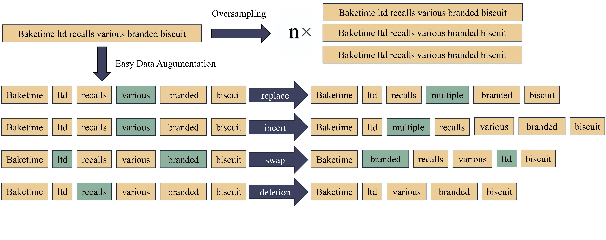
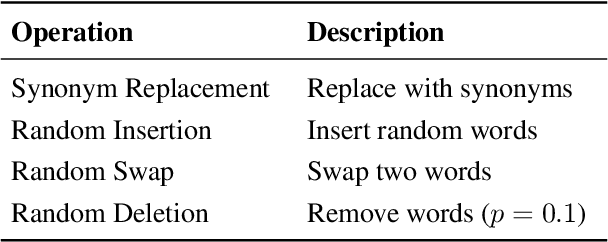
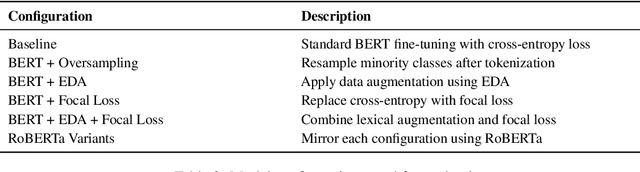
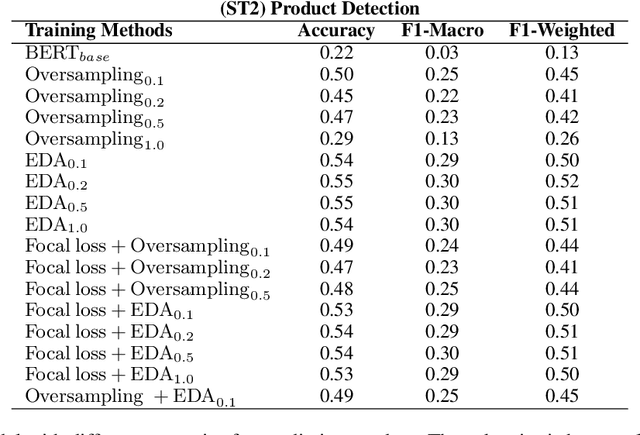
Classification tasks often suffer from imbal- anced data distribution, which presents chal- lenges in food hazard detection due to severe class imbalances, short and unstructured text, and overlapping semantic categories. In this paper, we present our system for SemEval- 2025 Task 9: Food Hazard Detection, which ad- dresses these issues by applying data augmenta- tion techniques to improve classification perfor- mance. We utilize transformer-based models, BERT and RoBERTa, as backbone classifiers and explore various data balancing strategies, including random oversampling, Easy Data Augmentation (EDA), and focal loss. Our ex- periments show that EDA effectively mitigates class imbalance, leading to significant improve- ments in accuracy and F1 scores. Furthermore, combining focal loss with oversampling and EDA further enhances model robustness, par- ticularly for hard-to-classify examples. These findings contribute to the development of more effective NLP-based classification models for food hazard detection.
Transformers for Complex Query Answering over Knowledge Hypergraphs
Apr 23, 2025Complex Query Answering (CQA) has been extensively studied in recent years. In order to model data that is closer to real-world distribution, knowledge graphs with different modalities have been introduced. Triple KGs, as the classic KGs composed of entities and relations of arity 2, have limited representation of real-world facts. Real-world data is more sophisticated. While hyper-relational graphs have been introduced, there are limitations in representing relationships of varying arity that contain entities with equal contributions. To address this gap, we sampled new CQA datasets: JF17k-HCQA and M-FB15k-HCQA. Each dataset contains various query types that include logical operations such as projection, negation, conjunction, and disjunction. In order to answer knowledge hypergraph (KHG) existential first-order queries, we propose a two-stage transformer model, the Logical Knowledge Hypergraph Transformer (LKHGT), which consists of a Projection Encoder for atomic projection and a Logical Encoder for complex logical operations. Both encoders are equipped with Type Aware Bias (TAB) for capturing token interactions. Experimental results on CQA datasets show that LKHGT is a state-of-the-art CQA method over KHG and is able to generalize to out-of-distribution query types.