 Add to Chrome
 Add to Firefox
 Add to Edge
Xmodel-VLM: A Simple Baseline for Multimodal Vision Language Model
May 15, 2024
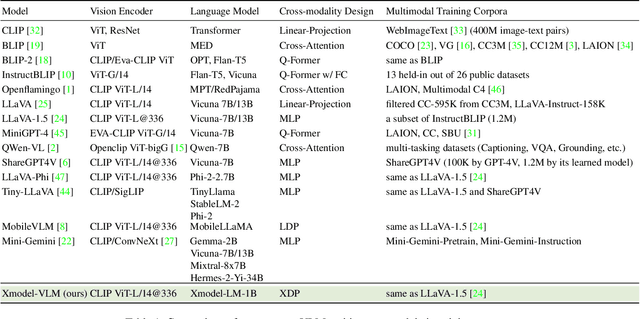
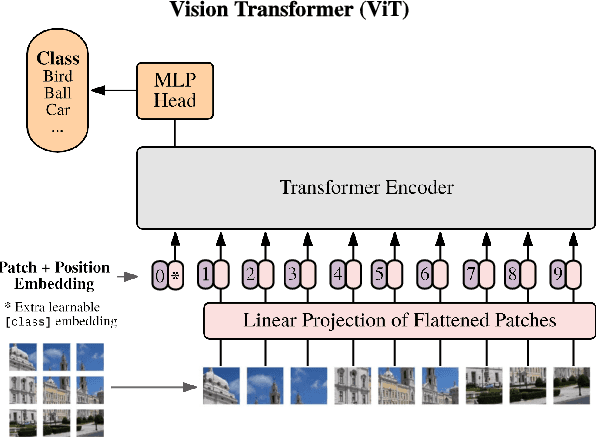
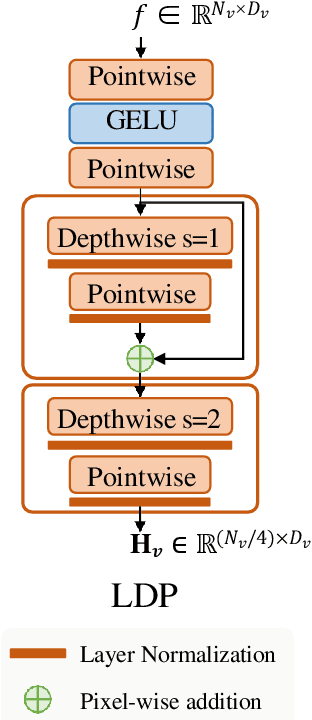

We introduce Xmodel-VLM, a cutting-edge multimodal vision language model. It is designed for efficient deployment on consumer GPU servers. Our work directly confronts a pivotal industry issue by grappling with the prohibitive service costs that hinder the broad adoption of large-scale multimodal systems. Through rigorous training, we have developed a 1B-scale language model from the ground up, employing the LLaVA paradigm for modal alignment. The result, which we call Xmodel-VLM, is a lightweight yet powerful multimodal vision language model. Extensive testing across numerous classic multimodal benchmarks has revealed that despite its smaller size and faster execution, Xmodel-VLM delivers performance comparable to that of larger models. Our model checkpoints and code are publicly available on GitHub at https://github.com/XiaoduoAILab/XmodelVLM.

Unveiling the Competitive Dynamics: A Comparative Evaluation of American and Chinese LLMs
May 09, 2024The strategic significance of Large Language Models (LLMs) in economic expansion, innovation, societal development, and national security has been increasingly recognized since the advent of ChatGPT. This study provides a comprehensive comparative evaluation of American and Chinese LLMs in both English and Chinese contexts. We proposed a comprehensive evaluation framework that encompasses natural language proficiency, disciplinary expertise, and safety and responsibility, and systematically assessed 16 prominent models from the US and China under various operational tasks and scenarios. Our key findings show that GPT 4-Turbo is at the forefront in English contexts, whereas Ernie-Bot 4 stands out in Chinese contexts. The study also highlights disparities in LLM performance across languages and tasks, stressing the necessity for linguistically and culturally nuanced model development. The complementary strengths of American and Chinese LLMs point to the value of Sino-US collaboration in advancing LLM technology. The research presents the current LLM competition landscape and offers valuable insights for policymakers and businesses regarding strategic LLM investments and development. Future work will expand on this framework to include emerging LLM multimodal capabilities and business application assessments.
Federated Adaptation for Foundation Model-based Recommendations
May 08, 2024


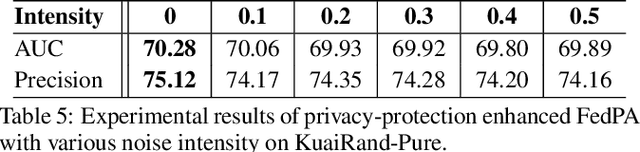
With the recent success of large language models, particularly foundation models with generalization abilities, applying foundation models for recommendations becomes a new paradigm to improve existing recommendation systems. It becomes a new open challenge to enable the foundation model to capture user preference changes in a timely manner with reasonable communication and computation costs while preserving privacy. This paper proposes a novel federated adaptation mechanism to enhance the foundation model-based recommendation system in a privacy-preserving manner. Specifically, each client will learn a lightweight personalized adapter using its private data. The adapter then collaborates with pre-trained foundation models to provide recommendation service efficiently with fine-grained manners. Importantly, users' private behavioral data remains secure as it is not shared with the server. This data localization-based privacy preservation is embodied via the federated learning framework. The model can ensure that shared knowledge is incorporated into all adapters while simultaneously preserving each user's personal preferences. Experimental results on four benchmark datasets demonstrate our method's superior performance. Implementation code is available to ease reproducibility.
Large Language Models for Cyber Security: A Systematic Literature Review
May 08, 2024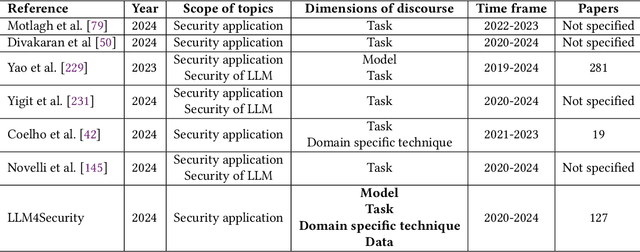
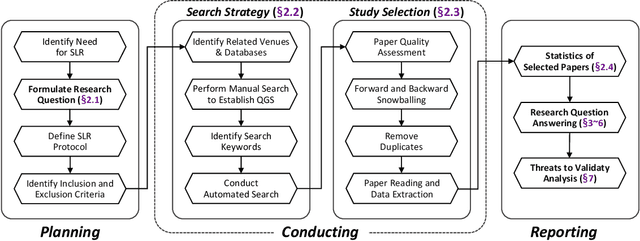
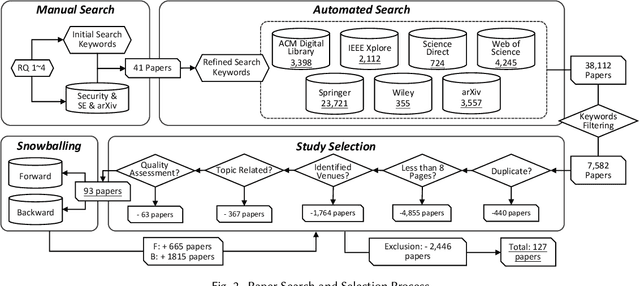
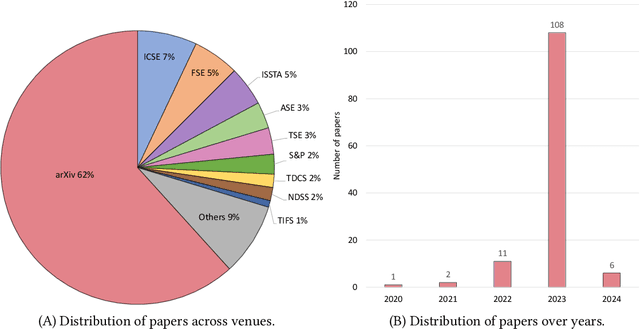
The rapid advancement of Large Language Models (LLMs) has opened up new opportunities for leveraging artificial intelligence in various domains, including cybersecurity. As the volume and sophistication of cyber threats continue to grow, there is an increasing need for intelligent systems that can automatically detect vulnerabilities, analyze malware, and respond to attacks. In this survey, we conduct a comprehensive review of the literature on the application of LLMs in cybersecurity (LLM4Security). By comprehensively collecting over 30K relevant papers and systematically analyzing 127 papers from top security and software engineering venues, we aim to provide a holistic view of how LLMs are being used to solve diverse problems across the cybersecurity domain. Through our analysis, we identify several key findings. First, we observe that LLMs are being applied to a wide range of cybersecurity tasks, including vulnerability detection, malware analysis, network intrusion detection, and phishing detection. Second, we find that the datasets used for training and evaluating LLMs in these tasks are often limited in size and diversity, highlighting the need for more comprehensive and representative datasets. Third, we identify several promising techniques for adapting LLMs to specific cybersecurity domains, such as fine-tuning, transfer learning, and domain-specific pre-training. Finally, we discuss the main challenges and opportunities for future research in LLM4Security, including the need for more interpretable and explainable models, the importance of addressing data privacy and security concerns, and the potential for leveraging LLMs for proactive defense and threat hunting. Overall, our survey provides a comprehensive overview of the current state-of-the-art in LLM4Security and identifies several promising directions for future research.
Revisiting a Pain in the Neck: Semantic Phrase Processing Benchmark for Language Models
May 05, 2024We introduce LexBench, a comprehensive evaluation suite enabled to test language models (LMs) on ten semantic phrase processing tasks. Unlike prior studies, it is the first work to propose a framework from the comparative perspective to model the general semantic phrase (i.e., lexical collocation) and three fine-grained semantic phrases, including idiomatic expression, noun compound, and verbal construction. Thanks to \ourbenchmark, we assess the performance of 15 LMs across model architectures and parameter scales in classification, extraction, and interpretation tasks. Through the experiments, we first validate the scaling law and find that, as expected, large models excel better than the smaller ones in most tasks. Second, we investigate further through the scaling semantic relation categorization and find that few-shot LMs still lag behind vanilla fine-tuned models in the task. Third, through human evaluation, we find that the performance of strong models is comparable to the human level regarding semantic phrase processing. Our benchmarking findings can serve future research aiming to improve the generic capability of LMs on semantic phrase comprehension. Our source code and data are available at https://github.com/jacklanda/LexBench
Agent Hospital: A Simulacrum of Hospital with Evolvable Medical Agents
May 05, 2024
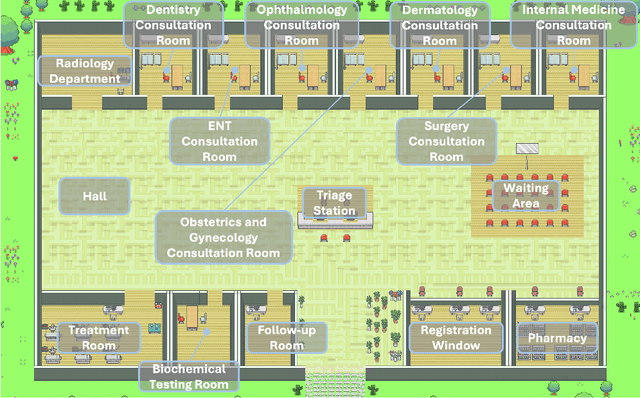
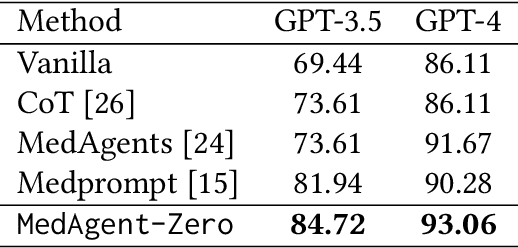

In this paper, we introduce a simulacrum of hospital called Agent Hospital that simulates the entire process of treating illness. All patients, nurses, and doctors are autonomous agents powered by large language models (LLMs). Our central goal is to enable a doctor agent to learn how to treat illness within the simulacrum. To do so, we propose a method called MedAgent-Zero. As the simulacrum can simulate disease onset and progression based on knowledge bases and LLMs, doctor agents can keep accumulating experience from both successful and unsuccessful cases. Simulation experiments show that the treatment performance of doctor agents consistently improves on various tasks. More interestingly, the knowledge the doctor agents have acquired in Agent Hospital is applicable to real-world medicare benchmarks. After treating around ten thousand patients (real-world doctors may take over two years), the evolved doctor agent achieves a state-of-the-art accuracy of 93.06% on a subset of the MedQA dataset that covers major respiratory diseases. This work paves the way for advancing the applications of LLM-powered agent techniques in medical scenarios.
PropertyGPT: LLM-driven Formal Verification of Smart Contracts through Retrieval-Augmented Property Generation
May 04, 2024
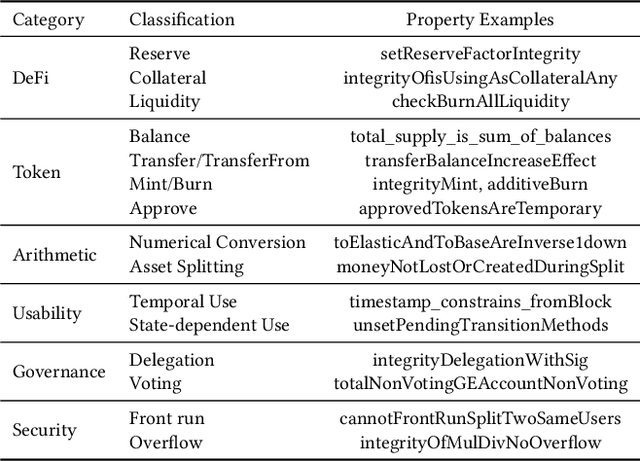


With recent advances in large language models (LLMs), this paper explores the potential of leveraging state-of-the-art LLMs, such as GPT-4, to transfer existing human-written properties (e.g., those from Certora auditing reports) and automatically generate customized properties for unknown code. To this end, we embed existing properties into a vector database and retrieve a reference property for LLM-based in-context learning to generate a new prop- erty for a given code. While this basic process is relatively straight- forward, ensuring that the generated properties are (i) compilable, (ii) appropriate, and (iii) runtime-verifiable presents challenges. To address (i), we use the compilation and static analysis feedback as an external oracle to guide LLMs in iteratively revising the generated properties. For (ii), we consider multiple dimensions of similarity to rank the properties and employ a weighted algorithm to identify the top-K properties as the final result. For (iii), we design a dedicated prover to formally verify the correctness of the generated prop- erties. We have implemented these strategies into a novel system called PropertyGPT, with 623 human-written properties collected from 23 Certora projects. Our experiments show that PropertyGPT can generate comprehensive and high-quality properties, achieving an 80% recall compared to the ground truth. It successfully detected 26 CVEs/attack incidents out of 37 tested and also uncovered 12 zero-day vulnerabilities, resulting in $8,256 bug bounty rewards.
Vision-based Discovery of Nonlinear Dynamics for 3D Moving Target
Apr 27, 2024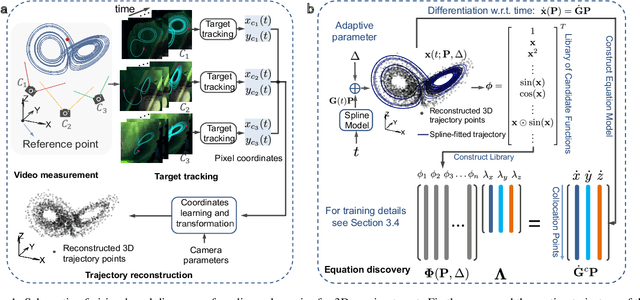
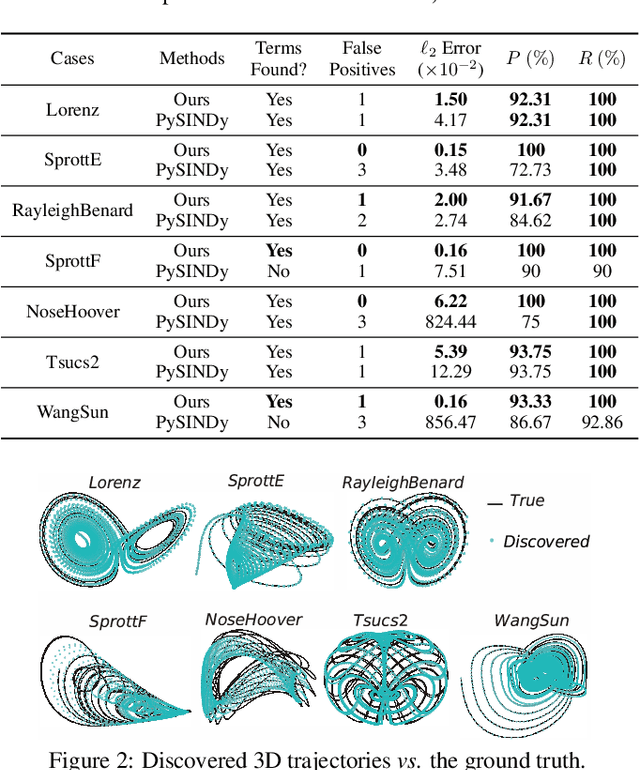
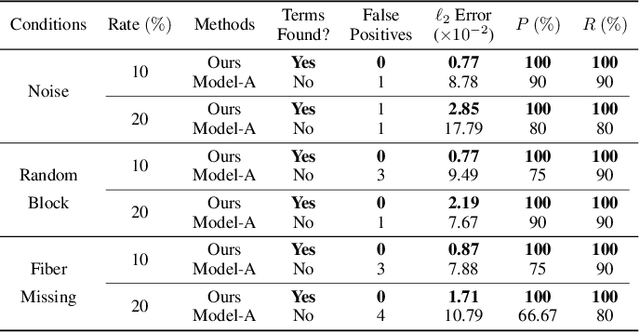
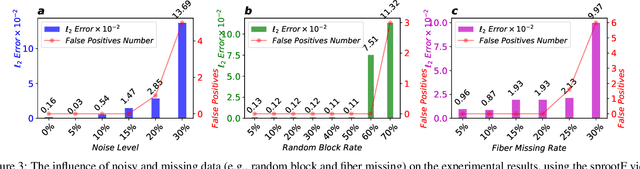
Data-driven discovery of governing equations has kindled significant interests in many science and engineering areas. Existing studies primarily focus on uncovering equations that govern nonlinear dynamics based on direct measurement of the system states (e.g., trajectories). Limited efforts have been placed on distilling governing laws of dynamics directly from videos for moving targets in a 3D space. To this end, we propose a vision-based approach to automatically uncover governing equations of nonlinear dynamics for 3D moving targets via raw videos recorded by a set of cameras. The approach is composed of three key blocks: (1) a target tracking module that extracts plane pixel motions of the moving target in each video, (2) a Rodrigues' rotation formula-based coordinate transformation learning module that reconstructs the 3D coordinates with respect to a predefined reference point, and (3) a spline-enhanced library-based sparse regressor that uncovers the underlying governing law of dynamics. This framework is capable of effectively handling the challenges associated with measurement data, e.g., noise in the video, imprecise tracking of the target that causes data missing, etc. The efficacy of our method has been demonstrated through multiple sets of synthetic videos considering different nonlinear dynamics.
* 17 pages
A General Black-box Adversarial Attack on Graph-based Fake News Detectors
Apr 26, 2024Graph Neural Network (GNN)-based fake news detectors apply various methods to construct graphs, aiming to learn distinctive news embeddings for classification. Since the construction details are unknown for attackers in a black-box scenario, it is unrealistic to conduct the classical adversarial attacks that require a specific adjacency matrix. In this paper, we propose the first general black-box adversarial attack framework, i.e., General Attack via Fake Social Interaction (GAFSI), against detectors based on different graph structures. Specifically, as sharing is an important social interaction for GNN-based fake news detectors to construct the graph, we simulate sharing behaviors to fool the detectors. Firstly, we propose a fraudster selection module to select engaged users leveraging local and global information. In addition, a post injection module guides the selected users to create shared relations by sending posts. The sharing records will be added to the social context, leading to a general attack against different detectors. Experimental results on empirical datasets demonstrate the effectiveness of GAFSI.
MAS-SAM: Segment Any Marine Animal with Aggregated Features
Apr 24, 2024
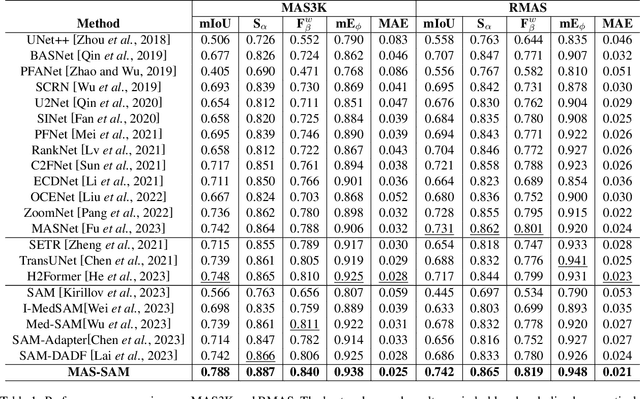
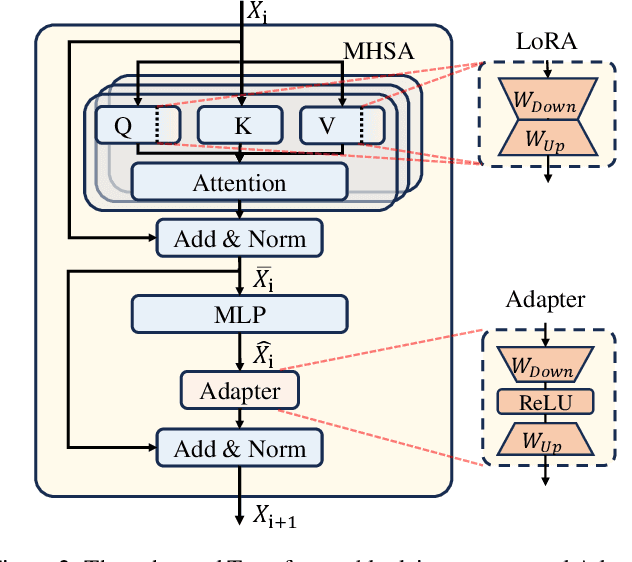
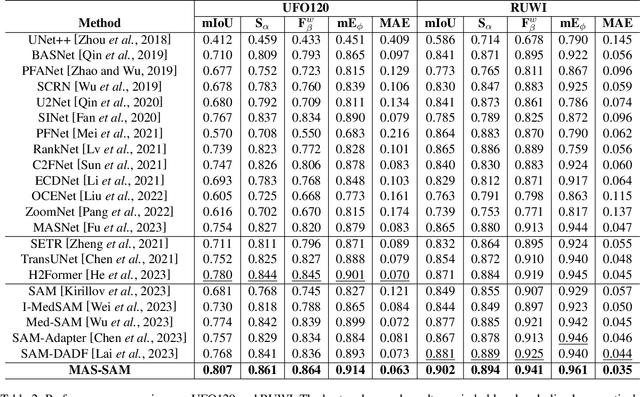
Recently, Segment Anything Model (SAM) shows exceptional performance in generating high-quality object masks and achieving zero-shot image segmentation. However, as a versatile vision model, SAM is primarily trained with large-scale natural light images. In underwater scenes, it exhibits substantial performance degradation due to the light scattering and absorption. Meanwhile, the simplicity of the SAM's decoder might lead to the loss of fine-grained object details. To address the above issues, we propose a novel feature learning framework named MAS-SAM for marine animal segmentation, which involves integrating effective adapters into the SAM's encoder and constructing a pyramidal decoder. More specifically, we first build a new SAM's encoder with effective adapters for underwater scenes. Then, we introduce a Hypermap Extraction Module (HEM) to generate multi-scale features for a comprehensive guidance. Finally, we propose a Progressive Prediction Decoder (PPD) to aggregate the multi-scale features and predict the final segmentation results. When grafting with the Fusion Attention Module (FAM), our method enables to extract richer marine information from global contextual cues to fine-grained local details. Extensive experiments on four public MAS datasets demonstrate that our MAS-SAM can obtain better results than other typical segmentation methods. The source code is available at https://github.com/Drchip61/MAS-SAM.