 Add to Chrome
 Add to Firefox
 Add to Edge
Motion-Conditioned Multi-View Fusion for Myocardial Infarction Localization from Echocardiography
Jul 16, 2026
Myocardial infarction (MI) remains a leading cause of mortality worldwide. Echocardiography (Echo) is a widely available modality for MI assessment, where regional wall motion abnormality is a key indicator. Prior learning based methods for myocardial motion analysis often use handcrafted descriptors or densely supervised estimation, but the need for extensive annotation limits applicability. Foundation models have recently improved vision-based Echo analysis; however, most methods operate on single views and segment-level localization remains unreliable under view-dependent ambiguity, especially in apical views. To address this, we propose MCF-Net, a novel motion-guided multi-view fusion framework that fuses myocardial motion cues with foundation model representations to localize infarction. Visual features are extracted using EchoPrime, a pretrained Echo foundation model shared across dual views. Cardiac motion is modeled with extremely sparse supervision: a single annotated template frame is transferred across videos to initialize point tracking, avoiding dense labels. Motion-derived segment-aware soft masks provide coarse spatial priors that selectively enhance features for challenging myocardial segments. A motion-conditioned fusion mechanism then integrates motion and vision across views, refining predictions without overriding strong appearance cues. On segment-level MI localization, MCF-Net achieves 72.4\% F1 and 84.9\% accuracy, outperforming state-of-the-art motion-only, vision-only, and fusion baselines.

Constraint-Aware Hierarchical Search for Regulation-Driven Fine-Grained Classification
Jul 12, 2026Tasks such as customs tariff classification, export control categorization, and standards-based equipment coding require assigning an input instance to a fine-grained class under an explicit regulatory hierarchy. Unlike standard text classification, the correct label in these tasks is not determined by semantic similarity alone, but by rule-defined boundaries, threshold conditions, exclusion clauses, definitions, and local exceptions. As a result, two highly similar inputs may require different labels, while a retrieved passage that appears relevant may still be inapplicable under the governing rules. Existing flat classifiers, hierarchical text classification methods, and retrieval-augmented LLM systems are not designed to jointly enforce hierarchical validity, rule consistency, and fine-grained boundary reasoning. In this paper, we formulate this setting as regulation-driven fine-grained hierarchical classification, where an external instance must be assigned to a fine-grained class through a valid path in a regulatory hierarchy and supported by auditable evidence. We construct four benchmark datasets from representative regulation-intensive scenarios and validate the annotations through an expert-in-the-loop process. We further propose a constraint-aware hierarchical search framework that converts regulatory documents into a searchable tree, retrieves only valid local candidate nodes, and uses structured regulatory fields with evidence snippets to guide each next-hop decision. Experiments show that our method achieves the best mean accuracy on all four datasets and provides interpretable decision paths, with the largest gains on cases involving fine-grained neighboring categories and rule-based boundary conditions.
Paper2Rebuttal: A Multi-Agent Framework for Transparent Author Response Assistance
Jan 20, 2026Writing effective rebuttals is a high-stakes task that demands more than linguistic fluency, as it requires precise alignment between reviewer intent and manuscript details. Current solutions typically treat this as a direct-to-text generation problem, suffering from hallucination, overlooked critiques, and a lack of verifiable grounding. To address these limitations, we introduce $\textbf{RebuttalAgent}$, the first multi-agents framework that reframes rebuttal generation as an evidence-centric planning task. Our system decomposes complex feedback into atomic concerns and dynamically constructs hybrid contexts by synthesizing compressed summaries with high-fidelity text while integrating an autonomous and on-demand external search module to resolve concerns requiring outside literature. By generating an inspectable response plan before drafting, $\textbf{RebuttalAgent}$ ensures that every argument is explicitly anchored in internal or external evidence. We validate our approach on the proposed $\textbf{RebuttalBench}$ and demonstrate that our pipeline outperforms strong baselines in coverage, faithfulness, and strategic coherence, offering a transparent and controllable assistant for the peer review process. Code will be released.
The RoboSense Challenge: Sense Anything, Navigate Anywhere, Adapt Across Platforms
Jan 08, 2026Autonomous systems are increasingly deployed in open and dynamic environments -- from city streets to aerial and indoor spaces -- where perception models must remain reliable under sensor noise, environmental variation, and platform shifts. However, even state-of-the-art methods often degrade under unseen conditions, highlighting the need for robust and generalizable robot sensing. The RoboSense 2025 Challenge is designed to advance robustness and adaptability in robot perception across diverse sensing scenarios. It unifies five complementary research tracks spanning language-grounded decision making, socially compliant navigation, sensor configuration generalization, cross-view and cross-modal correspondence, and cross-platform 3D perception. Together, these tasks form a comprehensive benchmark for evaluating real-world sensing reliability under domain shifts, sensor failures, and platform discrepancies. RoboSense 2025 provides standardized datasets, baseline models, and unified evaluation protocols, enabling large-scale and reproducible comparison of robust perception methods. The challenge attracted 143 teams from 85 institutions across 16 countries, reflecting broad community engagement. By consolidating insights from 23 winning solutions, this report highlights emerging methodological trends, shared design principles, and open challenges across all tracks, marking a step toward building robots that can sense reliably, act robustly, and adapt across platforms in real-world environments.
Effective Attention-Guided Multi-Scale Medical Network for Skin Lesion Segmentation
Dec 08, 2025In the field of healthcare, precise skin lesion segmentation is crucial for the early detection and accurate diagnosis of skin diseases. Despite significant advances in deep learning for image processing, existing methods have yet to effectively address the challenges of irregular lesion shapes and low contrast. To address these issues, this paper proposes an innovative encoder-decoder network architecture based on multi-scale residual structures, capable of extracting rich feature information from different receptive fields to effectively identify lesion areas. By introducing a Multi-Resolution Multi-Channel Fusion (MRCF) module, our method captures cross-scale features, enhancing the clarity and accuracy of the extracted information. Furthermore, we propose a Cross-Mix Attention Module (CMAM), which redefines the attention scope and dynamically calculates weights across multiple contexts, thus improving the flexibility and depth of feature capture and enabling deeper exploration of subtle features. To overcome the information loss caused by skip connections in traditional U-Net, an External Attention Bridge (EAB) is introduced, facilitating the effective utilization of information in the decoder and compensating for the loss during upsampling. Extensive experimental evaluations on several skin lesion segmentation datasets demonstrate that the proposed model significantly outperforms existing transformer and convolutional neural network-based models, showcasing exceptional segmentation accuracy and robustness.
HiDream-I1: A High-Efficient Image Generative Foundation Model with Sparse Diffusion Transformer
May 28, 2025Recent advancements in image generative foundation models have prioritized quality improvements but often at the cost of increased computational complexity and inference latency. To address this critical trade-off, we introduce HiDream-I1, a new open-source image generative foundation model with 17B parameters that achieves state-of-the-art image generation quality within seconds. HiDream-I1 is constructed with a new sparse Diffusion Transformer (DiT) structure. Specifically, it starts with a dual-stream decoupled design of sparse DiT with dynamic Mixture-of-Experts (MoE) architecture, in which two separate encoders are first involved to independently process image and text tokens. Then, a single-stream sparse DiT structure with dynamic MoE architecture is adopted to trigger multi-model interaction for image generation in a cost-efficient manner. To support flexiable accessibility with varied model capabilities, we provide HiDream-I1 in three variants: HiDream-I1-Full, HiDream-I1-Dev, and HiDream-I1-Fast. Furthermore, we go beyond the typical text-to-image generation and remould HiDream-I1 with additional image conditions to perform precise, instruction-based editing on given images, yielding a new instruction-based image editing model namely HiDream-E1. Ultimately, by integrating text-to-image generation and instruction-based image editing, HiDream-I1 evolves to form a comprehensive image agent (HiDream-A1) capable of fully interactive image creation and refinement. To accelerate multi-modal AIGC research, we have open-sourced all the codes and model weights of HiDream-I1-Full, HiDream-I1-Dev, HiDream-I1-Fast, HiDream-E1 through our project websites: https://github.com/HiDream-ai/HiDream-I1 and https://github.com/HiDream-ai/HiDream-E1. All features can be directly experienced via https://vivago.ai/studio.
Enhancing Embedding Representation Stability in Recommendation Systems with Semantic ID
Apr 02, 2025The exponential growth of online content has posed significant challenges to ID-based models in industrial recommendation systems, ranging from extremely high cardinality and dynamically growing ID space, to highly skewed engagement distributions, to prediction instability as a result of natural id life cycles (e.g, the birth of new IDs and retirement of old IDs). To address these issues, many systems rely on random hashing to handle the id space and control the corresponding model parameters (i.e embedding table). However, this approach introduces data pollution from multiple ids sharing the same embedding, leading to degraded model performance and embedding representation instability. This paper examines these challenges and introduces Semantic ID prefix ngram, a novel token parameterization technique that significantly improves the performance of the original Semantic ID. Semantic ID prefix ngram creates semantically meaningful collisions by hierarchically clustering items based on their content embeddings, as opposed to random assignments. Through extensive experimentation, we demonstrate that Semantic ID prefix ngram not only addresses embedding instability but also significantly improves tail id modeling, reduces overfitting, and mitigates representation shifts. We further highlight the advantages of Semantic ID prefix ngram in attention-based models that contextualize user histories, showing substantial performance improvements. We also report our experience of integrating Semantic ID into Meta production Ads Ranking system, leading to notable performance gains and enhanced prediction stability in live deployments.
Policy-Guided Causal State Representation for Offline Reinforcement Learning Recommendation
Feb 04, 2025


In offline reinforcement learning-based recommender systems (RLRS), learning effective state representations is crucial for capturing user preferences that directly impact long-term rewards. However, raw state representations often contain high-dimensional, noisy information and components that are not causally relevant to the reward. Additionally, missing transitions in offline data make it challenging to accurately identify features that are most relevant to user satisfaction. To address these challenges, we propose Policy-Guided Causal Representation (PGCR), a novel two-stage framework for causal feature selection and state representation learning in offline RLRS. In the first stage, we learn a causal feature selection policy that generates modified states by isolating and retaining only the causally relevant components (CRCs) while altering irrelevant components. This policy is guided by a reward function based on the Wasserstein distance, which measures the causal effect of state components on the reward and encourages the preservation of CRCs that directly influence user interests. In the second stage, we train an encoder to learn compact state representations by minimizing the mean squared error (MSE) loss between the latent representations of the original and modified states, ensuring that the representations focus on CRCs. We provide a theoretical analysis proving the identifiability of causal effects from interventions, validating the ability of PGCR to isolate critical state components for decision-making. Extensive experiments demonstrate that PGCR significantly improves recommendation performance, confirming its effectiveness for offline RL-based recommender systems.
CAD-GPT: Synthesising CAD Construction Sequence with Spatial Reasoning-Enhanced Multimodal LLMs
Dec 27, 2024
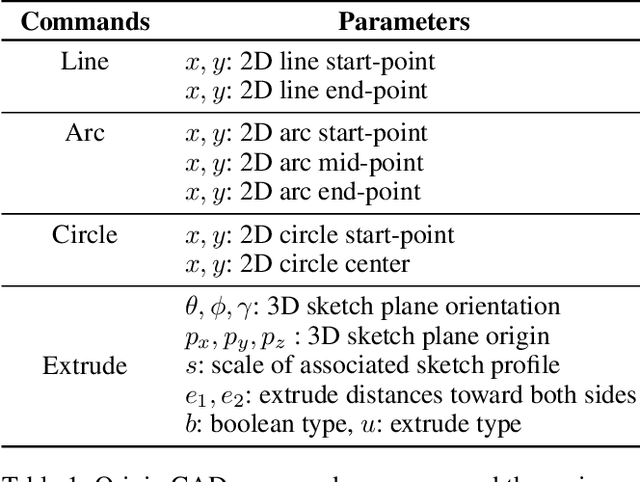
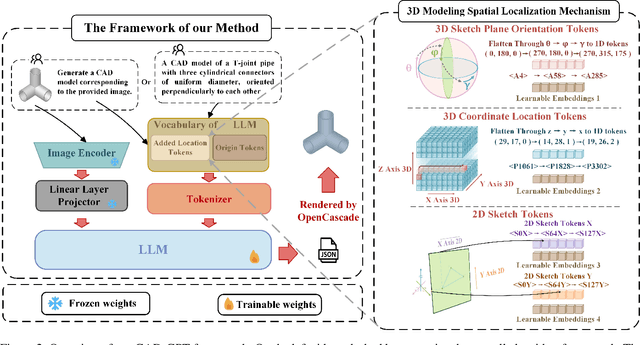
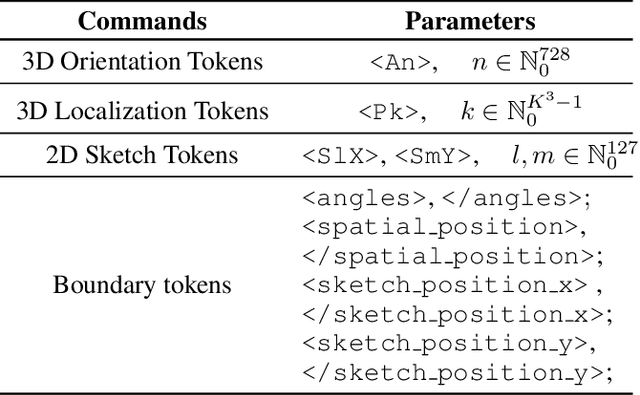
Computer-aided design (CAD) significantly enhances the efficiency, accuracy, and innovation of design processes by enabling precise 2D and 3D modeling, extensive analysis, and optimization. Existing methods for creating CAD models rely on latent vectors or point clouds, which are difficult to obtain and costly to store. Recent advances in Multimodal Large Language Models (MLLMs) have inspired researchers to use natural language instructions and images for CAD model construction. However, these models still struggle with inferring accurate 3D spatial location and orientation, leading to inaccuracies in determining the spatial 3D starting points and extrusion directions for constructing geometries. This work introduces CAD-GPT, a CAD synthesis method with spatial reasoning-enhanced MLLM that takes either a single image or a textual description as input. To achieve precise spatial inference, our approach introduces a 3D Modeling Spatial Mechanism. This method maps 3D spatial positions and 3D sketch plane rotation angles into a 1D linguistic feature space using a specialized spatial unfolding mechanism, while discretizing 2D sketch coordinates into an appropriate planar space to enable precise determination of spatial starting position, sketch orientation, and 2D sketch coordinate translations. Extensive experiments demonstrate that CAD-GPT consistently outperforms existing state-of-the-art methods in CAD model synthesis, both quantitatively and qualitatively.
Action-Attentive Deep Reinforcement Learning for Autonomous Alignment of Beamlines
Nov 19, 2024Synchrotron radiation sources play a crucial role in fields such as materials science, biology, and chemistry. The beamline, a key subsystem of the synchrotron, modulates and directs the radiation to the sample for analysis. However, the alignment of beamlines is a complex and time-consuming process, primarily carried out manually by experienced engineers. Even minor misalignments in optical components can significantly affect the beam's properties, leading to suboptimal experimental outcomes. Current automated methods, such as bayesian optimization (BO) and reinforcement learning (RL), although these methods enhance performance, limitations remain. The relationship between the current and target beam properties, crucial for determining the adjustment, is not fully considered. Additionally, the physical characteristics of optical elements are overlooked, such as the need to adjust specific devices to control the output beam's spot size or position. This paper addresses the alignment of beamlines by modeling it as a Markov Decision Process (MDP) and training an intelligent agent using RL. The agent calculates adjustment values based on the current and target beam states, executes actions, and iterates until optimal parameters are achieved. A policy network with action attention is designed to improve decision-making by considering both state differences and the impact of optical components. Experiments on two simulated beamlines demonstrate that our algorithm outperforms existing methods, with ablation studies highlighting the effectiveness of the action attention-based policy network.