 Add to Chrome
 Add to Firefox
 Add to Edge
Learning Anatomy-Grounded CT Vision-Language Representations with Organ-Hierarchical Report Knowledge
Jul 12, 2026
Medical vision-language pretraining (VLP) from paired CT images and radiology reports enables scalable representation learning, but most existing methods align either whole scans with entire reports or local image regions with text fragments. These formulations underuse a key property of radiology reports: findings are organized around anatomical structures, with abnormalities described by organs, disease concepts, locations, and severity-related attributes. We propose OKA-CT, an organ-hierarchical knowledge-augmented framework for CT-report VLP. OKA-CT first converts free-text reports into organ-conditioned knowledge using radiology report parsing and LLM-assisted semantic structuring. The extracted hierarchy is used across two learning stages. Stage~1 injects anatomy-grounded evidence into the CT visual representation through fine-grained organ-conditioned supervision, while Stage~2 uses organ-specific report evidence to guide structured report-CT contrastive learning, where hierarchy-derived semantic soft targets treat non-paired cases with shared organ-level findings as weak semantic positives rather than uniform negatives. A lightweight query-based global branch further aggregates disease-relevant volumetric evidence for whole-scan representation. On CT-RATE and RAD-ChestCT datasets, OKA-CT achieves zero-shot abnormality diagnosis AUROCs of 84.9 and 72.2, outperforming prior CT VLP baselines. Retrieval and patch-occlusion analyses further show improved report-image alignment and stronger sensitivity to disease-associated anatomical regions.

Entropy-Based Data Selection for Language Models
Feb 19, 2026Modern language models (LMs) increasingly require two critical resources: computational resources and data resources. Data selection techniques can effectively reduce the amount of training data required for fine-tuning LMs. However, their effectiveness is closely related to computational resources, which always require a high compute budget. Owing to the resource limitations in practical fine-tuning scenario, we systematically reveal the relationship between data selection and uncertainty estimation of selected data. Although large language models (LLMs) exhibit exceptional capabilities in language understanding and generation, which provide new ways to alleviate data scarcity, evaluating data usability remains a challenging task. This makes efficient data selection indispensable. To mitigate these issues, we propose Entropy-Based Unsupervised Data Selection (EUDS) framework. Empirical experiments on sentiment analysis (SA), topic classification (Topic-CLS), and question answering (Q&A) tasks validate its effectiveness. EUDS establishes a computationally efficient data-filtering mechanism. Theoretical analysis and experimental results confirm the effectiveness of our approach. EUDS significantly reduces computational costs and improves training time efficiency with less data requirement. This provides an innovative solution for the efficient fine-tuning of LMs in the compute-constrained scenarios.
ELEMENT: Episodic and Lifelong Exploration via Maximum Entropy
Dec 05, 2024This paper proposes \emph{Episodic and Lifelong Exploration via Maximum ENTropy} (ELEMENT), a novel, multiscale, intrinsically motivated reinforcement learning (RL) framework that is able to explore environments without using any extrinsic reward and transfer effectively the learned skills to downstream tasks. We advance the state of the art in three ways. First, we propose a multiscale entropy optimization to take care of the fact that previous maximum state entropy, for lifelong exploration with millions of state observations, suffers from vanishing rewards and becomes very expensive computationally across iterations. Therefore, we add an episodic maximum entropy over each episode to speedup the search further. Second, we propose a novel intrinsic reward for episodic entropy maximization named \emph{average episodic state entropy} which provides the optimal solution for a theoretical upper bound of the episodic state entropy objective. Third, to speed the lifelong entropy maximization, we propose a $k$ nearest neighbors ($k$NN) graph to organize the estimation of the entropy and updating processes that reduces the computation substantially. Our ELEMENT significantly outperforms state-of-the-art intrinsic rewards in both episodic and lifelong setups. Moreover, it can be exploited in task-agnostic pre-training, collecting data for offline reinforcement learning, etc.
Revisiting a Pain in the Neck: Semantic Phrase Processing Benchmark for Language Models
May 05, 2024We introduce LexBench, a comprehensive evaluation suite enabled to test language models (LMs) on ten semantic phrase processing tasks. Unlike prior studies, it is the first work to propose a framework from the comparative perspective to model the general semantic phrase (i.e., lexical collocation) and three fine-grained semantic phrases, including idiomatic expression, noun compound, and verbal construction. Thanks to \ourbenchmark, we assess the performance of 15 LMs across model architectures and parameter scales in classification, extraction, and interpretation tasks. Through the experiments, we first validate the scaling law and find that, as expected, large models excel better than the smaller ones in most tasks. Second, we investigate further through the scaling semantic relation categorization and find that few-shot LMs still lag behind vanilla fine-tuned models in the task. Third, through human evaluation, we find that the performance of strong models is comparable to the human level regarding semantic phrase processing. Our benchmarking findings can serve future research aiming to improve the generic capability of LMs on semantic phrase comprehension. Our source code and data are available at https://github.com/jacklanda/LexBench
Versatile Medical Image Segmentation Learned from Multi-Source Datasets via Model Self-Disambiguation
Nov 17, 2023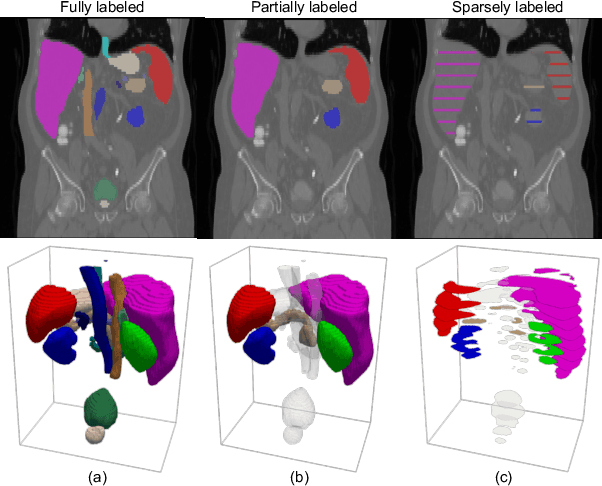
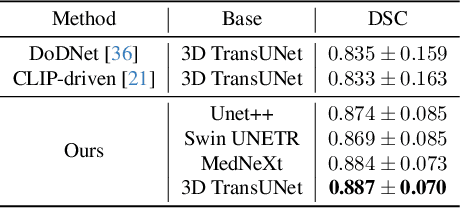
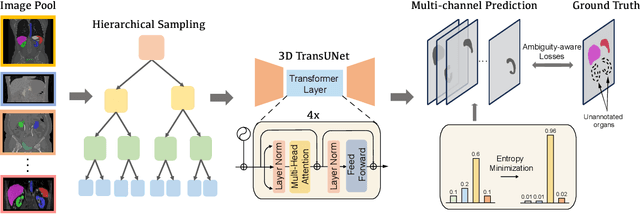
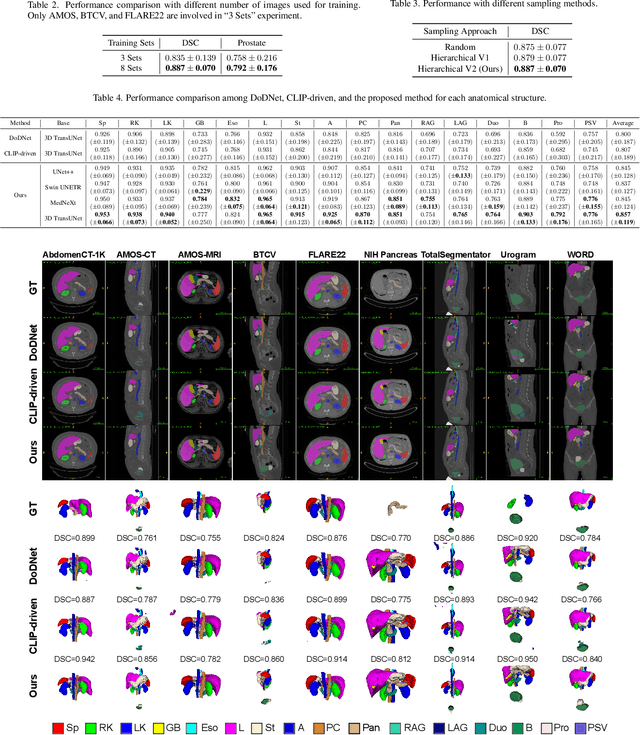
A versatile medical image segmentation model applicable to imaging data collected with diverse equipment and protocols can facilitate model deployment and maintenance. However, building such a model typically requires a large, diverse, and fully annotated dataset, which is rarely available due to the labor-intensive and costly data curation. In this study, we develop a cost-efficient method by harnessing readily available data with partially or even sparsely annotated segmentation labels. We devise strategies for model self-disambiguation, prior knowledge incorporation, and imbalance mitigation to address challenges associated with inconsistently labeled data from various sources, including label ambiguity and imbalances across modalities, datasets, and segmentation labels. Experimental results on a multi-modal dataset compiled from eight different sources for abdominal organ segmentation have demonstrated our method's effectiveness and superior performance over alternative state-of-the-art methods, highlighting its potential for optimizing the use of existing annotated data and reducing the annotation efforts for new data to further enhance model capability.
SurfNN: Joint Reconstruction of Multiple Cortical Surfaces from Magnetic Resonance Images
Mar 06, 2023To achieve fast, robust, and accurate reconstruction of the human cortical surfaces from 3D magnetic resonance images (MRIs), we develop a novel deep learning-based framework, referred to as SurfNN, to reconstruct simultaneously both inner (between white matter and gray matter) and outer (pial) surfaces from MRIs. Different from existing deep learning-based cortical surface reconstruction methods that either reconstruct the cortical surfaces separately or neglect the interdependence between the inner and outer surfaces, SurfNN reconstructs both the inner and outer cortical surfaces jointly by training a single network to predict a midthickness surface that lies at the center of the inner and outer cortical surfaces. The input of SurfNN consists of a 3D MRI and an initialization of the midthickness surface that is represented both implicitly as a 3D distance map and explicitly as a triangular mesh with spherical topology, and its output includes both the inner and outer cortical surfaces, as well as the midthickness surface. The method has been evaluated on a large-scale MRI dataset and demonstrated competitive cortical surface reconstruction performance.
Deep Clustering Survival Machines with Interpretable Expert Distributions
Jan 27, 2023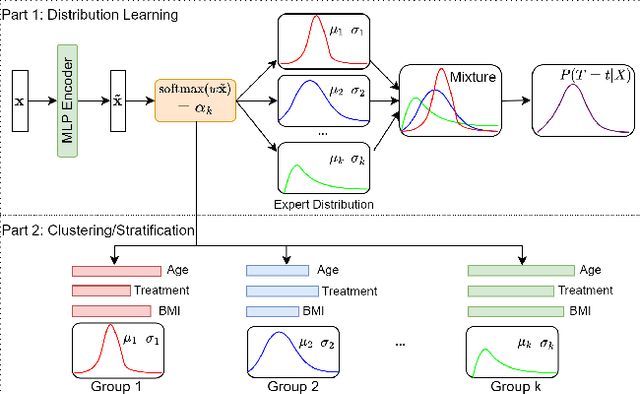
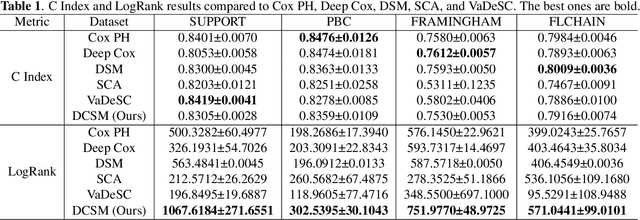
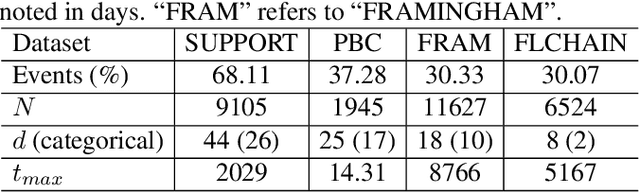
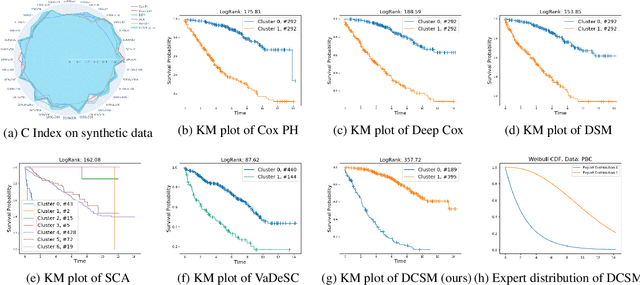
Conventional survival analysis methods are typically ineffective to characterize heterogeneity in the population while such information can be used to assist predictive modeling. In this study, we propose a hybrid survival analysis method, referred to as deep clustering survival machines, that combines the discriminative and generative mechanisms. Similar to the mixture models, we assume that the timing information of survival data is generatively described by a mixture of certain numbers of parametric distributions, i.e., expert distributions. We learn weights of the expert distributions for individual instances according to their features discriminatively such that each instance's survival information can be characterized by a weighted combination of the learned constant expert distributions. This method also facilitates interpretable subgrouping/clustering of all instances according to their associated expert distributions. Extensive experiments on both real and synthetic datasets have demonstrated that the method is capable of obtaining promising clustering results and competitive time-to-event predicting performance.
The Conditional Cauchy-Schwarz Divergence with Applications to Time-Series Data and Sequential Decision Making
Jan 21, 2023The Cauchy-Schwarz (CS) divergence was developed by Pr\'{i}ncipe et al. in 2000. In this paper, we extend the classic CS divergence to quantify the closeness between two conditional distributions and show that the developed conditional CS divergence can be simply estimated by a kernel density estimator from given samples. We illustrate the advantages (e.g., the rigorous faithfulness guarantee, the lower computational complexity, the higher statistical power, and the much more flexibility in a wide range of applications) of our conditional CS divergence over previous proposals, such as the conditional KL divergence and the conditional maximum mean discrepancy. We also demonstrate the compelling performance of conditional CS divergence in two machine learning tasks related to time series data and sequential inference, namely the time series clustering and the uncertainty-guided exploration for sequential decision making.
Causal Recurrent Variational Autoencoder for Medical Time Series Generation
Jan 16, 2023We propose causal recurrent variational autoencoder (CR-VAE), a novel generative model that is able to learn a Granger causal graph from a multivariate time series x and incorporates the underlying causal mechanism into its data generation process. Distinct to the classical recurrent VAEs, our CR-VAE uses a multi-head decoder, in which the $p$-th head is responsible for generating the $p$-th dimension of $\mathbf{x}$ (i.e., $\mathbf{x}^p$). By imposing a sparsity-inducing penalty on the weights (of the decoder) and encouraging specific sets of weights to be zero, our CR-VAE learns a sparse adjacency matrix that encodes causal relations between all pairs of variables. Thanks to this causal matrix, our decoder strictly obeys the underlying principles of Granger causality, thereby making the data generating process transparent. We develop a two-stage approach to train the overall objective. Empirically, we evaluate the behavior of our model in synthetic data and two real-world human brain datasets involving, respectively, the electroencephalography (EEG) signals and the functional magnetic resonance imaging (fMRI) data. Our model consistently outperforms state-of-the-art time series generative models both qualitatively and quantitatively. Moreover, it also discovers a faithful causal graph with similar or improved accuracy over existing Granger causality-based causal inference methods. Code of CR-VAE is publicly available at https://github.com/hongmingli1995/CR-VAE.
Deep Deterministic Independent Component Analysis for Hyperspectral Unmixing
Feb 15, 2022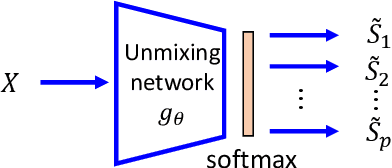
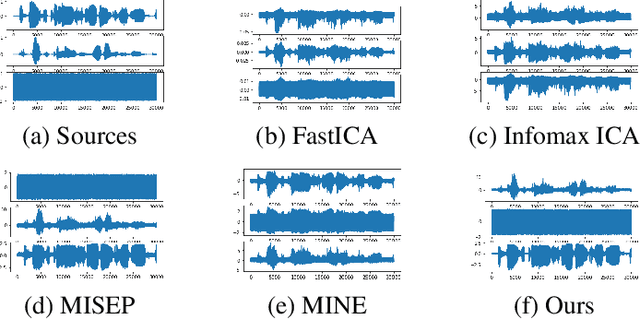
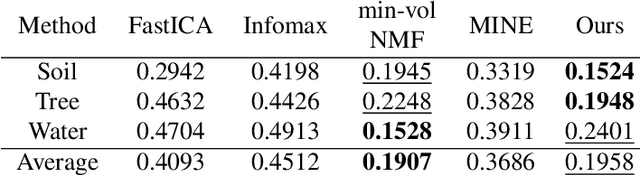
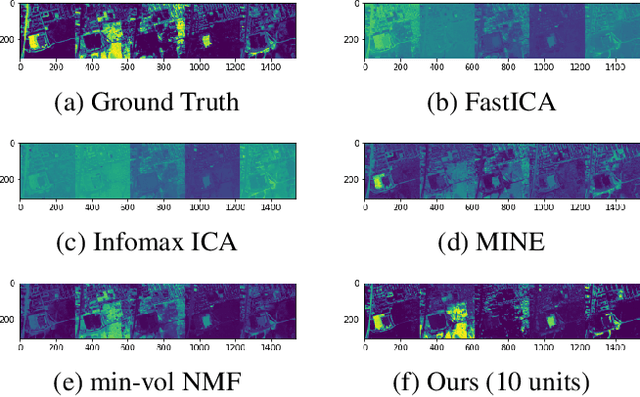
We develop a new neural network based independent component analysis (ICA) method by directly minimizing the dependence amongst all extracted components. Using the matrix-based R{\'e}nyi's $\alpha$-order entropy functional, our network can be directly optimized by stochastic gradient descent (SGD), without any variational approximation or adversarial training. As a solid application, we evaluate our ICA in the problem of hyperspectral unmixing (HU) and refute a statement that "\emph{ICA does not play a role in unmixing hyperspectral data}", which was initially suggested by \cite{nascimento2005does}. Code and additional remarks of our DDICA is available at https://github.com/hongmingli1995/DDICA.