 Add to Chrome
 Add to Firefox
 Add to Edge
Semantic-guided Prompt Organization for Universal Goal Hijacking against LLMs
May 23, 2024
With the rising popularity of Large Language Models (LLMs), assessing their trustworthiness through security tasks has gained critical importance. Regarding the new task of universal goal hijacking, previous efforts have concentrated solely on optimization algorithms, overlooking the crucial role of the prompt. To fill this gap, we propose a universal goal hijacking method called POUGH that incorporates semantic-guided prompt processing strategies. Specifically, the method starts with a sampling strategy to select representative prompts from a candidate pool, followed by a ranking strategy that prioritizes the prompts. Once the prompts are organized sequentially, the method employs an iterative optimization algorithm to generate the universal fixed suffix for the prompts. Experiments conducted on four popular LLMs and ten types of target responses verified the effectiveness of our method.

Scalable Optimization in the Modular Norm
May 23, 2024
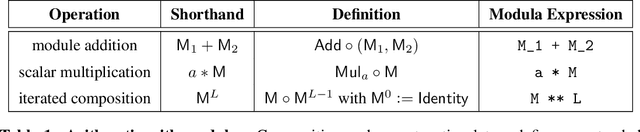


To improve performance in contemporary deep learning, one is interested in scaling up the neural network in terms of both the number and the size of the layers. When ramping up the width of a single layer, graceful scaling of training has been linked to the need to normalize the weights and their updates in the "natural norm" particular to that layer. In this paper, we significantly generalize this idea by defining the modular norm, which is the natural norm on the full weight space of any neural network architecture. The modular norm is defined recursively in tandem with the network architecture itself. We show that the modular norm has several promising applications. On the practical side, the modular norm can be used to normalize the updates of any base optimizer so that the learning rate becomes transferable across width and depth. This means that the user does not need to compute optimizer-specific scale factors in order to scale training. On the theoretical side, we show that for any neural network built from "well-behaved" atomic modules, the gradient of the network is Lipschitz-continuous in the modular norm, with the Lipschitz constant admitting a simple recursive formula. This characterization opens the door to porting standard ideas in optimization theory over to deep learning. We have created a Python package called Modula that automatically normalizes weight updates in the modular norm of the architecture. The package is available via "pip install modula" with source code at https://github.com/jxbz/modula.
Membership Inference on Text-to-Image Diffusion Models via Conditional Likelihood Discrepancy
May 23, 2024
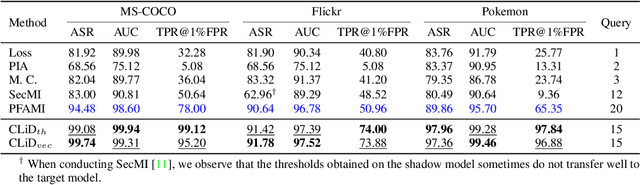

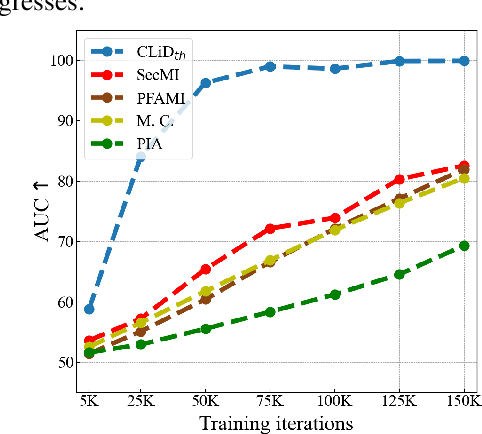
Text-to-image diffusion models have achieved tremendous success in the field of controllable image generation, while also coming along with issues of privacy leakage and data copyrights. Membership inference arises in these contexts as a potential auditing method for detecting unauthorized data usage. While some efforts have been made on diffusion models, they are not applicable to text-to-image diffusion models due to the high computation overhead and enhanced generalization capabilities. In this paper, we first identify a conditional overfitting phenomenon in text-to-image diffusion models, indicating that these models tend to overfit the conditional distribution of images given the text rather than the marginal distribution of images. Based on this observation, we derive an analytical indicator, namely Conditional Likelihood Discrepancy (CLiD), to perform membership inference. This indicator reduces the stochasticity in estimating the memorization of individual samples. Experimental results demonstrate that our method significantly outperforms previous methods across various data distributions and scales. Additionally, our method shows superior resistance to overfitting mitigation strategies such as early stopping and data augmentation.
LOGIN: A Large Language Model Consulted Graph Neural Network Training Framework
May 22, 2024
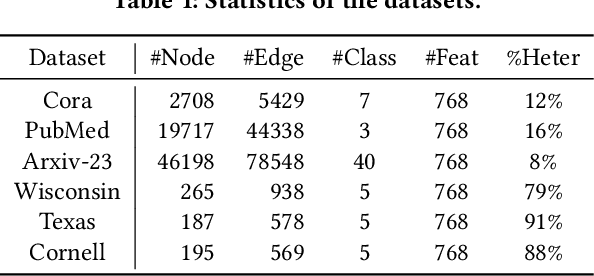


Recent prevailing works on graph machine learning typically follow a similar methodology that involves designing advanced variants of graph neural networks (GNNs) to maintain the superior performance of GNNs on different graphs. In this paper, we aim to streamline the GNN design process and leverage the advantages of Large Language Models (LLMs) to improve the performance of GNNs on downstream tasks. We formulate a new paradigm, coined "LLMs-as-Consultants," which integrates LLMs with GNNs in an interactive manner. A framework named LOGIN (LLM Consulted GNN training) is instantiated, empowering the interactive utilization of LLMs within the GNN training process. First, we attentively craft concise prompts for spotted nodes, carrying comprehensive semantic and topological information, and serving as input to LLMs. Second, we refine GNNs by devising a complementary coping mechanism that utilizes the responses from LLMs, depending on their correctness. We empirically evaluate the effectiveness of LOGIN on node classification tasks across both homophilic and heterophilic graphs. The results illustrate that even basic GNN architectures, when employed within the proposed LLMs-as-Consultants paradigm, can achieve comparable performance to advanced GNNs with intricate designs. Our codes are available at https://github.com/QiaoYRan/LOGIN.
ComboStoc: Combinatorial Stochasticity for Diffusion Generative Models
May 22, 2024


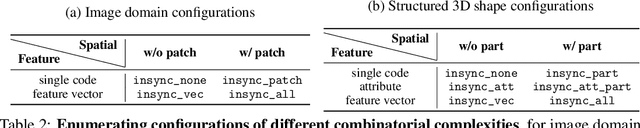
In this paper, we study an under-explored but important factor of diffusion generative models, i.e., the combinatorial complexity. Data samples are generally high-dimensional, and for various structured generation tasks, there are additional attributes which are combined to associate with data samples. We show that the space spanned by the combination of dimensions and attributes is insufficiently sampled by existing training scheme of diffusion generative models, causing degraded test time performance. We present a simple fix to this problem by constructing stochastic processes that fully exploit the combinatorial structures, hence the name ComboStoc. Using this simple strategy, we show that network training is significantly accelerated across diverse data modalities, including images and 3D structured shapes. Moreover, ComboStoc enables a new way of test time generation which uses insynchronized time steps for different dimensions and attributes, thus allowing for varying degrees of control over them.
Active Object Detection with Knowledge Aggregation and Distillation from Large Models
May 21, 2024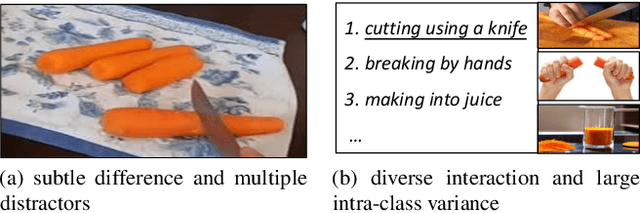
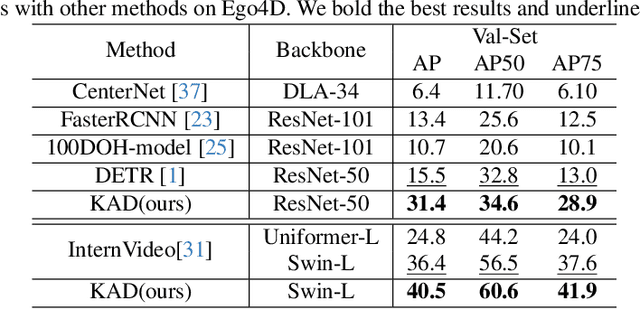
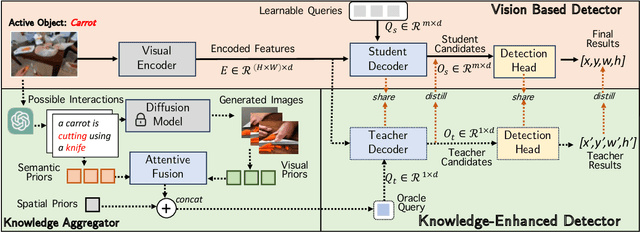
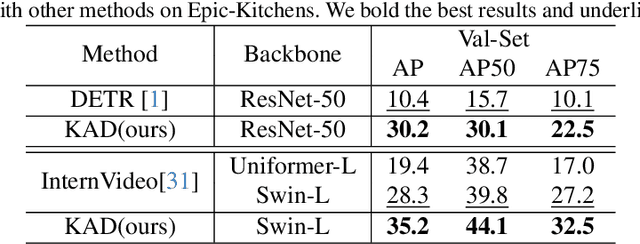
Accurately detecting active objects undergoing state changes is essential for comprehending human interactions and facilitating decision-making. The existing methods for active object detection (AOD) primarily rely on visual appearance of the objects within input, such as changes in size, shape and relationship with hands. However, these visual changes can be subtle, posing challenges, particularly in scenarios with multiple distracting no-change instances of the same category. We observe that the state changes are often the result of an interaction being performed upon the object, thus propose to use informed priors about object related plausible interactions (including semantics and visual appearance) to provide more reliable cues for AOD. Specifically, we propose a knowledge aggregation procedure to integrate the aforementioned informed priors into oracle queries within the teacher decoder, offering more object affordance commonsense to locate the active object. To streamline the inference process and reduce extra knowledge inputs, we propose a knowledge distillation approach that encourages the student decoder to mimic the detection capabilities of the teacher decoder using the oracle query by replicating its predictions and attention. Our proposed framework achieves state-of-the-art performance on four datasets, namely Ego4D, Epic-Kitchens, MECCANO, and 100DOH, which demonstrates the effectiveness of our approach in improving AOD.
Diff-BGM: A Diffusion Model for Video Background Music Generation
May 20, 2024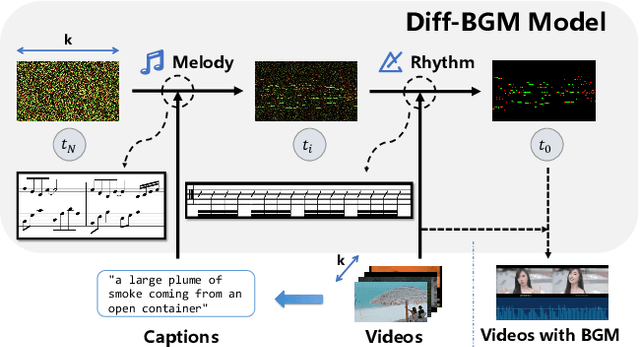
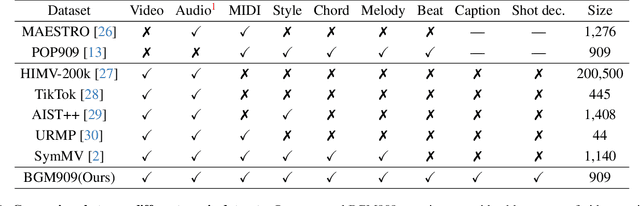
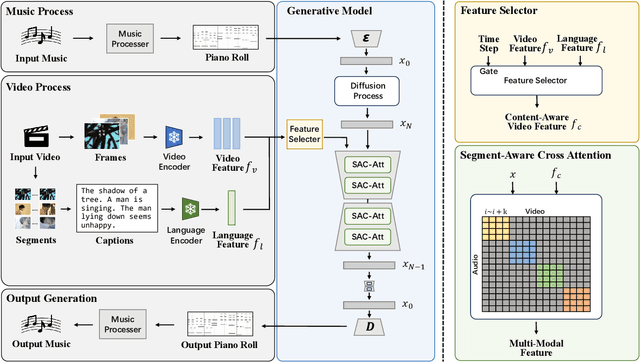
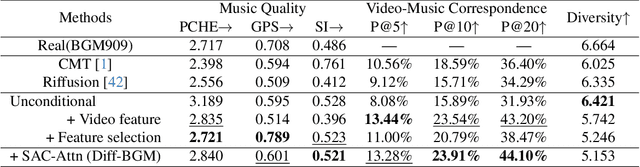
When editing a video, a piece of attractive background music is indispensable. However, video background music generation tasks face several challenges, for example, the lack of suitable training datasets, and the difficulties in flexibly controlling the music generation process and sequentially aligning the video and music. In this work, we first propose a high-quality music-video dataset BGM909 with detailed annotation and shot detection to provide multi-modal information about the video and music. We then present evaluation metrics to assess music quality, including music diversity and alignment between music and video with retrieval precision metrics. Finally, we propose the Diff-BGM framework to automatically generate the background music for a given video, which uses different signals to control different aspects of the music during the generation process, i.e., uses dynamic video features to control music rhythm and semantic features to control the melody and atmosphere. We propose to align the video and music sequentially by introducing a segment-aware cross-attention layer. Experiments verify the effectiveness of our proposed method. The code and models are available at https://github.com/sizhelee/Diff-BGM.
Conformal Counterfactual Inference under Hidden Confounding
May 20, 2024



Personalized decision making requires the knowledge of potential outcomes under different treatments, and confidence intervals about the potential outcomes further enrich this decision-making process and improve its reliability in high-stakes scenarios. Predicting potential outcomes along with its uncertainty in a counterfactual world poses the foundamental challenge in causal inference. Existing methods that construct confidence intervals for counterfactuals either rely on the assumption of strong ignorability, or need access to un-identifiable lower and upper bounds that characterize the difference between observational and interventional distributions. To overcome these limitations, we first propose a novel approach wTCP-DR based on transductive weighted conformal prediction, which provides confidence intervals for counterfactual outcomes with marginal converage guarantees, even under hidden confounding. With less restrictive assumptions, our approach requires access to a fraction of interventional data (from randomized controlled trials) to account for the covariate shift from observational distributoin to interventional distribution. Theoretical results explicitly demonstrate the conditions under which our algorithm is strictly advantageous to the naive method that only uses interventional data. After ensuring valid intervals on counterfactuals, it is straightforward to construct intervals for individual treatment effects (ITEs). We demonstrate our method across synthetic and real-world data, including recommendation systems, to verify the superiority of our methods compared against state-of-the-art baselines in terms of both coverage and efficiency
Networking Systems for Video Anomaly Detection: A Tutorial and Survey
May 16, 2024


The increasing prevalence of surveillance cameras in smart cities, coupled with the surge of online video applications, has heightened concerns regarding public security and privacy protection, which propelled automated Video Anomaly Detection (VAD) into a fundamental research task within the Artificial Intelligence (AI) community. With the advancements in deep learning and edge computing, VAD has made significant progress and advances synergized with emerging applications in smart cities and video internet, which has moved beyond the conventional research scope of algorithm engineering to deployable Networking Systems for VAD (NSVAD), a practical hotspot for intersection exploration in the AI, IoVT, and computing fields. In this article, we delineate the foundational assumptions, learning frameworks, and applicable scenarios of various deep learning-driven VAD routes, offering an exhaustive tutorial for novices in NSVAD. This article elucidates core concepts by reviewing recent advances and typical solutions, and aggregating available research resources (e.g., literatures, code, tools, and workshops) accessible at https://github.com/fdjingliu/NSVAD. Additionally, we showcase our latest NSVAD research in industrial IoT and smart cities, along with an end-cloud collaborative architecture for deployable NSVAD to further elucidate its potential scope of research and application. Lastly, this article projects future development trends and discusses how the integration of AI and computing technologies can address existing research challenges and promote open opportunities, serving as an insightful guide for prospective researchers and engineers.
DiverGen: Improving Instance Segmentation by Learning Wider Data Distribution with More Diverse Generative Data
May 16, 2024Instance segmentation is data-hungry, and as model capacity increases, data scale becomes crucial for improving the accuracy. Most instance segmentation datasets today require costly manual annotation, limiting their data scale. Models trained on such data are prone to overfitting on the training set, especially for those rare categories. While recent works have delved into exploiting generative models to create synthetic datasets for data augmentation, these approaches do not efficiently harness the full potential of generative models. To address these issues, we introduce a more efficient strategy to construct generative datasets for data augmentation, termed DiverGen. Firstly, we provide an explanation of the role of generative data from the perspective of distribution discrepancy. We investigate the impact of different data on the distribution learned by the model. We argue that generative data can expand the data distribution that the model can learn, thus mitigating overfitting. Additionally, we find that the diversity of generative data is crucial for improving model performance and enhance it through various strategies, including category diversity, prompt diversity, and generative model diversity. With these strategies, we can scale the data to millions while maintaining the trend of model performance improvement. On the LVIS dataset, DiverGen significantly outperforms the strong model X-Paste, achieving +1.1 box AP and +1.1 mask AP across all categories, and +1.9 box AP and +2.5 mask AP for rare categories.