 Add to Chrome
 Add to Firefox
 Add to Edge
Sketch2Scene: Automatic Generation of Interactive 3D Game Scenes from User's Casual Sketches
Aug 08, 2024
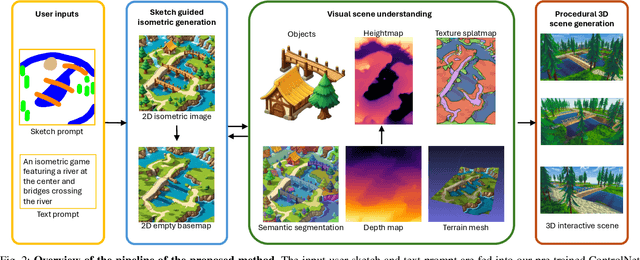
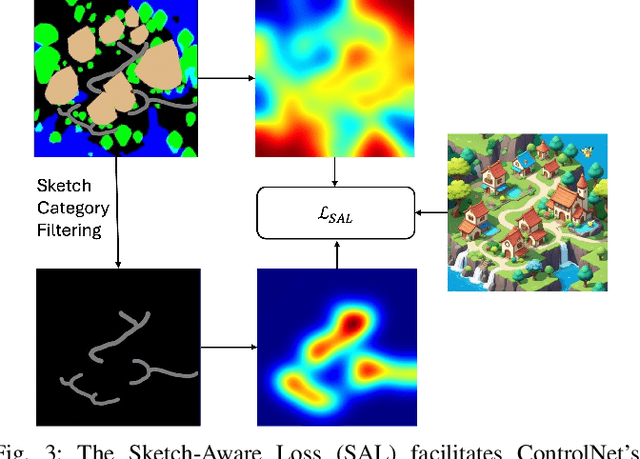

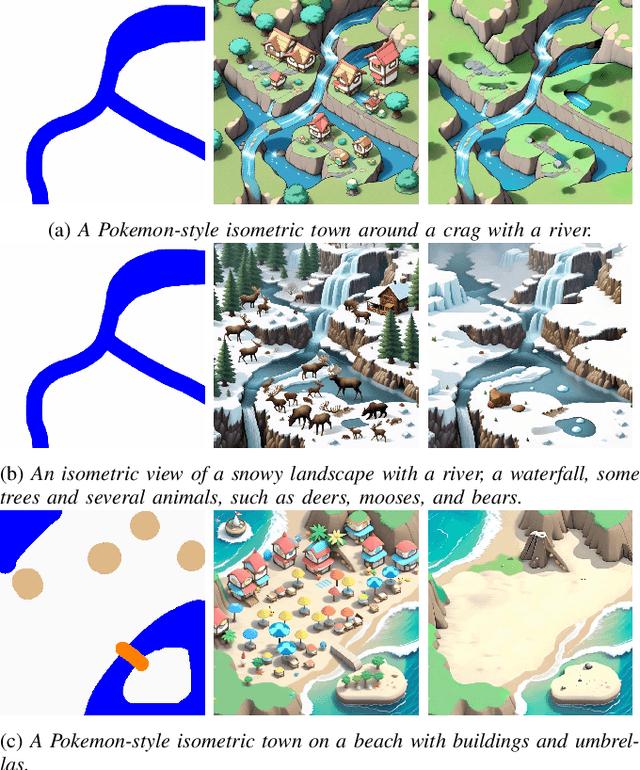
3D Content Generation is at the heart of many computer graphics applications, including video gaming, film-making, virtual and augmented reality, etc. This paper proposes a novel deep-learning based approach for automatically generating interactive and playable 3D game scenes, all from the user's casual prompts such as a hand-drawn sketch. Sketch-based input offers a natural, and convenient way to convey the user's design intention in the content creation process. To circumvent the data-deficient challenge in learning (i.e. the lack of large training data of 3D scenes), our method leverages a pre-trained 2D denoising diffusion model to generate a 2D image of the scene as the conceptual guidance. In this process, we adopt the isometric projection mode to factor out unknown camera poses while obtaining the scene layout. From the generated isometric image, we use a pre-trained image understanding method to segment the image into meaningful parts, such as off-ground objects, trees, and buildings, and extract the 2D scene layout. These segments and layouts are subsequently fed into a procedural content generation (PCG) engine, such as a 3D video game engine like Unity or Unreal, to create the 3D scene. The resulting 3D scene can be seamlessly integrated into a game development environment and is readily playable. Extensive tests demonstrate that our method can efficiently generate high-quality and interactive 3D game scenes with layouts that closely follow the user's intention.

A Multi-Source Heterogeneous Knowledge Injected Prompt Learning Method for Legal Charge Prediction
Aug 05, 2024Legal charge prediction, an essential task in legal AI, seeks to assign accurate charge labels to case descriptions, attracting significant recent interest. Existing methods primarily employ diverse neural network structures for modeling case descriptions directly, failing to effectively leverage multi-source external knowledge. We propose a prompt learning framework-based method that simultaneously leverages multi-source heterogeneous external knowledge from a legal knowledge base, a conversational LLM, and related legal articles. Specifically, we match knowledge snippets in case descriptions via the legal knowledge base and encapsulate them into the input through a hard prompt template. Additionally, we retrieve legal articles related to a given case description through contrastive learning, and then obtain factual elements within the case description through a conversational LLM. We fuse the embedding vectors of soft prompt tokens with the encoding vector of factual elements to achieve knowledge-enhanced model forward inference. Experimental results show that our method achieved state-of-the-art results on CAIL-2018, the largest legal charge prediction dataset, and our method has lower data dependency. Case studies also demonstrate our method's strong interpretability.
Exploring Query Understanding for Amazon Product Search
Aug 05, 2024


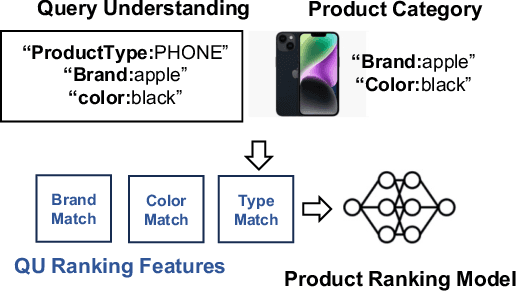
Online shopping platforms, such as Amazon, offer services to billions of people worldwide. Unlike web search or other search engines, product search engines have their unique characteristics, primarily featuring short queries which are mostly a combination of product attributes and structured product search space. The uniqueness of product search underscores the crucial importance of the query understanding component. However, there are limited studies focusing on exploring this impact within real-world product search engines. In this work, we aim to bridge this gap by conducting a comprehensive study and sharing our year-long journey investigating how the query understanding service impacts Amazon Product Search. Firstly, we explore how query understanding-based ranking features influence the ranking process. Next, we delve into how the query understanding system contributes to understanding the performance of a ranking model. Building on the insights gained from our study on the evaluation of the query understanding-based ranking model, we propose a query understanding-based multi-task learning framework for ranking. We present our studies and investigations using the real-world system on Amazon Search.
CACE-Net: Co-guidance Attention and Contrastive Enhancement for Effective Audio-Visual Event Localization
Aug 04, 2024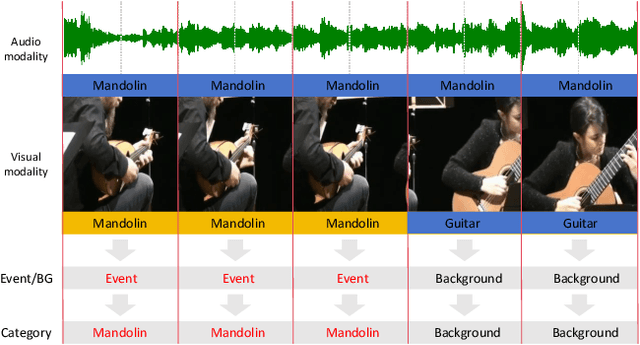
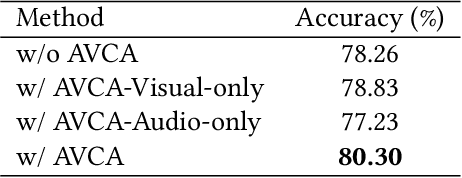
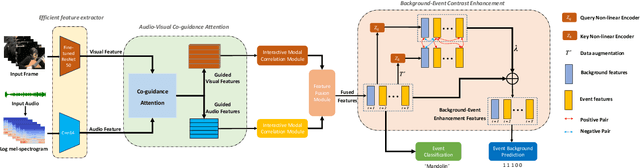
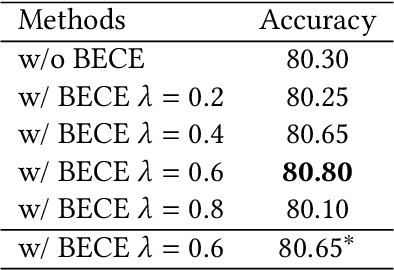
The audio-visual event localization task requires identifying concurrent visual and auditory events from unconstrained videos within a network model, locating them, and classifying their category. The efficient extraction and integration of audio and visual modal information have always been challenging in this field. In this paper, we introduce CACE-Net, which differs from most existing methods that solely use audio signals to guide visual information. We propose an audio-visual co-guidance attention mechanism that allows for adaptive bi-directional cross-modal attentional guidance between audio and visual information, thus reducing inconsistencies between modalities. Moreover, we have observed that existing methods have difficulty distinguishing between similar background and event and lack the fine-grained features for event classification. Consequently, we employ background-event contrast enhancement to increase the discrimination of fused feature and fine-tuned pre-trained model to extract more refined and discernible features from complex multimodal inputs. Specifically, we have enhanced the model's ability to discern subtle differences between event and background and improved the accuracy of event classification in our model. Experiments on the AVE dataset demonstrate that CACE-Net sets a new benchmark in the audio-visual event localization task, proving the effectiveness of our proposed methods in handling complex multimodal learning and event localization in unconstrained videos. Code is available at https://github.com/Brain-Cog-Lab/CACE-Net.
SF-TIM: A Simple Framework for Enhancing Quadrupedal Robot Jumping Agility by Combining Terrain Imagination and Measurement
Aug 01, 2024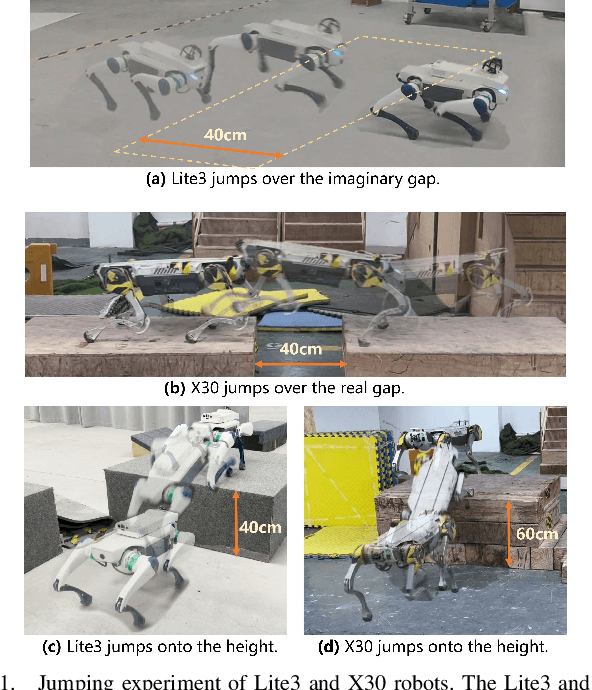
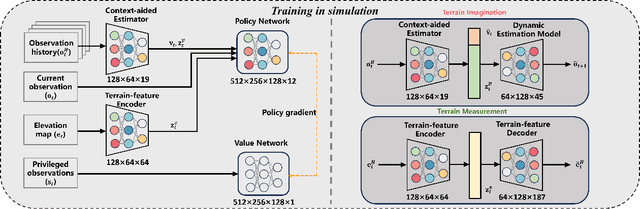
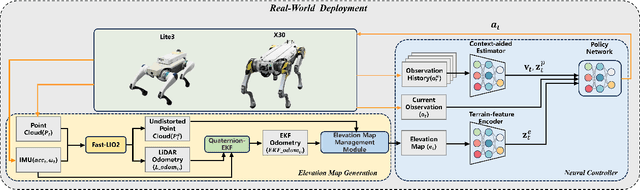
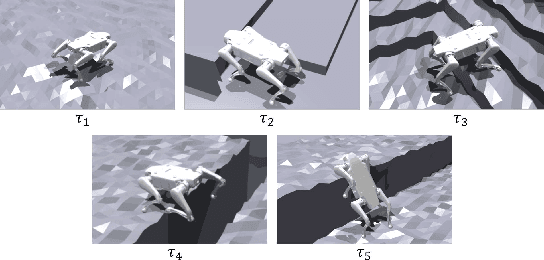
Dynamic jumping on high platforms and over gaps differentiates legged robots from wheeled counterparts. Compared to walking on rough terrains, dynamic locomotion on abrupt surfaces requires fusing proprioceptive and exteroceptive perception for explosive movements. In this paper, we propose SF-TIM (Simple Framework combining Terrain Imagination and Measurement), a single-policy method that enhances quadrupedal robot jumping agility, while preserving their fundamental blind walking capabilities. In addition, we introduce a terrain-guided reward design specifically to assist quadrupedal robots in high jumping, improving their performance in this task. To narrow the simulation-to-reality gap in quadrupedal robot learning, we introduce a stable and high-speed elevation map generation framework, enabling zero-shot simulation-to-reality transfer of locomotion ability. Our algorithm has been deployed and validated on both the small-/large-size quadrupedal robots, demonstrating its effectiveness in real-world applications: the robot has successfully traversed various high platforms and gaps, showing the robustness of our proposed approach. A demo video has been made available at https://flysoaryun.github.io/SF-TIM.
FIND: Fine-tuning Initial Noise Distribution with Policy Optimization for Diffusion Models
Jul 28, 2024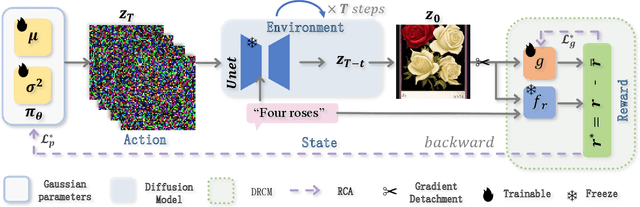
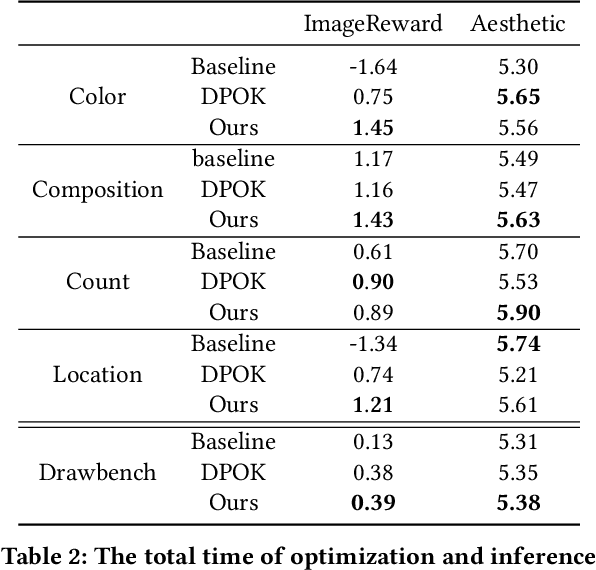
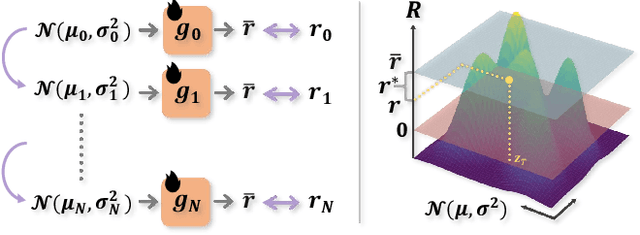

In recent years, large-scale pre-trained diffusion models have demonstrated their outstanding capabilities in image and video generation tasks. However, existing models tend to produce visual objects commonly found in the training dataset, which diverges from user input prompts. The underlying reason behind the inaccurate generated results lies in the model's difficulty in sampling from specific intervals of the initial noise distribution corresponding to the prompt. Moreover, it is challenging to directly optimize the initial distribution, given that the diffusion process involves multiple denoising steps. In this paper, we introduce a Fine-tuning Initial Noise Distribution (FIND) framework with policy optimization, which unleashes the powerful potential of pre-trained diffusion networks by directly optimizing the initial distribution to align the generated contents with user-input prompts. To this end, we first reformulate the diffusion denoising procedure as a one-step Markov decision process and employ policy optimization to directly optimize the initial distribution. In addition, a dynamic reward calibration module is proposed to ensure training stability during optimization. Furthermore, we introduce a ratio clipping algorithm to utilize historical data for network training and prevent the optimized distribution from deviating too far from the original policy to restrain excessive optimization magnitudes. Extensive experiments demonstrate the effectiveness of our method in both text-to-image and text-to-video tasks, surpassing SOTA methods in achieving consistency between prompts and the generated content. Our method achieves 10 times faster than the SOTA approach. Our homepage is available at \url{https://github.com/vpx-ecnu/FIND-website}.
Physical Adversarial Attack on Monocular Depth Estimation via Shape-Varying Patches
Jul 24, 2024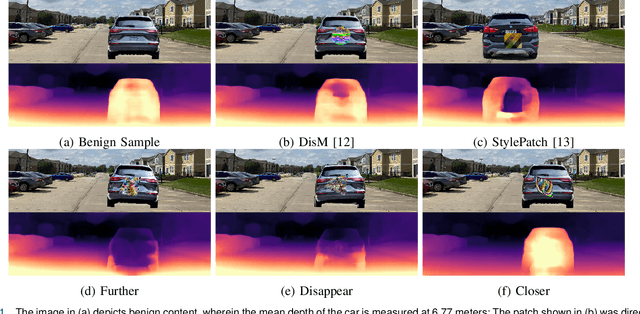
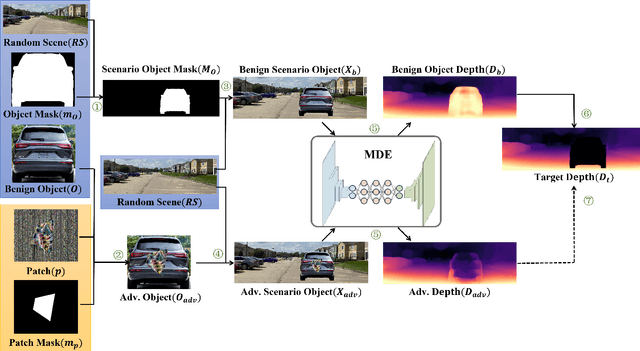
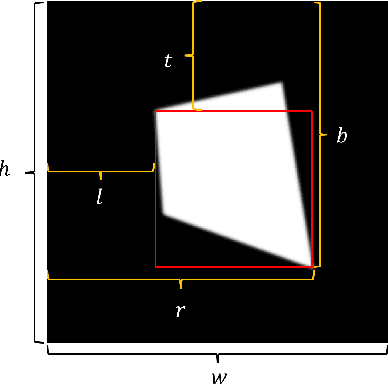
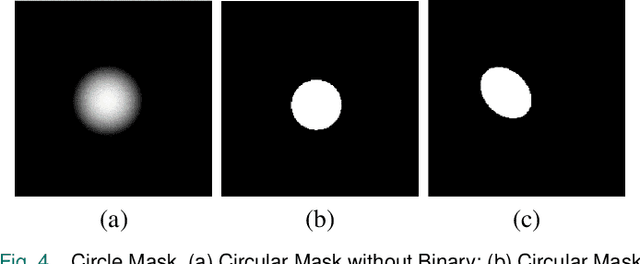
Adversarial attacks against monocular depth estimation (MDE) systems pose significant challenges, particularly in safety-critical applications such as autonomous driving. Existing patch-based adversarial attacks for MDE are confined to the vicinity of the patch, making it difficult to affect the entire target. To address this limitation, we propose a physics-based adversarial attack on monocular depth estimation, employing a framework called Attack with Shape-Varying Patches (ASP), aiming to optimize patch content, shape, and position to maximize effectiveness. We introduce various mask shapes, including quadrilateral, rectangular, and circular masks, to enhance the flexibility and efficiency of the attack. Furthermore, we propose a new loss function to extend the influence of the patch beyond the overlapping regions. Experimental results demonstrate that our attack method generates an average depth error of 18 meters on the target car with a patch area of 1/9, affecting over 98\% of the target area.
LawLuo: A Chinese Law Firm Co-run by LLM Agents
Jul 23, 2024


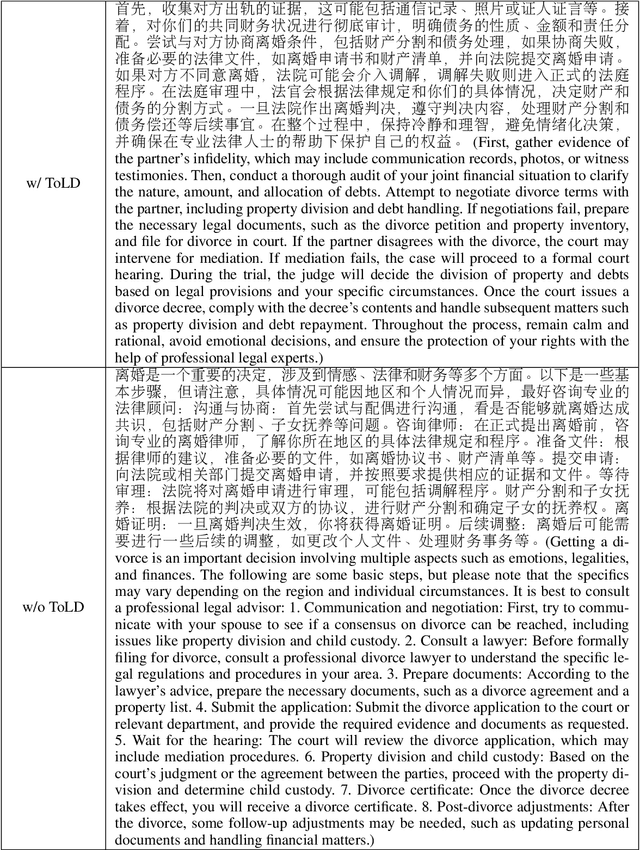
Large Language Models (LLMs) demonstrate substantial potential in delivering legal consultation services to users without a legal background, attributed to their superior text comprehension and generation capabilities. Nonetheless, existing Chinese legal LLMs limit interaction to a single model-user dialogue, unlike the collaborative consultations typical of law firms, where multiple staff members contribute to a single consultation. This limitation prevents an authentic consultation experience. Additionally, extant Chinese legal LLMs suffer from critical limitations: (1) insufficient control over the quality of instruction fine-tuning data; (2) increased model hallucination resulting from users' ambiguous queries; and (3) a reduction in the model's ability to follow instructions over multiple dialogue turns. In response to these challenges, we propose a novel legal dialogue framework that leverages the collaborative capabilities of multiple LLM agents, termed LawLuo. This framework encompasses four agents: a receptionist, a lawyer, a secretary, and a boss, each responsible for different functionalities, collaboratively providing a comprehensive legal consultation to users. Additionally, we constructed two high-quality legal dialogue datasets, KINLED and MURLED, and fine-tuned ChatGLM-3-6b using these datasets. We propose a legal query clarification algorithm called ToLC. Experimental results demonstrate that LawLuo outperforms baseline LLMs, including GPT-4, across three dimensions: lawyer-like language style, the usefulness of legal advice, and the accuracy of legal knowledge. Our code and datasets are available at https://github.com/NEFUJing/LawLuo.
UICrit: Enhancing Automated Design Evaluation with a UICritique Dataset
Jul 11, 2024Automated UI evaluation can be beneficial for the design process; for example, to compare different UI designs, or conduct automated heuristic evaluation. LLM-based UI evaluation, in particular, holds the promise of generalizability to a wide variety of UI types and evaluation tasks. However, current LLM-based techniques do not yet match the performance of human evaluators. We hypothesize that automatic evaluation can be improved by collecting a targeted UI feedback dataset and then using this dataset to enhance the performance of general-purpose LLMs. We present a targeted dataset of 3,059 design critiques and quality ratings for 983 mobile UIs, collected from seven experienced designers. We carried out an in-depth analysis to characterize the dataset's features. We then applied this dataset to achieve a 55% performance gain in LLM-generated UI feedback via various few-shot and visual prompting techniques. We also discuss future applications of this dataset, including training a reward model for generative UI techniques, and fine-tuning a tool-agnostic multi-modal LLM that automates UI evaluation.
Handling Distance Constraint in Movable Antenna Aided Systems: A General Optimization Framework
Jul 11, 2024The movable antenna (MA) is a promising technology to exploit more spatial degrees of freedom for enhancing wireless system performance. However, the MA-aided system introduces the non-convex antenna distance constraints, which poses challenges in the underlying optimization problems. To fill this gap, this paper proposes a general framework for optimizing the MA-aided system under the antenna distance constraints. Specifically, we separate the non-convex antenna distance constraints from the objective function by introducing auxiliary variables. Then, the resulting problem can be efficiently solved under the alternating optimization framework. For the subproblems with respect to the antenna position variables and auxiliary variables, the proposed algorithms are able to obtain at least stationary points without any approximations. To verify the effectiveness of the proposed optimization framework, we present two case studies: capacity maximization and regularized zero-forcing precoding. Simulation results demonstrate the proposed optimization framework outperforms the existing baseline schemes under both cases.