 Add to Chrome
 Add to Firefox
 Add to Edge
Unleashing the Agility of Wheeled-Legged Robots for High-Dynamic Reflexive Obstacle Evasion
Apr 26, 2026
Wheeled-legged robots combine the energy efficiency of wheeled locomotion with the terrain adaptability of legged systems, making them promising platforms for agile mobility in complex and dynamic environments. However, enabling high-dynamic reflexive evasion against fast-moving obstacles remains challenging due to the hybrid morphology, mode coupling, and non-holonomic constraints of such platforms. In this work, we propose AWARE, Adaptive Wheeled-Legged Avoidance and Reflexive Evasion, a hierarchical reinforcement learning framework for high-dynamic obstacle avoidance in wheeled-legged robots. The proposed system naturally exhibits diverse emergent gaits and evasive behaviors, including forward lunge and lateral dodge, thereby leveraging the robot's hybrid morphology to enhance agility under highly dynamic threats. Extensive experiments in Isaac Lab simulation and real-world deployment on the M20 platform across diverse dynamic scenarios demonstrate that AWARE achieves robust and agile obstacle avoidance while revealing behaviorally distinct evasive strategies. These results highlight both the practical effectiveness of AWARE and the intrinsic reflexive agility of wheeled-legged robots.

SF-TIM: A Simple Framework for Enhancing Quadrupedal Robot Jumping Agility by Combining Terrain Imagination and Measurement
Aug 01, 2024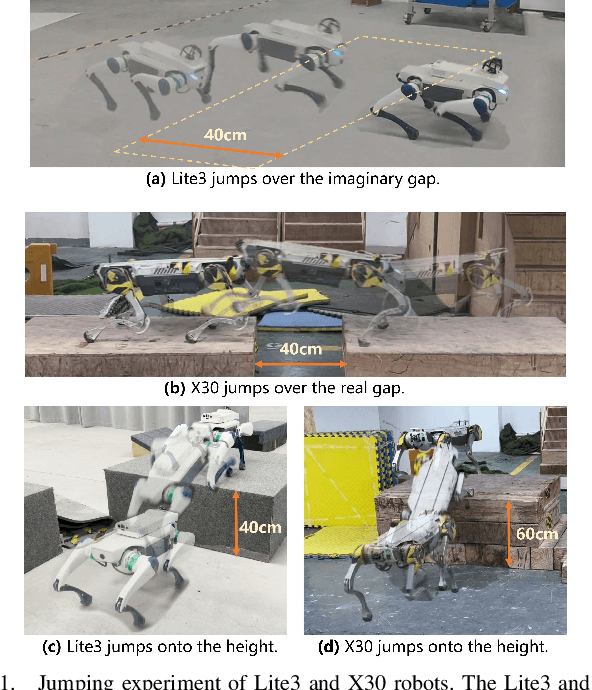
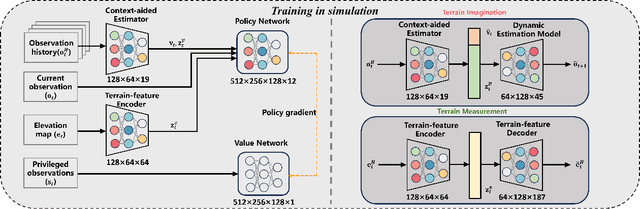
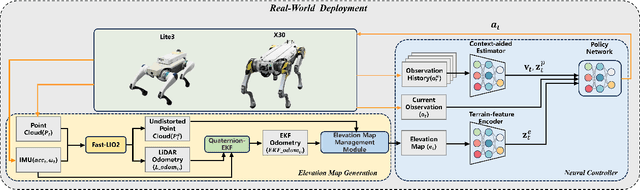
Dynamic jumping on high platforms and over gaps differentiates legged robots from wheeled counterparts. Compared to walking on rough terrains, dynamic locomotion on abrupt surfaces requires fusing proprioceptive and exteroceptive perception for explosive movements. In this paper, we propose SF-TIM (Simple Framework combining Terrain Imagination and Measurement), a single-policy method that enhances quadrupedal robot jumping agility, while preserving their fundamental blind walking capabilities. In addition, we introduce a terrain-guided reward design specifically to assist quadrupedal robots in high jumping, improving their performance in this task. To narrow the simulation-to-reality gap in quadrupedal robot learning, we introduce a stable and high-speed elevation map generation framework, enabling zero-shot simulation-to-reality transfer of locomotion ability. Our algorithm has been deployed and validated on both the small-/large-size quadrupedal robots, demonstrating its effectiveness in real-world applications: the robot has successfully traversed various high platforms and gaps, showing the robustness of our proposed approach. A demo video has been made available at https://flysoaryun.github.io/SF-TIM.