 Add to Chrome
 Add to Firefox
 Add to Edge
Post-interactive Multimodal Trajectory Prediction for Autonomous Driving
Mar 12, 2025
Modeling the interactions among agents for trajectory prediction of autonomous driving has been challenging due to the inherent uncertainty in agents' behavior. The interactions involved in the predicted trajectories of agents, also called post-interactions, have rarely been considered in trajectory prediction models. To this end, we propose a coarse-to-fine Transformer for multimodal trajectory prediction, i.e., Pioformer, which explicitly extracts the post-interaction features to enhance the prediction accuracy. Specifically, we first build a Coarse Trajectory Network to generate coarse trajectories based on the observed trajectories and lane segments, in which the low-order interaction features are extracted with the graph neural networks. Next, we build a hypergraph neural network-based Trajectory Proposal Network to generate trajectory proposals, where the high-order interaction features are learned by the hypergraphs. Finally, the trajectory proposals are sent to the Proposal Refinement Network for further refinement. The observed trajectories and trajectory proposals are concatenated together as the inputs of the Proposal Refinement Network, in which the post-interaction features are learned by combining the previous interaction features and trajectory consistency features. Moreover, we propose a three-stage training scheme to facilitate the learning process. Extensive experiments on the Argoverse 1 dataset demonstrate the superiority of our method. Compared with the baseline HiVT-64, our model has reduced the prediction errors by 4.4%, 8.4%, 14.4%, 5.7% regarding metrics minADE6, minFDE6, MR6, and brier-minFDE6, respectively.

EVE: Towards End-to-End Video Subtitle Extraction with Vision-Language Models
Mar 06, 2025The advent of Large Vision-Language Models (LVLMs) has advanced the video-based tasks, such as video captioning and video understanding. Some previous research indicates that taking texts in videos as input can further improve the performance of video understanding. As a type of indispensable information in short videos or movies, subtitles can assist LVLMs to better understand videos. Most existing methods for video subtitle extraction are based on a multi-stage framework, handling each frame independently. They can hardly exploit the temporal information of videos. Although some LVLMs exhibit the robust OCR capability, predicting accurate timestamps for subtitle texts is still challenging. In this paper, we propose an End-to-end Video Subtitle Extraction method, called EVE, which consists of three modules: a vision encoder, an adapter module, and a large language model. To effectively compress the visual tokens from the vision encoder, we propose a novel adapter InterleavedVT to interleave two modalities. It contains a visual compressor and a textual region compressor. The proposed InterleavedVT exploits both the merits of average pooling and Q-Former in token compression. Taking the temporal information of videos into account, we introduce a sliding-window mechanism in the textual region compressor. To benchmark the video subtitle extraction task, we propose a large dataset ViSa including 2.5M videos. Extensive experiments on ViSa demonstrate that the proposed EVE can outperform existing open-sourced tools and LVLMs.
Rethinking Video Tokenization: A Conditioned Diffusion-based Approach
Mar 05, 2025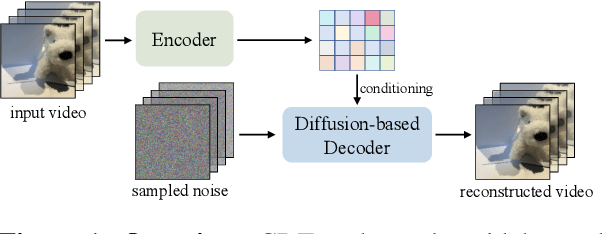
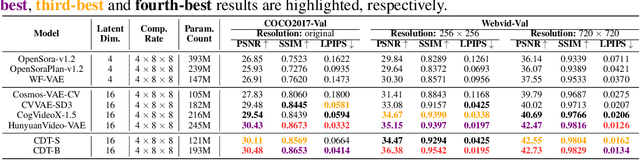
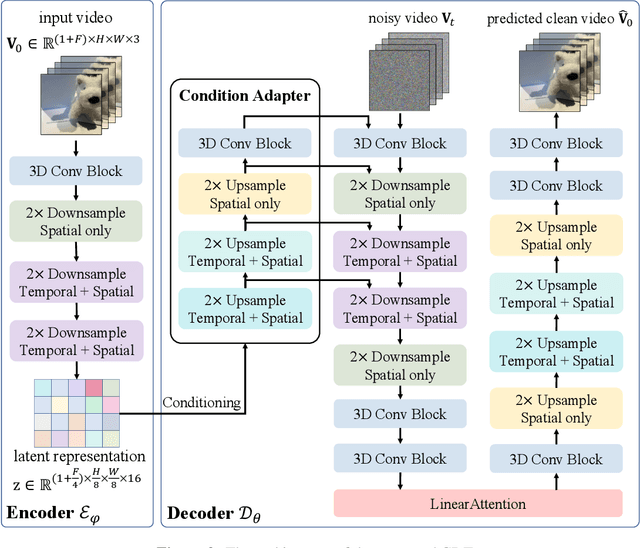
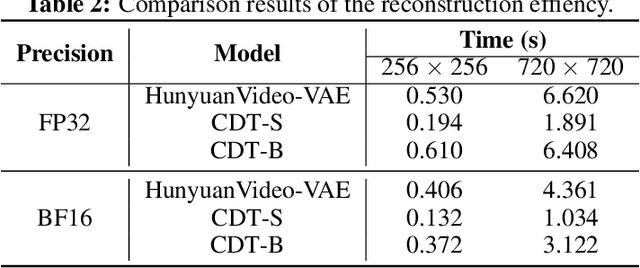
Video tokenizers, which transform videos into compact latent representations, are key to video generation. Existing video tokenizers are based on the VAE architecture and follow a paradigm where an encoder compresses videos into compact latents, and a deterministic decoder reconstructs the original videos from these latents. In this paper, we propose a novel \underline{\textbf{C}}onditioned \underline{\textbf{D}}iffusion-based video \underline{\textbf{T}}okenizer entitled \textbf{\ourmethod}, which departs from previous methods by replacing the deterministic decoder with a 3D causal diffusion model. The reverse diffusion generative process of the decoder is conditioned on the latent representations derived via the encoder. With a feature caching and sampling acceleration, the framework efficiently reconstructs high-fidelity videos of arbitrary lengths. Results show that {\ourmethod} achieves state-of-the-art performance in video reconstruction tasks using just a single-step sampling. Even a smaller version of {\ourmethod} still achieves reconstruction results on par with the top two baselines. Furthermore, the latent video generation model trained using {\ourmethod} also shows superior performance.
Human-aligned Safe Reinforcement Learning for Highway On-Ramp Merging in Dense Traffic
Mar 04, 2025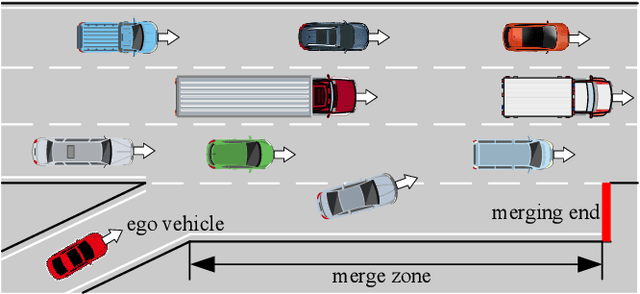
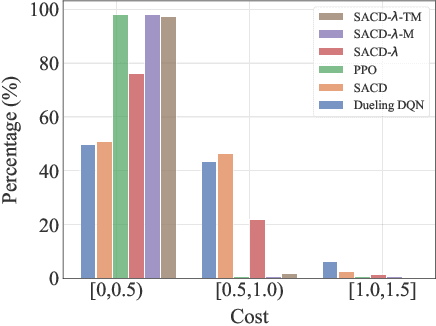
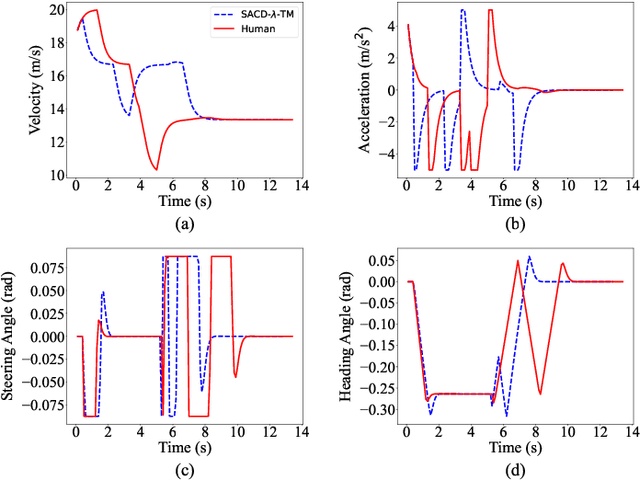
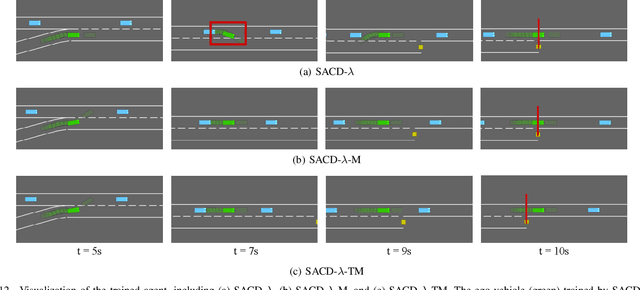
Most reinforcement learning (RL) approaches for the decision-making of autonomous driving consider safety as a reward instead of a cost, which makes it hard to balance the tradeoff between safety and other objectives. Human risk preference has also rarely been incorporated, and the trained policy might be either conservative or aggressive for users. To this end, this study proposes a human-aligned safe RL approach for autonomous merging, in which the high-level decision problem is formulated as a constrained Markov decision process (CMDP) that incorporates users' risk preference into the safety constraints, followed by a model predictive control (MPC)-based low-level control. The safety level of RL policy can be adjusted by computing cost limits of CMDP's constraints based on risk preferences and traffic density using a fuzzy control method. To filter out unsafe or invalid actions, we design an action shielding mechanism that pre-executes RL actions using an MPC method and performs collision checks with surrounding agents. We also provide theoretical proof to validate the effectiveness of the shielding mechanism in enhancing RL's safety and sample efficiency. Simulation experiments in multiple levels of traffic densities show that our method can significantly reduce safety violations without sacrificing traffic efficiency. Furthermore, due to the use of risk preference-aware constraints in CMDP and action shielding, we can not only adjust the safety level of the final policy but also reduce safety violations during the training stage, proving a promising solution for online learning in real-world environments.
A General Optimization Framework for Tackling Distance Constraints in Movable Antenna-Aided Systems
Mar 04, 2025The recently emerged movable antenna (MA) shows great promise in leveraging spatial degrees of freedom to enhance the performance of wireless systems. However, resource allocation in MA-aided systems faces challenges due to the nonconvex and coupled constraints on antenna positions. This paper systematically reveals the challenges posed by the minimum antenna separation distance constraints. Furthermore, we propose a penalty optimization framework for resource allocation under such new constraints for MA-aided systems. Specifically, the proposed framework separates the non-convex and coupled antenna distance constraints from the movable region constraints by introducing auxiliary variables. Subsequently, the resulting problem is efficiently solved by alternating optimization, where the optimization of the original variables resembles that in conventional resource allocation problem while the optimization with respect to the auxiliary variables is achieved in closedform solutions. To illustrate the effectiveness of the proposed framework, we present three case studies: capacity maximization, latency minimization, and regularized zero-forcing precoding. Simulation results demonstrate that the proposed optimization framework consistently outperforms state-of-the-art schemes.
Mixture of Experts-augmented Deep Unfolding for Activity Detection in IRS-aided Systems
Feb 27, 2025In the realm of activity detection for massive machine-type communications, intelligent reflecting surfaces (IRS) have shown significant potential in enhancing coverage for devices lacking direct connections to the base station (BS). However, traditional activity detection methods are typically designed for a single type of channel model, which does not reflect the complexities of real-world scenarios, particularly in systems incorporating IRS. To address this challenge, this paper introduces a novel approach that combines model-driven deep unfolding with a mixture of experts (MoE) framework. By automatically selecting one of three expert designs and applying it to the unfolded projected gradient method, our approach eliminates the need for prior knowledge of channel types between devices and the BS. Simulation results demonstrate that the proposed MoE-augmented deep unfolding method surpasses the traditional covariance-based method and black-box neural network design, delivering superior detection performance under mixed channel fading conditions.
Graph Augmentation for Cross Graph Domain Generalization
Feb 25, 2025Cross-graph node classification, utilizing the abundant labeled nodes from one graph to help classify unlabeled nodes in another graph, can be viewed as a domain generalization problem of graph neural networks (GNNs) due to the structure shift commonly appearing among various graphs. Nevertheless, current endeavors for cross-graph node classification mainly focus on model training. Data augmentation approaches, a simple and easy-to-implement domain generalization technique, remain under-explored. In this paper, we develop a new graph structure augmentation for the crossgraph domain generalization problem. Specifically, low-weight edgedropping is applied to remove potential noise edges that may hinder the generalization ability of GNNs, stimulating the GNNs to capture the essential invariant information underlying different structures. Meanwhile, clustering-based edge-adding is proposed to generate invariant structures based on the node features from the same distribution. Consequently, with these augmentation techniques, the GNNs can maintain the domain invariant structure information that can improve the generalization ability. The experiments on out-ofdistribution citation network datasets verify our method achieves state-of-the-art performance among conventional augmentations.
NaturalReasoning: Reasoning in the Wild with 2.8M Challenging Questions
Feb 18, 2025Scaling reasoning capabilities beyond traditional domains such as math and coding is hindered by the lack of diverse and high-quality questions. To overcome this limitation, we introduce a scalable approach for generating diverse and challenging reasoning questions, accompanied by reference answers. We present NaturalReasoning, a comprehensive dataset comprising 2.8 million questions that span multiple domains, including STEM fields (e.g., Physics, Computer Science), Economics, Social Sciences, and more. We demonstrate the utility of the questions in NaturalReasoning through knowledge distillation experiments which show that NaturalReasoning can effectively elicit and transfer reasoning capabilities from a strong teacher model. Furthermore, we demonstrate that NaturalReasoning is also effective for unsupervised self-training using external reward models or self-rewarding.
Exploiting Task Relationships for Continual Learning Using Transferability-Aware Task Embeddings
Feb 17, 2025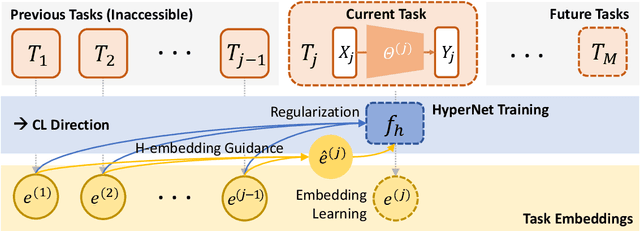
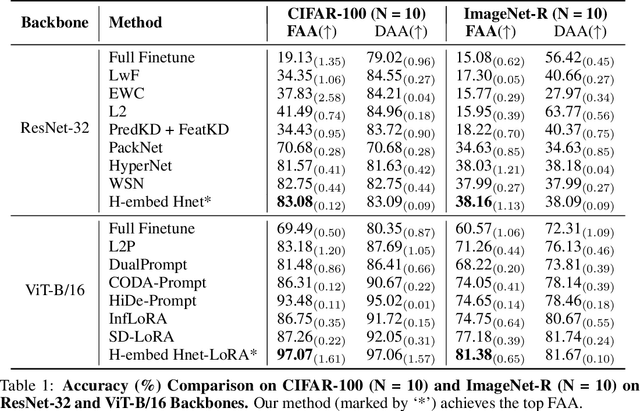
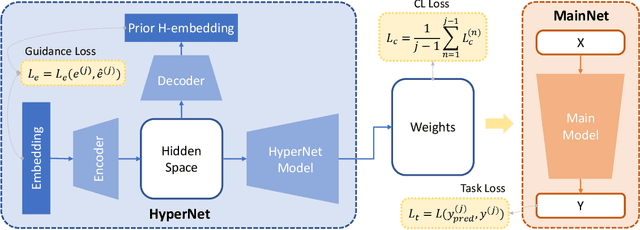
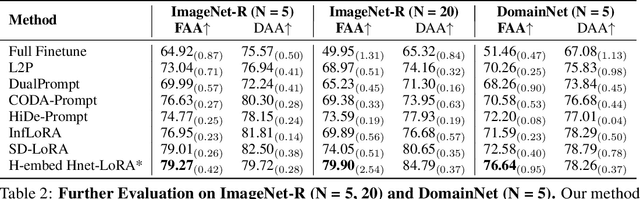
Continual learning (CL) has been an essential topic in the contemporary application of deep neural networks, where catastrophic forgetting (CF) can impede a model's ability to acquire knowledge progressively. Existing CL strategies primarily address CF by regularizing model updates or separating task-specific and shared components. However, these methods focus on task model elements while overlooking the potential of leveraging inter-task relationships for learning enhancement. To address this, we propose a transferability-aware task embedding named H-embedding and train a hypernet under its guidance to learn task-conditioned model weights for CL tasks. Particularly, H-embedding is introduced based on an information theoretical transferability measure and is designed to be online and easy to compute. The framework is also characterized by notable practicality, which only requires storing a low-dimensional task embedding for each task, and can be efficiently trained in an end-to-end way. Extensive evaluations and experimental analyses on datasets including Permuted MNIST, Cifar10/100, and ImageNet-R demonstrate that our framework performs prominently compared to various baseline methods, displaying great potential in exploiting intrinsic task relationships.
On the kernel learning problem
Feb 17, 2025The classical kernel ridge regression problem aims to find the best fit for the output $Y$ as a function of the input data $X\in \mathbb{R}^d$, with a fixed choice of regularization term imposed by a given choice of a reproducing kernel Hilbert space, such as a Sobolev space. Here we consider a generalization of the kernel ridge regression problem, by introducing an extra matrix parameter $U$, which aims to detect the scale parameters and the feature variables in the data, and thereby improve the efficiency of kernel ridge regression. This naturally leads to a nonlinear variational problem to optimize the choice of $U$. We study various foundational mathematical aspects of this variational problem, and in particular how this behaves in the presence of multiscale structures in the data.