 Add to Chrome
 Add to Firefox
 Add to Edge
S-Agent: Spatial Tool-Use Elicits Reasoning for Spatial Intelligence
Jun 18, 2026
Real-world spatial intelligence requires reasoning over a continuous and evolving 3D world, yet existing VLMs and tool-augmented agents largely remain tied to static, stateless inference from isolated visual observations. We introduce \textbf{\textsc{S-Agent}}, a spatial tool-use agentic paradigm for understanding and reasoning over continuous multi-view images and videos. By formulating spatial reasoning as spatio-temporal evidence accumulation rather than isolated frame-level prediction, \textsc{S-Agent} reshapes spatial perception into scene-centric understanding beyond frame-centric recognition. Specifically, \textsc{S-Agent} casts the VLM as a semantic planner that decides what evidence is needed, while a hierarchy of spatial tools and experts grounds objects in 2D, lifts them into 3D geometric evidence, and aggregates this evidence into high-level spatial knowledge (\textit{e.g.}, counting, measurement, orientation, and relative position). Additionally, a temporal memory mechanism, including Scene Memory for maintaining the evolving scene state and Agent Memory for accumulating reasoning context, enables evidence integration across frames and reasoning steps. Comprehensive experiments on multi-view and video spatial reasoning benchmarks show that \textsc{S-Agent} consistently improves both open-source and closed-source VLMs in a training-free manner. Beyond inference-time augmentation, supervised fine-tuning (SFT) on \textsc{S-Agent}-generated spatial trajectories \textsc{S-300K} yields \textsc{S-Agent-8B}, a compact spatial agent that significantly surpasses similar-scale baselines (e.g., Qwen3-VL-8B) and performs comparably to advanced closed-source models (e.g., GPT-5.4 and Gemini 3).

CompilerKV: Risk-Adaptive KV Compression via Offline Experience Compilation
Feb 09, 2026Large Language Models (LLMs) in long-context scenarios are severely constrained by the linear growth of Key-Value (KV) cache memory. Existing KV compression methods rely either on static thresholds and attention-only heuristics or on coarse memory budget allocation. Under tight memory budgets, these methods overlook two key factors: prompt-dependent variation in compression risk and functional heterogeneity across attention heads, which destabilize token selection and lead to tail failures. To address these challenges, we propose CompilerKV, a risk-adaptive and head-aware compression framework that compiles offline experience into reusable decision tables for prefill-only deployment. CompilerKV integrates two key synergistic components: (i) a Head Heterogeneity Table, learned via offline contextual bandits, which assigns head-specific reliability weights to govern functional differences across attention heads explicitly; and (ii) a Risk-Adaptive Threshold Gating mechanism that jointly models attention entropy and local perplexity, transforming prompt-level risk into deployable retention thresholds. Experiments on LongBench show CompilerKV dominates SOTA methods under a 512-token budget, recovering 97.7\% of FullKV performance while achieving up to +5.2 points gain over the strongest competitor.
ASCoT: An Adaptive Self-Correction Chain-of-Thought Method for Late-Stage Fragility in LLMs
Aug 07, 2025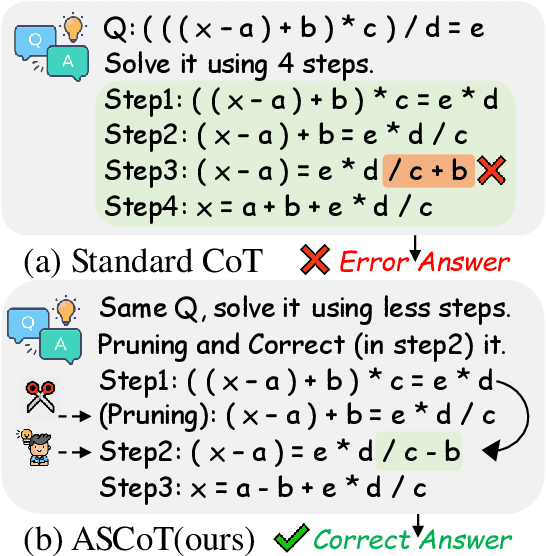
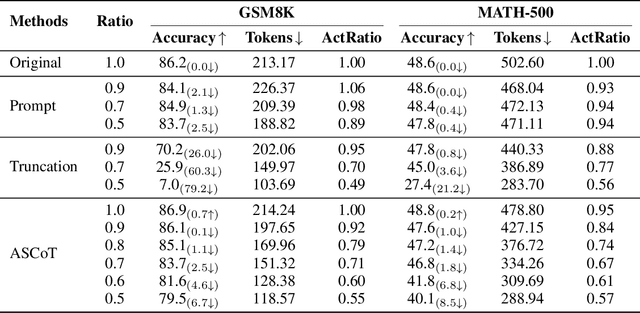
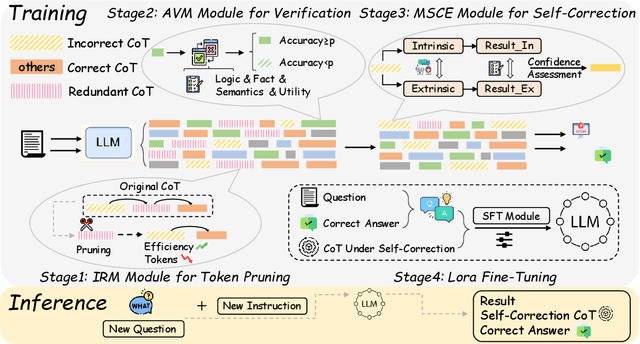
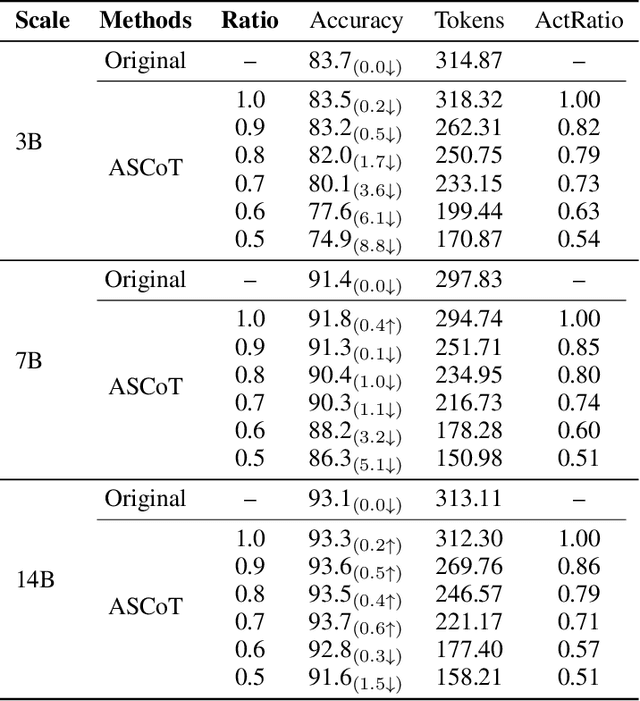
Chain-of-Thought (CoT) prompting has significantly advanced the reasoning capabilities of Large Language Models (LLMs), yet the reliability of these reasoning chains remains a critical challenge. A widely held "cascading failure" hypothesis suggests that errors are most detrimental when they occur early in the reasoning process. This paper challenges that assumption through systematic error-injection experiments, revealing a counter-intuitive phenomenon we term "Late-Stage Fragility": errors introduced in the later stages of a CoT chain are significantly more likely to corrupt the final answer than identical errors made at the beginning. To address this specific vulnerability, we introduce the Adaptive Self-Correction Chain-of-Thought (ASCoT) method. ASCoT employs a modular pipeline in which an Adaptive Verification Manager (AVM) operates first, followed by the Multi-Perspective Self-Correction Engine (MSCE). The AVM leverages a Positional Impact Score function I(k) that assigns different weights based on the position within the reasoning chains, addressing the Late-Stage Fragility issue by identifying and prioritizing high-risk, late-stage steps. Once these critical steps are identified, the MSCE applies robust, dual-path correction specifically to the failure parts. Extensive experiments on benchmarks such as GSM8K and MATH demonstrate that ASCoT achieves outstanding accuracy, outperforming strong baselines, including standard CoT. Our work underscores the importance of diagnosing specific failure modes in LLM reasoning and advocates for a shift from uniform verification strategies to adaptive, vulnerability-aware correction mechanisms.