 Add to Chrome
 Add to Firefox
 Add to Edge
Turbo: Informativity-Driven Acceleration Plug-In for Vision-Language Models
Dec 12, 2023
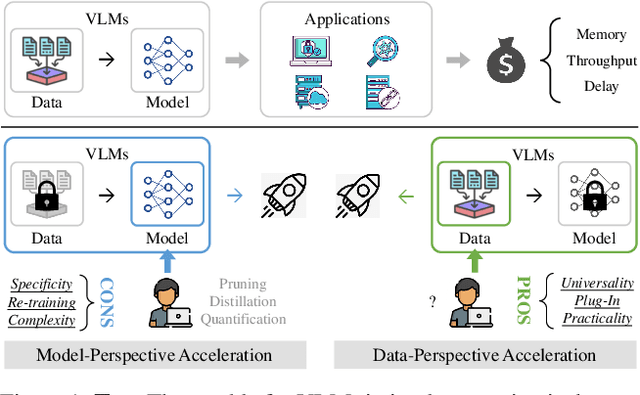
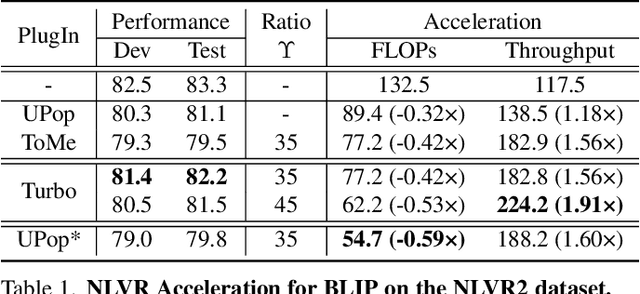

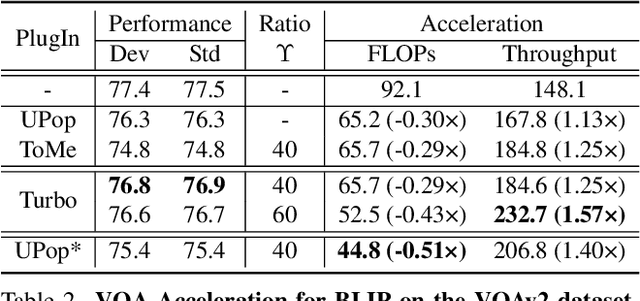
Vision-Language Large Models (VLMs) have become primary backbone of AI, due to the impressive performance. However, their expensive computation costs, i.e., throughput and delay, impede potentials in real-world scenarios. To achieve acceleration for VLMs, most existing methods focus on the model perspective: pruning, distillation, quantification, but completely overlook the data-perspective redundancy. To fill the overlook, this paper pioneers the severity of data redundancy, and designs one plug-and-play Turbo module guided by information degree to prune inefficient tokens from visual or textual data. In pursuit of efficiency-performance trade-offs, information degree takes two key factors into consideration: mutual redundancy and semantic value. Concretely, the former evaluates the data duplication between sequential tokens; while the latter evaluates each token by its contribution to the overall semantics. As a result, tokens with high information degree carry less redundancy and stronger semantics. For VLMs' calculation, Turbo works as a user-friendly plug-in that sorts data referring to information degree, utilizing only top-level ones to save costs. Its advantages are multifaceted, e.g., being generally compatible to various VLMs across understanding and generation, simple use without retraining and trivial engineering efforts. On multiple public VLMs benchmarks, we conduct extensive experiments to reveal the gratifying acceleration of Turbo, under negligible performance drop.

DiAD: A Diffusion-based Framework for Multi-class Anomaly Detection
Dec 11, 2023
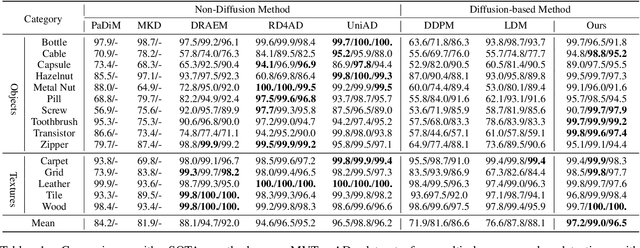
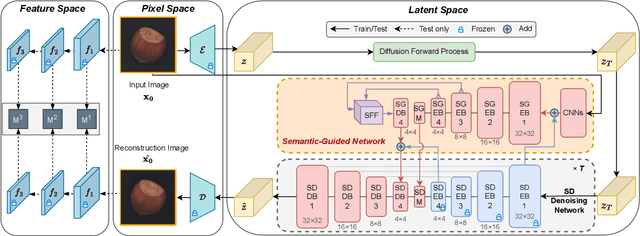
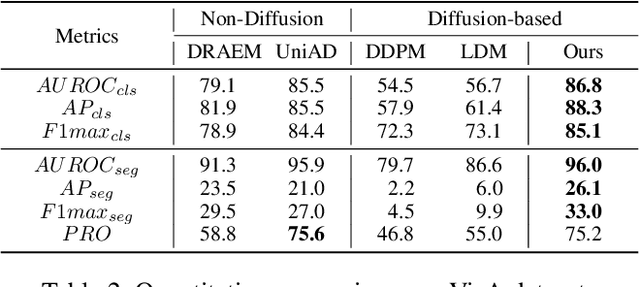
Reconstruction-based approaches have achieved remarkable outcomes in anomaly detection. The exceptional image reconstruction capabilities of recently popular diffusion models have sparked research efforts to utilize them for enhanced reconstruction of anomalous images. Nonetheless, these methods might face challenges related to the preservation of image categories and pixel-wise structural integrity in the more practical multi-class setting. To solve the above problems, we propose a Difusion-based Anomaly Detection (DiAD) framework for multi-class anomaly detection, which consists of a pixel-space autoencoder, a latent-space Semantic-Guided (SG) network with a connection to the stable diffusion's denoising network, and a feature-space pre-trained feature extractor. Firstly, The SG network is proposed for reconstructing anomalous regions while preserving the original image's semantic information. Secondly, we introduce Spatial-aware Feature Fusion (SFF) block to maximize reconstruction accuracy when dealing with extensively reconstructed areas. Thirdly, the input and reconstructed images are processed by a pre-trained feature extractor to generate anomaly maps based on features extracted at different scales. Experiments on MVTec-AD and VisA datasets demonstrate the effectiveness of our approach which surpasses the state-of-the-art methods, e.g., achieving 96.8/52.6 and 97.2/99.0 (AUROC/AP) for localization and detection respectively on multi-class MVTec-AD dataset. Code will be available at https://lewandofskee.github.io/projects/diad.
AnomalyDiffusion: Few-Shot Anomaly Image Generation with Diffusion Model
Dec 10, 2023Anomaly inspection plays an important role in industrial manufacture. Existing anomaly inspection methods are limited in their performance due to insufficient anomaly data. Although anomaly generation methods have been proposed to augment the anomaly data, they either suffer from poor generation authenticity or inaccurate alignment between the generated anomalies and masks. To address the above problems, we propose AnomalyDiffusion, a novel diffusion-based few-shot anomaly generation model, which utilizes the strong prior information of latent diffusion model learned from large-scale dataset to enhance the generation authenticity under few-shot training data. Firstly, we propose Spatial Anomaly Embedding, which consists of a learnable anomaly embedding and a spatial embedding encoded from an anomaly mask, disentangling the anomaly information into anomaly appearance and location information. Moreover, to improve the alignment between the generated anomalies and the anomaly masks, we introduce a novel Adaptive Attention Re-weighting Mechanism. Based on the disparities between the generated anomaly image and normal sample, it dynamically guides the model to focus more on the areas with less noticeable generated anomalies, enabling generation of accurately-matched anomalous image-mask pairs. Extensive experiments demonstrate that our model significantly outperforms the state-of-the-art methods in generation authenticity and diversity, and effectively improves the performance of downstream anomaly inspection tasks. The code and data are available in https://github.com/sjtuplayer/anomalydiffusion.
HOLD: Category-agnostic 3D Reconstruction of Interacting Hands and Objects from Video
Nov 30, 2023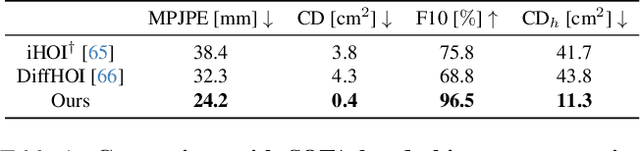

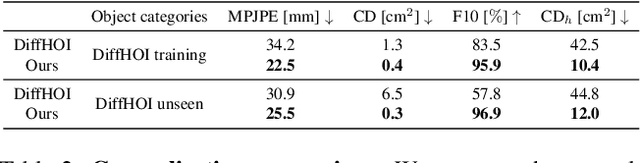
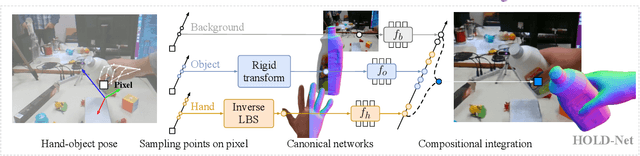
Since humans interact with diverse objects every day, the holistic 3D capture of these interactions is important to understand and model human behaviour. However, most existing methods for hand-object reconstruction from RGB either assume pre-scanned object templates or heavily rely on limited 3D hand-object data, restricting their ability to scale and generalize to more unconstrained interaction settings. To this end, we introduce HOLD -- the first category-agnostic method that reconstructs an articulated hand and object jointly from a monocular interaction video. We develop a compositional articulated implicit model that can reconstruct disentangled 3D hand and object from 2D images. We also further incorporate hand-object constraints to improve hand-object poses and consequently the reconstruction quality. Our method does not rely on 3D hand-object annotations while outperforming fully-supervised baselines in both in-the-lab and challenging in-the-wild settings. Moreover, we qualitatively show its robustness in reconstructing from in-the-wild videos. Code: https://github.com/zc-alexfan/hold
Enhancing Cross-domain Click-Through Rate Prediction via Explicit Feature Augmentation
Nov 30, 2023
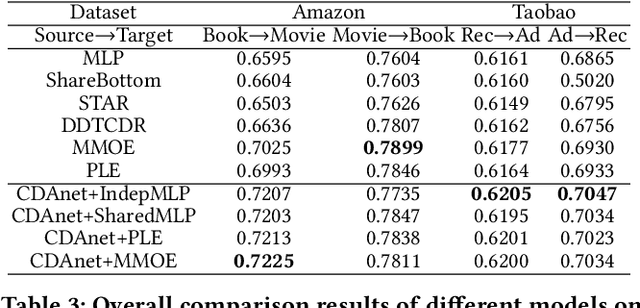
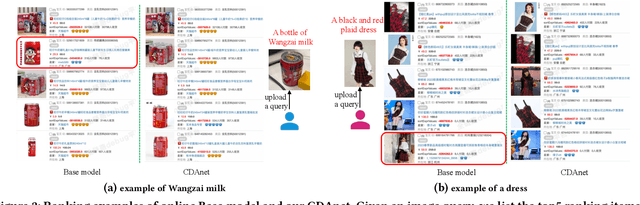

Cross-domain CTR (CDCTR) prediction is an important research topic that studies how to leverage meaningful data from a related domain to help CTR prediction in target domain. Most existing CDCTR works design implicit ways to transfer knowledge across domains such as parameter-sharing that regularizes the model training in target domain. More effectively, recent researchers propose explicit techniques to extract user interest knowledge and transfer this knowledge to target domain. However, the proposed method mainly faces two issues: 1) it usually requires a super domain, i.e. an extremely large source domain, to cover most users or items of target domain, and 2) the extracted user interest knowledge is static no matter what the context is in target domain. These limitations motivate us to develop a more flexible and efficient technique to explicitly transfer knowledge. In this work, we propose a cross-domain augmentation network (CDAnet) being able to perform explicit knowledge transfer between two domains. Specifically, CDAnet contains a designed translation network and an augmentation network which are trained sequentially. The translation network computes latent features from two domains and learns meaningful cross-domain knowledge of each input in target domain by using a designed cross-supervised feature translator. Later the augmentation network employs the explicit cross-domain knowledge as augmented information to boost the target domain CTR prediction. Through extensive experiments on two public benchmarks and one industrial production dataset, we show CDAnet can learn meaningful translated features and largely improve the performance of CTR prediction. CDAnet has been conducted online A/B test in image2product retrieval at Taobao app, bringing an absolute 0.11 point CTR improvement, a relative 0.64% deal growth and a relative 1.26% GMV increase.
On the View-and-Channel Aggregation Gain in Integrated Sensing and Edge AI
Nov 14, 2023Sensing and edge artificial intelligence (AI) are two key features of the sixth-generation (6G) mobile networks. Their natural integration, termed Integrated sensing and edge AI (ISEA), is envisioned to automate wide-ranging Internet-of-Tings (IoT) applications. To achieve a high sensing accuracy, multi-view features are uploaded to an edge server for aggregation and inference using an AI model. The view aggregation is realized efficiently using over-the-air computing (AirComp), which also aggregates channels to suppress channel noise. At its nascent stage, ISEA still lacks a characterization of the fundamental performance gains from view-and-channel aggregation, which motivates this work. Our framework leverages a well-established distribution model of multi-view sensing data where the classic Gaussian-mixture model is modified by adding sub-spaces matrices to represent individual sensor observation perspectives. Based on the model, we study the End-to-End sensing (inference) uncertainty, a popular measure of inference accuracy, of the said ISEA system by a novel approach involving designing a scaling-tight uncertainty surrogate function, global discriminant gain, distribution of receive Signal-to-Noise Ratio (SNR), and channel induced discriminant loss. We prove that the E2E sensing uncertainty diminishes at an exponential rate as the number of views/sensors grows, where the rate is proportional to global discriminant gain. Given channel distortion, we further show that the exponential scaling remains with a reduced decay rate related to the channel induced discriminant loss. Furthermore, we benchmark AirComp against equally fast, traditional analog orthogonal access, which reveals a sensing-accuracy crossing point between the schemes, leading to the proposal of adaptive access-mode switching. Last, the insights from our framework are validated by experiments using real-world dataset.
Don't Make Your LLM an Evaluation Benchmark Cheater
Nov 03, 2023Large language models~(LLMs) have greatly advanced the frontiers of artificial intelligence, attaining remarkable improvement in model capacity. To assess the model performance, a typical approach is to construct evaluation benchmarks for measuring the ability level of LLMs in different aspects. Despite that a number of high-quality benchmarks have been released, the concerns about the appropriate use of these benchmarks and the fair comparison of different models are increasingly growing. Considering these concerns, in this paper, we discuss the potential risk and impact of inappropriately using evaluation benchmarks and misleadingly interpreting the evaluation results. Specially, we focus on a special issue that would lead to inappropriate evaluation, \ie \emph{benchmark leakage}, referring that the data related to evaluation sets is occasionally used for model training. This phenomenon now becomes more common since pre-training data is often prepared ahead of model test. We conduct extensive experiments to study the effect of benchmark leverage, and find that it can dramatically boost the evaluation results, which would finally lead to an unreliable assessment of model performance. To improve the use of existing evaluation benchmarks, we finally present several guidelines for both LLM developers and benchmark maintainers. We hope this work can draw attention to appropriate training and evaluation of LLMs.
Joint Localization and Communication Enhancement in Uplink Integrated Sensing and Communications System with Clock Asynchronism
Oct 28, 2023


In this paper, we propose a joint single-base localization and communication enhancement scheme for the uplink (UL) integrated sensing and communications (ISAC) system with asynchronism, which can achieve accurate single-base localization of user equipment (UE) and significantly improve the communication reliability despite the existence of timing offset (TO) due to the clock asynchronism between UE and base station (BS). Our proposed scheme integrates the CSI enhancement into the multiple signal classification (MUSIC)-based AoA estimation and thus imposes no extra complexity on the ISAC system. We further exploit a MUSIC-based range estimation method and prove that it can suppress the time-varying TO-related phase terms. Exploiting the AoA and range estimation of UE, we can estimate the location of UE. Finally, we propose a joint CSI and data signals-based localization scheme that can coherently exploit the data and the CSI signals to improve the AoA and range estimation, which further enhances the single-base localization of UE. The extensive simulation results show that the enhanced CSI can achieve equivalent bit error rate performance to the minimum mean square error (MMSE) CSI estimator. The proposed joint CSI and data signals-based localization scheme can achieve decimeter-level localization accuracy despite the existing clock asynchronism and improve the localization mean square error (MSE) by about 8 dB compared with the maximum likelihood (ML)-based benchmark method.
DYNAMITE: Dynamic Interplay of Mini-Batch Size and Aggregation Frequency for Federated Learning with Static and Streaming Dataset
Oct 20, 2023Federated Learning (FL) is a distributed learning paradigm that can coordinate heterogeneous edge devices to perform model training without sharing private data. While prior works have focused on analyzing FL convergence with respect to hyperparameters like batch size and aggregation frequency, the joint effects of adjusting these parameters on model performance, training time, and resource consumption have been overlooked, especially when facing dynamic data streams and network characteristics. This paper introduces novel analytical models and optimization algorithms that leverage the interplay between batch size and aggregation frequency to navigate the trade-offs among convergence, cost, and completion time for dynamic FL training. We establish a new convergence bound for training error considering heterogeneous datasets across devices and derive closed-form solutions for co-optimized batch size and aggregation frequency that are consistent across all devices. Additionally, we design an efficient algorithm for assigning different batch configurations across devices, improving model accuracy and addressing the heterogeneity of both data and system characteristics. Further, we propose an adaptive control algorithm that dynamically estimates network states, efficiently samples appropriate data batches, and effectively adjusts batch sizes and aggregation frequency on the fly. Extensive experiments demonstrate the superiority of our offline optimal solutions and online adaptive algorithm.
TRANSOM: An Efficient Fault-Tolerant System for Training LLMs
Oct 18, 2023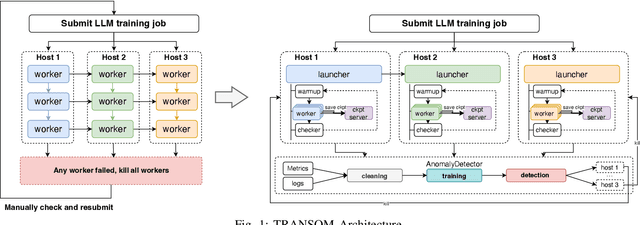
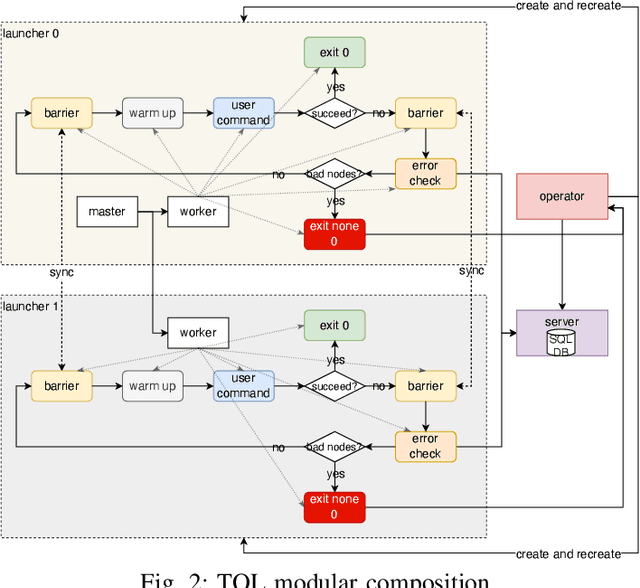
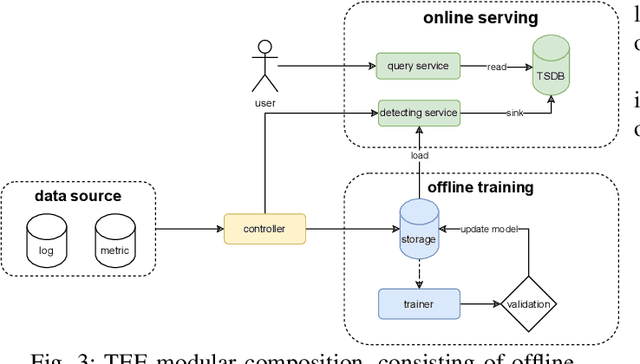
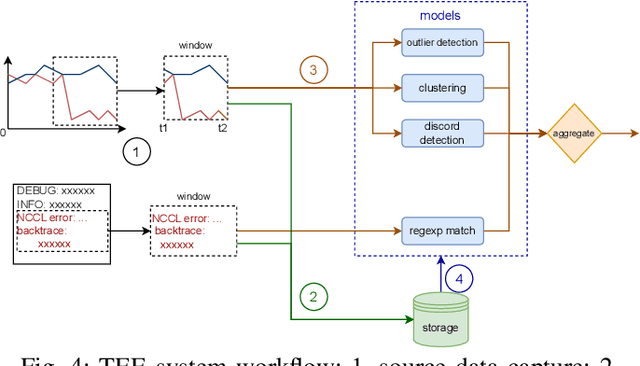
Large language models (LLMs) with hundreds of billions or trillions of parameters, represented by chatGPT, have achieved profound impact on various fields. However, training LLMs with super-large-scale parameters requires large high-performance GPU clusters and long training periods lasting for months. Due to the inevitable hardware and software failures in large-scale clusters, maintaining uninterrupted and long-duration training is extremely challenging. As a result, A substantial amount of training time is devoted to task checkpoint saving and loading, task rescheduling and restart, and task manual anomaly checks, which greatly harms the overall training efficiency. To address these issues, we propose TRANSOM, a novel fault-tolerant LLM training system. In this work, we design three key subsystems: the training pipeline automatic fault tolerance and recovery mechanism named Transom Operator and Launcher (TOL), the training task multi-dimensional metric automatic anomaly detection system named Transom Eagle Eye (TEE), and the training checkpoint asynchronous access automatic fault tolerance and recovery technology named Transom Checkpoint Engine (TCE). Here, TOL manages the lifecycle of training tasks, while TEE is responsible for task monitoring and anomaly reporting. TEE detects training anomalies and reports them to TOL, who automatically enters the fault tolerance strategy to eliminate abnormal nodes and restart the training task. And the asynchronous checkpoint saving and loading functionality provided by TCE greatly shorten the fault tolerance overhead. The experimental results indicate that TRANSOM significantly enhances the efficiency of large-scale LLM training on clusters. Specifically, the pre-training time for GPT3-175B has been reduced by 28%, while checkpoint saving and loading performance have improved by a factor of 20.