 Add to Chrome
 Add to Firefox
 Add to Edge
ADWIN: Adaptive Windows for Horizon-Aware On-Policy Distillation
May 27, 2026
On-policy distillation (OPD) transfers reasoning behavior by training a student on teacher feedback along student-generated trajectories, but standard full-rollout training ties every update to a costly completion and can over-allocate supervision to late positions with low marginal value for the current student. We revisit this assumption through the useful supervision horizon: student-induced rollouts can drift from teacher-preferred continuations, while aligned prefixes may already preserve the long-horizon OPD update direction. We propose ADWIN, an adaptive-window framework for OPD that treats rollout length as an online admissibility decision, training on short teacher-anchored prefixes while using delayed full-rollout probes to audit prefix--full alignment and adapt the next horizon with staleness control. Across math and code reasoning benchmarks in single-task, multi-task, and strong-to-weak settings, ADWIN improves the accuracy--compute trade-off over full-rollout OPD and prefix-based baselines, reducing end-to-end training cost by up to 4.1 times while achieving comparable or better accuracy.

RLVR Datasets and Where to Find Them: Tracing Data Lineage for Better Training Data
May 26, 2026The proliferation of Reinforcement Learning from Verifiable Rewards (RLVR) datasets has exacerbated provenance collapse due to unclear lineage among existing datasets. To bridge this fragmented RLVR data landscape, we propose Atomic-source Tracing via Lineage-Aware Search (ATLAS), a systematic framework for tracing RLVR datasets back to their atomic sources, attributing over 99.7% of 1.45M instances to 20 atomic sources. Our analysis reveals that most RLVR datasets are variants of a small set of shared upstream sources, with few introducing genuinely new data, and many facing data contamination risks. These findings naturally motivate us to curate a new RLVR dataset, DAPO++, and to benchmark existing datasets from a lineage-aware perspective. To this end, we propose Source-level Counterfactual Attribution (SCA) as a guiding principle to curate a decontaminated training dataset with concentrated learning signals. Essentially, SCA measures a sample's marginal utility by comparing per-atomic-source RL checkpoints against a shared base model. Building upon these attribution signals, we further design a composite dataset quality score Q that strongly correlates with downstream RLVR performance. Experiments on Qwen3 series models verify that DAPO++ consistently improves performance on held-out benchmarks, while Q reliably predicts downstream RLVR training effectiveness. Our code and data is available at https://github.com/Celine-hxy/ATLAS.
Learning to Foresee: Unveiling the Unlocking Efficiency of On-Policy Distillation
May 13, 2026On-policy distillation (OPD) has emerged as an efficient post-training paradigm for large language models. However, existing studies largely attribute this advantage to denser and more stable supervision, while the parameter-level mechanisms underlying OPD's efficiency remain poorly understood. In this work, we argue that OPD's efficiency stems from a form of ``foresight'': it establishes a stable update trajectory toward the final model early in training. This foresight manifests in two aspects. First, at the \textbf{Module-Allocation Level}, OPD identifies regions with low marginal utility and concentrates updates on modules that are more critical to reasoning. Second, at the \textbf{Update-Direction Level}, OPD exhibits stronger low-rank concentration, with its dominant subspaces aligning closely with the final update subspace early in training. Building on these findings, we propose \textbf{EffOPD}, a plug-and-play acceleration method that speeds up OPD by adaptively selecting an extrapolation step size and moving along the current update direction. EffOPD requires no additional trainable modules or complex hyperparameter tuning, and achieves an average training acceleration of $3\times$ while maintaining comparable final performance. Overall, our findings provide a parameter-dynamics perspective for understanding the efficiency of OPD and offer practical insights for designing more efficient post-training methods for large language models.
Listwise Policy Optimization: Group-based RLVR as Target-Projection on the LLM Response Simplex
May 07, 2026Reinforcement learning with verifiable rewards (RLVR) has become a standard approach for large language models (LLMs) post-training to incentivize reasoning capacity. Among existing recipes, group-based policy gradient is prevalent, which samples a group of responses per prompt and updates the policy via group-relative advantage signals. This work reveals that these optimization strategies share a common geometric structure: each implicitly defines a target distribution on the response simplex and projects toward it via first-order approximation. Building on this insight, we propose Listwise Policy Optimization (LPO) to explicitly conduct the target-projection, which demystifies the implicit target by restricting the proximal RL objective to the response simplex, and then projects the policy via exact divergence minimization. This framework provides (i) monotonic improvement on the listwise objective with bounded, zero-sum, and self-correcting projection gradients, and (ii) flexibility in divergence selection with distinct structural properties through the decoupled projection step. On diverse reasoning tasks and LLM backbones, LPO consistently improves training performance over typical policy gradient baselines under matched targets, while intrinsically preserving optimization stability and response diversity.
Tool Learning Needs Nothing More Than a Free 8B Language Model
Apr 20, 2026Reinforcement learning (RL) has become a prevalent paradigm for training tool calling agents, which typically requires online interactive environments. Existing approaches either rely on training data with ground truth annotations or require advanced commercial language models (LMs) to synthesize environments that keep fixed once created. In this work, we propose TRUSTEE, a data-free method training tool calling agents with dynamic environments fully simulated by free open-source LMs that can be as small as 8B, including task generation, user simulation, tool simulation and trajectory evaluation, paired with an adaptive curriculum learning mechanism that controls various aspects of the task difficulty dynamically during training. Our empirical results show that TRUSTEE brings consistent improvements across various domains and outperforms all the baselines which require extra external resources for training. These confirm that, with a sufficiently sophisticated design, even simulated environments with a local 8B LM as the backbone could set a strong baseline for tool learning, without expensive annotated data, realistic human interactions, executable tools or costly verifiable environments from human experts or commercial LMs. We hope our proposed paradigm could inspire future research on environment scaling with limited resources.
Learning beyond Teacher: Generalized On-Policy Distillation with Reward Extrapolation
Feb 12, 2026On-policy distillation (OPD), which aligns the student with the teacher's logit distribution on student-generated trajectories, has demonstrated strong empirical gains in improving student performance and often outperforms off-policy distillation and reinforcement learning (RL) paradigms. In this work, we first theoretically show that OPD is a special case of dense KL-constrained RL where the reward function and the KL regularization are always weighted equally and the reference model can by any model. Then, we propose the Generalized On-Policy Distillation (G-OPD) framework, which extends the standard OPD objective by introducing a flexible reference model and a reward scaling factor that controls the relative weight of the reward term against the KL regularization. Through comprehensive experiments on math reasoning and code generation tasks, we derive two novel insights: (1) Setting the reward scaling factor to be greater than 1 (i.e., reward extrapolation), which we term ExOPD, consistently improves over standard OPD across a range of teacher-student size pairings. In particular, in the setting where we merge the knowledge from different domain experts, obtained by applying domain-specific RL to the same student model, back into the original student, ExOPD enables the student to even surpass the teacher's performance boundary and outperform the domain teachers. (2) Building on ExOPD, we further find that in the strong-to-weak distillation setting (i.e., distilling a smaller student from a larger teacher), performing reward correction by choosing the reference model as the teacher's base model before RL yields a more accurate reward signal and further improves distillation performance. However, this choice assumes access to the teacher's pre-RL variant and incurs more computational overhead. We hope our work offers new insights for future research on OPD.
Composition-RL: Compose Your Verifiable Prompts for Reinforcement Learning of Large Language Models
Feb 12, 2026Large-scale verifiable prompts underpin the success of Reinforcement Learning with Verifiable Rewards (RLVR), but they contain many uninformative examples and are costly to expand further. Recent studies focus on better exploiting limited training data by prioritizing hard prompts whose rollout pass rate is 0. However, easy prompts with a pass rate of 1 also become increasingly prevalent as training progresses, thereby reducing the effective data size. To mitigate this, we propose Composition-RL, a simple yet useful approach for better utilizing limited verifiable prompts targeting pass-rate-1 prompts. More specifically, Composition-RL automatically composes multiple problems into a new verifiable question and uses these compositional prompts for RL training. Extensive experiments across model sizes from 4B to 30B show that Composition-RL consistently improves reasoning capability over RL trained on the original dataset. Performance can be further boosted with a curriculum variant of Composition-RL that gradually increases compositional depth over training. Additionally, Composition-RL enables more effective cross-domain RL by composing prompts drawn from different domains. Codes, datasets, and models are available at https://github.com/XinXU-USTC/Composition-RL.
Small Generalizable Prompt Predictive Models Can Steer Efficient RL Post-Training of Large Reasoning Models
Feb 02, 2026Reinforcement learning enhances the reasoning capabilities of large language models but often involves high computational costs due to rollout-intensive optimization. Online prompt selection presents a plausible solution by prioritizing informative prompts to improve training efficiency. However, current methods either depend on costly, exact evaluations or construct prompt-specific predictive models lacking generalization across prompts. This study introduces Generalizable Predictive Prompt Selection (GPS), which performs Bayesian inference towards prompt difficulty using a lightweight generative model trained on the shared optimization history. Intermediate-difficulty prioritization and history-anchored diversity are incorporated into the batch acquisition principle to select informative prompt batches. The small predictive model also generalizes at test-time for efficient computational allocation. Experiments across varied reasoning benchmarks indicate GPS's substantial improvements in training efficiency, final performance, and test-time efficiency over superior baseline methods.
ORBIT: On-policy Exploration-Exploitation for Controllable Multi-Budget Reasoning
Jan 13, 2026Recent Large Reasoning Models (LRMs) achieve strong performance by leveraging long-form Chain-of-Thought (CoT) reasoning, but uniformly applying overlong reasoning at inference time incurs substantial and often unnecessary computational cost. To address this, prior work explores various strategies to infer an appropriate reasoning budget from the input. However, such approaches are unreliable in the worst case, as estimating the minimal required reasoning effort is fundamentally difficult, and they implicitly fix the trade-off between reasoning cost and accuracy during training, limiting flexibility under varying deployment scenarios. Motivated by these limitations, we propose ORBIT, a controllable multi-budget reasoning framework with well-separated reasoning modes triggered by input. ORBIT employs multi-stage reinforcement learning to discover Pareto-optimal reasoning behaviors at each effort, followed by on-policy distillation to fuse these behaviors into a single unified model. Experiments show that ORBIT achieves (1) controllable reasoning behavior over multiple modes, (2) competitive reasoning density within each mode, and (3) integration of these frontier policies into a single unified student model while preserving clear mode separation and high per-mode performance.
VI-MMRec: Similarity-Aware Training Cost-free Virtual User-Item Interactions for Multimodal Recommendation
Dec 09, 2025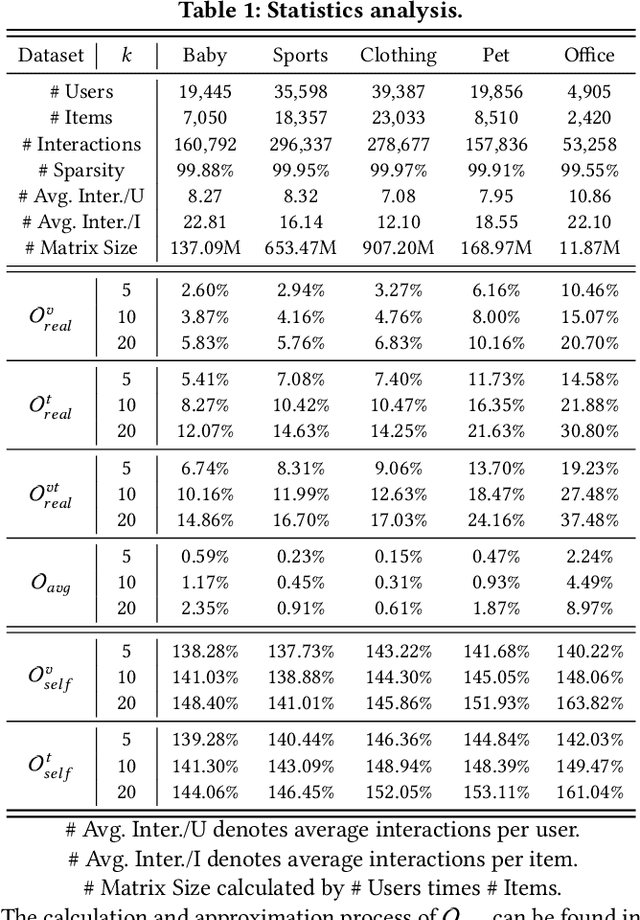
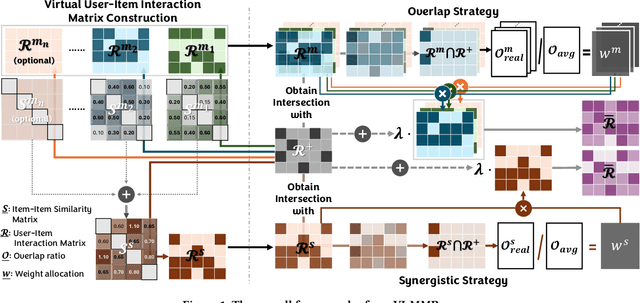
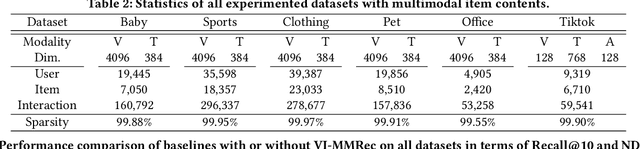
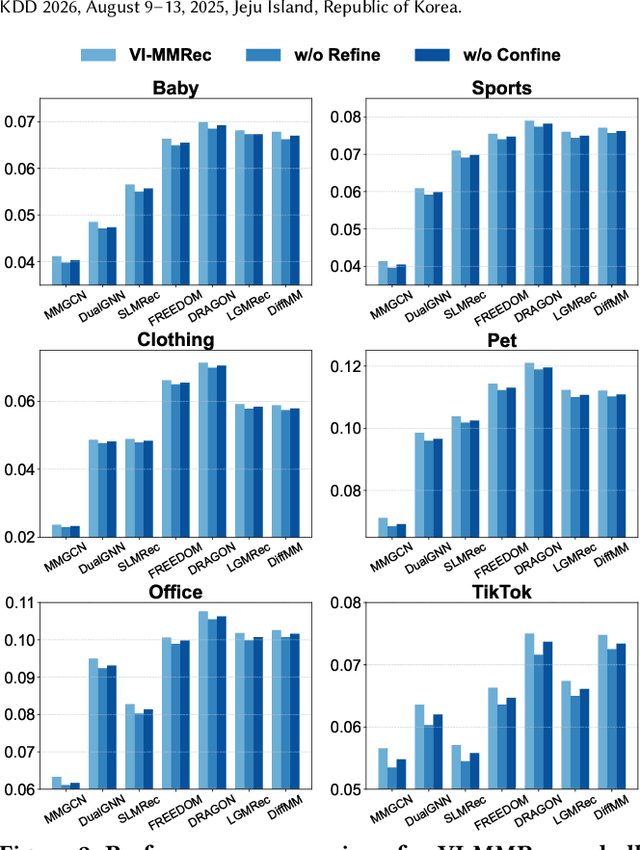
Although existing multimodal recommendation models have shown promising performance, their effectiveness continues to be limited by the pervasive data sparsity problem. This problem arises because users typically interact with only a small subset of available items, leading existing models to arbitrarily treat unobserved items as negative samples. To this end, we propose VI-MMRec, a model-agnostic and training cost-free framework that enriches sparse user-item interactions via similarity-aware virtual user-item interactions. These virtual interactions are constructed based on modality-specific feature similarities of user-interacted items. Specifically, VI-MMRec introduces two different strategies: (1) Overlay, which independently aggregates modality-specific similarities to preserve modality-specific user preferences, and (2) Synergistic, which holistically fuses cross-modal similarities to capture complementary user preferences. To ensure high-quality augmentation, we design a statistically informed weight allocation mechanism that adaptively assigns weights to virtual user-item interactions based on dataset-specific modality relevance. As a plug-and-play framework, VI-MMRec seamlessly integrates with existing models to enhance their performance without modifying their core architecture. Its flexibility allows it to be easily incorporated into various existing models, maximizing performance with minimal implementation effort. Moreover, VI-MMRec introduces no additional overhead during training, making it significantly advantageous for practical deployment. Comprehensive experiments conducted on six real-world datasets using seven state-of-the-art multimodal recommendation models validate the effectiveness of our VI-MMRec.