 Add to Chrome
 Add to Firefox
 Add to Edge
Infini Memory: Maintainable Topic Documents for Long-Term LLM Agent Memory
Jun 09, 2026
Long-term LLM agents need persistent memory that can track changing facts and provide relevant evidence across sessions. Existing memory systems often store observations as isolated records, summaries, or indexed fragments, which makes evidence aggregation, fact revision, and memory maintenance difficult. We propose Infini Memory, a maintainable text-based persistent memory architecture that treats agent memory as topic-structured documents. Each topic document serves as a semantic unit for collecting related evidence, preserving metadata, and revising facts over time. New observations are first staged in a buffer and periodically consolidated into coherent textual contexts. At inference time, an agentic retrieval procedure lets the LLM read memory through iterative tool calls rather than a single retrieval step. On MemoryAgentBench, Infini Memory achieves 64.7% overall score. Ablations show that topic-structured maintenance and iterative evidence inspection improve complementary aspects of long-term memory use.

BitSnap: Checkpoint Sparsification and Quantization in LLM Training
Nov 18, 2025As large language models (LLMs) continue to grow in size and complexity, efficient checkpoint saving\&loading has become crucial for managing storage, memory usage, and fault tolerance in LLM training. The current works do not comprehensively take into account the optimization of these several aspects. This paper proposes a novel checkpoint sparsification and quantization method that adapts dynamically to different training stages and model architectures. We present a comprehensive analysis of existing lossy and lossless compression techniques, identify current limitations, and introduce our adaptive approach that balances compression ratio, speed, and precision impact throughout the training process. Experiments on different sizes of LLMs demonstrate that our bitmask-based sparsification method achieves 16x compression ratio without compromising model accuracy. Additionally, the cluster-based quantization method achieves 2x compression ratio with little precision loss.
TRANSOM: An Efficient Fault-Tolerant System for Training LLMs
Oct 18, 2023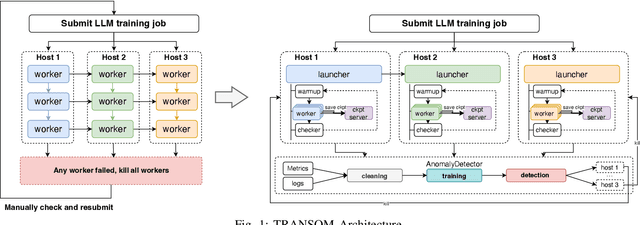
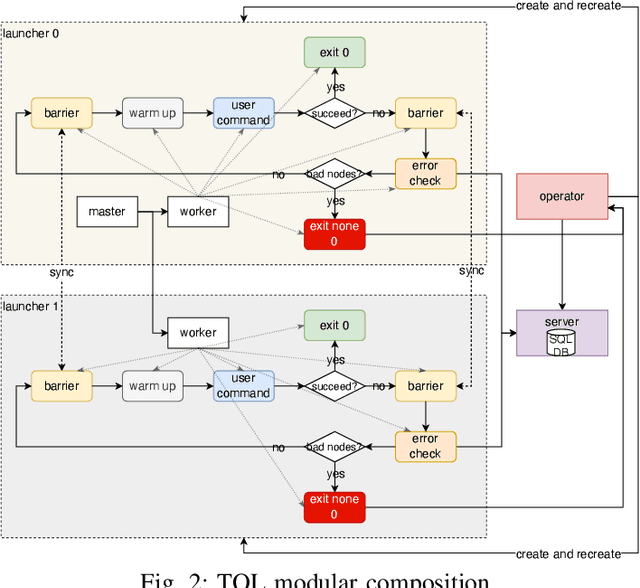
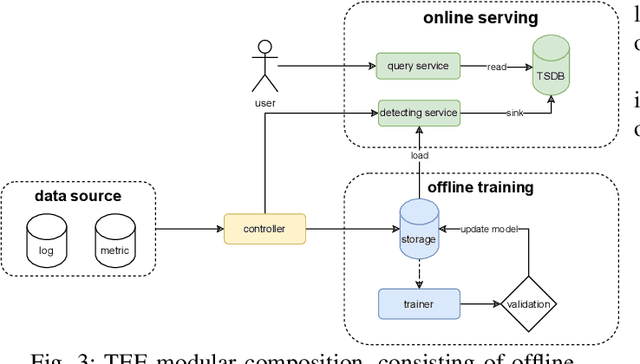
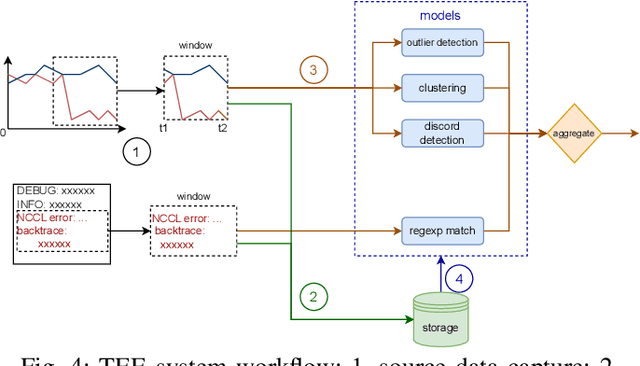
Large language models (LLMs) with hundreds of billions or trillions of parameters, represented by chatGPT, have achieved profound impact on various fields. However, training LLMs with super-large-scale parameters requires large high-performance GPU clusters and long training periods lasting for months. Due to the inevitable hardware and software failures in large-scale clusters, maintaining uninterrupted and long-duration training is extremely challenging. As a result, A substantial amount of training time is devoted to task checkpoint saving and loading, task rescheduling and restart, and task manual anomaly checks, which greatly harms the overall training efficiency. To address these issues, we propose TRANSOM, a novel fault-tolerant LLM training system. In this work, we design three key subsystems: the training pipeline automatic fault tolerance and recovery mechanism named Transom Operator and Launcher (TOL), the training task multi-dimensional metric automatic anomaly detection system named Transom Eagle Eye (TEE), and the training checkpoint asynchronous access automatic fault tolerance and recovery technology named Transom Checkpoint Engine (TCE). Here, TOL manages the lifecycle of training tasks, while TEE is responsible for task monitoring and anomaly reporting. TEE detects training anomalies and reports them to TOL, who automatically enters the fault tolerance strategy to eliminate abnormal nodes and restart the training task. And the asynchronous checkpoint saving and loading functionality provided by TCE greatly shorten the fault tolerance overhead. The experimental results indicate that TRANSOM significantly enhances the efficiency of large-scale LLM training on clusters. Specifically, the pre-training time for GPT3-175B has been reduced by 28%, while checkpoint saving and loading performance have improved by a factor of 20.