 Add to Chrome
 Add to Firefox
 Add to Edge
Self-Discover: Large Language Models Self-Compose Reasoning Structures
Feb 06, 2024

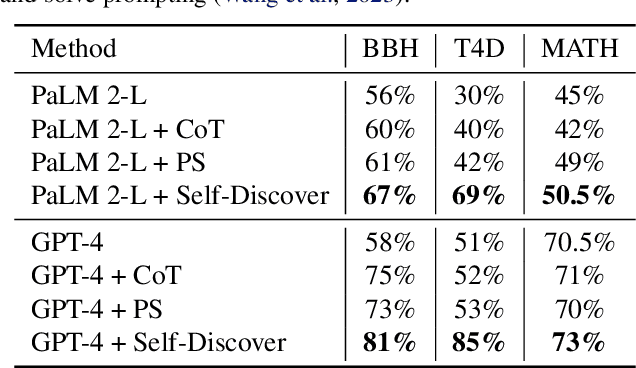


We introduce SELF-DISCOVER, a general framework for LLMs to self-discover the task-intrinsic reasoning structures to tackle complex reasoning problems that are challenging for typical prompting methods. Core to the framework is a self-discovery process where LLMs select multiple atomic reasoning modules such as critical thinking and step-by-step thinking, and compose them into an explicit reasoning structure for LLMs to follow during decoding. SELF-DISCOVER substantially improves GPT-4 and PaLM 2's performance on challenging reasoning benchmarks such as BigBench-Hard, grounded agent reasoning, and MATH, by as much as 32% compared to Chain of Thought (CoT). Furthermore, SELF-DISCOVER outperforms inference-intensive methods such as CoT-Self-Consistency by more than 20%, while requiring 10-40x fewer inference compute. Finally, we show that the self-discovered reasoning structures are universally applicable across model families: from PaLM 2-L to GPT-4, and from GPT-4 to Llama2, and share commonalities with human reasoning patterns.

Chain of Code: Reasoning with a Language Model-Augmented Code Emulator
Dec 08, 2023


Code provides a general syntactic structure to build complex programs and perform precise computations when paired with a code interpreter - we hypothesize that language models (LMs) can leverage code-writing to improve Chain of Thought reasoning not only for logic and arithmetic tasks, but also for semantic ones (and in particular, those that are a mix of both). For example, consider prompting an LM to write code that counts the number of times it detects sarcasm in an essay: the LM may struggle to write an implementation for "detect_sarcasm(string)" that can be executed by the interpreter (handling the edge cases would be insurmountable). However, LMs may still produce a valid solution if they not only write code, but also selectively "emulate" the interpreter by generating the expected output of "detect_sarcasm(string)" and other lines of code that cannot be executed. In this work, we propose Chain of Code (CoC), a simple yet surprisingly effective extension that improves LM code-driven reasoning. The key idea is to encourage LMs to format semantic sub-tasks in a program as flexible pseudocode that the interpreter can explicitly catch undefined behaviors and hand off to simulate with an LM (as an "LMulator"). Experiments demonstrate that Chain of Code outperforms Chain of Thought and other baselines across a variety of benchmarks; on BIG-Bench Hard, Chain of Code achieves 84%, a gain of 12% over Chain of Thought. CoC scales well with large and small models alike, and broadens the scope of reasoning questions that LMs can correctly answer by "thinking in code". Project webpage: https://chain-of-code.github.io.
Universal Self-Consistency for Large Language Model Generation
Nov 29, 2023
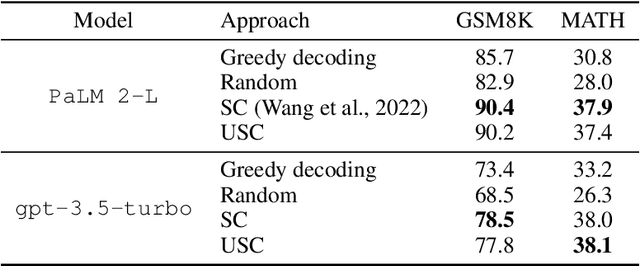


Self-consistency with chain-of-thought prompting (CoT) has demonstrated remarkable performance gains on various challenging tasks, by utilizing multiple reasoning paths sampled from large language models (LLMs). However, self-consistency relies on the answer extraction process to aggregate multiple solutions, which is not applicable to free-form answers. In this work, we propose Universal Self-Consistency (USC), which leverages LLMs themselves to select the most consistent answer among multiple candidates. We evaluate USC on a variety of benchmarks, including mathematical reasoning, code generation, long-context summarization, and open-ended question answering. On open-ended generation tasks where the original self-consistency method is not applicable, USC effectively utilizes multiple samples and improves the performance. For mathematical reasoning, USC matches the standard self-consistency performance without requiring the answer formats to be similar. Finally, without access to execution results, USC also matches the execution-based voting performance on code generation.
Steady-State Analysis and Online Learning for Queues with Hawkes Arrivals
Nov 13, 2023We investigate the long-run behavior of single-server queues with Hawkes arrivals and general service distributions and related optimization problems. In detail, utilizing novel coupling techniques, we establish finite moment bounds for the stationary distribution of the workload and busy period processes. In addition, we are able to show that, those queueing processes converge exponentially fast to their stationary distribution. Based on these theoretic results, we develop an efficient numerical algorithm to solve the optimal staffing problem for the Hawkes queues in a data-driven manner. Numerical results indicate a sharp difference in staffing for Hawkes queues, compared to the classic GI/GI/1 model, especially in the heavy-traffic regime.
Large Language Models can Learn Rules
Oct 10, 2023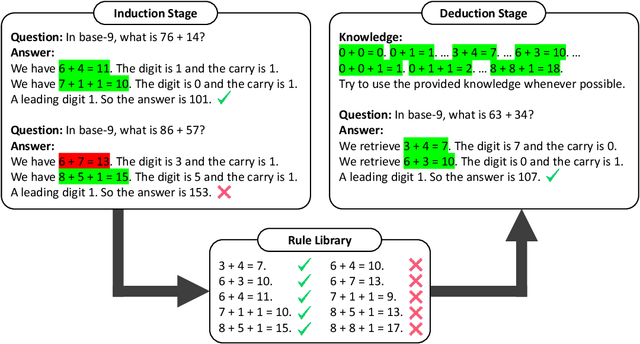
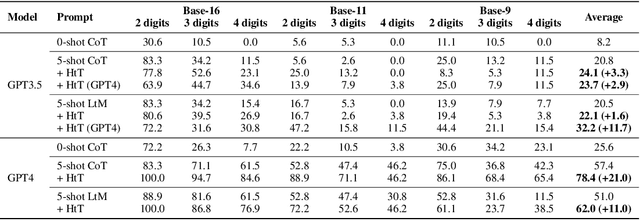
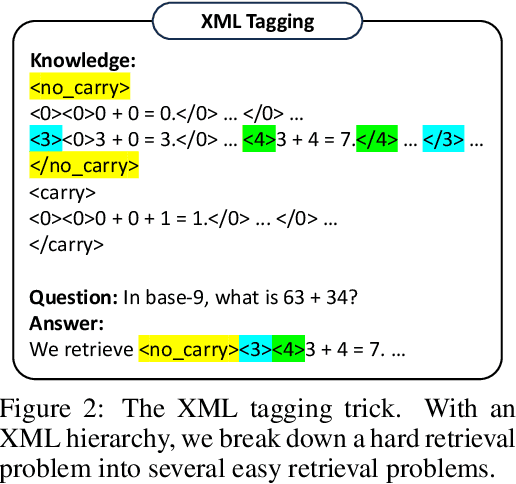
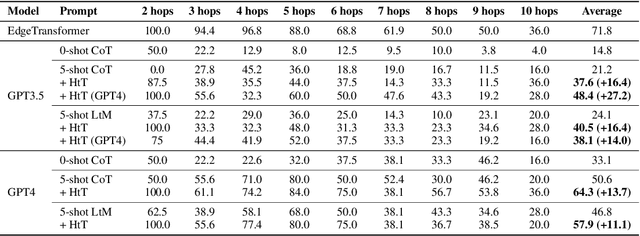
When prompted with a few examples and intermediate steps, large language models (LLMs) have demonstrated impressive performance in various reasoning tasks. However, prompting methods that rely on implicit knowledge in an LLM often hallucinate incorrect answers when the implicit knowledge is wrong or inconsistent with the task. To tackle this problem, we present Hypotheses-to-Theories (HtT), a framework that learns a rule library for reasoning with LLMs. HtT contains two stages, an induction stage and a deduction stage. In the induction stage, an LLM is first asked to generate and verify rules over a set of training examples. Rules that appear and lead to correct answers sufficiently often are collected to form a rule library. In the deduction stage, the LLM is then prompted to employ the learned rule library to perform reasoning to answer test questions. Experiments on both numerical reasoning and relational reasoning problems show that HtT improves existing prompting methods, with an absolute gain of 11-27% in accuracy. The learned rules are also transferable to different models and to different forms of the same problem.
Take a Step Back: Evoking Reasoning via Abstraction in Large Language Models
Oct 09, 2023We present Step-Back Prompting, a simple prompting technique that enables LLMs to do abstractions to derive high-level concepts and first principles from instances containing specific details. Using the concepts and principles to guide the reasoning steps, LLMs significantly improve their abilities in following a correct reasoning path towards the solution. We conduct experiments of Step-Back Prompting with PaLM-2L models and observe substantial performance gains on a wide range of challenging reasoning-intensive tasks including STEM, Knowledge QA, and Multi-Hop Reasoning. For instance, Step-Back Prompting improves PaLM-2L performance on MMLU Physics and Chemistry by 7% and 11%, TimeQA by 27%, and MuSiQue by 7%.
Large Language Models as Analogical Reasoners
Oct 07, 2023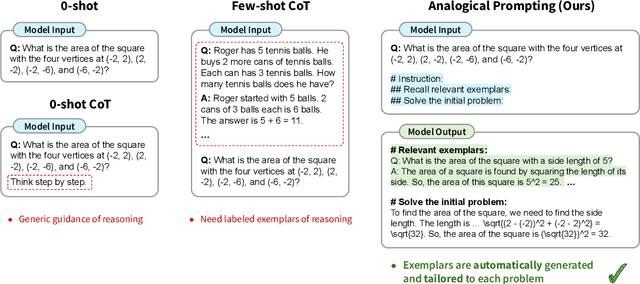
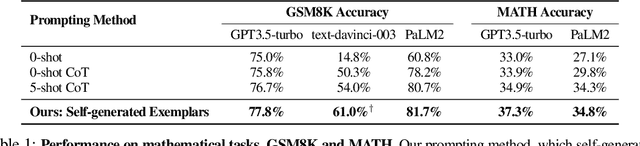
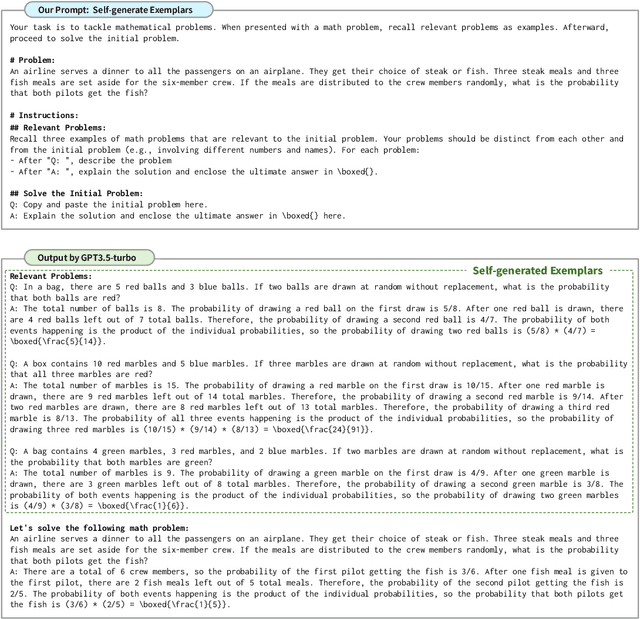
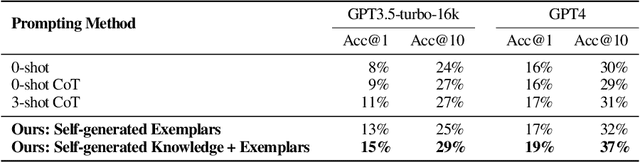
Chain-of-thought (CoT) prompting for language models demonstrates impressive performance across reasoning tasks, but typically needs labeled exemplars of the reasoning process. In this work, we introduce a new prompting approach, Analogical Prompting, designed to automatically guide the reasoning process of large language models. Inspired by analogical reasoning, a cognitive process in which humans draw from relevant past experiences to tackle new problems, our approach prompts language models to self-generate relevant exemplars or knowledge in the context, before proceeding to solve the given problem. This method presents several advantages: it obviates the need for labeling or retrieving exemplars, offering generality and convenience; it can also tailor the generated exemplars and knowledge to each problem, offering adaptability. Experimental results show that our approach outperforms 0-shot CoT and manual few-shot CoT in a variety of reasoning tasks, including math problem solving in GSM8K and MATH, code generation in Codeforces, and other reasoning tasks in BIG-Bench.
Large Language Models Cannot Self-Correct Reasoning Yet
Oct 03, 2023Large Language Models (LLMs) have emerged as a groundbreaking technology with their unparalleled text generation capabilities across various applications. Nevertheless, concerns persist regarding the accuracy and appropriateness of their generated content. A contemporary methodology, self-correction, has been proposed as a remedy to these issues. Building upon this premise, this paper critically examines the role and efficacy of self-correction within LLMs, shedding light on its true potential and limitations. Central to our investigation is the notion of intrinsic self-correction, whereby an LLM attempts to correct its initial responses based solely on its inherent capabilities, without the crutch of external feedback. In the context of reasoning, our research indicates that LLMs struggle to self-correct their responses without external feedback, and at times, their performance might even degrade post self-correction. Drawing from these insights, we offer suggestions for future research and practical applications in this field.
Large Language Models as Optimizers
Sep 07, 2023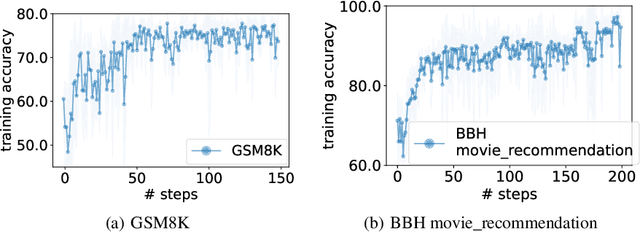
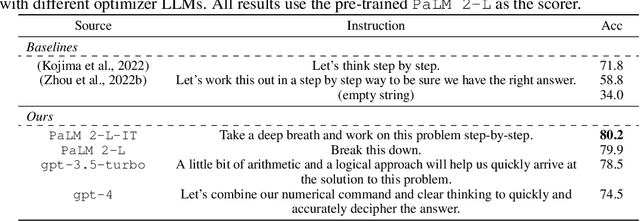
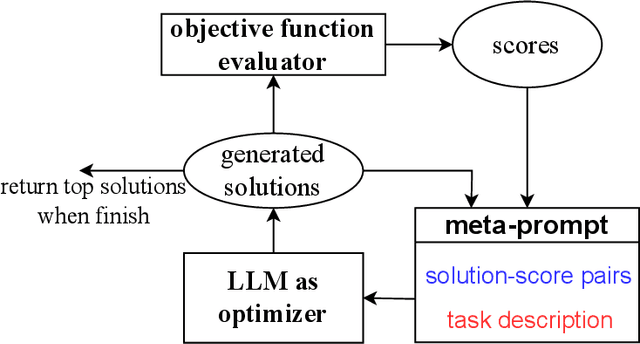
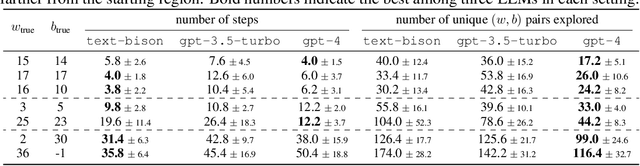
Optimization is ubiquitous. While derivative-based algorithms have been powerful tools for various problems, the absence of gradient imposes challenges on many real-world applications. In this work, we propose Optimization by PROmpting (OPRO), a simple and effective approach to leverage large language models (LLMs) as optimizers, where the optimization task is described in natural language. In each optimization step, the LLM generates new solutions from the prompt that contains previously generated solutions with their values, then the new solutions are evaluated and added to the prompt for the next optimization step. We first showcase OPRO on linear regression and traveling salesman problems, then move on to prompt optimization where the goal is to find instructions that maximize the task accuracy. With a variety of LLMs, we demonstrate that the best prompts optimized by OPRO outperform human-designed prompts by up to 8% on GSM8K, and by up to 50% on Big-Bench Hard tasks.
BioCoder: A Benchmark for Bioinformatics Code Generation with Contextual Pragmatic Knowledge
Sep 05, 2023Pre-trained language models like ChatGPT have significantly improved code generation. As these models scale up, there is an increasing need for the output to handle more intricate tasks. Moreover, in bioinformatics, generating functional programs poses additional notable challenges due to the amount of domain knowledge, the need for complicated data operations, and intricate functional dependencies between the operations. Here, we present BioCoder, a benchmark developed to evaluate existing pre-trained models in generating bioinformatics code. In relation to function-code generation, BioCoder covers potential package dependencies, class declarations, and global variables. It incorporates 1026 functions and 1243 methods in Python and Java from GitHub and 253 examples from the Rosalind Project. BioCoder incorporates a fuzz-testing framework for evaluation, and we have applied it to evaluate many models including InCoder, CodeGen, CodeGen2, SantaCoder, StarCoder, StarCoder+, InstructCodeT5+, and ChatGPT. Our detailed analysis of these models emphasizes the importance of domain knowledge, pragmatic code generation, and contextual understanding. Our dataset, benchmark, Docker images, and scripts required for testing are all available at https://github.com/gersteinlab/biocoder.