 Add to Chrome
 Add to Firefox
 Add to Edge
Swift-Image: Exploring the Performance Frontier of Compact Unified Image Generation Models
Aug 20, 2026
We present Swift-Image, a compact unified model for text-to-image generation, single-image editing, and multi-image editing. Our goal is to explore how far a relatively small visual generator can be pushed through systematic training engineering under a constrained computational budget. Swift-Image adopts an efficient 6B single-stream DiT and a progressive training pipeline that evolves from broad semantic coverage to higher resolution, stronger visual quality, and unified generation-editing supervision. For post-training, we employ parallel expert reinforcement learning followed by multi-teacher on-policy distillation to alleviate interference among heterogeneous objectives. We further decouple high-level reasoning from pixel-level rendering with a Prompt Enhancer that translates user requests into generator-aligned visual specifications. For efficient deployment, structural pruning and few-step distillation produce 3B and accelerated variants. Swift-Image achieves leading aggregate performance among evaluated open-source models with only 6B parameters and 243K GPU training hours; the compressed 3B model incurs nearly no loss, while few-step distillation further improves aggregate editing performance with substantially fewer sampling steps. Our study also summarizes practical lessons for architecture, data curriculum, post-training, prompt enhancement, and model compression.

From Corpora to Co-Evolving Capabilities: Capability-Centric Data Design for Generalist Image Generation
Aug 18, 2026Large-scale image generation has benefited from advances in data scale, quality, rebalancing, and recaptioning, yet conventional pipelines typically optimize task-specific datasets in isolation. A central challenge is not only how to curate each task-specific corpus, but also how to organize heterogeneous supervision according to the dependencies among generative capabilities. We present a \textbf{capability-driven data infrastructure} that couples capability-specific supervision construction with capability-aligned curriculum scheduling. Its three specialized yet interoperable data engines build complementary relational supervision for text-image grounding, inter-image transformation, and image-knowledge association, while caption experts align T2I and editing supervision across tasks and granularities. A multi-stage curriculum jointly evolves task composition, visual-concept distribution, data quality, and image resolution along the dependency order of capability acquisition, with capability-aware evaluation closing the loop through targeted retrieval, expert construction, and gap-aware resampling. At scale, the framework curates a 440M-image T2I corpus, 120M editing pairs, and over 27M image-entity pairs. With this infrastructure, we train multimodal diffusion models at two scales from scratch, with 3B and 6B sizes respectively. We conduct quantitative evaluation on CPI-Bench, along with qualitative evaluations across diverse text-to-image and editing scenarios. Experimental results present broad visual coverage, versatile rendering, and effective transfer across generative capabilities.
CPI-Bench: A Comprehensive,Practical and Intelligent Benchmark for Real-World Image Editing
Aug 14, 2026With the rapid advancement of image editing models and their widespread application across various domains, there is an increasingly urgent need to deploy these model capabilities directly into real-world scenarios. However, existing benchmarks remain confined to simple single-image tasks, suffering from limited coverage dimensions and an inability to effectively differentiate performance among diverse models. Consequently, they fail to reliably evaluate model performance in complex multi-image editing, highly demanding reasoning instructions, and practical deployment settings. To address these limitations, we propose CPI-Bench, a Comprehensive, Practical andIntelligent benchmark for real-world image editing. CPI-Bench comprises three core subsets: CPI-General-Bench, which comprehensively covers diverse editing tasks and pioneers the inclusion of multi-image editing evaluation; CPI-Practical-Bench, which focuses on high-frequency real-user application scenarios; and CPI-Intelligent-Bench, which is dedicated to evaluating capabilities in highly demanding reasoning-based editing. Evaluation results of mainstream image editing models based on CPI-Bench demonstrate that CPI-Bench enhances performance differentiation among models. It provides a comprehensive and reliable quantification of gaps in general editing capabilities, practical deployment efficacy, and advanced reasoning-based editing, offering invaluable guidance for the future optimization of image editing models. Crucially, our ranking analysis reveals that CPI-Bench achieves the highest alignment with the Arena Image Edit Leaderboard, indicating it faithfully captures the preferences and perceptual judgments of human evaluators, serving as a robust proxy for real-world user experience.
Why Post-Norm Transformers Collapse: Attention Amplification and Gradient Repair Failure
Aug 11, 2026Deep decoder-only Transformers often replace the original Post-Norm architecture with Pre-Norm variants because Post-Norm training is highly sensitive to warmup and learning rate under conventional initialization schemes. Although prior work has identified rank collapse and gradient vanishing as related symptoms, it remains poorly understood how causal attention creates high-similarity representations and why training dynamics fail to repair them. We give a two-stage analysis of Post-Norm rank collapse using token similarity as a scalar state variable. First, at initialization, causal attention acts approximately as a prefix-averaging operator that increases token similarity across depth, while the SwiGLU branch contributes only a smaller damping effect. Second, once training enters a high-similarity regime, growth of pre-normalization residual norms makes the RMSNorm backward factor contractive; under mild conditions, gradients to earlier layers decay geometrically. As a complementary result, we characterize the properties of a collapsed network: its best predictor is frequency distribution with relatively high loss floor, and gradients in collapsed layers vanish at frequency distribution. Experiments on 48-layer decoder-only Transformers trained on C4 dataset match the predicted initialization-time similarity growth and collapse-time gradient contraction, and show that collapsed runs stay near the predicted frequency loss. Together, these results distinguish the forward similarity amplification and backward repair incapacity in Post-Norm collapse, while also characterizing the behavior of collapsed networks.
Tstars-Tryon 1.0: Robust and Realistic Virtual Try-On for Diverse Fashion Items
Apr 22, 2026Recent advances in image generation and editing have opened new opportunities for virtual try-on. However, existing methods still struggle to meet complex real-world demands. We present Tstars-Tryon 1.0, a commercial-scale virtual try-on system that is robust, realistic, versatile, and highly efficient. First, our system maintains a high success rate across challenging cases like extreme poses, severe illumination variations, motion blur, and other in-the-wild conditions. Second, it delivers highly photorealistic results with fine-grained details, faithfully preserving garment texture, material properties, and structural characteristics, while largely avoiding common AI-generated artifacts. Third, beyond apparel try-on, our model supports flexible multi-image composition (up to 6 reference images) across 8 fashion categories, with coordinated control over person identity and background. Fourth, to overcome the latency bottlenecks of commercial deployment, our system is heavily optimized for inference speed, delivering near real-time generation for a seamless user experience. These capabilities are enabled by an integrated system design spanning end-to-end model architecture, a scalable data engine, robust infrastructure, and a multi-stage training paradigm. Extensive evaluation and large-scale product deployment demonstrate that Tstars-Tryon1.0 achieves leading overall performance. To support future research, we also release a comprehensive benchmark. The model has been deployed at an industrial scale on the Taobao App, serving millions of users with tens of millions of requests.
MuSEAgent: A Multimodal Reasoning Agent with Stateful Experiences
Mar 29, 2026Research agents have recently achieved significant progress in information seeking and synthesis across heterogeneous textual and visual sources. In this paper, we introduce MuSEAgent, a multimodal reasoning agent that enhances decision-making by extending the capabilities of research agents to discover and leverage stateful experiences. Rather than relying on trajectory-level retrieval, we propose a stateful experience learning paradigm that abstracts interaction data into atomic decision experiences through hindsight reasoning. These experiences are organized into a quality-filtered experience bank that supports policy-driven experience retrieval at inference time. Specifically, MuSEAgent enables adaptive experience exploitation through complementary wide- and deep-search strategies, allowing the agent to dynamically retrieve multimodal guidance across diverse compositional semantic viewpoints. Extensive experiments demonstrate that MuSEAgent consistently outperforms strong trajectory-level experience retrieval baselines on both fine-grained visual perception and complex multimodal reasoning tasks. These results validate the effectiveness of stateful experience modeling in improving multimodal agent reasoning.
From Physical Degradation Models to Task-Aware All-in-One Image Restoration
Jan 15, 2026All-in-one image restoration aims to adaptively handle multiple restoration tasks with a single trained model. Although existing methods achieve promising results by introducing prompt information or leveraging large models, the added learning modules increase system complexity and hinder real-time applicability. In this paper, we adopt a physical degradation modeling perspective and predict a task-aware inverse degradation operator for efficient all-in-one image restoration. The framework consists of two stages. In the first stage, the predicted inverse operator produces an initial restored image together with an uncertainty perception map that highlights regions difficult to reconstruct, ensuring restoration reliability. In the second stage, the restoration is further refined under the guidance of this uncertainty map. The same inverse operator prediction network is used in both stages, with task-aware parameters introduced after operator prediction to adapt to different degradation tasks. Moreover, by accelerating the convolution of the inverse operator, the proposed method achieves efficient all-in-one image restoration. The resulting tightly integrated architecture, termed OPIR, is extensively validated through experiments, demonstrating superior all-in-one restoration performance while remaining highly competitive on task-aligned restoration.
ScaleLong: A Multi-Timescale Benchmark for Long Video Understanding
May 29, 2025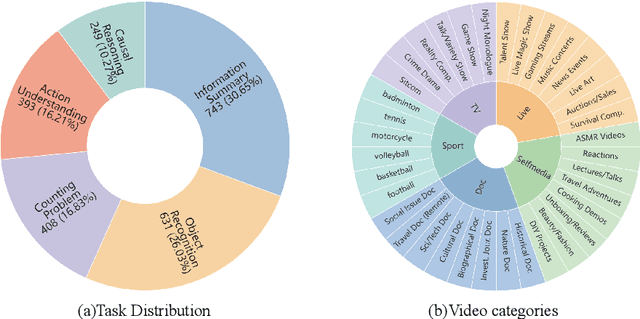
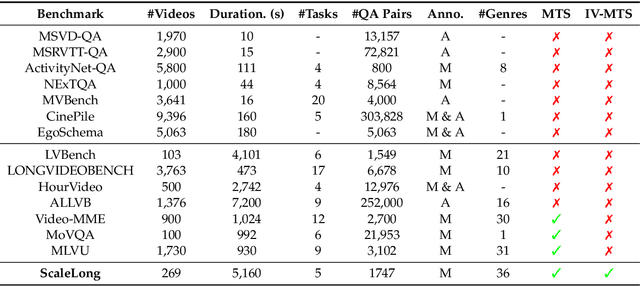
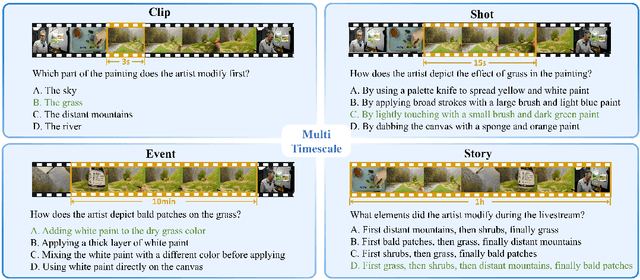
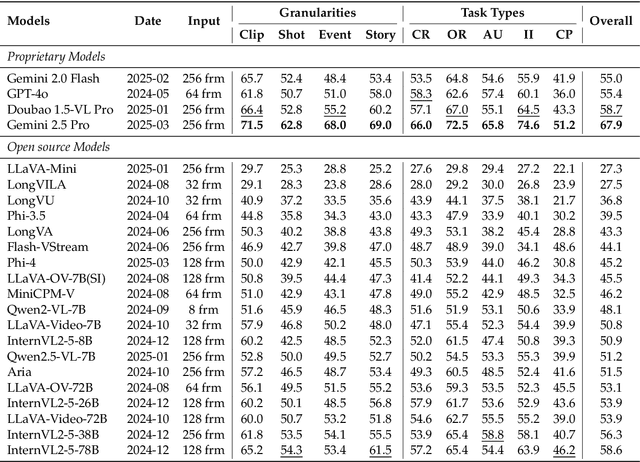
Although long-video understanding demands that models capture hierarchical temporal information -- from clip (seconds) and shot (tens of seconds) to event (minutes) and story (hours) -- existing benchmarks either neglect this multi-scale design or scatter scale-specific questions across different videos, preventing direct comparison of model performance across timescales on the same content. To address this, we introduce ScaleLong, the first benchmark to disentangle these factors by embedding questions targeting four hierarchical timescales -- clip (seconds), shot (tens of seconds), event (minutes), and story (hours) -- all within the same video content. This within-content multi-timescale questioning design enables direct comparison of model performance across timescales on identical videos. ScaleLong features 269 long videos (avg.\ 86\,min) from 5 main categories and 36 sub-categories, with 4--8 carefully designed questions, including at least one question for each timescale. Evaluating 23 MLLMs reveals a U-shaped performance curve, with higher accuracy at the shortest and longest timescales and a dip at intermediate levels. Furthermore, ablation studies show that increased visual token capacity consistently enhances reasoning across all timescales. ScaleLong offers a fine-grained, multi-timescale benchmark for advancing MLLM capabilities in long-video understanding. The code and dataset are available https://github.com/multimodal-art-projection/ScaleLong.
KORGym: A Dynamic Game Platform for LLM Reasoning Evaluation
May 21, 2025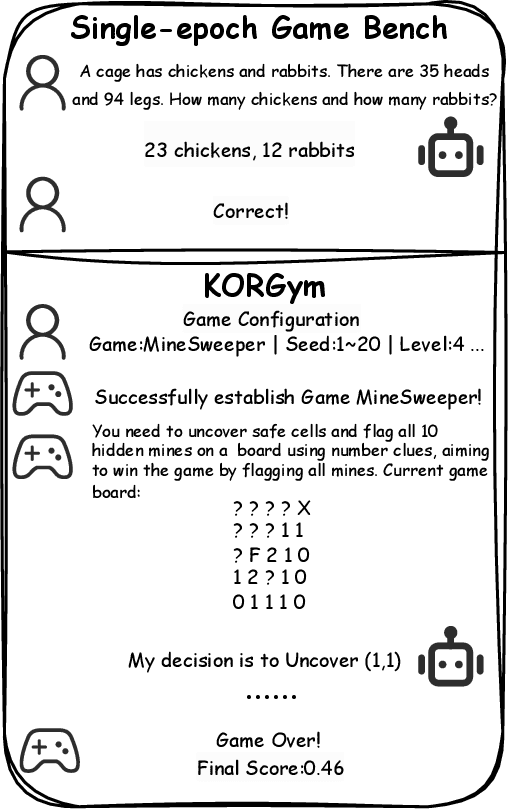
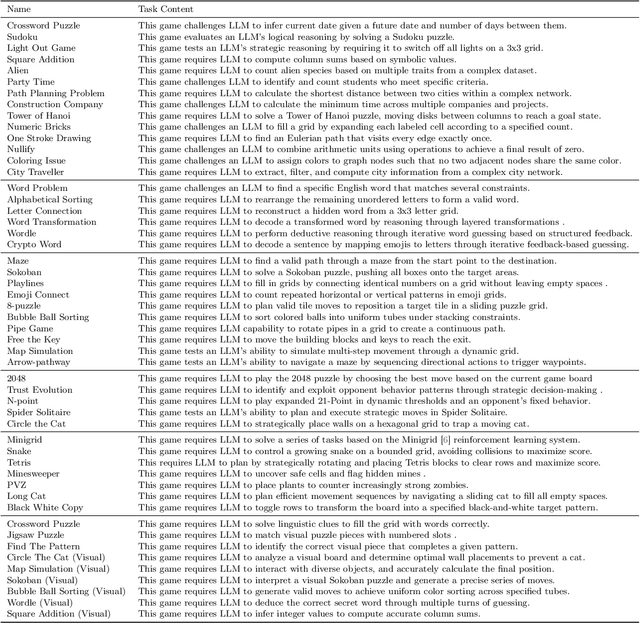
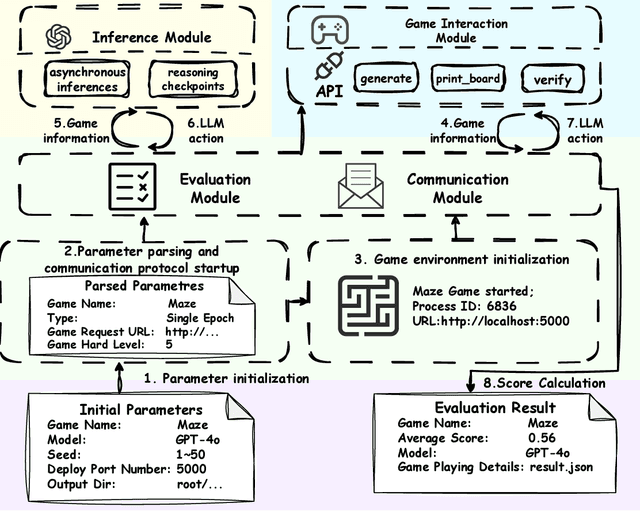
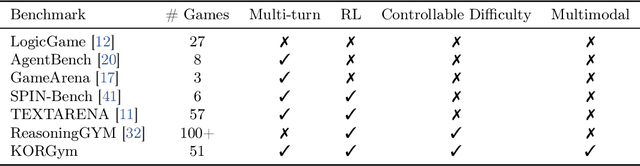
Recent advancements in large language models (LLMs) underscore the need for more comprehensive evaluation methods to accurately assess their reasoning capabilities. Existing benchmarks are often domain-specific and thus cannot fully capture an LLM's general reasoning potential. To address this limitation, we introduce the Knowledge Orthogonal Reasoning Gymnasium (KORGym), a dynamic evaluation platform inspired by KOR-Bench and Gymnasium. KORGym offers over fifty games in either textual or visual formats and supports interactive, multi-turn assessments with reinforcement learning scenarios. Using KORGym, we conduct extensive experiments on 19 LLMs and 8 VLMs, revealing consistent reasoning patterns within model families and demonstrating the superior performance of closed-source models. Further analysis examines the effects of modality, reasoning strategies, reinforcement learning techniques, and response length on model performance. We expect KORGym to become a valuable resource for advancing LLM reasoning research and developing evaluation methodologies suited to complex, interactive environments.
Lifting Scheme-Based Implicit Disentanglement of Emotion-Related Facial Dynamics in the Wild
Dec 17, 2024
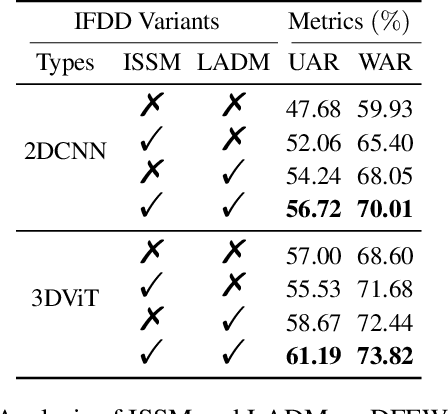
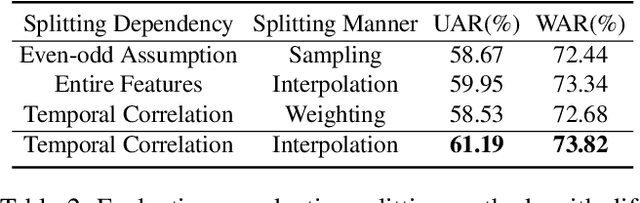

In-the-wild Dynamic facial expression recognition (DFER) encounters a significant challenge in recognizing emotion-related expressions, which are often temporally and spatially diluted by emotion-irrelevant expressions and global context respectively. Most of the prior DFER methods model tightly coupled spatiotemporal representations which may incorporate weakly relevant features, leading to information redundancy and emotion-irrelevant context bias. Several DFER methods have highlighted the significance of dynamic information, but utilize explicit manners to extract dynamic features with overly strong prior knowledge. In this paper, we propose a novel Implicit Facial Dynamics Disentanglement framework (IFDD). Through expanding wavelet lifting scheme to fully learnable framework, IFDD disentangles emotion-related dynamic information from emotion-irrelevant global context in an implicit manner, i.e., without exploit operations and external guidance. The disentanglement process of IFDD contains two stages, i.e., Inter-frame Static-dynamic Splitting Module (ISSM) for rough disentanglement estimation and Lifting-based Aggregation-Disentanglement Module (LADM) for further refinement. Specifically, ISSM explores inter-frame correlation to generate content-aware splitting indexes on-the-fly. We preliminarily utilize these indexes to split frame features into two groups, one with greater global similarity, and the other with more unique dynamic features. Subsequently, LADM first aggregates these two groups of features to obtain fine-grained global context features by an updater, and then disentangles emotion-related facial dynamic features from the global context by a predictor. Extensive experiments on in-the-wild datasets have demonstrated that IFDD outperforms prior supervised DFER methods with higher recognition accuracy and comparable efficiency.