 Add to Chrome
 Add to Firefox
 Add to Edge
From Corpora to Co-Evolving Capabilities: Capability-Centric Data Design for Generalist Image Generation
Aug 18, 2026
Large-scale image generation has benefited from advances in data scale, quality, rebalancing, and recaptioning, yet conventional pipelines typically optimize task-specific datasets in isolation. A central challenge is not only how to curate each task-specific corpus, but also how to organize heterogeneous supervision according to the dependencies among generative capabilities. We present a \textbf{capability-driven data infrastructure} that couples capability-specific supervision construction with capability-aligned curriculum scheduling. Its three specialized yet interoperable data engines build complementary relational supervision for text-image grounding, inter-image transformation, and image-knowledge association, while caption experts align T2I and editing supervision across tasks and granularities. A multi-stage curriculum jointly evolves task composition, visual-concept distribution, data quality, and image resolution along the dependency order of capability acquisition, with capability-aware evaluation closing the loop through targeted retrieval, expert construction, and gap-aware resampling. At scale, the framework curates a 440M-image T2I corpus, 120M editing pairs, and over 27M image-entity pairs. With this infrastructure, we train multimodal diffusion models at two scales from scratch, with 3B and 6B sizes respectively. We conduct quantitative evaluation on CPI-Bench, along with qualitative evaluations across diverse text-to-image and editing scenarios. Experimental results present broad visual coverage, versatile rendering, and effective transfer across generative capabilities.

CPI-Bench: A Comprehensive,Practical and Intelligent Benchmark for Real-World Image Editing
Aug 14, 2026With the rapid advancement of image editing models and their widespread application across various domains, there is an increasingly urgent need to deploy these model capabilities directly into real-world scenarios. However, existing benchmarks remain confined to simple single-image tasks, suffering from limited coverage dimensions and an inability to effectively differentiate performance among diverse models. Consequently, they fail to reliably evaluate model performance in complex multi-image editing, highly demanding reasoning instructions, and practical deployment settings. To address these limitations, we propose CPI-Bench, a Comprehensive, Practical andIntelligent benchmark for real-world image editing. CPI-Bench comprises three core subsets: CPI-General-Bench, which comprehensively covers diverse editing tasks and pioneers the inclusion of multi-image editing evaluation; CPI-Practical-Bench, which focuses on high-frequency real-user application scenarios; and CPI-Intelligent-Bench, which is dedicated to evaluating capabilities in highly demanding reasoning-based editing. Evaluation results of mainstream image editing models based on CPI-Bench demonstrate that CPI-Bench enhances performance differentiation among models. It provides a comprehensive and reliable quantification of gaps in general editing capabilities, practical deployment efficacy, and advanced reasoning-based editing, offering invaluable guidance for the future optimization of image editing models. Crucially, our ranking analysis reveals that CPI-Bench achieves the highest alignment with the Arena Image Edit Leaderboard, indicating it faithfully captures the preferences and perceptual judgments of human evaluators, serving as a robust proxy for real-world user experience.
Tstars-Tryon 1.0: Robust and Realistic Virtual Try-On for Diverse Fashion Items
Apr 22, 2026Recent advances in image generation and editing have opened new opportunities for virtual try-on. However, existing methods still struggle to meet complex real-world demands. We present Tstars-Tryon 1.0, a commercial-scale virtual try-on system that is robust, realistic, versatile, and highly efficient. First, our system maintains a high success rate across challenging cases like extreme poses, severe illumination variations, motion blur, and other in-the-wild conditions. Second, it delivers highly photorealistic results with fine-grained details, faithfully preserving garment texture, material properties, and structural characteristics, while largely avoiding common AI-generated artifacts. Third, beyond apparel try-on, our model supports flexible multi-image composition (up to 6 reference images) across 8 fashion categories, with coordinated control over person identity and background. Fourth, to overcome the latency bottlenecks of commercial deployment, our system is heavily optimized for inference speed, delivering near real-time generation for a seamless user experience. These capabilities are enabled by an integrated system design spanning end-to-end model architecture, a scalable data engine, robust infrastructure, and a multi-stage training paradigm. Extensive evaluation and large-scale product deployment demonstrate that Tstars-Tryon1.0 achieves leading overall performance. To support future research, we also release a comprehensive benchmark. The model has been deployed at an industrial scale on the Taobao App, serving millions of users with tens of millions of requests.
How Control Information Influences Multilingual Text Image Generation and Editing?
Jul 16, 2024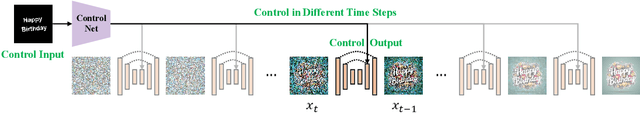
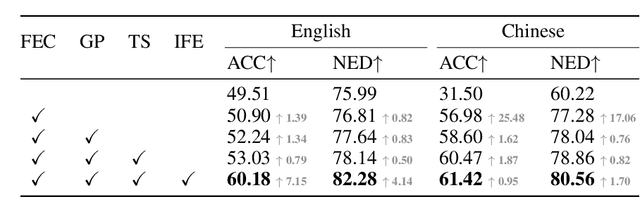
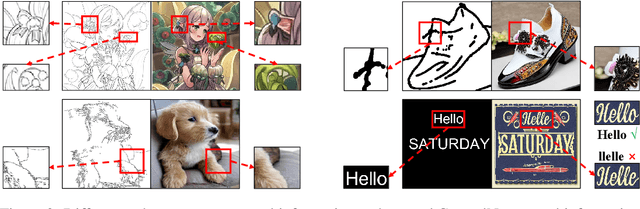
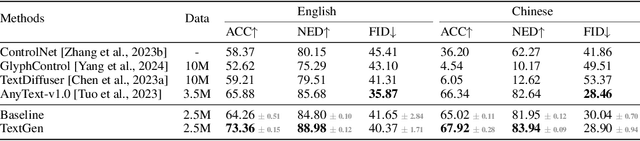
Visual text generation has significantly advanced through diffusion models aimed at producing images with readable and realistic text. Recent works primarily use a ControlNet-based framework, employing standard font text images to control diffusion models. Recognizing the critical role of control information in generating high-quality text, we investigate its influence from three perspectives: input encoding, role at different stages, and output features. Our findings reveal that: 1) Input control information has unique characteristics compared to conventional inputs like Canny edges and depth maps. 2) Control information plays distinct roles at different stages of the denoising process. 3) Output control features significantly differ from the base and skip features of the U-Net decoder in the frequency domain. Based on these insights, we propose TextGen, a novel framework designed to enhance generation quality by optimizing control information. We improve input and output features using Fourier analysis to emphasize relevant information and reduce noise. Additionally, we employ a two-stage generation framework to align the different roles of control information at different stages. Furthermore, we introduce an effective and lightweight dataset for training. Our method achieves state-of-the-art performance in both Chinese and English text generation. The code and dataset will be made available.
Self-Supervised Pre-training with Symmetric Superimposition Modeling for Scene Text Recognition
May 11, 2024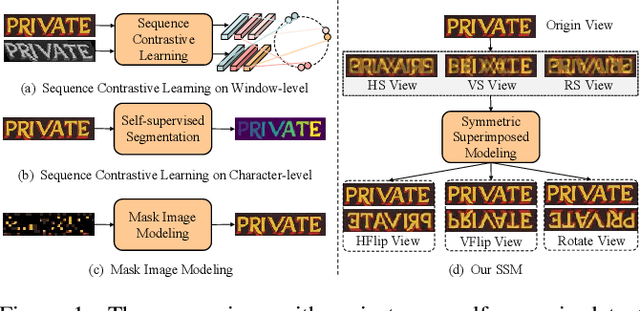

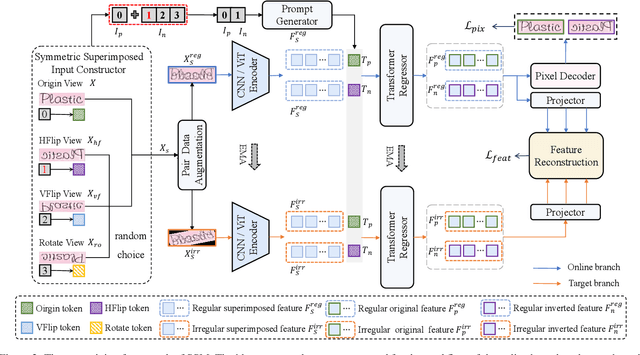
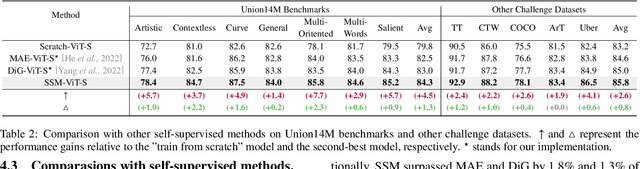
In text recognition, self-supervised pre-training emerges as a good solution to reduce dependence on expansive annotated real data. Previous studies primarily focus on local visual representation by leveraging mask image modeling or sequence contrastive learning. However, they omit modeling the linguistic information in text images, which is crucial for recognizing text. To simultaneously capture local character features and linguistic information in visual space, we propose Symmetric Superimposition Modeling (SSM). The objective of SSM is to reconstruct the direction-specific pixel and feature signals from the symmetrically superimposed input. Specifically, we add the original image with its inverted views to create the symmetrically superimposed inputs. At the pixel level, we reconstruct the original and inverted images to capture character shapes and texture-level linguistic context. At the feature level, we reconstruct the feature of the same original image and inverted image with different augmentations to model the semantic-level linguistic context and the local character discrimination. In our design, we disrupt the character shape and linguistic rules. Consequently, the dual-level reconstruction facilitates understanding character shapes and linguistic information from the perspective of visual texture and feature semantics. Experiments on various text recognition benchmarks demonstrate the effectiveness and generality of SSM, with 4.1% average performance gains and 86.6% new state-of-the-art average word accuracy on Union14M benchmarks. The code is available at https://github.com/FaltingsA/SSM.
Choose What You Need: Disentangled Representation Learning for Scene Text Recognition, Removal and Editing
May 07, 2024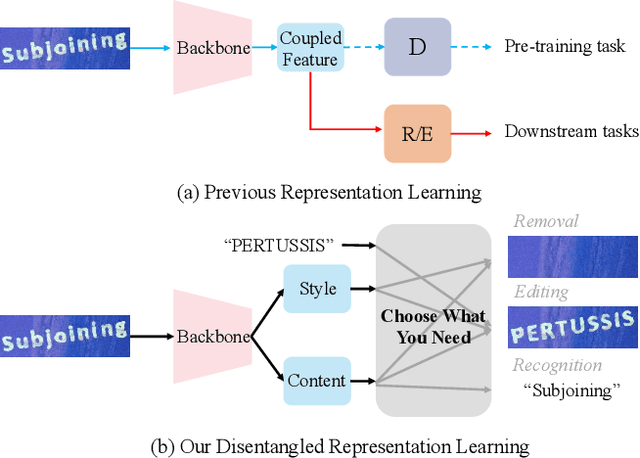
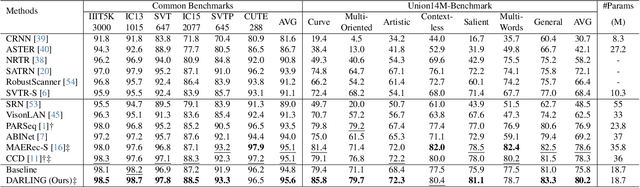
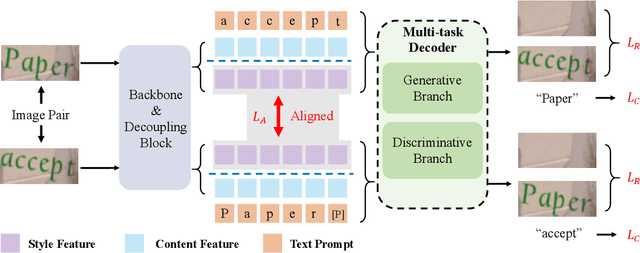
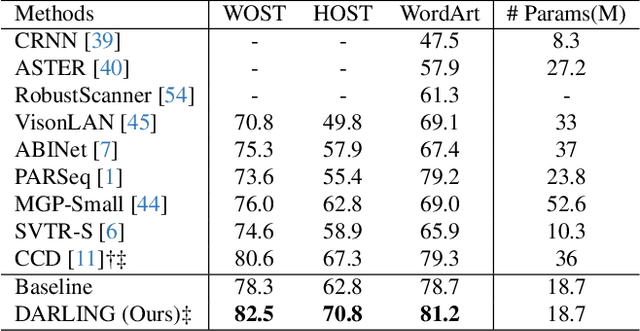
Scene text images contain not only style information (font, background) but also content information (character, texture). Different scene text tasks need different information, but previous representation learning methods use tightly coupled features for all tasks, resulting in sub-optimal performance. We propose a Disentangled Representation Learning framework (DARLING) aimed at disentangling these two types of features for improved adaptability in better addressing various downstream tasks (choose what you really need). Specifically, we synthesize a dataset of image pairs with identical style but different content. Based on the dataset, we decouple the two types of features by the supervision design. Clearly, we directly split the visual representation into style and content features, the content features are supervised by a text recognition loss, while an alignment loss aligns the style features in the image pairs. Then, style features are employed in reconstructing the counterpart image via an image decoder with a prompt that indicates the counterpart's content. Such an operation effectively decouples the features based on their distinctive properties. To the best of our knowledge, this is the first time in the field of scene text that disentangles the inherent properties of the text images. Our method achieves state-of-the-art performance in Scene Text Recognition, Removal, and Editing.